
Jonathan: Courageous Faith and Loyal Love (1 Samuel 13–31)




Transcript
Good to see you this evening. We're going to be in the book of 1 Samuel looking at the life of a man named Jonathan tonight. I'm looking forward to this study. It's very interesting how things turned out. Sometimes this happens that the A.M. sermon topic is basically the same as the P.M. sermon topic. So if you were here for this morning's lesson, now we get an illustration of what genuine sincere love looks like in the life of Jonathan. so I'm looking forward to studying this with you. Whenever we look at Old Testament characters, everybody's different, and it's interesting whenever we zone in on a particular person, sometimes their story is scattered throughout, and that's kind of the way Jonathan is. Jonathan is never really the main character in the story of the Bible, but he's there, and his story is important and fascinating because it teaches us so much about faithful love. He is a man of great love and compassion and wisdom and he's a wonderful example for us of the kind of life that we should be aspiring to and his humility and his willingness to serve others and his faithfulness. So I'm looking forward to studying this tonight.
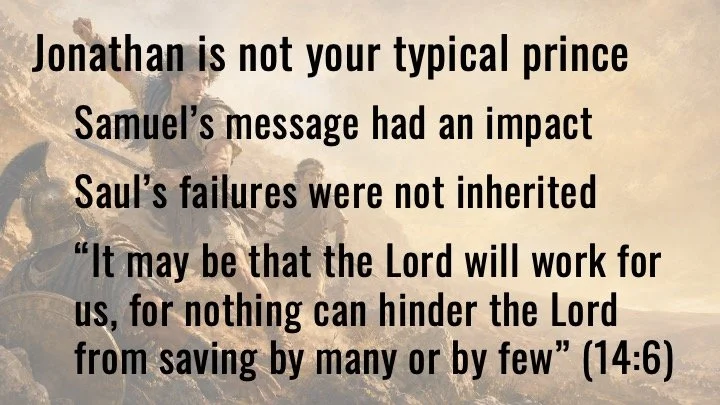
You might think of a prince maybe a little bit differently than I think is the reality of Jonathan's life. Whenever I think of a prince, I think of some spoiled, you know, guy that grew up in a palace, and his life was easy, and he got trained by the best people, and he just always knew he was gonna reign, and everything was just so easy in his life. Well that couldn't be further from the picture that we have of Jonathan. He doesn't appear to be your typical prince. He appears to be a man who is just trying to be faithful, just trying to do all the right things and honor and glorify God. If you remember in previous lessons, we learned about the man Samuel and Samuel had preached a very strong message to Israel and turned all of the Israelites hearts back to God and caused them to desire to please God and obey God and to get out of that cycle of rebellion that was prominent during the time period of judges.
Samuel was a wonderful man to turn the people back to God and it seems as though his message is having a lasting impact as we see generations now that are demonstrating faith unlike anything we've ever seen before and that's going to be the case with Jonathan. He is going to stand out among his peers with the exception of course of David who we will study about as well. But Jonathan is one of those who took the message of Samuel to heart. He loves God faithfully and Even though his father who we learned about last time was not very faithful. We see Jonathan Doesn't inherit that the failures of Saul are not inherited by his son.
He didn't follow in his father's footsteps He didn't continue down the path of self exaltation and self glorification that Saul did He didn't become disobedient rebellious against God's will to establish himself He didn't become greedy, but Saul did so as we look at the life of Jonathan I think it's interesting to contrast his life with that of Saul Whenever we first are introduced to Jonathan in chapter 13 of first Samuel We see that he is given a thousand men and Saul himself is given two thousand men So apparently he was a very capable man and he goes up against a whole garrison and he defeats them and what's interesting is Saul kind of takes the credit for it So Jonathan in his great faith goes out and defeats a garrison of Philistines and Saul Takes the credit for it and and causes stirs the people up to go out and fight the Philistines again Except what we see happen is Saul is very foolish Saul decides to have a sacrifice to God that was not supposed to happen. He didn't wait on Samuel.
He decided to go ahead and offer up his own sacrifice, and so it seems as though the Israelites are going to be defeated by the Philistines because Saul had gone against the commandment of God. So Saul had this great blunder, this great failure, and because of it Samuel even tells Saul that you're not gonna continue. Your legacy, your dynasty is not gonna be established because you have rebelled and gone against the Word of the Lord. But as you continue that story, you see Israel doesn't get defeated by the Philistines. They scatter, they become kind of hidden in caves, and Saul especially is hidden in a cave. And we see Jonathan, along with his armor-bearer, come out into the open and he walks up to an outpost of the Philistines and he is alone with his armor bearer, but he looks up and he says, it may be that the Lord will work for us, for nothing can hinder the Lord from saving by many or by few. Can you imagine that.
Can you imagine having this army of like 600 men that are terrified because this great Philistine army and there was even more before and everybody ran off and now Saul is run away and he's hiding in a cave and Jonathan comes out alone with his armor bearer and thinks, let's go take that outpost. Maybe God will be with us. He says if the men call for us to come up there, we'll know God is for us." And they did, and he did. He went up that hill. They had the advantage in every possible way. He and his armor bearer destroyed, killed about 20 men, and it caused the Philistines to go into a panic. They started killing one another with swords and defeating each other. Instead of the Israelites having this great defeat, God brings about this defeat because of the faith of Jonathan. Well news starts to spread and everybody else starts to join in on the battle. All the Hebrews who had run away start coming back. Saul comes out of his cave with all his Israelites and they start chasing down all of these Philistines to go and defeat them because of Jonathan's bravery.
But Saul is not is not content with you know surviving, he decides to make a rash vow that we're not going to eat anything until all those Philistines are destroyed. Well, that doesn't work out well. Jonathan wasn't there. He didn't hear the vow and they all come across this nice land of honey and he reaches out his staff, he gets some honey and he eats it. Oh no, he's going to be cursed. Things start going bad and And then they start trying to figure out what's going on. Who ate, who ate, who ate? Well, they find out it was Jonathan and Saul says, well, we've got to kill him.
He's, he's eaten, he's now cursed. Saul was willing to kill his own son because of a rash vow that he made. Very interesting. But the military stands up and says, no, Jonathan cannot be killed. He is the reason why we have had this great victory. And so basically it just makes Saul look horrible this whole event and scenario makes Saul look horrible But Jonathan just says how ridiculous that vow was he even points it out We would have had a great defeat today if it wasn't for your vow dad. Good job And so what we see in the introduction of Jonathan is that he is very bold and very courageous But he doesn't appear to be proud or arrogant like his father He says maybe God will do this for us and he trusts in the Lord and he desires to please the Lord.
He desires to be an instrument that God uses to bring success for his people. What's interesting is we continue in the storyline. We learn about Saul's sin and we learn about Samuel choosing David to be the king and Jonathan's kind of forgotten about for a little while and then we read about David coming out into the battle against Goliath, and he slays the giant Goliath. And then finally we read about Jonathan again in chapter 18. And whatever we read about him, it's very interesting. He is very humble before David. David had just slain Goliath, and Jonathan was there as everybody else was there, and Jonathan wasn't going out to defeat Goliath. Even though Jonathan is bold and courageous, even though he is trusting in the Lord, he was terrified of Goliath. But David went out and defeated Goliath. And Jonathan wasn't envious. He wasn't upset. He didn't hate David for being so bold and so courageous more than him.
He was impressed. And not only that, he was he was willing to give himself to David. Listen to this verse 1 of chapter 18. As soon as he had finished speaking to Saul, the soul of Jonathan was knit to the soul of David, and Jonathan loved him as his own soul. Notice these words about Jonathan. He loved him as his own soul. Jonathan was impressed and cared for David. It says, after that, verse 3, Jonathan made a covenant with David because he loved him as his own soul. And Jonathan stripped himself of the robe that was on him and gave it to David and his armor and even his sword and his bow and his belt. And David went out and was successful wherever Saul sent him." So notice here, Jonathan is honoring David greatly. He's demonstrating a covenant love.
He's making a covenant with him. He's being faithful to David and he's giving David his own robe, his own belt, his own sword, his own bow. These are valuable things in Israel. The Philistines had taken all their swords and weapons. So this is valuable stuff that he is just handing over to David. And it's his stuff. Jonathan is the heir to the throne. And here he is giving his stuff and saying, essentially, David, you are greater than I, and handing him all of this. Notice in this, Jonathan is exalting David, honoring David, he's not jealously thinking, uh-oh, I got somebody who's coming for my spot. I got somebody who's a threat. I got to protect my place. I need to make sure this young whippersnapper knows his place. He doesn't come in here trying to claim territory that belongs to And he's not looking at him and thinking I gotta I gotta do something. This is scary. I'm gonna lose everything But instead he makes a covenant with him because he loves him as his own soul In this you see Jonathan is binding himself up into David. He's saying as you succeed I succeed as I succeed you just you succeed.
We are one It's it's very similar to the type of covenant language we see in a marriage He is committing Himself to David. Why would He do that? Because David is a man who has the same kind of heart as Jonathan does. David is a man who sees what God can do and believes in God's power and His strength, and He trusts in the Lord fully, and He's faithful to Him. And Jonathan thinks, I haven't met many men like this. This is the type of man that I want to be joined together with, and I want to give myself to. And what a great relationship that that would make. That two men now would have the kind of faith to step out and to do difficult things and to do risky things, believing that God would work with them. Can you imagine a nation that is ruled by two men like that who were faithful like that? Well, as time goes on, we see that that's not the way it works out. David is very successful in all his battles, but Saul is not like Jonathan. Saul gets very jealous of David. As the singers are singing, Saul's killed his thousands and David's killed his ten thousands.
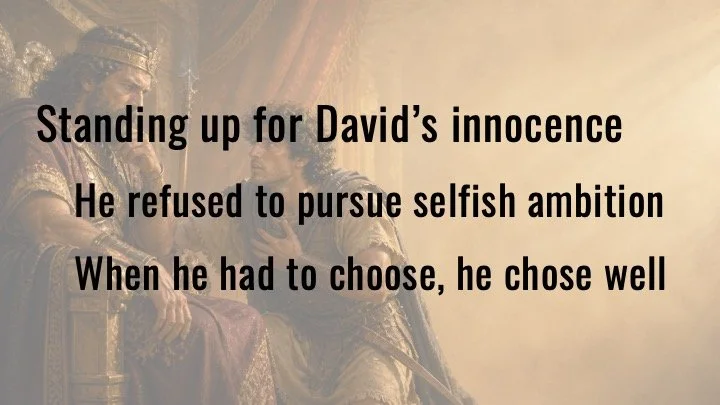
Saul's upset, and Saul gets so jealous that he's ready to kill David, thinking David's surely gonna take the throne away from me and my son Jonathan, who he wanted to reign after him. Jonathan didn't have those feelings at all. In fact, whenever David was accusing, Saul was accusing David and ready to kill David, Jonathan stands up to Saul for David and says, David has been loyal to you. He has been faithful to you. He is innocent. We shouldn't be trying to kill him. He is loved by all the people and he has always been successful. God's given him great success. And so Jonathan advocates for David. He intercedes for him and he tries to make sure that David is safe. And in that we see again, he's not pursuing selfish ambition. Saul is thinking about himself. He's thinking, how can I excel? How can I be the best? How can I be the greatest? How can I ensure my dynasty? How can I ensure my legacy?
and Jonathan doesn't care anything about that. He just knows this is wrong. David is a man who loves the Lord and I do not want my father to be guilty of shedding his blood. He's put in a hard spot and he chooses well. In fact, as we continue through the story of Jonathan, we learn that Saul says okay and he doesn't kill David. It allows David to keep serving him and being a soldier in the army, a commander even.
But eventually Saul's jealousy takes over and he goes after David again and this time he hides everything from his son Jonathan. He doesn't let Jonathan know about it. He throws spears at David. He sends out men to go get David. He even goes out after David himself to try to capture David on multiple occasions. He even tries to send armies to try to capture him. And it never works because God has taken care of him. And so David escapes and he comes back and he talks to Jonathan and he says, Jonathan, your father's trying to kill me. And Jonathan says, no way. My dad, we've talked. He knows you're innocent. He would never do that. David says, I'm telling you, he's trying to kill me. So Jonathan tests his father to see whether he's really trying to kill David, and it turns out he is. And once again, Jonathan had to make a choice.
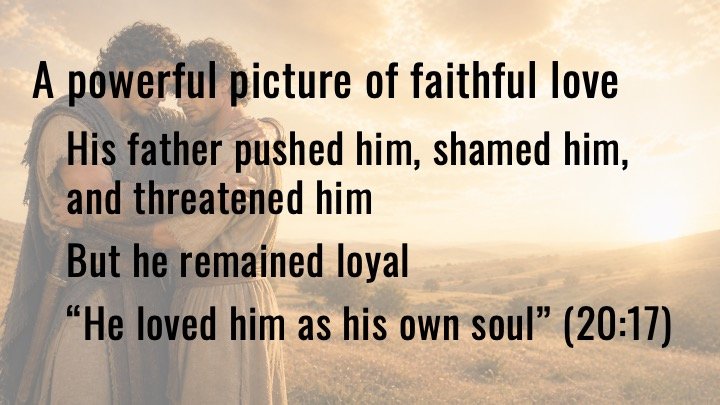
His father shames him. His father speaks horrible, horrible things to him, tells him that he's going to lose the throne to David because he's being so foolish, and makes it very evident that he he wants to murder David and Jonathan doesn't reveal where David is. He doesn't betray his friend. Instead, he conceals where David is and he goes and he speaks to David secretly and he tells David about what Saul is doing and he weeps with David over the sufferings that David is about to go through because David is now going to be an outcast. He's going to be an exile essentially, from the kingdom. Saul is going to be chasing David down wherever he goes.
And Jonathan can't be friends with David anymore. Jonathan can't be joined to him and they can't work together because David would surely find out or Saul would surely find out and kill David. Throughout everything, we see Jonathan remaining faithful to David. He's a picture of faithful love. He's willing to endure suffering at the hands of his own family in order to remain faithful to David. He is what we call loyal. He's not going to just turn his back on David because it suits him. Because it allows for him to have an easy path to the throne. David's dead, it's all mine for the taking. That's not the way he's thinking.
Because it says again, he loved him as his own soul. Well, as time goes on, we see David struggling out in the wilderness and Jonathan helps him from time to time. He comes and meets him and encourages him and he tells him, you're going to be great. You're going to be king one day. I know you are. And he says, I want to be right there beside you whenever you're king. And their relationship seemed wonderful. though Saul was causing them to be separated. But eventually Saul was very foolish and rebelling against God throughout, and he was going to be killed, going up in battle against the Philistines. And unfortunately, when Saul is killed, so also is Jonathan. Jonathan dies alongside his father, Saul. He stayed faithful also to his father throughout all of that. He fought with him.
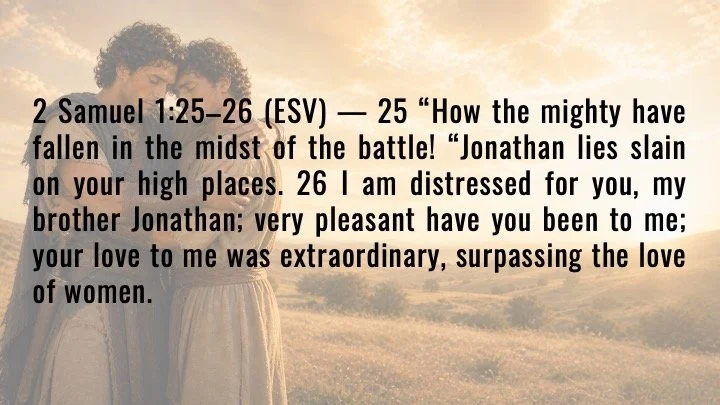
He served him. He was just overall a very faithful man. And David also showed faithful love to Jonathan, and he showed faithful love even to Saul who had gone against him and betrayed him. So David's going to be this picture of faithful love as well. But as David is looking back on Jonathan, I love the words that David uses to describe Jonathan after he has already passed away. He says in 2 Samuel 1.25, How the mighty have fallen in the midst of the battle, Jonathan lies slain on your high places. I am distressed for you, my brother Jonathan. Very pleasant have you been to me, for your love to me was extraordinary, surpassing the love of women. Notice in this, David has an affection, a brotherly affection with Jonathan that's greater than the love that he had, it seems, with all his brothers. His other brothers aren't really ever mentioned throughout the rest of the story of David, but David has found a way to connect with somebody who's not his own brother, but someone who has the same faith as he has. He's able to develop a greater relationship with this man than he's ever found with a woman.
Women apparently are kind of flippant, maybe flattering whenever you're the king. I don't know. Abigail seemed like a good one. Michal was the daughter of Saul, but then he marries a bunch of women who know he's king. So I imagine there was a struggle there. But here he sees Jonathan and the way Jonathan loved him and cared about him, and he thinks, I wish I had this kind of relationship with more people. Like, this is like one of a kind. This doesn't happen every day, and it was amazing. So as we read through that, we see and understand who Jonathan is a little bit better. It paints a picture for us of faithful love, and what faithful love really looks like. We talked about sincere love, genuine love this morning. Faithful love is along the same lines. It's a love that like Jonathan trusts in God and believes that God can deliver by many or by few, not worried or thinking about what you see, but thinking beyond what we see, thinking in the spiritual realm what God can do with just a little. I think that's amazing that we see Jonathan thinking that way and in the New Testament we see that we're supposed to think along the same lines.
We're supposed to believe that God can do things that are exceedingly, abundantly, beyond all that we ask or think. Ephesians 3. So faithful love trusts and believes in God and it trusts and believes in one another. We see that with Jonathan trusting David and David trusting Jonathan. Also, we see faithful love puts God's glory ahead of our own. Notice, Jonathan doesn't care about the fact that he's going to lose the throne. He could care less. He's not going to be the most important man in Israel. Whoop-de-doo. It doesn't matter. He would rather have David on the throne because look at David defeating Goliath. He demonstrated more faith and God was with him and that's the most important thing.
Faithful love is not jealous. It's not worried about other people excelling beyond myself. You know, I've seen and heard of and wondered about preachers sometimes that a lot of times preachers are kind of jealous and kind of looking at other people and what other people have and and other preachers have, and their scenarios, and they're worried about the fact they don't have what they have, and they feel underappreciated, and all this kind of stuff. Faithful love doesn't do that. And as we work, and we interact with people at our jobs, that we shouldn't be worried about somebody else excelling and getting and doing better than us, as we interact with each other, we shouldn't be upset because a brother is excelling at their workplace or that they've got gifts that we don't have.
That's not the way we should be thinking at all. We should be desiring what is for their good, as we talked about this morning. Faithful love is trying to do good to everybody and do what's right, and whenever the choice is to be made of doing the right thing or doing what is to our best advantage, we choose the right thing. We choose what is going to benefit someone else instead of us, because who cares if we excel in this life in an external way. We're not here for that purpose to cause ourselves to be glorified. We're here to lift one another up. Romans 12, outdo one another in showing honor.
That's exactly what we see Jonathan doing. Faithful love is extremely encouraging. I love how Jonathan goes up to David and says, you're going to be the king. You are. God's going to do it for you. And when he does, I want you to just remember me, okay? I mean, I love that. It's just like a complete acknowledgement, you're better than me, and I'm grateful for it. And may you exceed everyone's expectations and do well in everything that you do. I mean, that is just so amazing that that's his heart, that's his attitude. Can you imagine a church that's full of people who have that kind of attitude that, I just want you to do good, I just want you to be better than you've ever been, and I want you to be way better than me."
You know, that's what Brent said to me as he was mentoring me. He's like, I want you to stand on my shoulders. I want you to do better than me. That's what Barry says to his trainees. That's the mentality those guys have, and that's the mentality we need to have as well to one another. That if I know how to do something, then I want to help you to do it better than me, because I see in you a gift and ability that you could do this better than me and I'm encouraging you to do that Ultimately, this is the picture of love that we find in 1st Corinthians 13 Can't have two sermons on love and not mention 1st Corinthians 13 Love is patient and kind Love does not envy or boast is not arrogant or rude. It does not insist on its own way It is not irritable or resentful. It does not rejoice at wrongdoing, but rejoices with the truth.
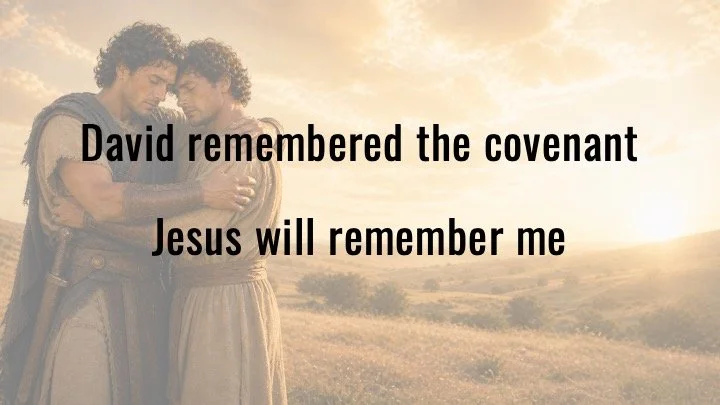
Love bears all things, believes all things, hopes all things, endures all things. Love never ends. This is a great picture of love and it's very much what we see in Jonathan that he is this way. He's not envious or boastful. He's not arrogant. He's not trying to promote himself, it doesn't matter to him. He is seeking the benefit of one another, and that's exactly who we need to be. And it's amazing also that we see David honoring Jonathan. After Jonathan dies, he has one son who lives, Mephibosheth. And Mephibosheth is dropped after finding out that Jonathan has died, the maid drops him, and he cripples his feet, and David, after he is made king, says, I want to do something good for Jonathan's line. Is there any descendant of Jonathan left? They say, yeah, there's Mephibosheth, and David remembers the faithful love of Jonathan, so he honors Mephibosheth, bringing him to his house, allowing him to dine at his table. He remembers the covenant that he made with Jonathan. Think for just a second about how many parallels there are with us and with Jesus. Think about how Jonathan gave up his robes, his royal robes, in order to serve David.
Think about how he interceded for David in order to keep David from suffering the judgment. Think about how he made that covenant with David, even though David, who's David? He's just a shepherd boy, right? But he demonstrated faith and Jonathan loved that and he wanted to knit his soul to David. What does Jesus do? He sees our faith and he wants to make us knit together with Him. He wants us to be joined together with Him and having a faithful love toward us and us having a faithful love toward Him. In the picture here, David represents Jesus. You know David is also very clearly portrayed as the Messiah figure and for David to remember Jonathan in his covenant we also think if we're the Jonathan who's faithfully knit to our David, Jesus is going to remember that covenant when we die.
And he's going to be faithful to it, and he's going to provide for us. There's a lot of really interesting dynamics here in the life of Jonathan and how it's intertwined with David. As David is very typological of the Messiah, we see Jonathan is typological of the Messiah in some ways, and also he's typological of us in some ways. That we're supposed to be men and women who are having this kind of brotherly affection, rejoicing with those who rejoice, weeping with those who weep. That's who we're supposed to be. We're supposed to be men and women who are excited to join ourselves with other men and women who are putting their faith in God. That's what God calls us to. So the story of Jonathan teaches us much about faithful love. I hope that we'll take these lessons home with us and make them a part of our lives. I hope we will be in that kind of relationship and develop that kind of relationship with one another for the many years, however many God gives us here on this earth. If you're here tonight and you need to render obedience to God, at this time we offer an invitation song for you. I am resolved. If you are resolved, don't linger. Come forward. Let us know what you need as we stand and as we sing.