
Transcript
Tonight, we're going to be studying about Saul and learning about the man who was crowned king and really the tragedy of his life because it is ultimately a tragedy. You know, some people look like they have everything going for them. Some people have the looks. They've got the abilities it seems like. They just fit the part, even their presence. It just puts off this air of ability. They have the ability to do whatever it is that they set their minds to. And apparently, that was Saul. Everybody who looked at him eventually came to that determination that he's the guy. He's the one that should be our king. He's the one that should be everything. And that's why it's so depressing and tragic to see that he fails miserably.
It's interesting. As we study the life of Saul, we really learn that it doesn't matter what someone looks like on the outside. What really matters is what is in their heart. And that is ultimately the issue with Saul. That's what makes his story so important for us to read and study and understand because as we look at him, we learn to stop looking at the outside and to start looking much more at the inside.
The story of Saul starts off with good things. Really, at the beginning, it's like, oh yeah, this is the guy. Everything is good. And whenever we come to chapter 9 of 1 Samuel, we see that the Israelites, as we studied last time, have asked Samuel for a king. God has said, okay, give him a king. And now he's going to give them a king. And the man is going to be Saul. But it's not obvious at first that it's going to be him. The story starts off telling us about Saul going, looking for his father's donkey. Apparently, he's a young man who is helping out at his father's farm. And he's going out to look for a donkey. And God works it so that he's in the area of Samuel.
And his servant tells him, hey, let's go up to the prophet. And he'll tell us where the donkey is. So they go up to the prophet. And lo and behold, God speaks to Samuel and says, this is the guy. He's the one who you're going to anoint to be the king of Israel. So Saul is told that that's exactly what's going to happen. And then Samuel proves it to him by foretelling certain events that are going to take place in Saul's life. And Saul's going to know that this is really from God, that God has chosen him. Well, all of those things start to happen. And Saul is anointed as the king. All Israel's gathered together to select a king.
And they cast lots to find out who's going to be the guy. And they determine it's going to be Saul, but they can't find him. He's hiding among the baggage. And that's very interesting. What is Saul doing? Why is he hiding like that? We find out that he is a man like no other in all Israel. He is head and shoulders above everybody else. He's a tall man. He looks the part. And so everybody looks at him and perhaps they have mixed emotions about him. Because on one hand, he's hiding in the baggage. He's not owning this. It doesn't seem like he's the kind of guy who has been looking for the opportunity to be made king. It's not like he was desiring this and lobbying for it, being very political and trying to kiss babies and shake hands to make everybody like him.
No, that wasn't what he was doing at all. Yet God chose him probably for that very reason, that he wasn't seeking it for himself. He seemed to be a humble man, a man who was helping his father look for donkeys. I mean, he was at service. He was helping people. And so as he selected at first, there's mixed emotions. Some people think, ah, who is he? Surely he can't be our king. And so after he is anointed as king, everybody just kind of returns home and goes about business as usual, ignoring the idea that they have a king. Even though they've asked for him, even though God has set him up with a king through Samuel, nobody really recognizes him to be the king and nothing really happens for a while until the Ammonites come up and they threaten the men of Jabesh-gilead, a town within Israel.
And they tell the men that if you will submit to us and you let us pluck out one of your eyes and be our servants, then we'll let you live. And the men of Jabesh-gilead say, okay, we'll submit to your terms if no one comes to our aid within the next seven days. And so they send out a message to all Israel trying to get people to come to their aid. And this is where Saul steps up. And he said, he cut, he's plowing the field with his oxen and he takes the oxen and he cuts them up into pieces and he sends them out to all Israel. And he said, may the man who refuses to come and fight on behalf of Israel, may their oxen be like this oxen.
And everybody responds to that. Nobody wants their oxen cut up. So there's a huge group that come and Saul leads them down to defeat the Ammonites and they do defeat the Ammonites. And everything seemed really good at this point. They are celebrating, they are feasting, they are rejoicing. And now they're not just anointing Saul as king, but they're proclaiming him as king saying he is going to be our king and he is able to go out for us and to lead our battles for us. Samuel is even there rejoicing alongside them, but Samuel makes it clear that if they refuse to continue following the word of the Lord with all their heart like Samuel had taught them, and even if Saul does, then they are going to be punished for that.
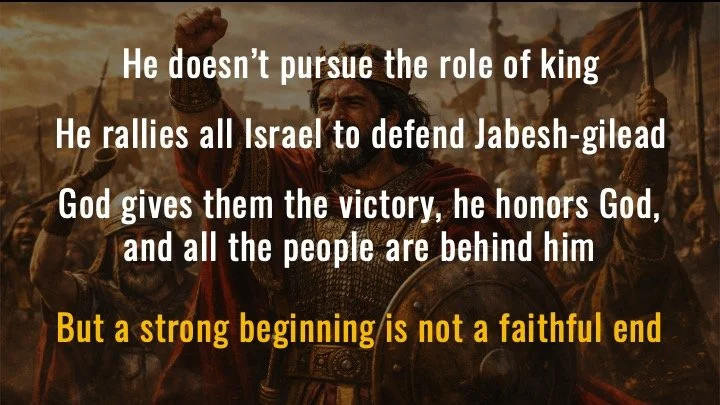
So it's very important that they continue to serve the Lord. Just because they've got a king doesn't mean that everything's going to go well for them. They must continue to serve the Lord. So at this point we see that every everything about Saul is pointing in the right direction. He seems to be a humble guy who has risen up and given this office and he's leading the people and he's being faithful. And that's a really good thing. He wasn't somebody who pursued the role of king. He has the ability to rally men behind him and go out and defeat the enemies of his people. He even credits the Lord with his victory. He honors God and he is able to encourage the people to be faithful.
So at first everything seems good, but what we're going to see is that having a strong beginning doesn't really mean anything.
Have you ever known a Christian who starts out on fire for the Lord and they're doing all kinds of things to serve God and they're really giving it their all and they're really zealous at the beginning and then they get burned out and then by the end they're not recognizable. They're not faithful at all. I've known Christians who were all about it. I mean they were asking everybody to come study with them, to come study with me. They were constantly trying to serve God in new ways and expand their abilities to serve God faithfully, but then eventually the trials came and people weren't moving as fast as they should and they got frustrated and they fell. They went after the ways of this world and so all their faithfulness and all their zeal didn't really matter and that's what we're going to see unfortunately is the case with Saul.
After this point Saul starts to battle against the Philistines. The Philistines are the most notable enemies of Saul at this time, of Israel at this time. They were oppressors of Israel. They were causing the people to suffer. They were taking away all of their weapons and only sharpening their plows and their hoes and their farming utensils for them and not allowing them to own any of those things. They were charging them to sharpen their stuff. They wouldn't let them have a blacksmith so that no one could create weapons of any kind in the land. So Saul became king and he had to deal with a major problem. The Philistines were their oppressors. Well the Philistines came up against them and they were ready to destroy the Israelites and Saul after a year of being king and reigning over Israel comes up with all of his men and he's ready to fight.
Samuel tells him I want you to wait seven days and after seven days I'm going to come and I'm going to offer a sacrifice and then the battle will be yours. God is going to take care of you but unfortunately that doesn't work out.
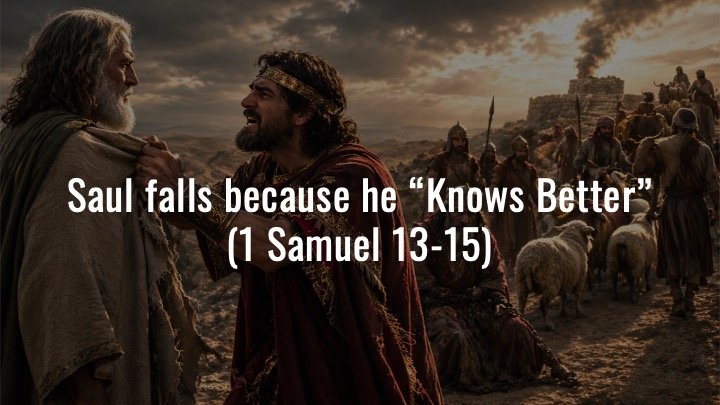
We see that Saul fails because he thinks he knows what's right to do. He thinks he knows the better way than the way that God has described to him.
In chapter 13 we see that Israel becomes very scared about these Philistines. I mean there's a ton of Philistines coming up in battle against them and they don't know what to do and they're starting to run away. They're starting to desert the army and so Saul's losing his people. They were already at a disadvantage and now he's losing people and it's all because they had to wait on Samuel to bring this sacrifice. The longer they wait the more scared the men become and so on the seventh day Samuel doesn't show up at the time that Saul thinks he should and so Saul says enough waiting I'll offer the sacrifice and then God will surely give us the victory. Well as soon as he finishes offering the sacrifice Samuel shows up and says what have you done?
Why didn't you wait? God would have given this into your hands and he would have made a name for you and he would have established you in your kingdom forever but you just needed to wait for God to deliver it to you instead of taking matters into your own hands and worshiping God the way that you thought you should worship. You see what we saw earlier as Saul's humility is revealed to be something else. He wasn't actually humble before he just had low self-esteem. He thought little of himself before but now Saul's the king and he's been proclaimed to be the king and he's got battles under his belt and victories and so he thinks that he knows better and it's interesting because in this part of the story we see that even though he's willing to do something so bold as go against the word and the command of God at the same time what he's doing is showing that he's very insecure and he's afraid of what's about to happen and he's become proud enough to think he knows better than God and God's commandments and so Saul offers up this sacrifice.
Well unfortunately Jonathan his son has more faith than he does and because of Jonathan they do have a great victory over the Philistines but still we are made aware that Saul has a character flaw and we kind of wonder what's going to happen there. I mean God's not establishing him but look at his son Jonathan maybe there's some hope.
Well whenever we get to chapter 15 we see God has set up Saul with another opportunity and this time God has told Saul you're going to go up against the Amalekites and you're going to destroy the Amalekites. You're going to completely wipe them off the map. Not a single Amalekite is going to live. In fact not even their animals all their cattle and all their possessions you just devote all of it to destruction because of the evil they did against my people when they were coming out of Egypt I want you to go and I want you to destroy them. Well Saul goes and he thinks that he completes the mission that God has given him to do and yet he keeps King Agag alive because I mean that's the king of the Amalekites and that's a nice trophy to have and he allows the people also to keep all the animals that are the best quality so that they can offer them in sacrifice to the Lord.
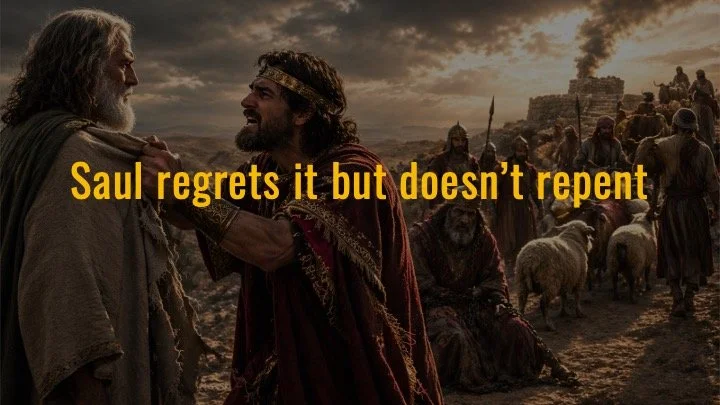
Well we'll devote them to destruction but we're going to take them up and offer them as a sacrifice in devoting them to destruction to the Lord. And so Samuel comes up and Saul greets him and says I have performed the commandment of the Lord and Samuel says uh what's the bleeding of sheep that I'm hearing in my ear right now? It's an amazing statement. A comment that says no you didn't. You didn't obey the command of the Lord. You disobeyed the command of the Lord and so Samuel rebukes Saul and tells him you have disobeyed the Lord. Why did you keep King Agag alive? Why did you keep these animals alive? And Saul says no no no I obeyed the commandment of the Lord.
We're going to destroy all the animals and and and yeah I just kept Agag. It's no big deal.
And here we see the heart of Saul and how it is totally corrupted that he's able to see his disobedience and think I have obeyed the commandment of the Lord.
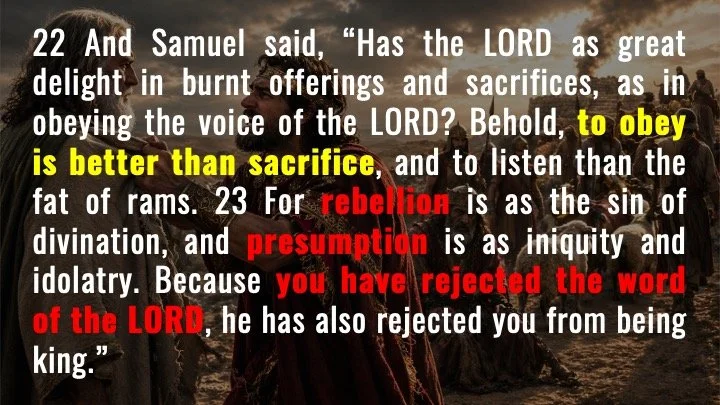
He thinks he's fine. He thinks he's done everything that he should do because he's justifying his disobedience. He's thinking the ends justify the means. Yes I know God commanded me to do this but this is so much better and this is what God really wants. He wants more sacrifices to him. Look at how I'm going to be able to honor him by offering all these animals as a burnt offering to him. And Samuel responds has the Lord as great a delight in burnt offerings and sacrifices as in obeying the voice of the Lord. Behold to obey is better than sacrifice and to listen than the fat of rams. For rebellion is as a sin of divination and presumption is as iniquity and idolatry because you have rejected the word of the Lord.
He has rejected you from being king. So Samuel rebukes Saul and Saul regrets what he has done but he doesn't repent of what he's done. He thinks he's fine and he even has tried to set up a monument to himself and his greatness before Samuel even got there. So something is very clearly wrong with Saul. I forgot I put this Saul up here.
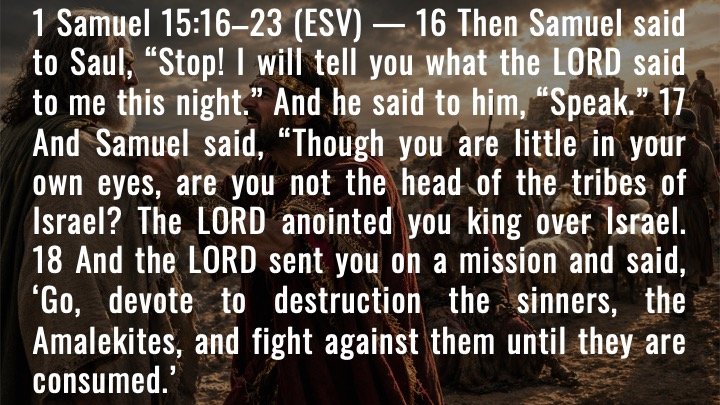
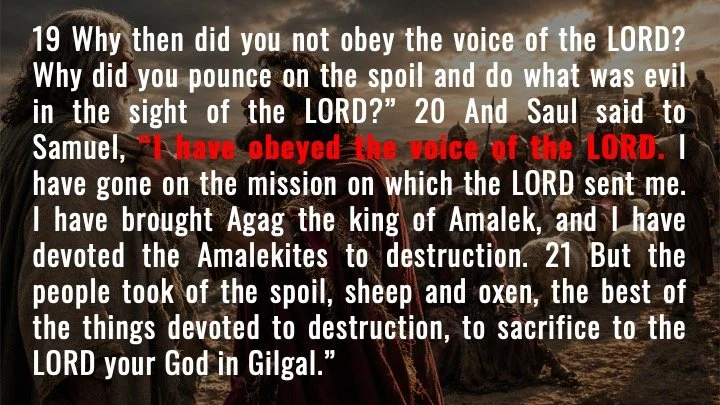
So this is in chapter 15 verses 16 through 23. This is essentially the narrative. It says Samuel said to Saul stop I will tell you what the Lord said to me this night and he said to him speak and Samuel said though you are little in your own eyes are you not the head of the tribes of Israel? The Lord anointed you king over Israel and the Lord sent you on a mission and said go devote to destruction the sinners the Amalekites and fight against them until they are consumed. Why then did you not obey the voice of the Lord? Why did you pounce on the spoil and do what was evil in the sight of the Lord? And Saul said to Samuel I have obeyed the voice of the Lord.
I have gone on the mission on which the Lord sent me. I have brought Agag the king of Amalek and I have devoted the Amalekites to destruction. But the people took the spoil sheep and oxen the best of the things devoted to destruction to sacrifice them to the Lord your God in Gilgal. And then Samuel says has the Lord as great delight in burnt offerings and sacrifices as in obeying the voice of the Lord. To obey is better than sacrifice. And these words are in parallel. Rebellion is as the sin of divination. Presumption is as iniquity and idolatry. You have rejected the word of the Lord. He has rejected you from being king.
Notice that what Saul has done in this situation most clearly explains the evil of his sin and what's going on within his heart. He is rebelling against the word of the Lord what God has commanded. He's not submitting to it. He's presuming that God will be okay with him doing something that God has not commanded him to do. And he's ultimately disobeying. At the end of this he reaches out to Samuel after Samuel is ready to walk away from him and he tears his tunic. And Samuel says your kingdom will be torn away from you. But then Saul says okay but go with me now to the elders. The very end is very sad because it shows us that Saul cares more about the approval of men than he cares about the approval of God.
He's completely lost sight on the will of God, the word of God. He's not really following in the ways of God. He's choosing to do what he thinks is best.
This is a very real danger that we all can fall into. It's very easy for us to take the command of God and translate it into whatever religious system that we've set up for ourselves. And when we're doing that we're not worshiping God. We're worshiping a form of God that we have set up for ourselves. And so we must be very careful and diligent in our study of God's word and in our evaluation of ourselves. We must be very introspective to be sure that we're not making the ends justify the means and basically overruling what God has very clearly commanded us. This is why we study so diligently and we're looking constantly at the Bible and we're considering how we are making mistakes or how we are maybe failing in certain areas because we don't want to be with the wrong heart like Saul has.
We see that this decision of Saul's to choose to do things his own way, to think he knows better than God is going to lead to his destruction. From this point in chapter 15 the story shifts and it's no longer really about Saul anymore. It actually becomes about David who we're going to learn about in the future. And really what it tells us about Saul from this point is just to illustrate for us the downward spiral that Saul goes down. I mean he is he's gone and God sends an evil spirit upon him to make him even more troubled and struggling and maybe it was in hopes that he would reach out to God and find some relief that he would be truly repentant but he wasn't he was just regretting that he made God mad and he was really continuing to seek his own will in his own way.
We see Saul getting very jealous of David and being consumed by that jealousy so much so that he starts hurling spears at David and even at his son Jonathan he commits all kinds of different sins even murdering priests and he goes on a hunt to try to kill David, who's totally righteous and innocent and everything. He's very selfish and self-focused, and it ends with him ultimately doing the very thing he forbade. He told the people, you are not to have any divination, you're not to have any sorcerers or sorceresses. But at the end of his life, he couldn't hear from the Lord, he couldn't get a message from the Lord anymore. And so he went himself to a sorceress in order to find out what was going to happen in the upcoming battle with the Philistines.
So we see Saul just goes further and further downhill, and he dies in the battle with the Philistines. Not because of the enemy killing him, but because he knew after all his sons were dead that he was going to die too, and he took his own life.
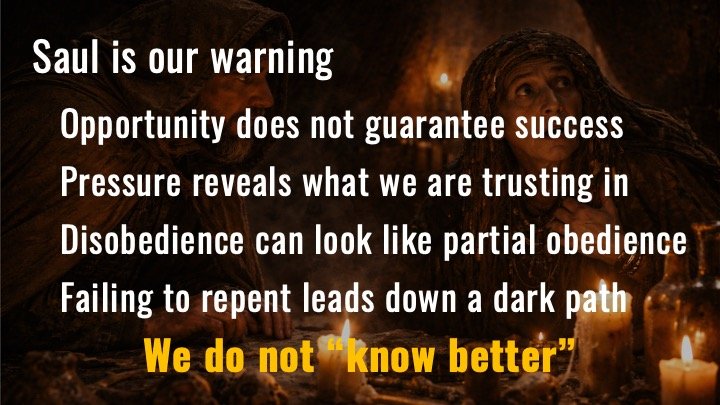
His story is very tragic, and it is ultimately here as a warning for all of us to help us understand that just because we have opportunities given to us, just because we might have an outward benefit, appearances, strengths, abilities, whatever it is, that doesn't guarantee our success. So maybe we don't have those, that doesn't guarantee our success, nor does it guarantee our favor, our success, our failure. Maybe I can get the word out. It doesn't, just because we have an opportunity, just because we have skills, doesn't mean that we're going to succeed. And ultimately it's not about us, and that's the problem that Saul is just so focused on himself that he can't see his need for God's help anymore.
He's relying on himself too much. And so opportunity doesn't guarantee his success even though he looks the part.
We see in this that pressure will reveal what we're trusting in. When the army's there and the seven days are up, the pressure is placed on Saul and he has to make that decision and he chooses to trust in himself instead of trusting in the Lord. And when the people want to keep the best of the animals, it appears Saul trusts in himself instead of trusting in the Lord, instead of obeying the Lord. So whenever God gives us commands and we're going out into the world, there's going to be times when pressure is put on us to obey those commands, but really the pressure is going to be to disobey those commands, to go after the ways of the world, and that's going to reveal what we're really trusting in.
Am I trusting in the Lord, or am I going to choose to trust in myself in my own ways to make my life more comfortable, and am I going to give in to the ways of the world?
We see that we can disobey, and our disobedience can look like partial obedience, and that's not what we want to do. We want to be obedient. And we see that if we fail to repent, if we just regret our sins, and we don't have hearts that are truly submitting to God and striving to serve him and surrendering our ways and our will to his will, that failure to repent can lead us in a downward spiral and result in ultimately a very dark path. Seen it happen in Christians before and it certainly can happen to all of us. We have to realize Saul's life is a warning that we don't know better than God does. So instead of relying on our own way instead of relying on our own wisdom we need to lean heavily on the will of the Lord and trust in him even whenever things get really really difficult.
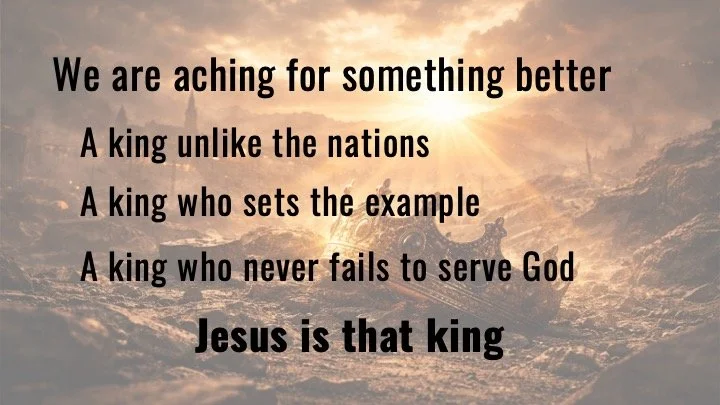
But of course as we study the story of Saul we see a desire within us. I mean the story of Saul makes us sad. It makes us wish that things would have worked out better. We want something better. We don't like tragedies. That's why 90% 99% of our movies are having happy endings, right? We do not like the tragedies. We're looking for something better. We're looking for a king that's not like the nations. All the people were like, give us a king like the nations. That's why they chose Saul. He was a king like the nations.
We're looking for a king that's different. We don't want a king that that gives in to the pressure who disobeys God and rebels against him. We want one who will be faithful even when the pressure is on. We want one who will set an example for us to follow so that we can stay in line with the will of the Lord, and we can be faithful to him, and we can enjoy the blessings of that relationship. We want a king who will never fail to serve God faithfully and cause us to suffer because of his unfaithfulness.
And as we move through the story of Samuel, we see David is a wonderful prospect. But David too will fail. Jesus is the king we're looking for. That's what we've seen all throughout the judges. It's like, give us a king, we need this guy to be our king. And no, he's he's going to be a terrible king. And Saul even looked like the part, but he couldn't do what we really need him to do.
So we need to surrender our will to God's will. We need to to give up on our ways and our desires, and we need to do what God desires for us to do in our lives. And God is going to take care of us. He's provided us with that king. We need to follow him and trust in him in everything that we do.
If you're here tonight and you've not been trusting in the king, I hope this encourages you to have the right mindset and the right heart and to do the right things. If there's anything that we can do to help you, please let us know. Please come as we stand and as we sing.