
Beset With Weakness (Exodus-Numbers)

Have you ever known someone whose life seems eclipsed by one colossal mistake? Think of Bobby Petrino's scandalous motorcycle crash with his mistress, or Richard Nixon's Watergate unraveling. These stories haunt us, don't they? We reduce people to their failures. Tonight, we meet Aaron—a man forever linked to a golden calf. But let's look deeper: his story isn't defined by idolatry. It's a testament to God's relentless grace for the weak.
The Call of Aaron (Exodus 4–12)
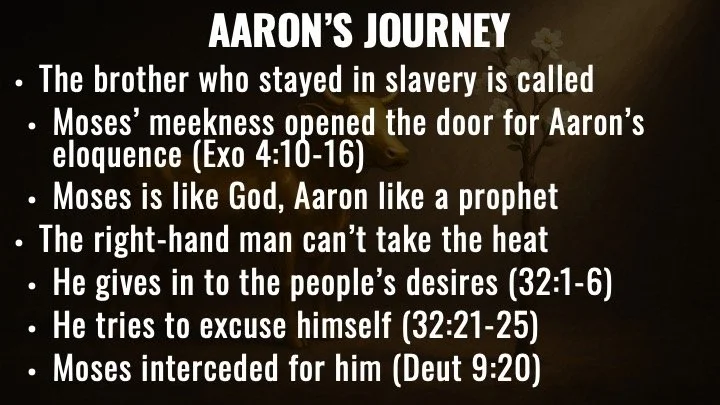
Aaron and Moses grew up in the same brutal era under Pharaoh's whip. Unlike Moses, adopted into Egyptian luxury, Aaron endured the Hebrews' slavery—immersed in their cries, their compromises, their sin.
The life of Aaron is a complicated one. After Moses was selected to be the leader of the people, he refused due to his inability to speak eloquently. God knew that Aaron would serve Moses well in this regard.
Exodus 4:10–16 (ESV) — 10 But Moses said to the Lord, “Oh, my Lord, I am not eloquent, either in the past or since you have spoken to your servant, but I am slow of speech and of tongue.” 11 Then the Lord said to him, “Who has made man’s mouth? Who makes him mute, or deaf, or seeing, or blind? Is it not I, the Lord? 12 Now therefore go, and I will be with your mouth and teach you what you shall speak.” 13 But he said, “Oh, my Lord, please send someone else.” 14 Then the anger of the Lord was kindled against Moses and he said, “Is there not Aaron, your brother, the Levite? I know that he can speak well. Behold, he is coming out to meet you, and when he sees you, he will be glad in his heart. 15 You shall speak to him and put the words in his mouth, and I will be with your mouth and with his mouth and will teach you both what to do. 16 He shall speak for you to the people, and he shall be your mouth, and you shall be as God to him.
God made it to where Aaron would be with Moses all the time. He saw everything that God did through Moses and became like a prophet with Moses being like God. Aaron would play a significant role in the redemption of God’s people. He was there for every plague and walked across the dry ground.
But Aaron wasn’t Moses. Don’t you wonder what that would have been like? He was like the puppet in the ventriloquist act. In some ways Aaron appears superior to his brother. He was three years older. It seems like Aaron had Moses beat in his ability to speak, but God chose Moses to lead the people. What would that feel like? Have you ever been in a position where you are forced to follow someone who is younger than you?
The Fall (Exodus 32)
After the people are saved from Egypt and make it to Sinai, Aaron stays beside Moses and works with him to lead the people. He even would go up on the mountain with Moses to hear the commandments from God. He was there with the seventy elders when they had the feast that ratified the covenant they were in, along with his two sons.
After that covenant was ratified, we learn that God wanted Moses to go up on the mountain alone. He leaves Aaron and Hur in charge. Moses is being shown heavenly realities and all of God’s plans for Aaron and his sons as high priest. Aaron takes center stage and appears to be the one whom God chooses to off sacrifices and stand as an intermediary for the people, offering the sacrifice and working in the tabernacle.
But as Moses is being told about all of this, Aaron is convinced by the people that Moses is not coming back. So, he does something awful.
Exodus 32:1–6 (ESV) — 1 When the people saw that Moses delayed to come down from the mountain, the people gathered themselves together to Aaron and said to him, “Up, make us gods who shall go before us. As for this Moses, the man who brought us up out of the land of Egypt, we do not know what has become of him.” 2 So Aaron said to them, “Take off the rings of gold that are in the ears of your wives, your sons, and your daughters, and bring them to me.” 3 So all the people took off the rings of gold that were in their ears and brought them to Aaron. 4 And he received the gold from their hand and fashioned it with a graving tool and made a golden calf. And they said, “These are your gods, O Israel, who brought you up out of the land of Egypt!” 5 When Aaron saw this, he built an altar before it. And Aaron made a proclamation and said, “Tomorrow shall be a feast to the Lord.” 6 And they rose up early the next day and offered burnt offerings and brought peace offerings. And the people sat down to eat and drink and rose up to play.
Aaron appears to be easily led and persuaded by the people. He seems to value their opinion and be more faithful to them than he is to God. He believes that this hunk of metal is the Lord.
Exodus 32:21–25 (ESV) — 21 And Moses said to Aaron, “What did this people do to you that you have brought such a great sin upon them?” 22 And Aaron said, “Let not the anger of my lord burn hot. You know the people, that they are set on evil. 23 For they said to me, ‘Make us gods who shall go before us. As for this Moses, the man who brought us up out of the land of Egypt, we do not know what has become of him.’ 24 So I said to them, ‘Let any who have gold take it off.’ So they gave it to me, and I threw it into the fire, and out came this calf.” 25 And when Moses saw that the people had broken loose (for Aaron had let them break loose, to the derision of their enemies),
Aaron’s response to Moses shows that he was weak. Aaron wasn’t a strong and faithful leader for Israel. He was not trustworthy and could not be left in charge of anything. His own words appear to be deceptive and do not match what is said about him earlier. He put up no fight against the people and willingly engraved the calf, telling them to worship it. So, as we read the story of Aaron, we have to understand that he is beset in weakness. He is overly sympathetic for the people and values their approval to the point of ignoring the commands of God.
But his words to Moses show that he has reverence and fear toward God. Notice that God does not destroy Aaron. He sends a plague to destroy many, but not Aaron or his family.
Later, Aaron will make another mistake by challenging Moses’ authority along with Mariam. It seems like he has no longer been allowed to enter God’s presence and he’s upset about that, but God sets him straight.
Restoration (Numbers 16)
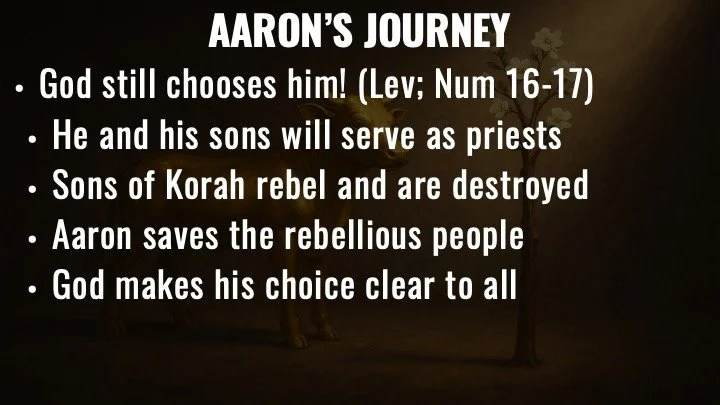
In spite of all these failures of Aaron, we see God being compassionate and merciful toward him. Moses even says in Deuteronomy 9:20 that he had to intercede for Aaron. But Aaron was selected to be the high priest, and God stuck to that decision. He made Aaron the high priest and selected his sons to be priests for all time.
On one occasion, the sons of Korah stood up and said, “You’ve gone too far, Moses and Aaron!” They were rebelling against God’s decision and so God destroyed them. Then leaders of the Israelites came up after that and tried grumbled about so many people dying, but God made Aaron’s staff bud and flower. After this event, shortly after destroying the sons of Korah, God sent another plague throughout the wilderness camp killing thousands. But Aaron grabbed a metal torch and ran out to save the people who had sinned against him and rebelled against the Lord.
We see Aaron being proven by God as His choice for High Priest. God selected Him and no one was going to overthrow God’s selection. But we also see Aaron taking on that role of intercession, affirming his calling as High Priest.
Lessons
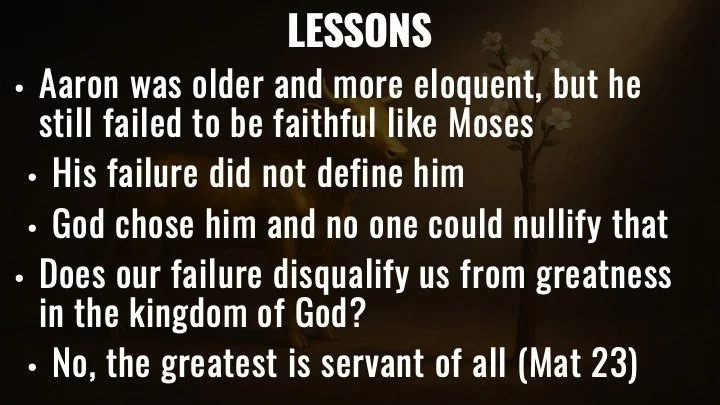
As we read the story of Aaron, we learn about a man who was weak and sinful being chosen for a high position in God’s kingdom. He saw the works of God, but he still failed to be faithful like Moses was faithful. The main thing for us to notice in his story is that his failure did not define him. Moses interceded for him and God was willing to place him in the same position of high priest. God also defeated those who tried to remove him from that position.
This teaches us that God is able to put us in a high position even though we are flawed and we fail. Have you ever looked at yourself and thought, “I could never teach, shepherd, lead others.” Are you sensitive to your weaknesses enough to notice that you are a flawed individual? That’s called being poor in spirit. We need that kind of heart. But God can take the weak and sinful and lift them up out of their failures, and establish them as powerful examples for all of God’s people.
We must learn not to be persuaded by the people around us and to stop falling to sin. But we must also learn that when we do fall, God is there for us. Jesus is able to intercede for us, and God will make us into an example of His mercy and grace. What’s important is that we learn form those mistakes and become more faithful. We must carry the censer and love those who have hated us like Aaron and ultimately like Christ.
What Do We Learn About Christ?
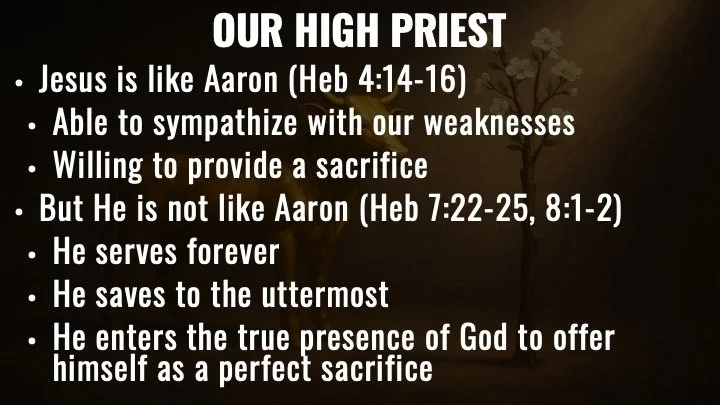
In this example we have a contrast to Christ and a comparison. Aaron was a weak high priest. He had to offer a sacrifice for himself before offering an atoning sacrifice for us. Christ is so much better than Aaron.
Hebrews 4:14–16 (ESV) — 14 Since then we have a great high priest who has passed through the heavens, Jesus, the Son of God, let us hold fast our confession. 15 For we do not have a high priest who is unable to sympathize with our weaknesses, but one who in every respect has been tempted as we are, yet without sin. 16 Let us then with confidence draw near to the throne of grace, that we may receive mercy and find grace to help in time of need.
Hebrews 7:22–25 (ESV) — 22 This makes Jesus the guarantor of a better covenant. 23 The former priests were many in number, because they were prevented by death from continuing in office, 24 but he holds his priesthood permanently, because he continues forever. 25 Consequently, he is able to save to the uttermost those who draw near to God through him, since he always lives to make intercession for them.
Hebrews 8:1–2 (ESV) — 1 Now the point in what we are saying is this: we have such a high priest, one who is seated at the right hand of the throne of the Majesty in heaven, 2 a minister in the holy places, in the true tent that the Lord set up, not man.