
Love That Won’t Let Go (Hosea 1–3)

Transcript
If you want to get out your Bibles and turn to Hosea, chapter 1, Hosea, chapter 1, I'll give you a few moments to do that. No Old Testament sometimes. We flip through those minor prophets and we wonder which one's which and where do we go? Do we go forward? Do we go backward? It's at the beginning of the minor prophets. So we're gonna begin our study of the book of Hosea this morning. I know it's a little unorthodox maybe to study Old Testament prophets on a Sunday morning. This is early, and are you awake enough for this? But Hosea is a wonderful book. Hosea is a great book to teach us and to help us understand more about our God, which has really been what we've been doing throughout this year.
We started off talking about, studying about prayer and learning how God wants us to pray to Him, and He's listening to us, and we can trust that we can turn to Him. We ought to be turning to Him in prayer often. And then we moved ahead and talked about how He is a God who pursues the lost. Looked at different parables and different events that shows that God is very compassionate and merciful, desiring for those who are lost to be saved. And then we talked about how that mercy that God shows us is supposed to transform us from within. And we looked at specific goals, if you remember, over the last month or so, the goal of serving others sacrificially, loving one another sincerely, living more fervently, and responding graciously.
These are all goals that are deep goals, that are heartfelt goals, that are supposed to happen within Christians, not checklist goals, but goals that we set for ourselves that we're constantly pursuing and that we never reach the point where we feel like we have satisfied the goal we will be doing this for the rest of our lives and now we're going to go into the book of Hosea and hopefully understand our sin and understand better God's love for us so that we can fall in love with him and we can put to death whatever sin remains in our lives that's ultimately the goal of our of our study but also we want to see that God is a God who stays with us even though we sin Even though we failed, maybe you are dealing with sin and you're struggling with it, or maybe you have in the past and you wonder about how God feels about that, well the book of Hosea teaches us a lot about God's patience and his endurance and his resilience that he has in loving those who are his sinful people.
Hosea is written by the prophet Hosea in the time period of the northern Kingdom's existence, the separated kingdoms of Israel and Judah, Hosea is primarily speaking to the northern kingdom of Israel as it's being ruled by one of the most prosperous kings, Jeroboam II. This is a time period when everything seems to be going well for the northern kingdom of Israel and the king Jeroboam II is not really following God's will at all. So it's kind of a conundrum as we as we study the history in which Hosea was written that the people of the northern kingdom of Israel are perhaps more wicked than they've ever been and and more sinful going after all kinds of pleasures and and and desiring more and more and more and more and receiving more and more and more and more even though they're evil and we see God allows them to continue to exist. But the book of Hosea teaches us that their days are are numbered. God is not going to allow them to continue in this sin. Even though it seems like they are loved by God, it seems like he has showered blessings upon them because they're so prosperous, that will soon end. And so essentially that's what this book is about.
And we're going to be learning about how God is going to describe their sin in a way that I hope will cut us to the heart because we too should find some relevance into these words because we too live in a very prosperous country in a very prosperous time but also a very sinful time where people around us are engaging in all kinds of pleasures and evils and we certainly do not want to mix with them and commit the same sins but we do find ourselves struggling with a lot of the sins that the people around us are struggling with and Hosea helps us to understand those sins a lot better and helps us to find a way to get out of those sins. So I look forward to this study together and I hope that you will be here for the lessons and that you will enjoy studying this great book as well. We're gonna study the first three chapters this morning. Three chapters is a lot so I'm gonna be summarizing kind of the storyline of the first three chapters. The book of Hosea starts with kind of a love story.
So you're gonna kind of get a love story at the beginning of this book, and then we're gonna get into the more prophetic language that is a little bit more difficult maybe to swallow, but this first section is just really a beautiful, beautiful section. We learn when we open up the book of Hosea that this is not just a book of words, but that this is a message that is going be lived out for the people of Israel to see and to understand their God and to see and to understand their own sin. As we open it up, we notice in verse two, when the Lord first spoke through Hosea, the Lord said to Hosea, go take to yourself a wife of whoredom and have children of whoredom. For the land commits great whoredom by forsaking the Lord. So he went and took Gomer, the daughter of Diblaim, and she conceived and bore him a son. So God decides that he's going to set apart this prophet, Hosea, and he's not just going to say, Hosea, I want you to go and tell all the people that they're committing adultery, that they're committing immorality that they have betrayed me and forsaken me and that they're being unfaithful to me.
He doesn't say, Hosea, just go out and tell them all these things. But he says, Hosea, you are going to be a living example for all the people to see and to understand what they have done to me. He marries Hosea to a sinful woman in a sinful society to prove a point to his people. Whenever they look at Hosea, they're gonna think about that relationship that he has with his wife that he takes, Gomer. Gomer is apparently a promiscuous woman. She's the type of woman who whenever you were looking at her as she was single, you were thinking, oh, she is trouble. She is not somebody that is going to have an easy time, you know, falling in line and being submissive to her husband and being faithful to him and living to serve him and to uplift him and exalt him. You have the beautiful picture of Proverbs 31 woman. Well, this is the opposite of that. This is the woman who is constantly seeking ways to cheat, constantly seeking ways to do things that are immoral and ungodly and she has no real concern about authority. She is rebellious against all authority. This is not the kind of woman that mothers want their sons to marry.
We try to get rid of them, right? We don't want that person to have anything to do with our son because we know that person is just going to give them heartache. God tells Hosea, I want you to marry her. Wow. Can you imagine being the prophet who is told to go and marry a woman who is like that? I mean maybe the idea sounds kind of fun. She's probably a fun-loving kind of person but But at the same time, you know, in the back of your mind, this person is going to be like a flame that burns out, like, she's not going to love me forever. Whatever kind of infatuation she might have for me is going to go away really quickly, and then she's going to go off and love someone else.
Well that's what he has called his prophet to do. And as he is married to Gomer, the daughter of Diblaim, she conceives and bears him a son. And God doesn't just want the marriage of Hosea and Gomer to be a symbol for the nation. He also brings children into this. And the first son he names in order to set the example and to make a statement for all of Israel and to preach this message. He calls him Jezreel. Jezreel. Jezreel is a valley in the northern kingdom of Israel, a valley where Jehu came in and kind of took over the nation. And he just started killing everybody. If you read the Old Testament history of Jehu, he was coming in and slaughtering all of these horrible people who God wanted him to kill, but he kind of took it beyond what God wanted. It's like he became bloodthirsty and and he just kept killing and kept killing and kept killing and he even accumulated all the prophets of Baal in a building and had them burn the building down with him in it.
He did all kinds of things to bring judgment upon Israel but unfortunately he doesn't become a faithful king and unfortunately a lot of the things that he did went beyond what God wanted and God decides he's gonna bring judgment on Jehu's house, Jeroboam II, is a descendant of Jehu. And so Jezreel's name tells the people that the house of Jehu is going to be judged for the blood that was spilled in Jezreel. He's going to put an end to the whole kingdom of Israel with Jehu's descendants. And that destruction is going to happen. And the valley of Jezreel is going to be where a lot of the battles are fought. Well he has him have another child. In this child he names Lo-ruhamah. Lo-ruhamah. Lo-ruhamah means no mercy. No not loved is the way the NIV puts it, and I thought that was fascinating. No mercy, no compassion, not loved. The idea of the daughter, can you imagine having a daughter born to you and thinking up a name? I've had friends name their children mercy. Can you imagine saying, no mercy or not loved? I mean that's the way that that child is gonna grow up hearing constantly, hey You're not loved. You're no mercy.
And as they're saying the name of the daughter of Hosea, they're being reminded of the judgment of God that has been prophesied through Hosea, that God is not going to give mercy to the house of Israel. He's not going to forgive them because of the evil that they've done. He's not going to save them from their immoralities and their hortom that they have committed. He will bring the sword against them and the bow against them and he will destroy them by war horses. He's gonna bring in their enemies and and defeat them and not show mercy to them. Well he has a third child from Gomer and this child is named Lo-ammi and this is an even more fascinating name than the others. Lo-ammi means not my people, essentially not mine. Now if you followed the story along so far, you know Hosea has married a promiscuous woman, so the name not mine is an indication that he's not Hosea's son. You imagine being brought up with the name, not mine. Every time your father calls you, you say, hey, not mine, come here. But that's the picture, and everybody's gonna look at him and see him as a child who was born from an adulterous relationship, because Gomer was unfaithful to Hosea.
And I imagine that probably all these children are the result of that. Later on in the judgment, it seems as though these are the children of her whoredom that she has committed immorality and has not been faithful to her husband and so here is God saying the people of Israel will no longer be called by my name they are not my people and I am not their God if you know your Old Testament you know that is a huge statement because God's promises throughout the Old Testament with Israel were, you're gonna be my people and I'm gonna be your God, we're gonna have a relationship together, I'm gonna take care of you, I'm gonna love you, I'm gonna provide for you and you are gonna represent me and you are gonna honor me and obey my commandments and and and we're gonna have a great relationship together and that's what God was looking forward to creating with Israel and here he's saying, that's not gonna happen for you. I'm gonna disown you. I'm gonna I'm gonna shun you. You're not my people and I am not your God. So that the life of Hosea is intended to be this symbolic representation of God's judgment for against Israel because of their immorality.
That God is going to bring judgment against the sins of the kings and of the people in the in the land of Israel he will not show them mercy and he will not take them in as his own. The last part of chapter one is interesting because he doesn't leave them with this judgment. You know in the Old Testament you read the prophets you're gonna get a lot of judgment but you're also gonna have mixed in some very profound statements of love and compassion and promises of a future hope. And we have that at the end of Hosea chapter 1. He says in verse 10, yet the number of the children of Israel shall be like the sand of the sea which cannot be measured or numbered. That's remembering the Abrahamic promises. And in the place where it was said to them, you are not my people, it shall be said to them, children of the living God and the children of Judah and the children of Israel shall be gathered together and they shall appoint for themselves one head and they shall go up from the land for great shall be the day of Jezreel."
Notice how it completely flips at the end and God is looking forward to this future hope and there are a number of statements made in this section that are referenced in the New Testament to talk about the messianic hope that Jesus has that we who are not God's people, we who are aliens and strangers because we had sinned, we can be brought in and made children of the Living God under our head, our David, our Messiah. So all of these comments at the end of chapter 1 are giving lots of hope. Well the story doesn't end and it really continues in chapter 3, but before we get to chapter 3, chapter 2 gives some indication of what the Israelites need to do at this time in light of this judgment that has been spoken against them because of the immoral wife of Hosea, the immoral nature of Israel, that they have been adulterous and gone after these other gods, God wants to explain the gross immorality of what they have done.
If you were here in the Bible class this morning, you've already heard this because the same kinds of things are said in Ezekiel chapter 16, the same text that we're studying. This just happens. I don't plan this out, but this just happens that we're on the same basic topics. You're getting this reinforced in your minds if you're in that class. Notice in chapter 2, we have portrayed at the beginning, say to your brothers, you are my people, your sisters, you have received mercy. And then it says in verse 2, plead with your mother, plead, for she is not my wife, and I am not her husband, that she put away her whoring.
Notice in chapter 2, there's this picture of a faithful husband who loves his wife and And he's saying, I want you to plead with Israel. I want you to tell them that they need to come back to me. I want them to be a part of my family again. I want them to put away these adulterous and whoring practices that they have entered into. And then he goes on in chapter two and he describes their evil and their wickedness that they've done. He says at the end of verse five, she said, I will go after my lovers who give me my bread and my water, my wool and my flax, my oil and my drink.
So she's sitting here saying, I'm gonna go after them. They give me everything that I need. And then it says in verse seven at the end, I will go and I will return to my first husband. God says, I'm gonna take away everything. You think they're giving you everything. I'm gonna take it all away from you. And then she says, well, I'll go back to my first husband now. Cause he was better for me then. And then he says, you didn't know. I was the one who provided for you from the beginning. I was the one who gave you your bread and your wine and all the things that you enjoyed.
And you thought your lovers gave them to you. And so there's this interaction that's being had though there's a wife that is receiving blessings from her husband, receiving a good life and security and abundance, and then she commits adultery and she starts thinking, these other lovers, these men whom I'm cheating on my husband with, they're really the ones who've given me everything that I enjoy. Israel has betrayed him and they don't even know that they've done it, they don't even care about what they've done. They are oblivious to the fact that they had a good husband who loved them and took care of them. And here is that good husband saying, I want you to plead with her so that I don't have to do this, but I'm gonna have to do it. I'm gonna strip her naked. I'm gonna take it all away from her. And God doesn't want to do this. I want you to just imagine for a moment that you're married to a wife who acts as unfaithfully as Gomer, who acts as unfaithfully as Israel, who says of all the good things that she has that you have given to her, these are because I sleep with all these other guys. That's why I have a big bank account.
That's why I have a nice house to live in and I have my pantry stocked and nice clothes nice jewelry because I sleep around with all these other guys and you don't give it to me but I have it because I enjoy all these other guys and they give it to me when they give you nothing they're losers they don't have a job they don't provide anything they can't and you went after them and your wife went after them and you were left footing the bill. What are you gonna do? You're gonna cut her off. That's what God says he's gonna do. He's going to cut her off. He's going to build a hedge around her and prevent her from enjoying all the things that she was previously enjoying, he's going to take it all back and he's going to just let her run away to her lovers and that's exactly what she's going to do.
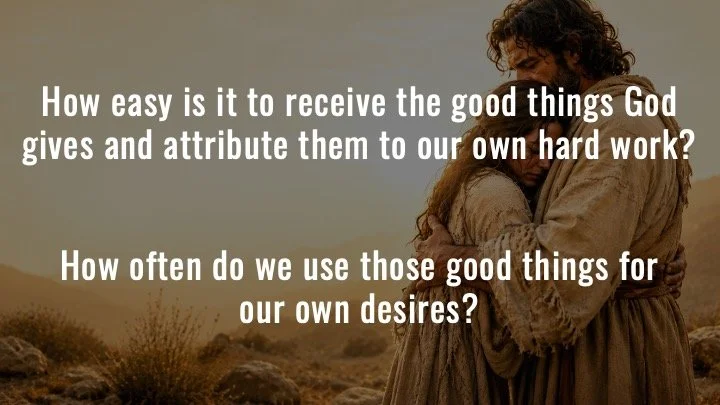
But this is talking about the people of God being unfaithful to God. The people of God receiving all of the blessings that God can give them. And then after they receive all of these wonderful blessings, they forget that it's God who gave it to them and they start looking at other things as though those other things have provided those blessings. My job gave me this. My beauty gave me this. My hard work gave me this. My strength gave me this. My wisdom. My knowledge. My understanding. I'm so great. Look at me. God is not going to stand for us taking the credit for the things that God has given. And it's easy for us to do that. Think about how easy it is for us to receive good things from God and attribute those things to ourselves, our own hard work, because we worked really hard.
I mean, we went to school or we labored at that job for decades and we earn these things and we deserve these things or we've done all the right things so we deserve a spouse that does this or that or we deserve children that are perfect we deserve all of these wonderful gifts and possessions that we have in this great country because we worked really hard you know there's people who've worked really hard and who are smarter than us and done more than us and have had less and have had nothing. We don't have what we enjoy because we are so great. We have what we enjoy because God is the one who has given these things to us. So we need to be careful because it's very easy for us to take all those good things that God gives to us and to act as though they're ours and we can use them however we desire to use them for whatever purpose we want to use them for when in fact it is God who has blessed us with these things and God desires us to use them in a way that will glorify his name and lift him up.
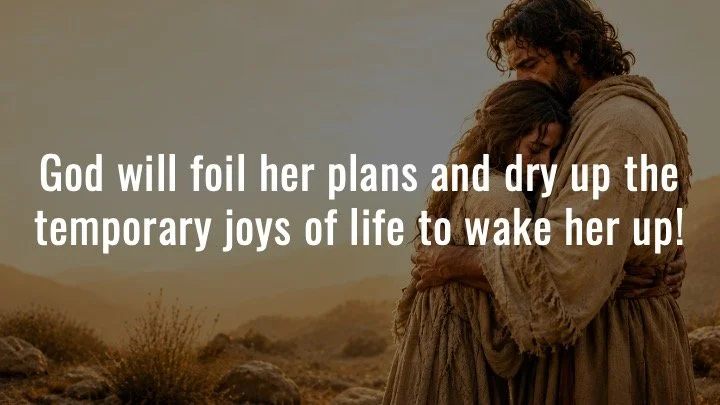
To put it another way, what Gomer needed to hear is what we need to hear. It's not about you. If you imagine a marriage relationship where one spouse thinks it's all about them, it's gonna be broken and horrible. Well the same goes with a relationship with God. If you think it's all about you and that God has done all these things because you are so great and so wonderful and such a good and righteous person, and you're missing it. It's not about you. God makes much of us. He blesses us. He loves us. He pours himself out for us, but not because we're so great, but because that's who he is. He's faithful and he's good. And as we read the story, we see God interacting in a way that I think is important because what we learn is God is going to foil all of her plans. He's going to make her naked. He's going to make her destitute. He's going to make her to the point where she has nothing and she's been betrayed by all of her lovers. And as you read that you might think well my God would never do that to me because he's a God of love and mercy and compassion and and he's so good.
But And I want you to see and understand that this story is teaching us He is good and that's why He does this. He takes away their blessings and their possessions because He loves them enough to say no. These are not because you are so great. These are because of Me and what I've given to you. acting like a spoiled child who needs to be spanked, who needs to have all her toys put in a garbage bag and put out by the road and taught, you don't get these things because you're so great and you deserve them. You get them because I am so great. So God in His mercy is going to take everything away from her. He's going to punish her because she's been using those gifts to feast and rejoice with With all her lovers, and she has totally forgotten about God.
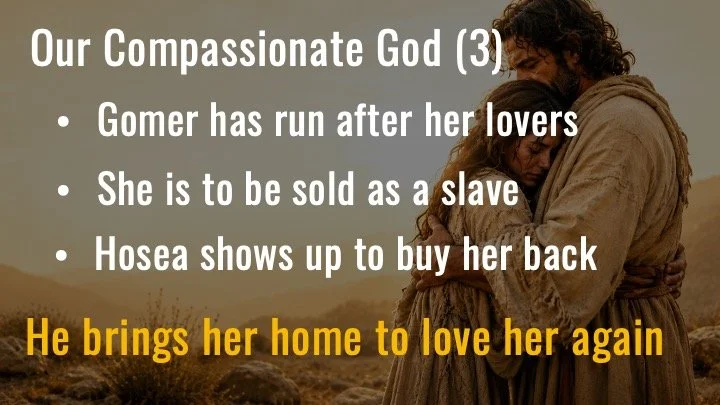
Well, there's another picture of promise and compassion and mercy given to us in chapter 3. We'll come back to chapter 2 in just a moment, but let's look at chapter 3 and see really the end of the story with Hosea and Gomer before we wrap up. In chapter 3, we see the Lord saying to Hosea, Go again, love a woman who is loved by another man and is an adulteress. Even as the Lord loves the children of Israel, though they turn to other gods and love cakes of raisins. So I bought her for fifteen shekels of silver and a homer and a lethech of barley. And I said to her, You must dwell as mine for many days.
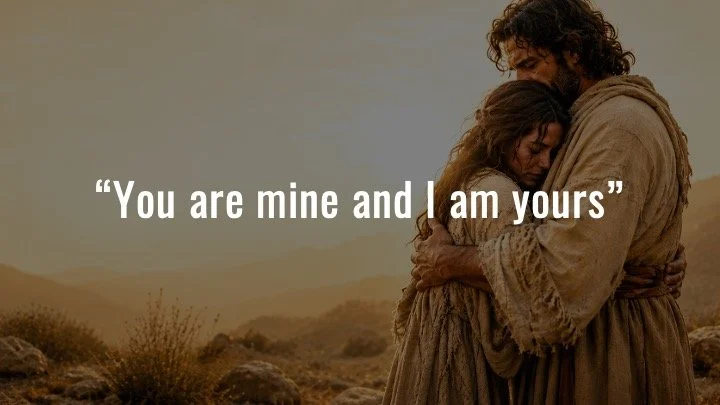
You shall not play the whore or belong to another man. So will I also be to you." Notice here the picture of God telling Hosea, you know, Gomer, she's run off. She's gone after other lovers. She's been this adulterous and evil wife and loved another man. She's now sold to slavery and she's been made naked and been defiled and been ashamed. I want you to go over there and I want you to buy her back. I want you to show her a love that doesn't run out, a love that keeps loving in spite of the horrible wickedness that she's committed. Can you imagine coming up and seeing your wife, dirty, messy, looks awful, just up on an auction block and people are hardly willing to even make a bid on her to be their slave. You got to take your own money out and you got to pay the price to get her back. And then he's told you're gonna bring her home and tell her you got to be mine now. You can't be the whore anymore. You shouldn't have to say that, you know. That should never have to be said. And he says you're gonna be faithful to me, and I'm going to be faithful to you.
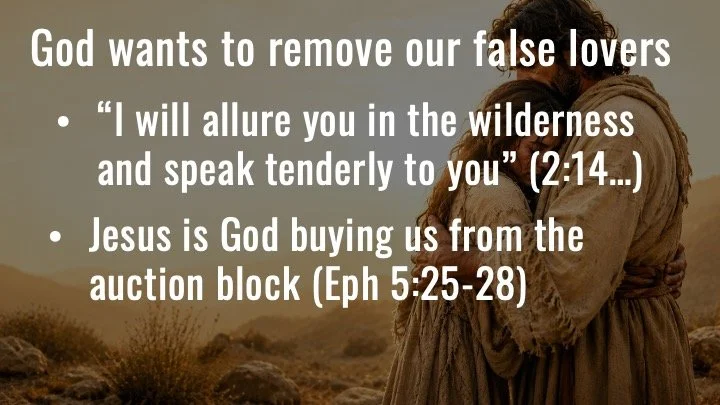
Now that's a very vivid picture that God wants to be inside of our minds, of love and compassion, and that is God saying, I'm gonna buy you back, and you're gonna be mine, and I'm going to be yours, and we're going to be faithful to each other. Wow, what a picture that is for all of us to see of God's unfailing love, and this is referring to God's love for Israel who have been unfaithful to him, and it's also referring to God's love for us. That even though we've sinned and we have betrayed Him and we have gone after this world and we've gone after the gods of this world and we love the money and we've loved the stuff and we love the people and we love the securities that this world has to offer, even though we have turned our backs on Him and cheated and been spiritually adulterous, God wants us to come back and He welcomes us back. And He wants to remove all of the lovers who don't provide us anything anyway. He wants us to remove them and get rid of them and not love those things anymore. And He wants to be our husband. He wants us to be His bride.
In chapter 2 verse 14 it says, As therefore, behold, I will allure her and bring her into the wilderness and speak tenderly to her. And there I will give her vineyards and make the Valley of Achor a door of hope." You see this picture of him saying he's going to allure and persuade her to come to him. It's not going to be this forceful, you got to come back here. What are you doing, you know? But it's this, I'm still here. You can come to me. Come on. I've got it already. It's going to be okay. This alluring and speaking tenderly, even though there's a deserving of judgment and punishment. God's given the punishment and He's allowed them to see it and now He's going to bring them back and He's going to buy them back.
This is a picture for us that Jesus is doing the exact thing that we see here. This is essentially God buying us from the auction block when we are sinners. Him cleaning us up. In Ephesians chapter 5, there's this portrayal of husbands love your wives as Christ loved the church and gave Himself for her. And it talks about Christ cleaning her and bathing her and beautifying her and sanctifying her and making her His holy and beautiful bride. Well, that is us. Let's read this Ephesians 5, 25 through 28. Love your wives as Christ loved the church and gave himself up for her that he might sanctify her having cleansed her By the washing of water with the word so that he might present the church to himself in Splendor without spot or wrinkle or any such thing That she might be holy and without blemish in the same way husbands should love their wives as their own bodies He who loves his wife loves himself You see this picture that we have in Hosea is the picture that we have in the New Testament as well that God has taken us from being very immoral, very evil, adulterous people and He's cleaned us up and He's brought us in and He's made us into His bride and He expects from us faithfulness.
He expects from us a love that doesn't stray and go after other gods, but a love that is faithful and pure at all I want you to think about in your life how you might have been idolatrous and might still be struggling with the idea of idolatry. Where do you go to whenever you need comfort? What do you place your hope in? What are you looking to for security? What do you fear losing more than anything else? What do you believe that you can't live happily without? The answer to all those things should be God. And if it's something else, there may be an idol tugging at your heart. Don't be adulterous.
Trust in and be faithful to your husband. I hope that you'll hear this message, and I hope that you'll choose to follow after and to love our great God who loves you. If there's anybody here this morning who has not given their life to God, has not entered into that covenant relationship and become the bride of Christ, we want to encourage you and help you in any way we can. If you are the bride of Christ and you're struggling with those kinds of things, see His love and His mercy and be motivated to not pursue those things anymore, to put away the sins that are raging in your heart and to live faithfully for God. The most important thing, have a good heart. Love God with all your heart, soul, mind, and strength.
If you need anything this morning, we can help you please let us know. Come as we stand and as we sing.