
Watching From the Window: Michal’s Warning (2 Samuel 6)



Transcript
Tonight we're going to be studying about Michal and some of you might say, well who's Michal. Michal is not a prominent figure in the Old Testament, but sometimes we find that those figures that we don't really think much about are the ones that teach us some of the more interesting and maybe more valuable lessons. So Michal is a woman's name, first of all. Let's get that straight. There's Michael the Archangel, but this is a different Michal. This is Michal who is the daughter of Saul, as we find out in 1 Samuel chapter 16. Saul has daughters as well, and Michal is not even the oldest daughter but a younger daughter of Saul's, and she becomes the wife of David, which makes something very interesting happen because we have a woman who is kind of stuck between two kingdoms, kind of similar to the whole Jonathan scenario where he's like best friends with David but also the son of Saul. Michal is the wife of David, but also the daughter of Saul. So as we study tonight and learn about Michal, we're gonna we're gonna learn some interesting things and it's gonna shed new light on Saul's household and what was going on perhaps inside of Saul's household. I labeled this sermon watching from the window.
I was thinking about how a lot of times in those old TV shows you've got like Bewitched or I Dream of Jeannie, you've got some neighbor That's real nosy and she's looking through the window to see what that what those people are doing. That's really weird Have you ever been that person who's looking through a window to see what your neighbors are up to like? What are they doing out there? You know kind of curious? I always feel like I'm one of those women and it kind of makes me feel ashamed But I've done that before maybe you've done that before kind of looking through the window kind of trying to see what's going on Well, that's an interesting picture to help us think about about how in our lives we can do that.
Even without a window that we're actually physically looking through, metaphorically, we can be looking through a window at what's going on without really being involved in whatever it is that we're watching. We can watch people who are celebrating and not join in their celebration. We can watch people worshiping and pouring out their hearts to God and not join in with the worship. Well, that's essentially what is gonna happen with Michal at the end of the story. She watches the ark get brought into Jerusalem and everybody's rejoicing and celebrating and here she is looking through a window and refusing to join in. And so as we read through the story, we're gonna understand what happened to lead up to that event and what that really means and how we can learn from it tonight.
So kind of ask yourself and think about, are there areas in your life where you're looking through a window and you're not willing to jump in, you're not willing to participate or be a part of something, you're much happier being more of a spectator. And we certainly don't wanna be spectators in our lives. We wanna be involved in the work that God has given us to do. Well, let's go back and let's start and think about Michal going back to 1 Samuel chapter 18. So 1 Samuel chapter 18 is where Michal really starts to be introduced to us. Well, she's mentioned in chapter 16, but really she's not given much attention until chapter 18 and she is Someone who is a daughter of Saul So think think for just a second what that would be like before we study about what happens with her Think about what it would have been like to grow up in the household of Saul what we learned about Saul in 1st Samuel chapter 16 and 17 is that he's got problems and 18 as well. He's struggling. He's got, he did something evil.
He refused to listen to God and acted out in his own way and did his own thing, offering up a sacrifice he wasn't supposed to offer, keeping the Amalekites. He wasn't supposed to keep the king alive. He kept him alive, keeping those animals alive to offer sacrifices. So something's wrong with Saul. And so she grew up in the household of a father who is king of Israel, but he's a king like the kings of the nations. There's something that's not quite right about him that has caused God to reject him. So she is growing up being influenced, having her father be the king who God has rejected. And so she is surrounded in a family that, And even though Jonathan, his character seems amazing, her father's character is not good.
And there's a lot of fear and there's a lot of jealousy in chapter 18 where we read about Saul becoming very jealous of David because Saul's killed his thousands and David's killed his ten thousands. So there's a lot of jealousy in that household. There's a lot of pressure that Saul seems to feel. He is constantly giving way to the will of the people instead of listening to God. So there's this feeling of image and looking like you're supposed to be on the throne. Saul seems to have a lot of insecurities within him, and there seems to be within Saul a self-exalting kind of way of life. He's really, it seems, out to exalt himself and glorify himself.
He's grabbing young men who seem strong to be soldiers, and he's just taking and using whatever he can get for himself and he doesn't seem to honor God in the way that David does. So maybe that kind of environment is what caused Michal to look at David and what we read is, she loved him. She loved David. Maybe she could see that within David there was a different kind of a heart that was the right kind of heart, not the heart that Saul had, but a heart that was more genuine and pure and not ruled by fear and anxiety and the pressure of everything else. Something about David stood out to her and made her love him.
We find out that David was supposed to marry Saul's older daughter, Merab, but Saul ended up giving her away to someone else. And so David wasn't going to marry the daughter of the king even though he slew Goliath and was promised to him. And then Saul finds out that Michal loves David, and Saul's wheels start turning. How can I use this to my benefit? And what Saul does is he twists her love into a weapon that he can use to try to defeat David. He thinks, oh, this is perfect, I'm going to set David up for this, he's going to fall because of this idea that he can marry my daughter, Michal, who loves him.
She's going to be a snare for him, and we're not really told exactly what he meant by that, but what follows immediately is his servants implying to David, hey, he wants you to be his son-in-law, and David says, oh, I can't afford the dowry, and they say, well, perhaps a hundred foreskins of Philistines will work. And so David goes out and fights the Philistines, and maybe Saul's thinking, well, he's going to kill himself trying to get the Philistine foreskins so that he can marry my daughter. Well, he goes with mighty men and he conquers 200 Philistines and gets their foreskins and offers it as a dowry So that he can purchase Michal. Now you're Michal. Oh, how romantic is that? I mean, come on That's kind of gross But he was willing to do that for her and he survived the Philistines and he's able to marry Michal Now Michal sees a man who was willing to put in the work in order to marry her He he apparently loved her in response and wanted to marry Michal And so it seems like everything would be great and they would live happily ever after wouldn't that be wonderful?
But we're left with kind of the question. Is this gonna work out? Because we know Saul has has made some major problems and he has some major issues But hey now David is a son-in-law to the king So technically he's in the line to be an heir to Saul's kingdom because if all the other siblings die Then here's Michal and her husband's gonna be the king So it seems like this would all work out but but how's this gonna work is? Michal gonna be influenced by David is she gonna become like David and be a woman after God's own heart or has Saul's world corrupted her in some way, and is she really going to be a snare for David and cause David to sin? Well, the story doesn't play out in that way to where she would cause David to sin, necessarily, and it doesn't work out to where he becomes king because all the rest of the men die, but instead what we find out is Saul hates David enough to say we've got to kill him. And after a After a failed attempt, he tries again, and then after that fails, he sends men to go and capture David in his own home.
So now imagine yourself as Michal in the home with your husband David, who you love, and there's soldiers outside, and now you have to figure out what you're going to do. These are soldiers from the king. And here's David, who you love, who is in danger. Well, she helps David to escape. joins the side of David it seems and she hides an image it says underneath cloth and says oh David's sick just you can come back later he's not gonna be here he's not here he's not he's not okay right now he can't get up and go with you and the soldiers go back and tell Saul and Saul says go get him we're gonna kill him don't don't let him stay and they go back and David's long gone she let David escape through a window and he's able to get away. So that's a very difficult situation for Michal. Now we look at that story and we see those events take place, but we kind of focus in on David and how he's escaping Saul. But think about Michal. She's just saved her husband from her father's attack. And now her husband is gone. Well what's gonna happen to her? What happens to Michal now? Well the story doesn't tell us about Michal.
For a while Michal kind of disappears from the text and we don't really learn about her until we come over into chapter 25 and we see that she's been remarried to a man named Palti okay and chapter 25 verse 44 that's pretty much all it says Saul had given Michal his daughter David's wife to Palti the son of Laish who was of Gallim. Now notice David has just taken Abigail to be his wife so it's almost like this is explaining why David is now marrying someone else like David wait a second you're married to Michal and that's like, okay, well, Michal got married to someone else. Saul gave her away to someone else. Now, in ancient times, whenever a king has a wife who is taken by another king, and he lays with her, then that dishonors the king. And especially concubines that would happen sometimes. And it was a way of dishonoring the king and showing you have power over him. Well, Saul, with his daughter, he gives her away to someone else. He basically is using Michal as a tool and in order to accomplish his purposes. So Michal is dealing with a very wicked father who is really taking advantage of her and using her in a way that's not morally right.
Well, years pass. David's out in the wilderness this whole time, and he's dealing with his own sufferings, and Michal is apparently married to Palti for those years and she kind of just makes her own life and seems to just function in whatever situation she's in. David of course is marrying other women and he's even becoming king after Saul dies and he takes on more wives and more concubines as he is now made king of Judah. But the kingdom of the north is separate from his kingdom of Judah, and he wants his wife back. And so he has power over Ish-bosheth, and Abner recognizes it, and so David sends a request to bring Michal back to him and have her return to him. That's his wife. He wants her back, and so he brings her back. And it's interesting because it tells us that her husband Palti was weeping and pleading with Abner, please don't take her away from me. So apparently that time period in between her sending David away and David calling for her back was filled with some kind of love or infatuation by Palti.
Apparently Palti and Michal really had a relationship going on and so there's some broken-heartedness over this, at least on Palti's part. We don't really, we don't really read about Michal. Now think about this though. Michal is being taken from a failing kingdom, okay, and a failing line, and she's now being made the Queen and the first Queen, like she's the first wife of David. Now I don't, I don't know exactly how that would have fit in with the other wives and and the jealousy and the feelings of animosity about all the things that have gone on in her absence. Maybe there was some some things like that going on, but think about yourself. How would you feel right now if you're Michal? You've been through a lot. You saved your husband who you loved, and then your father gave you away to another man, and now you're being... your father's died, your brothers are dead, and you're being ripped away from your husband, and now you're going back to your first husband, and he's He's got all these wives and all these concubines.
You think you'd be pretty upset about all this. I mean, it'd be a tough life, a tough situation to go through. You know, whenever we go through struggles in life, we have different feelings and different emotions that rise up within us, but really, ultimately, we are the ones who get to decide how we're going to let those things affect us. Are we going to be bitter? Are we going to have the jealousy and the fear and the anxiety and the pressure and all those kinds of things that perhaps were put into us by our parents, or things that we've developed over time, or are we going to overcome those things?
And are we going to be better than we were, than our situation? Well, unfortunately, Michal struggles a lot. Whenever we come to 2 Samuel chapter 6, we read about David doing something great. I mean, he's bringing the ark into Jerusalem and it seems as though everything would be good now. I mean she's made the Queen with her first husband, her love, and now everything should be right in the world and now she can live happily ever after, but unfortunately no. David comes into the city and you could just imagine it. Jerusalem has been taken over by David and he's made all these preparations. He's had the Ark brought in the way it's supposed to be brought in this time and everybody celebrating and rejoicing because David is at the head showing the people we honor our God who has brought us the victory and caused all these wonderful things to happen for our kingdom and we are bringing him into our head city to honor him as our King and our God. And Michal is not among the celebrations. David is there. All of Israel is there.
Everybody's rejoicing over the Ark of God coming in and praising God over this momentous day, and Michal stays in the palace that they're in and looks out the window, looks down on David, and the text tells us she looks at David as he's leaping and dancing before the Lord, verse 16 of 2 Samuel chapter 6, she looks at David leaping and dancing before the Lord and she despised him in her heart. She despises her husband. Well that doesn't seem right. Why would you despise David for this? I mean this is a wonderful celebration, a great event that's happening that's exalting God. Well her problem is David is not acting like a king. In her mind, a king is supposed to act in a certain way, and David has failed to act in the way that he's supposed to act. So Michal gets mad at David. She despises him in her heart and listen to the interchange between Michal and David. Go down to verse 20. It says, and David returned to bless his household.
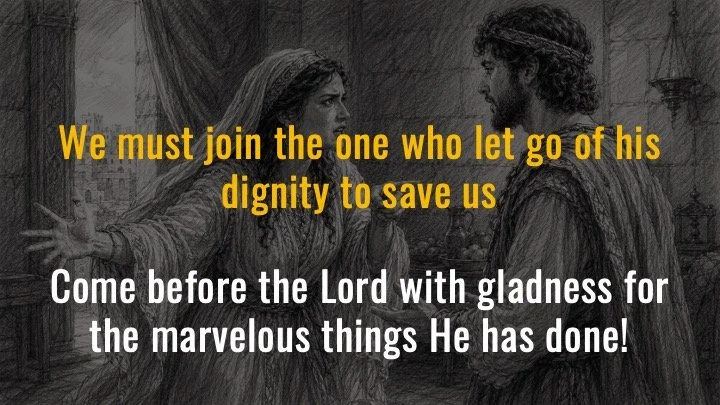
So he's just had all this excitement and all this joy and blessing all the people and now he comes to bless his own household but it says Michal the daughter of Saul, notice how it labels her, the daughter of Saul, came out to meet David and said how the king of Israel honored himself today, uncovering himself today before the eyes of his servants, female servants, as one of the vulgar fellows shamelessly uncovers himself. Can you sense the animosity, the malice within her? It says David said to Michal, it was before the Lord who chose me above your father and above all his house to appoint me as prince over Israel, the people of the Lord, and I will celebrate before the Lord. I will make myself yet more contemptible than this, and I will be abased in your eyes. But by the female servants of whom you have spoken, by them I shall be held in honor." And it says, Michal, the daughter of Saul, had no child to the day of her death. Now I find this whole interchange, this whole marital spat interesting.
We don't get a whole lot of marital spats in the Bible, but here we have one relayed for us perfectly to help us understand what is going on inside of David's house. Michal has been heavily influenced by her father. Can you see it in the words and in the things that she says? That she's jealous just like her father was. That she's focused on image and how she looks. And this is the reason why she's letting David have it. She's telling David what he's done is wrong. This is not something that a king is supposed to do. You've disrobed yourself. You're supposed to look like a king in front of all these people. How will they honor you? How will they respect you? And David says, this is before the Lord. This is not about me. I'm not here to serve my own interests. I'm not here to exalt myself. And that's exactly what Saul's interests are. Saul is the one who clung to his image. Saul is the one who wanted to look the part all the days of his life, and David has no interest in looking the part. He has no interest in appearing to be the king who is great in the presence of God. It's God!
Let him be held in honor, and he says, I will be held in honor among those female servants of whom you spoke, because they see it, they understand, but Michal is too haughty. She doesn't have the heart of David. She has pride within her. She thinks much of herself and she thinks much of David and she wants everyone to hold her in honor and hold David in honor as being the greatest in the kingdom and she looks down her nose at everybody else. In this little story we get a real clear picture of the difference between Saul's house and David's house, between Saul's heart and David's heart, as it's relayed for us in Michal, Saul's daughter. So as we read through this story and we learn about Michal, sure we can sympathize with her, she's become bitter, she's gone through a lot, but still notice how the text condemns her for making the decision to think much of herself and to think much of David and to think so little of God. She's just watching through the window refusing to participate in honoring God and glorifying Him as she should. This whole story of Michal is really a warning for us. To think about ourselves, what type of person am I?
Am I the person who has the heart like the house of Saul? Am I a critic who's looking from the window and judging everyone else who's doing all these things that are undignified and inappropriate and and not the way that they should be done? You know it's very easy stance to take. It's easy to look back and not be involved and say they're doing it all wrong and and you should do this and you should do that. It's easy for us to critique people instead of joining in on the work and giving yourself over to being zealous and fervent and maybe looking ridiculous in order to accomplish glorifying and magnifying God. You see at the heart of this is an issue of pride and self-exaltation and notice how it seems to be contagious. Saul's daughter has the same sickness in her heart that Saul had.
I think a lot of times we're very influenced by our family. The way our family interacts with people, the way they judge people behind closed doors, the way they talk about people behind their back, and the way they think about people, and the way they think about the church, all of of those types of things can have a profound impact on children, and they probably have had a profound impact on us. So as we read through the story of Michal, I think it's important for us to evaluate ourselves and see where we're at, to see if we followed down the same path as our parents, the same mistakes as our parents, or if we've truly been transformed from within, to have a heart and a mind that is humble before God and recognize the greatness of God. Notice Michal is right there. She's in the city in the presence of the ark of God and and in the presence of all the blessings that God has poured out on David and she's taking part and enjoying all those things, but she herself is not a godly person. She herself is not humble before God. She's not glorifying and honoring God the way that she should.
As we study this story we also learn something very powerful about David. There's a lot of lessons to learn about David but we learn something amazing about him and his willingness to be undignified, his willingness to be humiliated so to speak before all the people and to be lowering himself to being a servant like everyone else dressing himself in linen as As everyone else is, we see a very clear connection to our Lord. Remember, Jesus also was humiliated for us. Jesus suffered great indignity in order to save us. That's a beautiful picture that we see of Jesus. And as we read about David, we also, we see Jesus. Jesus is a wonderful Savior who doesn't care about the image.
He's not focused on exalting himself. He's focused on honoring and exalting God. And so we need to follow in his footsteps. We need to stop focusing on the external. That is a hard thing to get over. And we need to start living a life that is exalting God, even if it means that sometimes we're embarrassed because we tried really hard. We sang out and we were off key or we offered a prayer. We said something to try to encourage somebody. It came out wrong. Something happened. So what? You're trying to honor God, that's a great thing. The main thing is to remain humble before the Lord and to come before the Lord with gladness and marvel over the wonderful things that He's done for you.
That's what David's doing. He's seeing all these wonderful blessings that God's done for Him, and He can't contain Himself. He's just exploding with joy over God's salvation and God's love. After all He's been through, He can't help but exalt God, and that should be us. we should also be exalting God in that way. If you're here tonight and you need encouragement or help in doing that, we want to encourage you. We want to help you in any way we can. Please let us know what you need. Please come as we stand and as we sing.