
Real Freedom (Romans 7:1-8:4)
Have you ever tried to change something deep within yourself—maybe a habit, a mindset, or a way of living—only to find it feels impossible? Last week, we talked about how true change starts from the inside out, like reformatting a computer to run a new program. Our hearts need that kind of transformation. But two big questions arise: Why is this change so hard? And how can we actually do it? Today, we’ll tackle the first question by exploring three barriers to change Paul identifies in Romans 7:1–8:4: our covenant, our challenge, and our weakness. Let’s start with the covenant and discover how God sets us free to live in true freedom.
Freed From the Covenant (Romans 7:1–6)
Romans 7:1–6 (ESV) — 1 Or do you not know, brothers—for I am speaking to those who know the law—that the law is binding on a person only as long as he lives? 2 For a married woman is bound by law to her husband while he lives, but if her husband dies she is released from the law of marriage. 3 Accordingly, she will be called an adulteress if she lives with another man while her husband is alive. But if her husband dies, she is free from that law, and if she marries another man she is not an adulteress. 4 Likewise, my brothers, you also have died to the law through the body of Christ, so that you may belong to another, to him who has been raised from the dead, in order that we may bear fruit for God. 5 For while we were living in the flesh, our sinful passions, aroused by the law, were at work in our members to bear fruit for death. 6 But now we are released from the law, having died to that which held us captive, so that we serve in the new way of the Spirit and not in the old way of the written code.
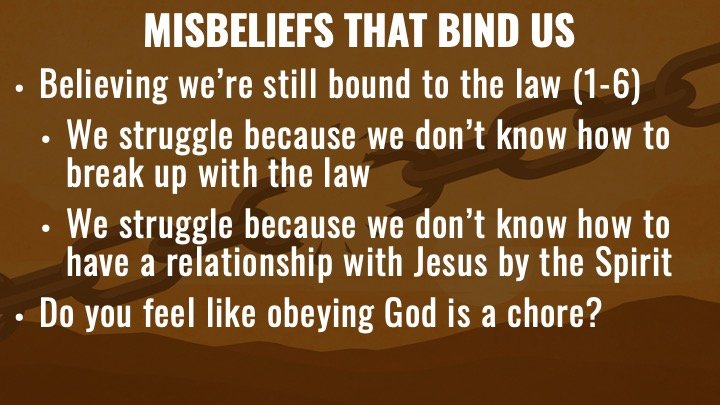
Imagine being locked into a contract you can’t escape, like a phone plan with no way out. That’s what the Old Testament law was like for God’s people—a binding covenant. Paul uses marriage to explain this. When you say, “Till death do us part,” you’re committed until one spouse dies. Similarly, the law held God’s people under contract. There were three ways to respond to this contract. 1. Rebel against it. 2. Become delusional about your ability to keep it. 3. Try to keep it while realizing your failure..
Here’s the good news: in Christ, you’re free! Paul says, “You have died to the law through the body of Christ, so that you may belong to another” (v. 4). Joining yourself to Jesus’ death broke the old covenant’s grip, like a spouse being freed by death to marry another. Now, you belong to Christ, raised from the dead, to live a life that bears fruit for God.
One might say, “Wait, I’m not a Jew and therefore not born under the OT law.” True. But you are under the moral law, which is just as binding, and we are set free from that as well.
Okay, that sounds like good news, but do we still act like we’re stuck in the old contract? Do we live like we’re still chained to an old covenant, or do we trust that we belong to Christ? We struggle to change because we don’t fully grasp that we’re free. We keep resisting like rule-breakers or selfishly striving like rule-keepers, instead of trusting we belong to Jesus and desiring to serve Him. Jesus is not like the law. He’s not cold and callous. He is full of compassion. He leads with warmth and tenderness. We have to stop living to do the bear minimum, and start loving Him back.
This heart transformation is tough because we’re slow to believe we’re truly His. The old covenant fueled rebellion or self-reliance, but in Christ, we’re called to a new way of serving by the Spirit, not a written code. Next week, we’ll unpack what this “new way of the Spirit” looks like.
The Challenge of Sin (7:7-13)
The second barrier is just the challenge of sin itself. One might wonder, “Why was the law given if it was just going to be removed? Why not have everyone saved from the moral code?” From the outside, the law appears to have just caused men to sin.
Romans 7:7–13 (ESV) — 7 What then shall we say? That the law is sin? By no means! Yet if it had not been for the law, I would not have known sin. For I would not have known what it is to covet if the law had not said, “You shall not covet.” 8 But sin, seizing an opportunity through the commandment, produced in me all kinds of covetousness. For apart from the law, sin lies dead. 9 I was once alive apart from the law, but when the commandment came, sin came alive and I died. 10 The very commandment that promised life proved to be death to me. 11 For sin, seizing an opportunity through the commandment, deceived me and through it killed me. 12 So the law is holy, and the commandment is holy and righteous and good. 13 Did that which is good, then, bring death to me? By no means! It was sin, producing death in me through what is good, in order that sin might be shown to be sin, and through the commandment might become sinful beyond measure.
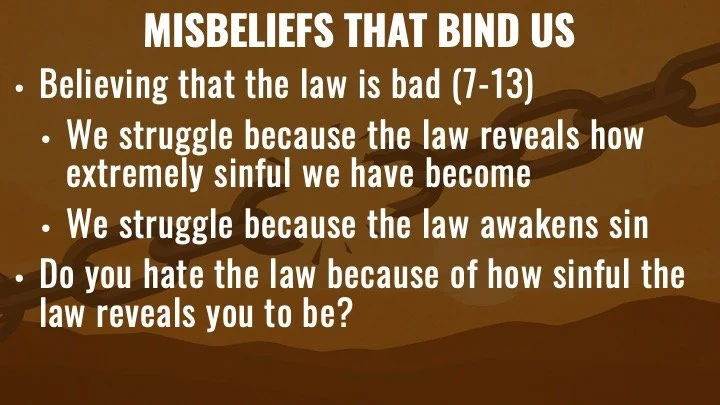
If the law can’t save us, why did God give it? Did it just make us sin more? Paul says, “By no means!” The law isn’t sin—it’s a spotlight that exposes sin. Think of it like a smoke detector: it doesn’t cause the fire, but it screams to let you know danger’s there. Paul explains, “I would not have known what it is to covet if the law had not said, ‘You shall not covet’” (v. 7). The law reveals the sin already hiding in our hearts, like coveting, showing us where we’re broken.
But it gets worse. The law doesn’t just expose sin—it stirs it up. Paul says sin “seized an opportunity” through the commandment, producing “all kinds of covetousness” (v. 8). It’s like seeing a “Wet Paint” sign and suddenly wanting to touch it. The law, meant to guide us toward life, awakens our rebellious nature. Paul reflects, “When the commandment came, sin came alive and I died” (v. 9). Sin, like a virus, was dormant until the law provoked it, revealing our spiritual deadness.
Is the law bad, then? No! Paul insists, “The law is holy, and the commandment is holy and righteous and good” (v. 12). The law does its job: it shows sin for what it is—“sinful beyond measure” (v. 13). Sin’s the real enemy, a destructive force that deceives and kills if left unchecked. This means we have to overcome something that is already inside of us and killing us.
The Problem Is Me (7:14-23)
But that’s not all. We struggle with leaving the law. We struggle with the sin that’s inside of us. This means the biggest barrier to putting God on the throne is me.
Romans 7:14–23 (ESV) — 14 For we know that the law is spiritual, but I am of the flesh, sold under sin. 15 For I do not understand my own actions. For I do not do what I want, but I do the very thing I hate. 16 Now if I do what I do not want, I agree with the law, that it is good. 17 So now it is no longer I who do it, but sin that dwells within me. 18 For I know that nothing good dwells in me, that is, in my flesh. For I have the desire to do what is right, but not the ability to carry it out. 19 For I do not do the good I want, but the evil I do not want is what I keep on doing. 20 Now if I do what I do not want, it is no longer I who do it, but sin that dwells within me. 21 So I find it to be a law that when I want to do right, evil lies close at hand. 22 For I delight in the law of God, in my inner being, 23 but I see in my members another law waging war against the law of my mind and making me captive to the law of sin that dwells in my members.
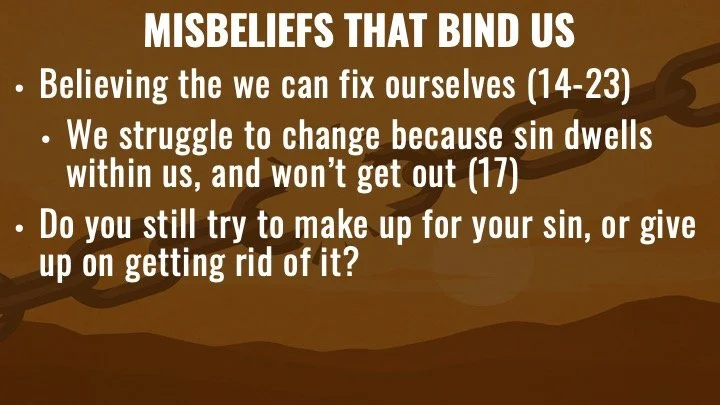
Why is heart transformation so hard? Paul points to the real problem: me. The law shows us what’s right, but our sinful nature fights back. It’s like being stuck in a car with a mind of its own—your hands are on the wheel, wanting to go one way, but the car veers toward danger. Paul confesses, “I do not do what I want, but I do the very thing I hate” (v. 15). He loves God’s law in his heart (v. 22), but his “flesh”—his weak nature—keeps dragging him toward sin.
This inner battle is relentless. Paul says sin “dwells within me” (v. 17), like an unwelcome guest that won’t leave. You want to be patient, but rage bubbles up. You want to stay pure, but wrong desires pull you away. The law makes you see these sins clearly, even hate them, but you feel powerless to stop. “I have the desire to do what is right, but not the ability to carry it out” (v. 18). It’s tempting to make excuses or give up, thinking, “This is just who I am.” But Paul’s point is clear: sin is a captor, holding us hostage in our own bodies.
Does this mean we’re doomed? No—there’s hope beyond ourselves. The struggle with sin sets the stage for the freedom found in Christ.
How Can We Be Free? (7:24-8:4)
Romans 7:24–8:4 (ESV) — 24 Wretched man that I am! Who will deliver me from this body of death? 25 Thanks be to God through Jesus Christ our Lord! So then, I myself serve the law of God with my mind, but with my flesh I serve the law of sin. 1 There is therefore now no condemnation for those who are in Christ Jesus. 2 For the law of the Spirit of life has set you free in Christ Jesus from the law of sin and death. 3 For God has done what the law, weakened by the flesh, could not do. By sending his own Son in the likeness of sinful flesh and for sin, he condemned sin in the flesh, 4 in order that the righteous requirement of the law might be fulfilled in us, who walk not according to the flesh but according to the Spirit.
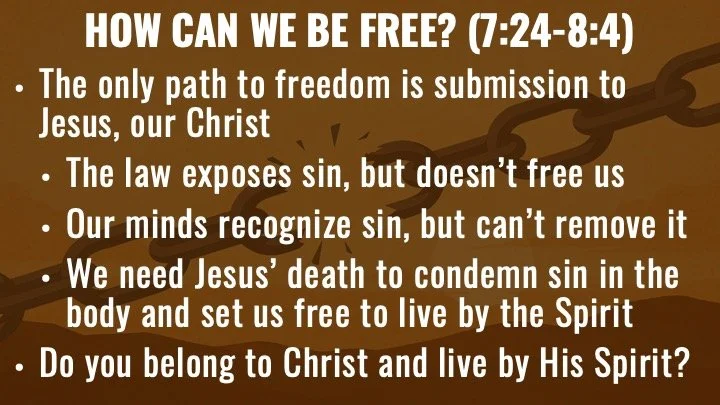
Paul’s cry—“Wretched man that I am! Who will deliver me?” (7:24)—is our cry. The law exposes sin but can’t save us. Our flesh is too weak. So, who can free us? Paul shouts, “Thanks be to God through Jesus Christ our Lord!” (7:25). The gospel is the good news: Jesus’ sacrifice breaks sin’s power. “There is therefore now no condemnation for those who are in Christ Jesus” (8:1). Through Christ’s death, God condemned sin, freeing us to live by the Spirit, not the flesh (8:2–4).
Three truths bring this home:
- The law reveals our need for freedom, not the freedom itself.
- Jesus’ sacrifice frees us from sin’s slavery and condemnation.
- The Spirit empowers us to live a new way, fulfilling God’s law through love, not legalism.
If you haven’t trusted Christ, choose Him today. Baptism is your first step to freedom, dying to sin and rising with Jesus. If you’re a believer struggling with sin, don’t give up—God’s Spirit is with you, forgiving your stumbles and empowering you to overcome. Reflect: Am I ready to trust Christ’s power to free me from sin’s grip?