
The Truth About Judgment (Romans 2:1-11)




We'll be in Romans chapter 2 this morning. If you want to get your Bibles and turn to Romans chapter 2, that's where we'll be studying from. First of all, before we begin the lesson this morning, I do want to take a second and say thank you to all of those who assisted in making the lectures great. There are many who sacrificed their time and a lot of effort in order to invite other people and bring their friends and bring their neighbors. And it was just a great meeting. It was the best meeting that we've had since I've been here as far as attendance goes. And I want to say thank you to all of those who were here and those of you who were tuning in online. We had more views on these videos as well than any other. So overall I think the meeting was a wonderful success and I want to say my appreciation to all of those who were able to be with us. Those who were not able to be with us I want to encourage you go online to our Facebook page and watch those live streams. Those are wonderful lessons that fill you with hope and motivate you to do God's will and to keep going in the difficulties of life. These are wonderful resources for us.
Today we're going to continue our study in the book of Romans. And we're going to be looking at this idea of judgment. If you remember a couple weeks ago, we looked at Romans 1 and saw a little bit more about God's wrath and how God, even in His wrath, still has love. He is not either totally wrathful or totally loving. He is a combination of the two.
Those two things are in tension. If you truly love, then you're going to have to, at some point, inflict wrath to help people understand what is hurting them, what is bad for them, what they must change in order to receive good things in life. You have to respond to the things that are going on in the lives of others. So wrath is necessary and it's important to see that God will inflict wrath on those who choose ungodliness and unrighteousness.
But today we're going to kind of go another level deeper and we're going to talk about an idea that is confusing to a lot of people. This is the idea of judgment. Do you know what's going to happen on the judgment day? Have you ever thought about that or considered that idea? I remember when I was a kid talking to my dad and he kind of gave me the impression that we can't understand the Bible.
He felt like this was something only certain men were gifted toward, and that it was beyond him to understand the Bible. I didn't understand that. It didn't seem right to me and I challenged that. And as soon as somebody really started showing me that you can understand the Bible, my mind was blown.
I thought, "Oh yes, we can understand this. This is good stuff and this is understandable." And I got very hungry to learn and understand what this is all about. Well, in some ways, people feel like the judgment is confusing. It's something that we won't ever understand until we're there on that day, and then it'll be made clear to us how God is really going to judge men and women on the earth. Have you ever felt that way? Have you ever felt like it's a confusing thing? And maybe you believe you're saved and yet at the same time, you're just kind of hoping.
I've heard Christians say, "I sure hope that God saves me," and maybe they had those kind of thoughts and feelings inside of them that there was some level of doubt about how the judgment day was going to go and what God was really going to do. It's almost like being saved puts us on this little tip of a pyramid and we could easily fall off in any direction and we're just kind of terrified of what's actually going to happen. I hope that if that's you, that this lesson helps you understand how God is going to judge. He has not been unclear in revealing to us what He will do on the judgment day. The problem isn't that God has been unclear. The problem is that there are a lot of people who have taught things that are different than what God is very clearly showing us, and they have confused us with their words and with their thoughts and their ideas. So, I hope by studying this today, you will have some level of clarity about how God is going to judge mankind because we need to know this. This is one of the main motivations for us to go out and evangelize. It is one of the main motivations for us to come into this building on a weekly basis, and whatever building we're around as much as we have the opportunity, and build up the body of Christ because there will be a judgment day. It has been promised, and God doesn't break His promises and we all need to be ready for that day. We need to be making preparations and we need to be helping each other to be on the right side of that judgment. So, we're going to study this idea today of judgment. And here's how we're going to do it. First of all, we're going to look at who God is going to judge to be wicked. Then we're going to see some ideas that go with this concept that God will judge the wicked.
Then we're going to look at who God will judge to be righteous before we end today.
Who Will God Judge to Be Wicked?
So first of all, who is God going to judge to be wicked? Well, let's go backward. I said 1:1, but let's look back at chapter 1 and starting in verse 29. It says, "They were filled with all manner of unrighteousness, evil, covetousness, malice. They are full of envy, murder, strife, deceit, maliciousness. They are gossips, slanderers, haters of God, insolent, haughty, boastful, inventors of evil, disobedient to parents, foolish, faithless, heartless, ruthless."
Notice all of these descriptions of people who are wicked and evil and unrighteous. You could add to that list sexually immoral which is in the previous paragraph here. There are so many different sins that are being listed here. And the picture is that these people who are doing these sins are going to be judged. Look at verse 32. Though they know God's righteous decree that those who practice such things deserve to die, they not only do them, but give approval of those who practice them. You know, the judgment that God is going to give on the earth is really not that complicated.
He will judge those who persist in doing evil. He gives them truth and he gives them opportunity to change and instead of changing they go further into sin. And the way these are described, listen to these ideas that they are full of envy, murder, strife, deceit, maliciousness. They're full of it. They're bursting at the seams of all kinds of evil things because they have pursued these things. They pursued these wicked things. Their life is full of it. And notice as you read these ideas, envy, murder, strife, deceit, gossiping, slandering, hating God, insolent, all of these things, these are things they are doing. They are involved in these sins.
These are actions that they are actively engaging in on a daily, weekly, monthly basis. And he says God is going to bring punishment. God's righteous decree that those who practice these things deserve to die. There is a judgment coming for them. Now, as we read this list, aren't we glad we haven't done any of these things?
We breathe a sigh of relief. But wait a second. There's a problem here. I don't think he meant gossip. I don't think that's that bad. Surely that doesn't need to be in here. Oh man, slander. You mean speaking bad about somebody who's wronged me? That doesn't make sense. That shouldn't be in there either, right? Disobedient to parents. Oh man, I don't think there's a single one of us who escapes condemnation in this list. And the statement that they know they deserve to die should be a terrifying thing to us. This is God's judgment against man: that those who practice these unrighteous and sinful things deserve to die. And not just those who do those things. Look at verse 32 again. He says they not only do them, but they give approval to those who practice them. Have you ever heard somebody maybe gossiping or slandering, talking bad about somebody else? Does that make you feel better? Have you ever seen somebody do something really bad and evil? Does that make you feel like, well, I'm not the only one? And you feel kind of justified in the things that you've done. And maybe you've justified the evil that you both are doing.
Because there are a lot of people who do that and you say, "Really, that's not that bad of a thing." And you give approval to that sin as though that sin's not a big deal, as though that sin doesn't deserve any punishment or any judgment because I mean, come on, everybody does it. And yet the picture here is those who practice these things deserve to die. And those who give approval to those who practice these things are also guilty. And they're doing the same kinds of things. Notice it goes further.
Verses 1-5 of chapter 2 say, "Therefore, you have no excuse, O man. Every one of you who judges, for in passing judgment on another, you condemn yourself, because you, the judge, practice the very same things. We know that the judgment of God rightly falls on those who practice such things. Do you suppose, O man, you who judge those who practice such things and yet do them yourself that you will escape the judgment of God? Or do you presume on the riches of His kindness and forbearance and patience, not knowing that God's kindness is meant to lead you to repentance. But because of your hard and impenitent heart, you're storing up wrath for yourself on the day of wrath when God's righteous judgment will be revealed." Notice here there's a third group that's mentioned as being worthy of judgment. And this is not the group that approves of the evil others are doing, but this is the group that disapproves. You know, as we think about slander, we think about gossip. We might be okay with it as long as it's not about us. But as soon as somebody starts talking bad about us, how do we feel about it? Oh, I don't like that so much.
I think that's evil. That person deserves punishment because they have hurt me. They've hurt my reputation. They've hurt my relationships. They've hurt my ability to succeed in life. And he says, "Whoa, whoa, whoa, whoa, whoa." Now, it's okay for you to do it, but it's not okay for them to do it? You see, that judgment, that standard that we set, even in our own judgments condemns us and makes us guilty. And that's what he's pointing out here is that none of you are escaping judgment from God. In judging others, you think you're making yourself okay, but you're really not.
You're actually just removing your excuse. You're removing your justification, and you're making yourself obviously guilty. Have you ever had that happen to you before? That you've judged somebody and you've talked bad about somebody and then somebody turns around and accuses you of doing the same thing and you kind of put your foot in your mouth. Done that quite a few times in my life.
Have you ever heard of a situation where maybe a church member has done something that seems so small but had enormous effects on the congregation, on families? Last year I was talking to a preacher friend of mine and he told me about a preacher that he had known and had been preaching at a location for about 15 years. Things had gone great, and he was doing well. He was evangelistic and reaching out to the lost. After service, he was talking with one of the ladies who was visiting. It was just friendly conversation, and they were laughing and enjoying each other. And one of the older ladies in the congregation saw that and started talking about how they were probably in an inappropriate relationship. Well, that word spread and spread in that congregation. Those who should have known those things were wrong justified it and said, "This guy has done something wrong. We need to put a stop to it." They put pressure on the elders. The man ended up being fired. He and his whole family had to uproot and leave and there was absolutely nothing going on. He came back to that congregation years later, and that congregation was almost dissolved. I mean, there was barely anybody left. And that woman was still there as she came up just crying, knowing exactly what she had done, understanding the error of her ways. You see, we make mistakes. We do things and we don't think anything about it. We think, "Oh, it's no big deal. It's just this small little lie or this small little word that we say." And yet our sin is worthy of punishment. It's worthy of judgment. And so the judgment is very clear and very easy to understand. If you sin, you are guilty and worthy of judgment and worthy of death. It's not that complicated.
The Root of the Problem
And the root of the problem is found in the next verses. He says in verses 6-10, "He will render to each one according to his works. To those who by patience and well-doing seek for glory, honor, and immortality, He will give eternal life. But for those who are self-seeking and do not obey the truth, but obey unrighteousness, there will be wrath and fury. There will be tribulation and distress for every human being who does evil, the Jew first and also the Greek, but glory and honor and peace for everyone who does good, the Jew first and also the Greek." Notice here He makes it clear what the root of the problem is in every single one of these sins. These people, and us, struggle with being self-seeking. We want what's best for ourselves. We only live once. We got to make our life the best it can possibly be. And so all of these sins have this common root that there is a heart within us that desires ourselves to be glorified and honored by men, by women who are all around us. We want everyone to think much of us. So we do whatever it takes in order to preserve that reputation, in order to preserve our riches, our wealth, our joy, our satisfaction. The things of this earth create a very earthly kind of focus, and it leads to sin, and that sin leads to judgment. That's what we read in the Scripture reading in James. We're enticed by our desires and then we sin and that sin brings forth death. Notice the words in verse 6 again. He will render to each one according to his works. This is worded many ways throughout Scripture. It is repeated over and over and over and over again. And we must believe it.
God will judge, not based on what we say about ourselves or what we think about ourselves or what we want to believe about ourselves. He will judge based on what we did in our lives. Other texts say the same thing. Matthew 16:27, for the Son of Man is going to come with his angels in the glory of His Father, and then he will repay each person according to what he has done. John 5:28-29. Do not marvel at this, for an hour is coming when all who are in the tombs will hear His voice and come out, those who have done good to the resurrection of life, and those who have done evil to the resurrection of judgment. 2 Corinthians 5:10 says, "For we must all appear before the judgment seat of Christ, so that each one may receive what is due for what he has done in the body, whether good or evil." And then we go to the end of the book, end of Revelation, we see: "I saw the dead, great and small, standing before the throne, and books were open. Then another book was open, which is the book of life. And the dead were judged by what was written in the books, according to what they had done. The sea gave up the dead who were in it. Death and Hades gave up the dead who were in them. They were judged, each one of them according to what they had done. And again in Revelation: 'Behold, I'm coming soon, bringing my recompense with me to repay each one for what he has done.' Do you see the image? Judgment day is clear. What God will do, how God will decide is clear. He will judge us based on how we have lived our lives. He will not turn a blind eye to our actions. He will not allow our excuses. He says, "You have no excuse." Don't we have excuses? We all have excuses.
What's your excuse for doing the sin that you've been doing all your life? What's your excuse for ignoring the word of God as you've been ignoring it all your life? Do you suppose that you will escape the judgment somehow? Well, that's a pretty questionable supposition. How do you know that? Do you presume that God will be kind to you even though you are hard-hearted and unrepentant? Do you think God will just ignore everything that you've done? Well, yeah, I'd like to think that my excuses are going to work. I'd like to think that I'll escape the judgment. I'd like to think that God will be kind toward me.
God Shows No Partiality
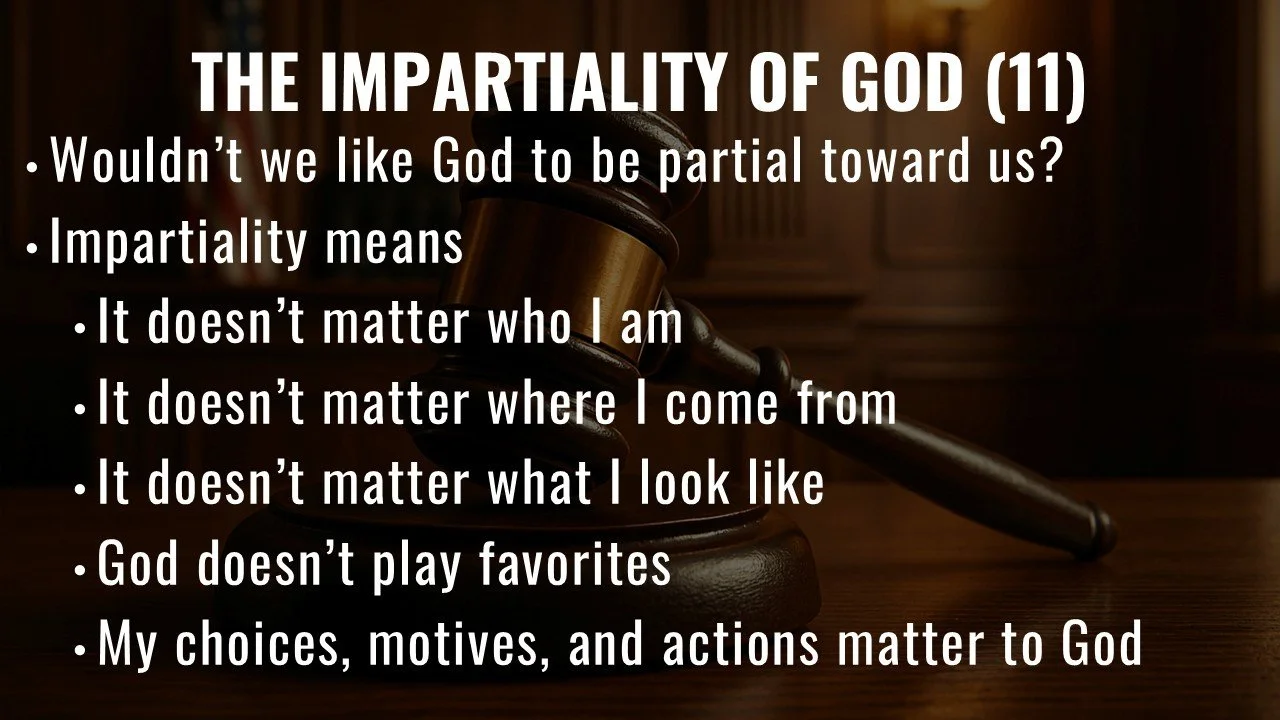
Look at verse 11: "For God shows no partiality." What does that mean? Well, first of all, it points us to this idea of we would really like for God to be partial toward us, wouldn't we? I think Andy mentioned in one of his lessons how sometimes there's favorites among kids. Parents have a favorite and other kids aren't the favorite and there's kind of this struggle. Maybe it was Brent who mentioned it talking about Joseph, but there's always this kind of struggle. And you know, we're okay with our parents showing favoritism as long as it's toward us. But if it's not toward us, we don't really like that idea at all. Okay?
But what we're seeing here is that God is not going to play favorites. It doesn't matter if you're a Jew. It doesn't matter if you're a Gentile. It doesn't matter what country you come from. It doesn't matter what you look like. It doesn't matter how people around you feel about you and what they think of you. I cannot preach anyone into heaven at their funeral.
That doesn't work. God isn't partial to people in that way. It doesn't matter that you're an American. You're in the greatest country in the world. That doesn't give you any extra privilege in God's sight. God is not going to say, "Oh, well, he's an American, so obviously he should get in. Those are the richest and best people of all." No. Impartiality means it doesn't matter who I am. It doesn't matter. It doesn't matter where I come from. It doesn't matter what I look like.
God does not play favorites. He will not accept you simply because you have decided to come to a church of Christ all your life or whatever. He doesn't play favorites. At the end of the day, the judgment will be based on my choices, my motives, and my actions. Same goes for you.
Each and every one of us will be judged not based on where we went to church or who our parents were or how good they were or how much we accomplished in life or any of these things that we think make us a good person and make us loved by God. Judgment won't be based on any of that. Instead, we see God will look at us and see how we're living, and He will make this determination about who is wicked and who is righteous.
Who Will God Judge to Be Righteous?
Let's see who He says is righteous. Verse 7 again, to those who by patience and well-doing, pause right there. What in the world does that mean? I don't talk like that. Maybe it's just me. I'm Southern, right? I even hear my slang now. Patient in well-doing. I don't say that, but other translations say persistent in doing good. Okay? So, the one He judges as righteous, the one who will receive eternal life is the one who persists in doing good. That gives you a picture, doesn't it? When I have to persist at something, that means it's really hard for me to do it. I don't want to do it.
It's not fun to do it. It's not easy to do it. And even when it's really hard, I persist. I do it anyway. I keep going with it because I believe it's the right thing and because I believe it's the good thing. And so He says, "Those who will be counted as righteous, those who will receive eternal life, are those who are persisting in doing good, even when it's hard, even when everybody else around them is doing evil, even when they really want to do what's evil, they instead choose to do what is good, not just say that they'll do it, not to just approve of what's good, but they will do what is good.
They are the ones who will receive eternal life. It's simple, isn't it? How many people do we know who give up on doing good? How many people do we know? How many of us in times of weakness and trial when life just isn't going the way we want it to? Things are not as we thought they would be. We feel like we got the short end of the stick and we think that doing something wrong is going to solve all of our problems. How many of us persisted in doing good? You know, we struggle with that.
But the picture of the one God is going to judge as righteous is the one who keeps going. Persistence means when you fail, you get back up and you go again. And so here's this picture that God is looking at us. He's seeing every single thing that we're doing, every choice we're making. And He is seeing whether we've given up on what's good and righteous and true and we started seeking our own exaltation and seeking a comfortable life. Or He is seeing when we give up what's comfortable and what's good for us, what could be beneficial for us, what could make us rich and wealthy and happy in this world, glory and honor and peace in this world. We give up on that in order to do what is right and good. He sees that and He says, "You know what? That's the kind of person whom I want. That's the kind of person who on the judgment day is going to stand and be approved of." There's something else here that I also found very fascinating. Verse 7. To those who by patience in well-doing, those who persist in doing good, seek for glory and honor and immortality, He will give life. Notice there's a second part here. First of all, they persist in doing good. Second of all, they seek glory and honor and immortality. I was actually talking to Brent and Andy about this the other day.
It's like this is not an easy concept for us to accept because on one hand He says those who are self-seeking will be condemned and judged. On the other hand, he says, "Those who seek glory, honor, and immortality will be righteous, and they will be able to stand the judgment." Well, they both sound self-seeking to me. Both of them are seeking a positive outcome. But there's a huge difference between the two.
On one hand, the self-seeking person is seeking glory and honor and immortality in the things of this world and in the things of this life. On the other hand, the person is seeking glory and honor and immortality from God. They're trusting in God. They're believing that God is the source of glory and honor and immortality. And they are seeking and they're longing to have a reward that God is promising to those who choose to persist in doing good and suffer in this life. This is the same thing Jesus said.
Lay up treasures for yourself in heaven where moth and rust do not destroy, where thieves do not break in and steal. You see, Jesus doesn't say to us, if you will come to Me, then I'll forgive you and you'll get to live eternally somewhere and I'm not going to give you anything else because I mean really you don't deserve anything else. No, He says, "I'm going to bless you and I'm going to give you an eternal, imperishable, undefiled inheritance." And that's what He desires to give. He says, "You're going to work, but you're not doing all these righteous things so that you'll be rewarded on earth. You're doing all these righteous things because you believe God is a rewarder of those who do those things and that He will provide all of these blessings in the end." You know, as we've studied through this judgment, you've been condemned, we've all been condemned by understanding our unrighteousness, our failure to do what is good and to do what is right.
Our Hope in Judgment
Hopefully you see and understand that there is hope. Paul is not getting to it yet. We have more to cover in Romans. And Paul is going to get to the hope and I don't want to leave you without hope. So I want to point you to a very important verse that we'll talk more about next week in verse 16 of chapter 2. It says, "On that day, the judgment day, when according to my gospel, God judges the secrets of men by Christ Jesus." You see, judgment day is very clear. Those who persist in doing evil, those who approve of evil, those who judge others who do evil and they practice it themselves, those who are self-seeking, they will be judged. And that means all of us will be judged. Judgment actually begins with the house of the Lord is what Peter says in 1 Peter 4. We will enter into judgment with God. And our only hope is not that we are found having done nothing evil and we've only persisted in good things. Our hope is not in that because we have no hope if that's what we need.
Our hope is not that we've never failed to persist in doing good. No, our hope is that the blood of our Savior will allow for forgiveness for those who are persisting in doing good and trusting in His promises. So on the judgment day we can say, "Lord, I believe in Your promises. I believe that You have sacrificed Yourself so that if I would become penitent, if I would repent of my wicked ways and if I would change the way that I'm living so that I'm not serving myself and seeking glory and honor in this life, but I'm seeking Your glory, Your honor, and Your reward that You promised me. I believe that You have offered Yourself to forgive me of my shortcomings and I'm trusting in You to stand up for me, because I, by myself, am unworthy." That's the gospel and that's the picture that we have before us of judgment. That's the truth of judgment. Not a single person is going to be able on the judgment day to stand up and say, "I'm a good person. Here's all my excuses for all the bad things I've done. I'm a good person." Huh? What do you think God's going to say to that? Well done, good, faithful servant.
No. Depart from me. I never knew you. You see, in Matthew 7, Jesus says very clearly, "There are going to be many who come to Me and they say, 'Look at all these wonderful things we've done for You. We cast out demons in Your name. We perform many mighty works and miracles in Your name.' And Jesus is going to say, 'I never knew you. Depart from me, workers of lawlessness.'" A lot of people are going to say that they're saved and believe that they're saved, but at the heart of it, they have not understood God's desire for them to persist in what is truly good and righteous in every facet of their lives to continue to weed out sin with a desire to be pure and holy and righteous and glorify God. And at the end of the day, believing it's not me and what I've done and how much I've grown that saves me, but it's ultimately Jesus' blood and sacrifice that I accepted and that I'm trusting in each and every day. Is that what you're trusting in? Is that your only hope in life? Is Jesus your hope? If He is not, He has made Himself available to you. You don't have to stand on the judgment day and receive the punishment we all deserve. You can be saved from that. You can be forgiven of all of your sins and be washed by the blood. Will you give your life to Him?
Will you change? And will you live for Him from this day forward? Will you make that commitment? If you've already made it, we want you to be encouraged to renew your efforts and to make sure that your life is showing deeds that correspond to what you're saying you believe. Have a faith that's genuine and true. And if you've not yet accepted Christ and been baptized for the forgiveness of sins, you've not been added to His church and been made alive in the Spirit, we want to help you and we want to encourage you. If you're willing to repent, willing to give your life to God, we're here to help. Please come as we stand and as we sing.