
Under The Palm Tree (Judges 4-5)
Imagine a world where you are so oppressed by evil people that you cannot step outside your town without the fear of being killed for sport. You don’t go outside your home at night because you don’t know what might be waiting for you. You live under an evil ruler with weapons powerful enough to crush you, and you have been completely disarmed.
Nine Hundred Chariots
This was the reality for Israel for twenty years.
Jabin, king of Canaan, had been given complete control after Israel once again chose to worship the gods of the land. God sold Israel into slavery, much like He did in Egypt. This was the promised curse for covenant unfaithfulness—but this situation appears more dire than ever before.
Their enemies had chariots of iron—nine hundred of them. They had the swords. They had the arrows. Israel was spread out, afraid, divided, and powerless to respond.
And yet, the people cried out to God for help.
They had been given multiple chances, and they continued in disobedience. They refused to learn the lesson. It would not have been unjust for God to let them live this way for another hundred years after such betrayal.
But He doesn’t.
He will save them.
God’s Intervention
Typically, in the book of Judges, we read about God raising up a savior, a deliverer, a judge. This man is usually mighty, able to rally the troops and defeat Israel’s enemies.
But that is not what we find in Judges 4.
The text tells us that Deborah, a prophetess, the wife of Lappidoth, was judging Israel at that time. Instead of preparing troops for battle, she is sitting under a palm tree in Ephraim, giving judgments to the people of Israel, settling disputes and speaking for God.
The first thing that stands out is that she is a woman.
Women are occasionally given leadership roles throughout Scripture. Miriam was the first prophetess. But no woman is given as much independent authority as Deborah. She is both a prophetess and a judge. She is more teacher and preacher than warrior. And yet, one thing becomes clear: she is Israel’s deliverer.
The text also tells us that she is the wife of Lappidoth. She is not presented as rejecting God’s order or operating outside of it. God has given her the spiritual gift of speaking for Him, making her a leader among Israel, and yet she is also presented as a wife within God’s design.
This naturally raises a question: Why would God make Deborah a judge?
Is it to prove that women are just as capable as men? Or is it because the men of Israel were failing to step into the leadership roles God had given them? Perhaps God is intentionally prodding them—exposing their weakness and calling them to step up.
Whatever the reason, Deborah is Israel’s judge.
And she summons Barak, the son of Abinoam, from Kedesh-Naphtali.
She says to him:
“Has not the Lord, the God of Israel, commanded you, ‘Go, gather your men at Mount Tabor, taking 10,000 from the people of Naphtali and the people of Zebulun. And I will draw out Sisera, the general of Jabin’s army, to meet you by the river Kishon with his chariots and his troops, and I will give him into your hand’?”
Deborah’s words are rhetorical. She speaks as though Barak already knows this is his calling. He simply has not committed himself to it.
Her words also reveal something about Barak: he has the influence to command ten thousand men—but he is unwilling to act. There is something about Sisera that terrifies him. Deborah’s message from God should be met with courage and resolve. It should be answered with a war cry. But it isn’t.
Barak responds: “If you will go with me, I will go, but if you will not go with me, I will not go.”
He is unwilling to fulfill God’s command without God’s prophet beside him. There is humility in that response—but there is also fear. He is afraid of making the wrong move. Afraid of acting without visible assurance.
Deborah agrees to go. But she tells him that his hesitation will cost him the honor God intended to give him. The glory will belong to a woman.
This answers the earlier question. God wants us to see the weakness of Israel’s men. He is exposing their fear and calling them to lead, to step forward as warriors for what is right.
The Battle and the Unexpected Victory
Barak gathers his men at Mount Tabor, and they descend to meet the Canaanite army that God has drawn out for battle. Israel may have planned an ambush—coming down from the mountains and trapping Sisera near the river.
But God has different plans.
Judges 5 tells us what chapter 4 only hints at: dark clouds rush in, and rain pours down so violently that the ground floods. Sisera’s chariots become useless. The army is swept westward.
Barak and his men pursue and destroy those who survive.
But Sisera escapes—fleeing east on foot.
He comes to the tent of a Canaanite sympathizer, a Kenite named Heber. Heber is away, but his wife, Jael, is there. She welcomes Sisera and appears to offer him safety. When he asks for water, she gives him milk. She promises to stand watch.
And as he falls asleep from exhaustion, Jael takes a tent peg and a hammer and drives it through his head.
When Barak arrives, she is waiting for him. She tells him to come and see the man he was seeking.
Just as Deborah prophesied, a woman receives the glory.
The Song of the Delivered
These events stand out in Judges because of how unusual they are. A woman leads. A prophet speaks. A foreign woman delivers the final blow.
And then comes the song.
Judges is a tragic book. Israel repeatedly fails to keep covenant with God. So this song is meant to slow us down and force us to reflect.
The song teaches us that God deserves the glory. When Israel’s leaders failed, God did not. He was the lightning. He was the thunder. He was the flood and the earthquake.
Without God, Israel would have remained oppressed—just as they were in Egypt.
This deliverance is meant to remind us of Egypt. Chariots swept away by water. An enemy undone by God’s power over creation. At any moment, God can intervene and remove the strongest force on earth.
He alone is all-powerful.
The song also reveals the condition of Israel. They were terrified. Isolated. Disarmed. Only some tribes volunteered to fight. Naphtali, Zebulun, Ephraim, Benjamin, and parts of Manasseh stepped forward. Reuben, Gad, and others debated and stayed behind—busy with work, fishing, and shepherding.
The song praises those who trusted the LORD and shames those who stayed home. It calls God’s people to remember His work and honor those who stepped forward in faith. Jael is even called “most blessed among women” for what she did.
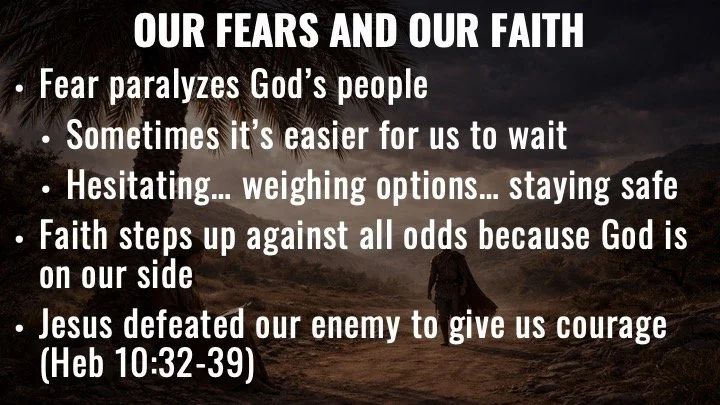
Our Fears and Our Faith
When we read this story and the following song, we get a picture of fear, oppression, and the temptation we may have to do nothing when things are dangerous.
The song in Judges 5 is not just celebrating a victory—it is teaching Israel how to think about fear and faith. If you listen closely, one idea rises above everything else:
Fear paralyzes God’s people, but faith steps forward trusting that God will act.
Fear Paralyzes God’s People
The song tells us that roads were abandoned and people hid in villages. Life got smaller. Movement stopped. Risk disappeared.
The song names tribes that showed up and tribes that stayed home. And the way it describes the ones who stayed home is almost painful: they aren’t portrayed as wicked men celebrating evil. They’re portrayed as men hesitating… weighing options… staying near what feels safe.
That’s what fear does. It turns obedience into a debate. It doesn’t always make us run—it makes us retreat into what feels safe. We stop doing what God has called us to do, not because we hate Him, but because we’re trying to protect ourselves.
Fear keeps us quiet when we should speak. Fear keeps us home when we should step out. Fear keeps us deliberating when God has already spoken.
Israel wasn’t defeated because they lacked numbers. They were defeated because fear trained them to live carefully under oppression.
The danger in this story is not only Sisera’s chariots. The danger is Israel learning how to live under oppression—how to adapt, how to cope, how to survive spiritually with the smallest amount of risk possible.
Everything in the song turns on that contrast.
Faith Steps Forward Without Guarantees
The song praises those who volunteered. Not the strongest. Not the most confident. The ones who showed up. Faith in this story is not bold talk—it’s movement. It’s obedience without control. It’s trusting that God will act when you cannot.
That’s why the victory belongs to God. The storm comes from Him. The flood comes from Him. The deliverance comes from Him. God does not ask His people to be fearless. He asks them to trust Him enough to move.
God’s Power Exposes What We Trust
Sisera’s chariots look unstoppable, until God turns them into dead weight. The song reminds Israel that the greatest threat to faith is trusting in what looks secure.
And we have our own chariots. Threats of discomfort, instability, chaos, shattered reputation, and insecurity drive us away from the fight.
God is kind enough to remind His people, again and again, that none of those things rule the world. He does.
Why This Story Leads Us to Jesus
Judges shows us a pattern: God’s people are fearful, divided, and hesitant—and God still delivers. That pattern points forward to Christ.
Because the greatest oppression was not Canaan. It was sin and death. And God did not defeat that enemy with force, but with faithfulness.
Jesus didn’t arrive with chariots. He arrived in weakness. And just like this story, the victory didn’t look like victory at first.
But God acted.
So the call of this text is not to be brave. It is to trust the God who still fights for His people. Fear asks, “What if I lose?” Faith asks, “What has God promised?”
And the song of Deborah invites us to choose which voice we will live by.