

Why don’t we pray? Why do we so often fail to pray at all?
We believe in prayer. We talk about prayer. We tell others they should pray. Yet when pressure mounts, when disappointment lingers, when life feels heavy or confusing, prayer is often what we neglect rather than the first place we turn. That raises an uncomfortable question: what is going on in our hearts and minds that keeps us from speaking to God?
When Jesus walked the earth, prayer was not an occasional discipline for Him; it was the rhythm of His life. The Gospels repeatedly show Him withdrawing from crowds, stepping away from demands, and separating Himself even from His closest companions so that He could pray. Sometimes He prayed early in the morning. Sometimes He prayed late into the night. Sometimes He prayed all night long. Prayer was not something Jesus fit into His schedule—it was the source of His strength and direction.
Eventually, the disciples noticed. They saw how prayer shaped Him, steadied Him, and sustained Him. And in Luke 11, one of them finally speaks up.
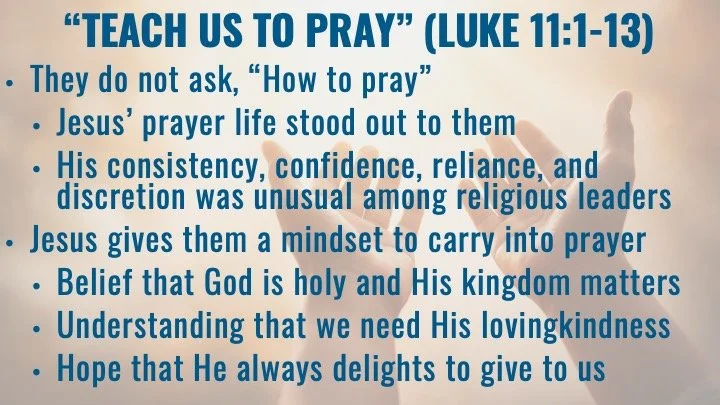
“Teach Us To Pray” (Luke 11:1–13)
“Lord, teach us to pray, as John taught his disciples.”
That request is more revealing than it first appears. They do not ask Jesus to teach them how to pray, as if they simply needed better words or a better structure. They ask Him to teach them to pray. They want what Jesus has. They recognize that prayer is not merely a technique—it is a posture, a relationship, a way of living before God.
Something about Jesus’ prayer life stood out to them. Perhaps it was the consistency of it. Perhaps it was the confidence with which He prayed. Perhaps it was the way prayer seemed to shape every decision He made. Whatever it was, they knew this was not empty religious speech. This was communion with God.
Jesus responds by giving what we often call “The Lord’s Prayer.” But He does not give it as a formula to be recited mindlessly. He gives it as a framework for thinking rightly about God and ourselves. God is holy. God’s kingdom comes first. We are dependent creatures who need daily provision, daily forgiveness, and daily guidance. Prayer begins with humility and trust, not performance.
That mindset would have been foreign to many who heard it, especially in a religious culture where prayer was often public, performative, and aimed at impressing others rather than communing with God.
Jesus then presses the lesson further. He tells a parable about a neighbor who keeps knocking in the middle of the night. He follows that with the picture of a father who gives good gifts to his children. And He draws a clear conclusion: prayer requires persistence because it is rooted in confidence, not desperation. Ask, seek, knock—not because God is reluctant, but because God is good.
This is the mindset Jesus wants His disciples to have toward prayer. God is not annoyed by our requests. He is not distant from our needs. He is a Father who delights to give what is good, ultimately giving His own Spirit to those who ask.
Praying Through Tears (1 Samuel 1:1–2:10)
To see what this kind of prayer looks like in real life, we turn to the story of Hannah.
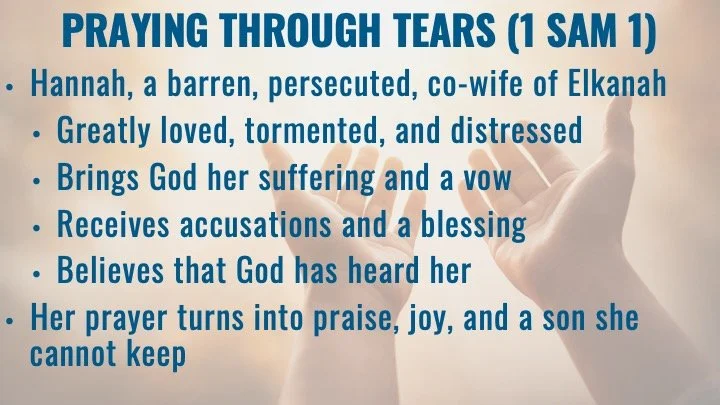
Hannah’s life is marked by quiet suffering. She is one of two wives of Elkanah, and like Sarah, Rebekah, and Rachel before her, she is barren. She is deeply loved by her husband, but her pain is made worse by Peninnah, who mocks her relentlessly. Hannah lives every day with a grief she cannot fix and a humiliation she cannot escape.
Each year, the family travels to Shiloh to worship. What should have been a joyful celebration becomes an annual reminder of Hannah’s sorrow. Surrounded by children she does not have, pitied by a husband who cannot heal her pain, and provoked by a rival who delights in her suffering, Hannah reaches a breaking point.
One year, she cannot eat. She cannot pretend. She excuses herself and goes to the entrance of the tabernacle, and there she does something important.
She brings God into her suffering.
She weeps bitterly. She prays silently. She pours out her soul before the Lord and asks Him to see her, to remember her, and to act. She even makes a vow, promising that if God gives her a son, she will give him back to the Lord for all his days.
Even then, misunderstanding follows. Eli the priest assumes she is drunk. But Hannah does not lash out or withdraw. She humbly explains that she is not intoxicated—she is devastated. She is pouring out her heart to God. Eli blesses her, and something remarkable happens next.
She leaves.
She eats.
She is no longer sad.
Nothing has changed yet, but her faith has. She believes God has heard her.
In time, God answers. Hannah gives birth to a son and names him Samuel—“God has heard.” And when the time comes, she keeps her vow. She gives her son back to the Lord, trusting that the God who gave him is worthy to receive him. Her prayer turns into praise, and her sorrow gives way to joy.
Lessons Learned
Now, let’s connect these two texts together to see what we can learn about prayer. There’s something here to help us pray more.
See the Power of Prayer
Hannah’s story shows us exactly what Jesus was teaching in Luke 11. Hannah did not assume God was distant. She did not believe her pain was too small. She did not conclude that her suffering was insignificant in the grand scheme of things. She believed that the God who rules the world also sees His servants personally.
Too often, we believe God can do anything—but quietly doubt that He will do anything for us. We trust His power in theory, but we question His personal concern in practice. We imagine God focused on the “big picture” while our daily griefs remain unnoticed.
Hannah refused to live independently from God. She brought Him into the place that hurt the most. Her faith is visible at every stage of the story—when she prays, when she waits, when she believes, when she gives, and when she praises. Prayer was not a transaction for Hannah; it was a relationship grounded in trust.
Believe in the “Yes”
God has absolute power. He raises up and brings low. He gives life and takes it away. There is nothing beyond His ability. But with all that power, He is not distant from His people. He sees you. He hears you. He knows your trials and your tears.
Jesus teaches us to pray believing that God wants to answer. That does not mean God always says “Yes.” Scripture is honest about that. Paul hears “No” about his thorn. Moses hears “No” about entering the Promised Land. But Jesus tells us to keep asking until God says no.
So ask. Ask for healing. Ask for relief. Ask for wisdom. Ask for restoration. Ask believing that God is good and that He knows how to give good gifts to His children.
We ask rightly when our prayers are shaped by God’s kingdom and God’s glory. That was Hannah’s heart. She trusted God not only with the gift, but with what she would do if He gave it.
Do Not Leave God Out
Do not leave God on the margins of your life. Do not suffer silently when God invites you to speak. If God loved you enough to send His Son to die for your sins, He cares about your pain now. Prayer is not a burden God tolerates—it is an invitation He extends.
The reason we do not pray is often not because we doubt God’s power, but because we doubt His goodness toward us. Jesus calls us to reject that doubt and to come to God with confidence, persistence, and trust.
So pray more. Pray honestly. Pray persistently. Pray believing that your Father hears you.
And watch what God does when His children finally knock on the door.
Conclusion
So why don’t we pray?
It is rarely because we doubt that God can answer. More often, it is because we quietly doubt that He will—at least for us, at least in this situation, at least this time. Somewhere along the way, we begin to live as though our burdens are either too small to matter or too complicated to bring before Him. And when that happens, prayer slowly fades from a relationship into a last resort.
But Jesus tells us to ask, to seek, and to knock—not as a test of persistence, but as an expression of trust. He wants His people to believe that God is not irritated by their prayers, not distant from their pain, and not indifferent to their needs. He wants us to pray like children who know their Father listens.
Hannah teaches us the same lesson. She did not clean up her grief before praying. She did not wait until she had the right words. She brought her broken heart into the presence of God and trusted Him to hear. And whether God answered immediately or asked her to wait, she refused to leave Him out of her suffering.
That is the invitation before us today.
Do not carry what you were never meant to carry alone. Do not assume silence means indifference. Do not stop asking simply because the answer has not yet come.
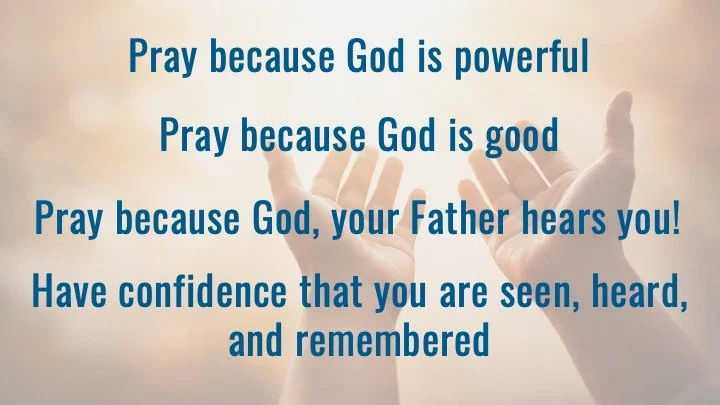
Pray—because God is powerful.
Pray—because God is good.
Pray—because your Father hears you.
And if you will believe that, if you will take Jesus at His word and bring your life to God in prayer, you may find that the greatest change is not in your circumstances, but in your confidence that you are never unseen, unheard, or forgotten by the God who loves you.