
Making Room For Outsiders (Romans 15-16)



I have a friend who moved to a city in California after learning to preach and teach the Bible. He hoped he could reach lost people there—and he was right. Many in that town were open to the gospel. Gang members, addicts, sexually immoral men and women heard the good news and committed their lives to Christ.
But that blessing created pressure.
The number of outsiders grew beyond the number of well-trained church members. They grew too big too quickly. And suddenly the church had to face questions that made them uncomfortable—questions that forced change. Not because the gospel failed… but because it succeeded.
That story isn’t just a modern story. It’s a Bible story.
The Scriptures are full of people who were pushed to the edges. Joseph was rejected by his brothers. Rahab was an outsider who aided Israel. Ruth was a Moabite. Hannah was barren and mocked. David was the overlooked shepherd. God’s people became exiles in Babylon—far from home, far from comfort, and easy to dismiss. Yet God chose to love them deeply.
And when you open the New Testament, Jesus mirrors that same heart. He launches His ministry in Galilee, a region scorned by elites. He calls fishermen and tax collectors. He eats with sinners and outcasts. Jesus doesn’t avoid outsiders—He moves toward them.
So here’s the challenge I want to lay on us today: embrace that mindset intentionally. Who are the outcasts around you—maybe the lonely neighbor, the struggling coworker, or the immigrant family? What would it look like for you to show them the care of God?
That’s exactly where Romans takes us.
We’re studying the closing chapters of Romans, and Paul is showing us God’s unchanging desire: to include the excluded through the gospel. From the beginning of the letter—where Paul announces the power of the gospel—to the end—where he calls for harmony—Paul’s whole vision is a church that is strong enough and united enough to welcome outsiders.
Because let’s be honest: when visitors walk into a church where people are fussing and fighting, they feel it. They don’t feel drawn in. They feel like they walked into a family argument. But harmony creates an environment where outsiders can breathe, listen, and stay.
So today we’re going to look at three key ideas from Romans 15–16:
- God’s Plan
- Paul’s Role
- Our Role
God’s Plan (15:8–13)
Romans 15:8–13 (ESV) — 8 For I tell you that Christ became a servant to the circumcised to show God’s truthfulness, in order to confirm the promises given to the patriarchs, 9 and in order that the Gentiles might glorify God for his mercy. As it is written, “Therefore I will praise you among the Gentiles, and sing to your name.” 10 And again it is said, “Rejoice, O Gentiles, with his people.” 11 And again, “Praise the Lord, all you Gentiles, and let all the peoples extol him.” 12 And again Isaiah says, “The root of Jesse will come, even he who arises to rule the Gentiles; in him will the Gentiles hope.” 13 May the God of hope fill you with all joy and peace in believing, so that by the power of the Holy Spirit you may abound in hope.
Jesus came first to Israel—not to reject them, but to fulfill every promise God had ever made. Their rejection of Him was not a failure of God’s plan. It was a refusal to believe what God had plainly revealed. And even in that rejection, God’s mercy overflowed beyond Israel.
Paul proves that this was always the plan by quoting Scripture—Psalms, Deuteronomy, Isaiah. These are not obscure lines. God repeatedly said the nations would rejoice, praise, hope, and be welcomed. This wasn’t Plan B. God has always intended to gather people from every background into one family.
The real issue was expectation. Many were looking for a Messiah who would restore political power and reinforce cultural superiority. But God was doing something bigger. In Christ, outsiders weren’t just tolerated—they were given hope.
That’s why Paul ends this section with a prayer:
“May the God of hope fill you with all joy and peace in believing…” (Romans 15:13)
Hope belongs to people who once had none. Outsiders are not second-class citizens in God’s kingdom. They are forgiven, transformed, and united in Christ. Superiority has no place here. In Christ, there is one people, one family, one hope.
Paul’s Role (15:14–29)
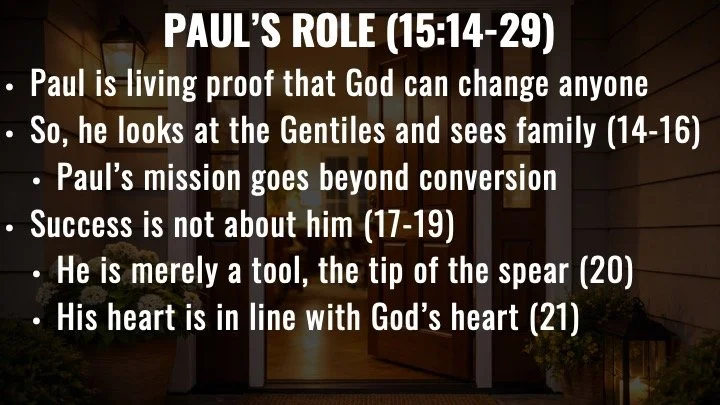
Paul is living proof that God can change anyone.
He was once a “Hebrew of Hebrews,” fiercely loyal to tradition and deeply hostile toward Gentiles. But Jesus met him on the Damascus road and redirected his life toward the very people he once despised.
So when Paul looks at the Roman Christians—mostly Gentiles—he doesn’t see a problem. He sees a family.
Romans 15:14–16 (ESV) — 14 I myself am satisfied about you, my brothers, that you yourselves are full of goodness, filled with all knowledge and able to instruct one another. 15 But on some points I have written to you very boldly by way of reminder, because of the grace given me by God 16 to be a minister of Christ Jesus to the Gentiles in the priestly service of the gospel of God, so that the offering of the Gentiles may be acceptable, sanctified by the Holy Spirit.
Paul’s mission is not just conversion; it is transformation. He wants outsiders to grow into mature, Christlike believers. It is not enough for people to say they follow Jesus. They must be shaped by Him.
And Paul is careful to take no credit for this work. He credits Christ for his success:
Romans 15:17–19 (ESV) — 17 In Christ Jesus, then, I have reason to be proud of my work for God. 18 For I will not venture to speak of anything except what Christ has accomplished through me to bring the Gentiles to obedience—by word and deed, 19 by the power of signs and wonders, by the power of the Spirit of God—so that from Jerusalem and all the way around to Illyricum I have fulfilled the ministry of the gospel of Christ;
That humility is striking. Paul works hard, travels endlessly, suffers deeply—and yet he sees himself as a tool in God’s hands. Not a hero. Not a celebrity. A servant.
And that’s where this hits us, isn’t it? How often do we do good things and then quietly admire ourselves for them? How often are we more concerned with how we look than whether Christ is seen? We aren’t here to be admired. We are here to serve and be used for God’s glory. I am a tool for God to use—and I’m happy to be one.
That posture is what fuels Paul’s ambition:
Romans 15:20–21 (ESV) — 20 and thus I make it my ambition to preach the gospel, not where Christ has already been named, lest I build on someone else’s foundation, 21 but as it is written, “Those who have never been told of him will see, and those who have never heard will understand.”
Paul pioneers like the tip of a spear, bringing the gospel to places where people have never heard. His ambition matches God’s heart: bring outsiders in.
Listen to those words again: “Those who have never been told… those who have never heard…” Paul understands that reaching outsiders is not a side project in God’s plan. It is central to who God is and what God does. And because it is central to God, Paul makes it central to himself.
Our Role (15:30–16:27)
Most of us are not Paul. We will not travel across empires or write Scripture. But Paul makes it clear that the mission depends on ordinary believers.
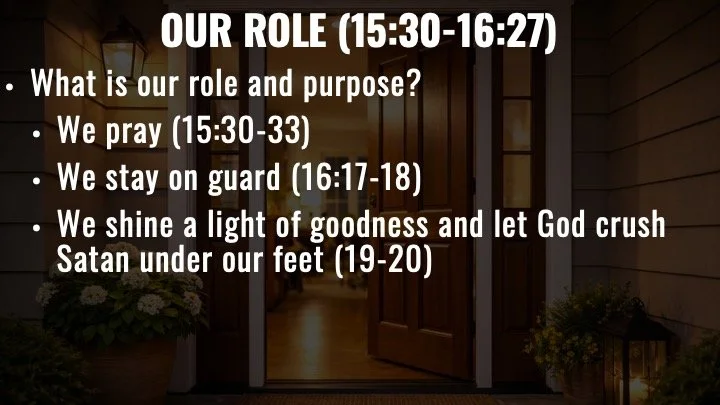
First, we pray.
Romans 15:30–33 (ESV) — 30 I appeal to you, brothers, by our Lord Jesus Christ and by the love of the Spirit, to strive together with me in your prayers to God on my behalf, 31 that I may be delivered from the unbelievers in Judea, and that my service for Jerusalem may be acceptable to the saints, 32 so that by God’s will I may come to you with joy and be refreshed in your company. 33 May the God of peace be with you all. Amen.
Paul begs the Romans to strive with him in prayer. He believes their prayers matter. They strengthen workers. They shape outcomes. Prayer is not passive support—it is participation. If we care about outsiders coming to Christ, we have to pray like it matters.
Second, we watch out.
Romans 16:17–20 (ESV) — 17 I appeal to you, brothers, to watch out for those who cause divisions and create obstacles contrary to the doctrine that you have been taught; avoid them. 18 For such persons do not serve our Lord Christ, but their own appetites, and by smooth talk and flattery they deceive the hearts of the naive. 19 For your obedience is known to all, so that I rejoice over you, but I want you to be wise as to what is good and innocent as to what is evil. 20 The God of peace will soon crush Satan under your feet. The grace of our Lord Jesus Christ be with you.
Paul warns that division creates obstacles. And obstacles don’t just harm insiders—they keep outsiders out. When churches obsess over preferences, minor grievances, and unclear disputes, outsiders feel it immediately. Fussing and fighting does not create a welcoming environment. Unity does.
Guard against dividers who prioritize petty differences—legalistic rules, cultural barriers, ego, control—over the mission. Satan loves a distracted church. But Paul says God will deal with the enemy. Our job is obedience, wisdom, and focus.
Conclusion (16:25–27)
Romans 16:25–27 (ESV) — 25 Now to him who is able to strengthen you according to my gospel and the preaching of Jesus Christ, according to the revelation of the mystery that was kept secret for long ages 26 but has now been disclosed and through the prophetic writings has been made known to all nations, according to the command of the eternal God, to bring about the obedience of faith— 27 to the only wise God be glory forevermore through Jesus Christ! Amen.
Paul ends where he began: with the gospel.
God strengthens His people through the message of Jesus Christ. That gospel is the foundation for every hard thing we’re called to do. It sustained Paul. It will sustain us. If we lose sight of it, we will turn inward. But if we stay rooted in it, we will always look outward.
So let me ask you again: who are the outsiders around you? The lonely neighbor. The struggling coworker. The family that feels out of place.
Take them seriously. Sit with them. Listen to them. Pray for them. Make God’s kingdom your ambition.
We are not here to be admired. We are here to be used. The church exists for the people who aren’t here yet. And there is no greater privilege than being a tool in the hands of a God who loves outsiders enough to bring them home.