
The Battle Belongs To The Lord (Joshua)

Standing at the Edge of Promise
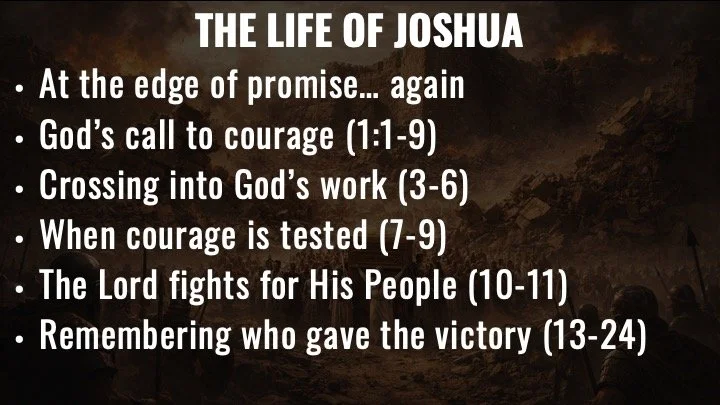
The people of Israel are finally standing on the edge of the promised land. For forty years they have wandered—living in tents, burying loved ones, and learning the hard way what unbelief costs. This generation knows what went wrong. They know what God desires from them now. But one question still hangs heavy in the air: who will lead them?
Moses is gone. But before he died, Moses laid his hands on Joshua, and Scripture tells us that Joshua became full of the spirit of wisdom. Joshua is not new to leadership. He has been near Moses since the early days. He fought battles in the wilderness. He watched what leadership costs when pressure mounts—because even Moses cracked under the weight of it. Taking Moses’ place is not just stepping into a role; it is stepping into a burden.
God’s Call to Courage (1:1-9)
That is why the opening of the book of Joshua is so kind. God does not hand Joshua a strategy or a pep talk. God gives Joshua Himself. The Lord makes Joshua the same core promises He once made to Moses. He promises the land. He promises His presence. And He anchors everything in obedience to His word.
Then three times God says it: “Be strong and courageous.” That repetition tells us something important. Joshua needs courage—not because God is uncertain, but because the calling is heavy. Courage in Joshua is not self-confidence. It is an obedient faith rooted in the presence of God and the word of God. Joshua is told that if he meditates on the Law day and night, if he does what God has said, then he will succeed. Strength and courage are not emotional traits here; they are covenant faithfulness under pressure.
Crossing into God’s Work (3-6)
The conquest begins in a way that makes the point immediately clear. God is not asking Joshua to invent power; He is asking him to trust God’s presence. The priests carry the ark into the Jordan River, and the moment their feet touch the water, the river stops. Israel crosses on dry ground again. God tells them this is not merely a crossing; it is a confirmation. The people are meant to know that God is with Joshua just as He was with Moses.
From there they move to Jericho, a fortress city. Israel is not told to build siege weapons or develop tactics. They are told to march. Quietly. Day after day. On the seventh day they circle the city seven times, blow the trumpets, and shout—and God brings the walls down. The victory is unmistakable. It is not Israel’s brilliance. It is God’s power.
When Courage Is Tested (7-9)
But immediately after this triumph, Israel learns a hard lesson. God’s power cannot be celebrated while sin is hidden in the camp. A man named Achan takes what was devoted to the Lord, and the next battle—against the small city of Ai—ends in humiliating defeat. One hidden sin drains the courage of thousands.
Israel learns what all of God’s people must learn: without God’s help, they stand no chance, and with God’s help, they cannot continue in rebellion. Judgment follows, the camp is cleansed, and Joshua gathers the people to read the Law aloud—men, women, children, and even the foreigner among them—so that the nation is rebuilt around obedience to God’s word.
Then comes another test, one that feels painfully familiar. The Gibeonites arrive with a convincing story. They look worn. They claim to be from far away. They ask for a treaty. It seems reasonable. It seems merciful. Joshua agrees.
And Scripture tells us the problem in one simple line: they did not ask counsel from the Lord.
The Gibeonites were neighbors, not travelers. They lied, and Joshua was deceived. Here Israel learns that not every failure comes through open rebellion. Some come through prayerless decisions that seem sensible at the time. Joshua refuses to break the covenant, and the Gibeonites become servants under Israel’s protection.
The Lord Fights for His People (10-11)
Soon after, five kings rise up against Gibeon, and Israel goes to defend them. God makes His power unmistakably clear once again. Scripture says the Lord kills more enemies with hailstones than Israel kills with the sword. God even extends the day so the victory is complete.
Later, kings from the north unite, believing numbers will succeed where obedience failed. God hardens them in their rebellion, and after years of conflict, Scripture says the land finally has rest from war. The message is consistent throughout: the Lord fights for His people exactly as He promised.
Remembering Who Gave the Victory (13-21; 23:1-11)
Some cities remain unconquered, but the people now possess land, rest, and inheritance—everything God promised Abraham long ago. Joshua knows what comes next if they are not careful. When the fighting stops, forgetting begins.
So Joshua gathers the people and reminds them of the truth they must never lose. It was the Lord who drove out great and strong nations. It was the Lord who fought for them. Therefore, Joshua says, “Be very careful to love the Lord your God.” He does not merely call them to rule-keeping. He calls them to love—and to be careful to love—because love does not die in a moment. It leaks. It cools. It is crowded out by comfort.
A Final Warning and a Clear Choice (23:12-16, 24:1-28)
Then Joshua speaks some of the most sobering words in the Old Testament. Every good promise God made has been fulfilled. Not one has failed. And the same faithful God who kept His promises will also bring covenant judgment if Israel serves other gods. Joshua sees the future clearly because he understands the human heart. The exile is centuries away, but the drift begins immediately.
So he presses them to a decision. Remove the idols. Stop pretending you can serve the Lord while clinging to powerless gods. Choose. “As for me and my house, we will serve the Lord.”
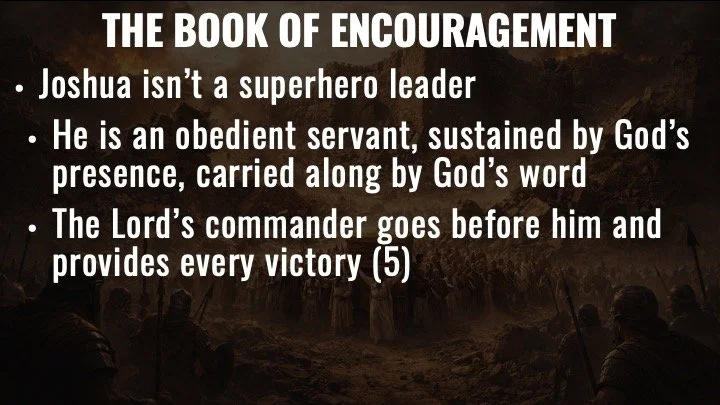
The Commander Who Goes Before Us (5:13-15)
The book of Joshua is meant to encourage God’s people—but not with shallow optimism. Joshua is not a superhero. He is a servant shaped by obedience, sustained by God’s presence, and carried by God’s faithfulness.
And if there is one scene that interprets the entire book, it happens before Jericho ever falls. Joshua is near the city when he sees a man standing with a drawn sword. Joshua asks the question we all ask: “Are you for us, or for our adversaries?”
The answer comes back: “No.” Not because the man standing with the sword is neutral, but because Joshua is asking the wrong question. “I am the commander of the army of the Lord. Now I have come.” Joshua falls on his face and worships, and the commander tells him to remove his sandals because the ground is holy.
That moment tells us everything. God does not join our side. We are called to submit to His. God is not a mascot or a power source for our plans. He is the King we bow before.
Be Strong and Courageous
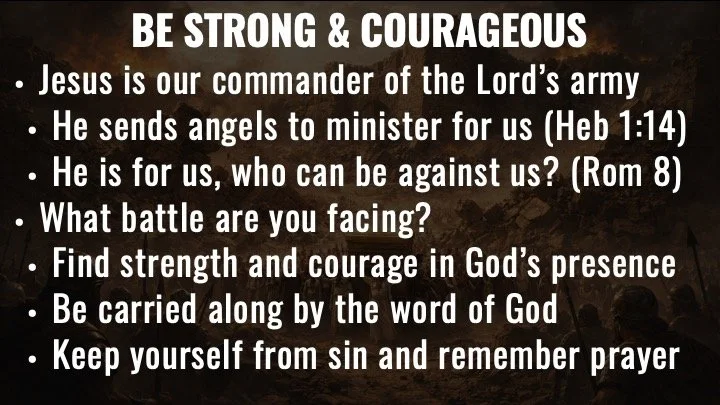
When we read that scene as Christians, we cannot miss the shape of Christ. Jesus is the true commander who goes before His people. He is the one we worship. He is the one who leads the real conquest—not of cities and nations, but of sin, death, and darkness. His army is not just made up of men, but also angels.
Hebrews 1:14 (ESV) — 14 Are they not all ministering spirits sent out to serve for the sake of those who are to inherit salvation?
So what battle are you facing? Maybe it is sin that has entrenched itself like a fortress. Maybe it is fear that keeps you silent about Christ. Maybe it is the slow drift where your love for God is cooling and you can feel it.
Joshua tells us what we need—not swagger, not confidence in ourselves, but strength and courage rooted in God’s presence and God’s word. Jesus tells us what God has promised His people: a kingdom, comfort, mercy, inheritance, and an identity that holds when the world pushes back. We are called to be salt when it would be easier to blend in and light when it would be easier to hide.
Because the same God who kept every promise to Joshua has not changed, and the same Lord who calls us to obey is the One who goes before us. So the decision lands exactly where Joshua landed it—not tomorrow, not when it is convenient.