
Embracing The Differences (Romans 14:1-15:7)


What breaks harmony in a local church?
Wouldn’t it be something if we could identify the root cause of division and stop it before it spreads? If churches could stop tearing themselves apart, they could actually begin to look like the body of Christ Paul describes.
Is the problem that we are too different? Too sinful? Too foolish?
Paul’s answer, if we’re honest, is yes to all three. We are different. We have been sinful and foolish. And yet, Paul still believes that harmony is not only possible—but expected—among the people of God.
So, in today’s text, Paul wants to get specific in order to address this obstacle head on. As Christians living in the twenty-first century, we must consider this text as a first century example of what harmony looks like in real life, and learn from it.
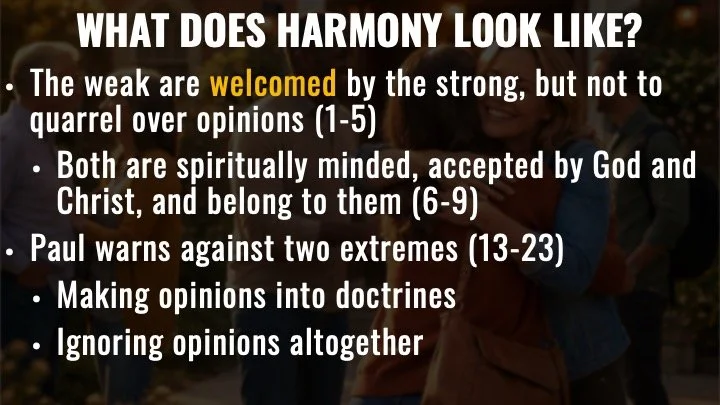
What Does Harmony Look Like In Real Life?
In Romans 14, Paul mentions one who is weak in faith and one who is strong in faith.
Romans 14:1–9 (ESV) — 1 As for the one who is weak in faith, welcome him, but not to quarrel over opinions. 2 One person believes he may eat anything, while the weak person eats only vegetables. 3 Let not the one who eats despise the one who abstains, and let not the one who abstains pass judgment on the one who eats, for God has welcomed him. 4 Who are you to pass judgment on the servant of another? It is before his own master that he stands or falls. And he will be upheld, for the Lord is able to make him stand. 5 One person esteems one day as better than another, while another esteems all days alike. Each one should be fully convinced in his own mind. 6 The one who observes the day, observes it in honor of the Lord. The one who eats, eats in honor of the Lord, since he gives thanks to God, while the one who abstains, abstains in honor of the Lord and gives thanks to God. 7 For none of us lives to himself, and none of us dies to himself. 8 For if we live, we live to the Lord, and if we die, we die to the Lord. So then, whether we live or whether we die, we are the Lord’s. 9 For to this end Christ died and lived again, that he might be Lord both of the dead and of the living.
When we hear the words weak in faith and strong in faith, they may not compute. To put it simply, the person who is weak in faith believes that God wants us to abstain from unclean food or work on the Sabbath day. The weak are not emotionally fragile. They sincerely believe God requires this because it has been ingrained in them since childhood. They seek to honor God in their obedience, and their conscience would be compromised if they did anything else.
The person who has a “weak faith” believes that God would be displeased with them if they ate meat that could be unclean or dedicated to idols. They are afraid that the food they eat might defile them and make them sinful before God. Their minds are focused on obedience in what is perhaps an unhealthy way and their consciences are sensitive to these actions.
The strong in faith honors God by thanking Him for every food or drink and by living for Him every day of the week. These beliefs have developed over time and led them to understand what God really wants. He calls them strong because they have faith that it’s okay to stop keeping the Old Testament laws. Isn’t that fascinating?
The person who has a “strong faith” knows that what we eat has no impact on our relationship with God. What matters is the intentions of the heart. They are called strong in faith because they trust God to save them even though they eat foods others view as sinful.
Both are spiritually minded. The weakness is not devotion—it is misunderstanding. And the strength is not arrogance—it is trust in the sufficiency of Christ.
Harmony Means We Welcome Others
Paul doesn’t tell us to create different denominations or sects based on every opinion that men might create and which side we fall on. Paul says that the strong brother should welcome the weak, and not to quarrel with them. They are both brothers and they don’t have to have the same opinion about everything. It’s clear that there is nothing wrong in eating the food or ignoring the day because he calls the strong brother a brother. In the same way, there is nothing wrong with holding on to that conviction that unclean foods should be avoided and the Sabbath must be honored. Both are in a saved position because God has chosen to accept them both. Christ has died for each of them.
In order for us to apply this to ourselves,we must consider what is an opinion and what is a core doctrine. Some teachings are core doctrine, that means that they cannot be subject to one’s own opinion. Others are dependent or subject to one’s beliefs or opinions. Don’t read this section and believe that all truths are matters of opinion. Paul is warning us against two errors that are extremes: 1. making opinions into doctrines and 2. ignoring opinions altogether. (There is a third error discussed elsewhere by Paul and the other apostles: making doctrines into opinions) But here he says that those with different opinions should be welcomed and not harshly treated.
Harmony Means We Maintain A Clear Conscience
Paul continues in these examples by telling us not to be judging or despising our brethren.
Romans 14:13–23 (ESV) — 13 Therefore let us not pass judgment on one another any longer, but rather decide never to put a stumbling block or hindrance in the way of a brother. 14 I know and am persuaded in the Lord Jesus that nothing is unclean in itself, but it is unclean for anyone who thinks it unclean. 15 For if your brother is grieved by what you eat, you are no longer walking in love. By what you eat, do not destroy the one for whom Christ died. 16 So do not let what you regard as good be spoken of as evil. 17 For the kingdom of God is not a matter of eating and drinking but of righteousness and peace and joy in the Holy Spirit. 18 Whoever thus serves Christ is acceptable to God and approved by men. 19 So then let us pursue what makes for peace and for mutual upbuilding. 20 Do not, for the sake of food, destroy the work of God. Everything is indeed clean, but it is wrong for anyone to make another stumble by what he eats. 21 It is good not to eat meat or drink wine or do anything that causes your brother to stumble. 22 The faith that you have, keep between yourself and God. Blessed is the one who has no reason to pass judgment on himself for what he approves. 23 But whoever has doubts is condemned if he eats, because the eating is not from faith. For whatever does not proceed from faith is sin.
In this section, Paul tells us to be careful when dealing with someone who has a different opinion. If we are right about the issue, we can still be wrong in how we handle it. He wants us to see that our goal is not uniformity. We aren’t trying to make everyone have all the same opinions about everything. If we try to do that, we will be creating obedience by coercion and compromising their consciences. This is not loving, but selfish. Paul even says that the one who forces a brother to do something they believe to be wrong is destroying the one for whom Christ died. This is a serious evil.
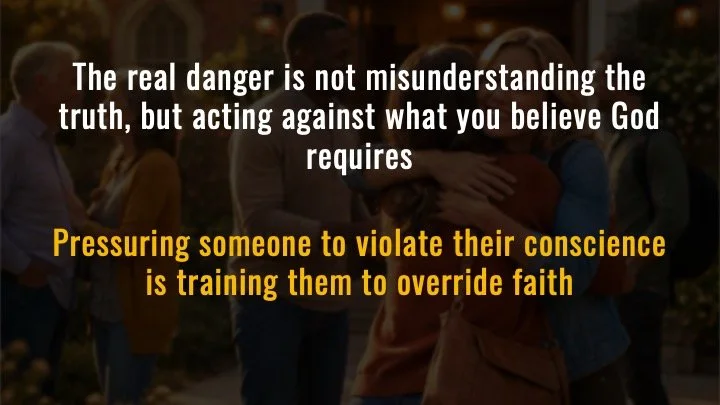
He tells us that we are valuing food and drink more than the work of God and the kingdom. These things aren’t as important to God as we make them out to be. Our opinions aren’t either. The person who interprets a text differently about how to please God is not an enemy of God. They are striving to please Him. The real danger is not misunderstanding—it is acting against what you believe God requires. When a person does what they believe is sinful, they are no longer acting in faith. They are choosing self over submission.
That is why Paul says the one who doubts and eats is condemned. Not because the food is sinful, but because the heart is rebelling against God as it understands Him.
So, the person who eats the food offered to idols or neglects the Sabbath while believing they should observe it is doing something that will sear their conscience and lead to them falling away from the Lord if they continue in it.
It is so important for us to do whatever we do with a firm conviction and confidence that God desires us to do it. But it is also important for us to recognize that people around us are trying to do the same thing. How can we possibly account for that?
The truth is that it’s impossible to avoid offending everyone. Some people have very sensitive consciences and very strong opinions. Our goal is to see where we have done something others believe is sinful and carefully back away from the issue like it’s a grenade. Paul even says that the one who forces a brother to do something they believe to be wrong is destroying the one for whom Christ died. That is not emotional harm—that is spiritual danger.
Pressuring someone to violate conscience trains them to override faith with self-authorization. If continued, that path hardens the heart and leads away from the Lord. Paul does not exaggerate this danger. He confronts it.
Each of us must study for ourselves to turn the weak faith into a strong one. People cannot force us to do this, but we can do this through study and effort. Peter and Paul had to do this and so can we.
Harmony Means We Follow Christ
The goal of every Christian is to keep Christ in view. Consider how he lived on earth with a perfect understanding of what God really wanted and what God didn’t care about. How many times did He challenge men and how many times did He let it go to prevent people from stumbling?
Romans 15:1–7 (ESV) — 1 We who are strong have an obligation to bear with the failings of the weak, and not to please ourselves. 2 Let each of us please his neighbor for his good, to build him up. 3 For Christ did not please himself, but as it is written, “The reproaches of those who reproached you fell on me.” 4 For whatever was written in former days was written for our instruction, that through endurance and through the encouragement of the Scriptures we might have hope. 5 May the God of endurance and encouragement grant you to live in such harmony with one another, in accord with Christ Jesus, 6 that together you may with one voice glorify the God and Father of our Lord Jesus Christ. 7 Therefore welcome one another as Christ has welcomed you, for the glory of God.
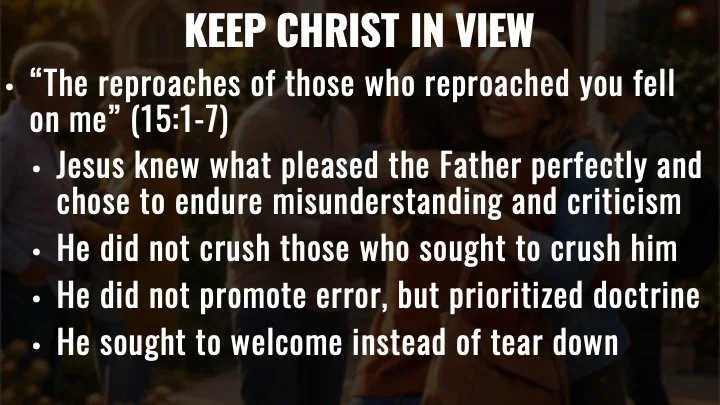
Jesus accepted the criticism that men had against God. Jesus knew perfectly what pleased the Father and what did not. And yet, He often endured misunderstanding, criticism, and false accusations rather than crushing people who were wrong.
He did not please Himself. He absorbed reproach so that others might be built up.
That does not mean Jesus affirmed error. It means He prioritized redemption over self-vindication.
So, if you are one with a strong faith, Paul is calling for you to bear with those who are judging you without despising them.
This is very difficult. Someone who believes that everyone must agree with them on the head covering or dress a certain way to please God might condemn you. I’ve known people who believe that a pitch pipe is a musical instrument and therefore “unscriptural.” There is no end to the opinions we can come up with.
Paul is encouraging us to bear patiently with them and live in harmony with them as much as possible. Our goal is not to tear them down, but to build them up and glorify God alongside them in one voice. If you have a strong opinion about something, believe that God can make everyone who disagrees with you stand. Have faith in that grace and mercy which forgave a sinner like you.
Will You Harmonize or Destroy?
The last words in this section go back to the idea of welcoming one another, but they give us an image. Paul says, “As Christ has welcomed you, for the glory of God.” Jesus doesn’t welcome us with extreme prejudice. He doesn’t take us through a checklist and make sure we believe all the right things before we can be a part of his people. He knows that we will need time to mature and develop an understanding of what is true. We will get there, but we aren’t going to be there when he accepts us and saves us.
Are you someone who has strong convictions about something you have studied about? Do you feel like you know what God wants us all to do? That’s great, but what will you do with that information? That is the more important question.
1 Corinthians 13:2 (ESV) — 2 And if I have prophetic powers, and understand all mysteries and all knowledge, and if I have all faith, so as to remove mountains, but have not love, I am nothing.
I’ve spoken to militant people who have no concept of this. They are blind and callous. They don’t care about anyone else or what anyone else has studied. They simply want to exalt their understanding, crushing people in the process. Paul is telling us that it’s possible to be right about truth and wrong about how we treat people who oppose it. He is also telling us that it’s possible to be wrong about some things and still be accepted by Christ.
So, the real question is, “How are you going to treat people who oppose you?” Are they all false teachers? Apparently not. Some are false teachers. They promote a form of Christianity that is fundamentally opposed to (anti) Christ. Others are just immature. God calls us to love them and bear their criticisms and judgments. He calls for us to join them in praising God.
Conclusion
Imagine how difficult it must have been for Jews and Gentiles to worship together in the first century. Their instincts, backgrounds, and convictions could not have been more different. And yet God demanded that they become one body, praising Him with one voice.
The question for us is simple and uncomfortable:
Will we welcome the people Christ welcomes?
Will we build up those who are still growing?
Or will we tear down the work of God over matters that do not define the kingdom?
This congregation will not remain uniform. New people will come. Some will not know what is “proper.” Some will misunderstand Scripture. Some will have sensitive consciences.
The question is not whether that will happen.
The question is whether we will harmonize—or destroy.
Christ welcomed us while we were still growing. He bore our weakness. He did not wait for perfect understanding before calling us His own.
Let us welcome one another as Christ has welcomed us—for the glory of God.