
A Hardened Heart (Exodus 4-14)
Have you ever had things going really well in your life and been scared to lose it?
Imagine being the sole ruler of the greatest civilization on earth. The Nile river provides abundant resources, the wealth of the nations have poured into your economy as a result of a famine, and you have at your disposal the largest slave labor force in history (Over 600k able bodied men). Life is good if you are Pharaoh, but this prosperity is fragile. You have to keep the slaves in their place so that they don’t rise up against you.
In Exodus, we read that there was a Pharaoh in power who tried to suppress the Hebrew people by killing off their male children. Then, we read about slavery and oppression that was constantly going on. It seems as though the Egyptians have been playing psychological games with the Hebrews to completely break their spirits so they wouldn’t want to change the way things have become. When we studied through the life of Moses, we could see that Israel was convinced that they had it good in Egypt. Nevermind the whips, the working from dawn to dusk, and the lack of financial prosperity. Hebrews were not treated fairly in any way.
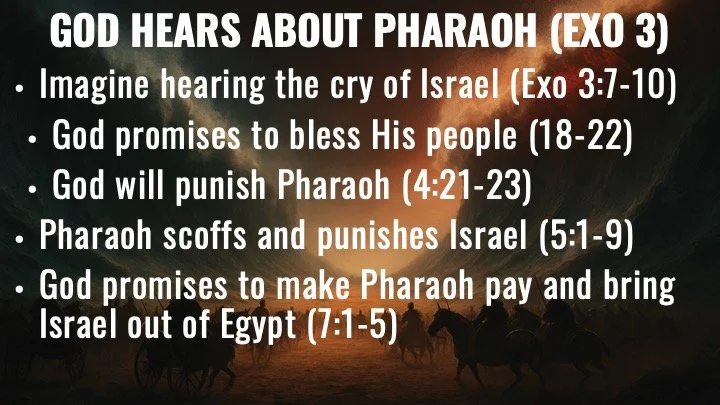
God Hears About Pharaoh (Exo 3:7-22)
In the wilderness, Moses is told to go to Pharaoh and command him to let God’s people go.
Exodus 3:7–10 (ESV) — 7 Then the Lord said, “I have surely seen the affliction of my people who are in Egypt and have heard their cry because of their taskmasters. I know their sufferings, 8 and I have come down to deliver them out of the hand of the Egyptians and to bring them up out of that land to a good and broad land, a land flowing with milk and honey, to the place of the Canaanites, the Hittites, the Amorites, the Perizzites, the Hivites, and the Jebusites. 9 And now, behold, the cry of the people of Israel has come to me, and I have also seen the oppression with which the Egyptians oppress them. 10 Come, I will send you to Pharaoh that you may bring my people, the children of Israel, out of Egypt.”
Imagine God hearing the cry of every Israelite. They were so tired and wishing for relief and wishing for God to deliver the promises he made to Abraham. They want to be free, but they don’t know how to become free.
The response of God was to send Moses to Egypt, knowing how stubborn Pharaoh can be.
Exodus 3:18–22 (ESV) — 18 And they will listen to your voice, and you and the elders of Israel shall go to the king of Egypt and say to him, ‘The Lord, the God of the Hebrews, has met with us; and now, please let us go a three days’ journey into the wilderness, that we may sacrifice to the Lord our God.’ 19 But I know that the king of Egypt will not let you go unless compelled by a mighty hand. 20 So I will stretch out my hand and strike Egypt with all the wonders that I will do in it; after that he will let you go. 21 And I will give this people favor in the sight of the Egyptians; and when you go, you shall not go empty, 22 but each woman shall ask of her neighbor, and any woman who lives in her house, for silver and gold jewelry, and for clothing. You shall put them on your sons and on your daughters. So you shall plunder the Egyptians.”
God points out that He knows the king of Egypt. He is not going to be easily persuaded to let go of his free labor force. Losing the Hebrews will bring major discomfort on the Egyptians.
Has anyone ever come to you and told you about a sin you were committing? Did you enjoy that? How many thoughts went through your head at that moment? Did you feel everything inside of you resisting? Did you run through all the scenarios and catastrophize about what changing might mean? Perhaps the sin you are committing is how you have always lived and all you’ve ever known. Or maybe you have put everything into this sin and you fear what will happen to your life if you give it up. In business they call that a sunk cost, meaning you would rather go down with the ship than sell a bad purchase. Now, you are being called upon to give that up.
After Moses agrees to go to Egypt and do what God asks him, God gives Moses a little bit of information about His plans.
Exodus 4:21–23 (ESV) — 21 And the Lord said to Moses, “When you go back to Egypt, see that you do before Pharaoh all the miracles that I have put in your power. But I will harden his heart, so that he will not let the people go. 22 Then you shall say to Pharaoh, ‘Thus says the Lord, Israel is my firstborn son, 23 and I say to you, “Let my son go that he may serve me.” If you refuse to let him go, behold, I will kill your firstborn son.’ ”
This is a brief summary of all the events that follow in Chapters 5-14.
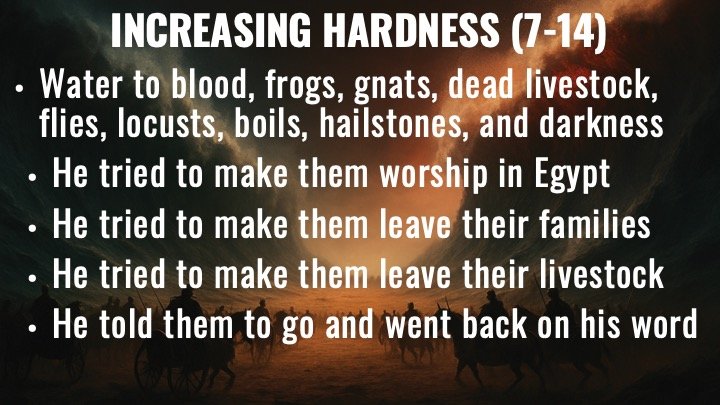
Increasing The Hardness? (Exo 7-14)
Moses will go to Egypt and speak to Pharaoh, but Pharaoh will refuse to listen to Moses and refuse to obey God. Instead of listening, he will increase the workload of the people and make life even harder. He hopes to pressure all of the people into being afraid to speak out. It seems to work. All of Israel is mad at Moses and Aaron for getting them into trouble.
But God doesn’t stop. He’s not going to let Pharaoh win. He sends Moses and Aaron back to Pharaoh, but he once again tells them of His plan to harden Pharaoh’s heart.
Exodus 7:1–5 (ESV) — 1 And the Lord said to Moses, “See, I have made you like God to Pharaoh, and your brother Aaron shall be your prophet. 2 You shall speak all that I command you, and your brother Aaron shall tell Pharaoh to let the people of Israel go out of his land. 3 But I will harden Pharaoh’s heart, and though I multiply my signs and wonders in the land of Egypt, 4 Pharaoh will not listen to you. Then I will lay my hand on Egypt and bring my hosts, my people the children of Israel, out of the land of Egypt by great acts of judgment. 5 The Egyptians shall know that I am the Lord, when I stretch out my hand against Egypt and bring out the people of Israel from among them.”
Then, God has Moses demonstrate miraculous signs, but Pharaoh won’t believe. After that, he begins to bring plague after plague upon Egypt and Pharaoh. The king’s response is nothing short of insanity. Listen to what one commentator said.
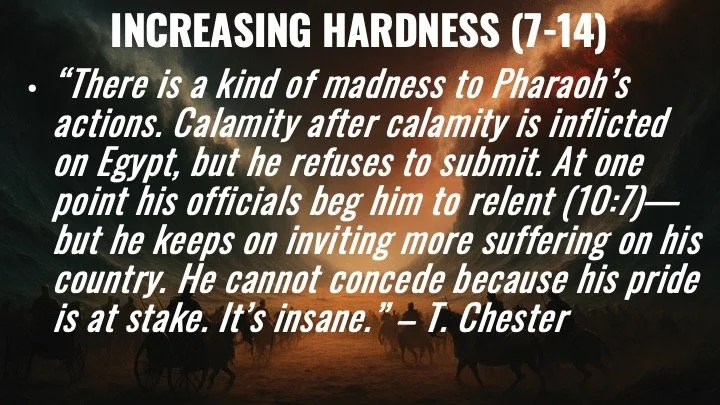
There is a kind of madness to Pharaoh’s actions. Calamity after calamity is inflicted on Egypt, but he refuses to submit. At one point his officials beg him to relent (10:7)—but he keeps on inviting more suffering on his country. He cannot concede because his pride is at stake. It’s insane.
Chester, T. (2016). Exodus for You (p. 69; C. Laferton, Ed.). The Good Book Company.
Any reasonable person would have tapped out when the whole place is covered in frogs or when hailstones are falling out of the sky, killing people and animals everywhere. The number of tragic events that happen after Moses calls for them should have been a clue that God was really behind this. But Pharaoh isn’t acting purely based on reason. He has been pushed to the point of insanity by God hardening Pharaoh’s heart. He says he will let Israel leave, then he doesn’t. He tells them to leave their wives and children behind, all their cattle behind, and to worship in the land, but they refuse and he refuses to let them go.
In the end, Pharaoh lets Israel go because God kills his first born son along with all of the first born of the land of Egypt. But even after letting the people go, he cannot stand his decision. He changes his mind and sends out an army of 600 chariots to round them up and bring them back. This is when God tells Moses the following.
Exodus 14:16–18 (ESV) — 16 Lift up your staff, and stretch out your hand over the sea and divide it, that the people of Israel may go through the sea on dry ground. 17 And I will harden the hearts of the Egyptians so that they shall go in after them, and I will get glory over Pharaoh and all his host, his chariots, and his horsemen. 18 And the Egyptians shall know that I am the Lord, when I have gotten glory over Pharaoh, his chariots, and his horsemen.”
The result of the hard hearted Egyptians was catastrophe for them, but also glory for God over them.
Hardening A Wicked Heart
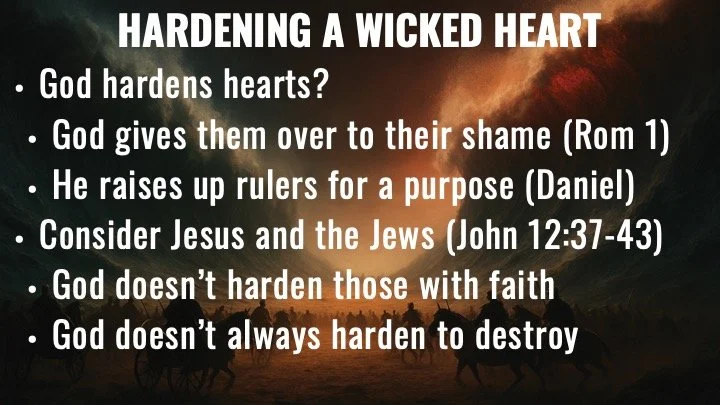
Now, there are many people out there who read that God hardened Pharaoh’s heart and they get the wrong ideas in their heads. Some look at this and think that God hardening a man’s heart is in some way forcing them to do evil and compromising their free will. But, if you pay attention to the story of Pharaoh, it’s easy to see that Pharaoh is already evil. All God does is remove any restraint. When it comes to rulers being established in kingdoms, God sets up certain people for certain purposes. Some are set up to take people captive like Nebuchadnezzar, others are to set people free like Cyrus. God has a purpose in everything he does, and He controls the kingdoms of men.
But notice that this is not an instance where God took a good man and made him evil. This was already an evil and oppressive ruler who was selfishly ambitious. God has the power, authority, and right to give someone like that over to his passions and evil desires (Romans 1). He does it with a plan to have glory among the nations. Glory in His power to save and in His power to defeat all who stand against Him. This whole story of hardening Pharaoh’s heart amplified the message and revealed how great his power is.
Consider that God had every right to kill Pharaoh and all the Egyptian people with the snap of his finger. Instead he uses them to help people understand who He is so they might turn and worship Him.
In The NT
This same thing happens throughout the Bible and even in the New Testament. Consider that Jesus recognized that the people weren’t really believing in Him. So what did He do? He started speaking to them in parables, and he refused to entrust himself to them. He called for them to think harder and listen more closely, but his actions actually led them to separate themselves more and stop following Him.
John 12:37–43 (ESV) — 37 Though he had done so many signs before them, they still did not believe in him, 38 so that the word spoken by the prophet Isaiah might be fulfilled: “Lord, who has believed what he heard from us, and to whom has the arm of the Lord been revealed?” 39 Therefore they could not believe. For again Isaiah said, 40 “He has blinded their eyes and hardened their heart, lest they see with their eyes, and understand with their heart, and turn, and I would heal them.” 41 Isaiah said these things because he saw his glory and spoke of him. 42 Nevertheless, many even of the authorities believed in him, but for fear of the Pharisees they did not confess it, so that they would not be put out of the synagogue; 43 for they loved the glory that comes from man more than the glory that comes from God.
This text provides a powerful explanation of what is really going on in the minds and hearts of the Jews. God seems to harden them after they made their choice. He pushes them deeper into the foolish and darkened mind which ultimately led to Christ being crucified. Only for them to later be awakened by a powerful message at Pentecost.
This leads us to the critical points of all of this. 1. God doesn’t harden the righteous or those who are trusting in Him. 2. God doesn’t always harden men to destroy them. He does that sometimes, but other times he hardens them with hope that they will be ashamed.
Will We Honor God?
So, the question we have to ask ourselves as we look at Pharaoh is how are we going to respond when God calls for us to do something we don’t like? He’s not going to ask us to “Let My people go!” But he will ask us to let go of something we are holding onto, something we don’t want to give up.
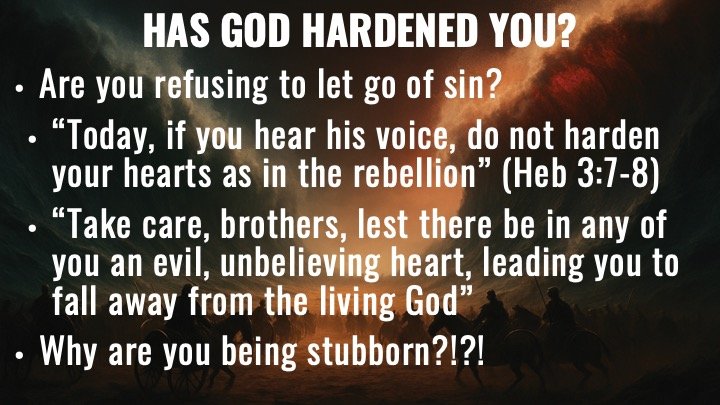
Throughout this, there is certainly a sense in which God is the one hardening Pharaoh’s heart, but it started with Pharaoh hardening his own heart. God knew Pharaoh would do that, but Pharaoh is the one who made that decision. The same can happen to us.
Hebrews 3:7–14 (ESV) — 7 Therefore, as the Holy Spirit says, “Today, if you hear his voice, 8 do not harden your hearts as in the rebellion, on the day of testing in the wilderness, 9 where your fathers put me to the test and saw my works for forty years. 10Therefore I was provoked with that generation, and said, ‘They always go astray in their heart; they have not known my ways.’ 11 As I swore in my wrath, ‘They shall not enter my rest.’ ” 12 Take care, brothers, lest there be in any of you an evil, unbelieving heart, leading you to fall away from the living God. 13 But exhort one another every day, as long as it is called “today,” that none of you may be hardened by the deceitfulness of sin. 14 For we have come to share in Christ, if indeed we hold our original confidence firm to the end.
God told Moses, “I know that the king of Egypt will not let you go unless compelled by a mighty hand.” What will it take for you to hear God’s message for you and to let go of the sin you are holding on to? Why are you being so stubborn!?!? Does it scare you to know that if you persist in this God might harden your heart and use you as an example of what not to do to your shame? He has every right to do so. Feel ashamed and cut to the heart over your passions and desires. Jesus said to, “Cut off your right hand” if it causes you to sin. LET IT GO!
Jesus said it like this, “He who loves his life will lose it, and he who loses his life for my sake will find it.” Do you have an evil and unbelieving heart that is unwilling to submit to God? Jesus died for you to be saved, but those who refuse to trust in Him have no hope. God wants to give you a new heart and a new spirit that resembles Christ’s humble and obedient one. Please come forward and let Him do that for you.