
Those Who Stumble (Romans 10:18-11:15)


You pray for someone year after year. You share the gospel with tears in your eyes. They shrug it off. Maybe even laugh at it. At some point you sit in your car afterward and ask, “What is the point?” or, “Why am I doing this?”
That ache Paul felt for Israel is the same ache you feel for that friend, that child, that sibling. Paul says he would give anything to see them come home to God. You have felt that too.
So, how should he feel toward his people after they have refused to believe? Should he shake off the dust of his shoes and forget about them? Is that what God has done?
Today we see that God is not done with them. Nor is He done with you. God is faithful, even when people are stubborn and slow to believe.
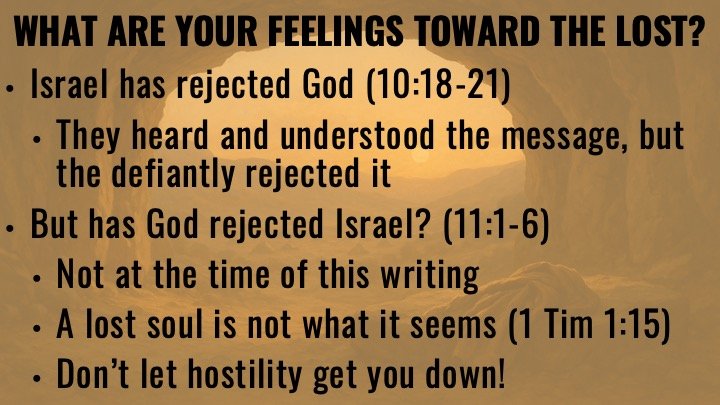
Israel Has Rejected God
In Chapters 9 and 10, we have seen how Israel has refused to believe in Jesus. They have chosen to reject the savior and pursued righteousness through law keeping. It will never get them to the point of salvation. God has made it easy for them, but they refuse to believe what they have heard and have understood.
Romans 10:18–21 (ESV) — 18 But I ask, have they not heard? Indeed they have, for “Their voice has gone out to all the earth, and their words to the ends of the world.” 19 But I ask, did Israel not understand? First Moses says, “I will make you jealous of those who are not a nation; with a foolish nation I will make you angry.” 20 Then Isaiah is so bold as to say, “I have been found by those who did not seek me; I have shown myself to those who did not ask for me.” 21 But of Israel he says, “All day long I have held out my hands to a disobedient and contrary people.”
These questions and answers are fascinating because they point out that everyone has heard and everyone has understood, but the Jews will need some additional nudging. Even the Gentiles have heard and understood the message. They have found salvation and they weren’t even looking for it. So, it is not as though Israel was unable to understand it. The problem is that Israel is disobedient and contrary. They have “stumbled over the stumbling stone.”
God Wants To Save
He furthers his point in Chapter 11 by asking the question, “Has God rejected His people?” This is a powerful question. One that Paul has been hinting at throughout the book. Has God rejected His people? God had never totally rejected His people. Even after Judah had completely abandoned Him and worshipped all kinds of idols, God saved a remnant.
Romans 11:1–6 (ESV) — 1 I ask, then, has God rejected his people? By no means! For I myself am an Israelite, a descendant of Abraham, a member of the tribe of Benjamin. 2 God has not rejected his people whom he foreknew. Do you not know what the Scripture says of Elijah, how he appeals to God against Israel? 3 “Lord, they have killed your prophets, they have demolished your altars, and I alone am left, and they seek my life.” 4 But what is God’s reply to him? “I have kept for myself seven thousand men who have not bowed the knee to Baal.” 5 So too at the present time there is a remnant, chosen by grace. 6 But if it is by grace, it is no longer on the basis of works; otherwise grace would no longer be grace.
To explain this, Paul gives us two examples to chew on.
Paul
The first example is himself. He says, “I am an Israelite and I am saved.” Think about that. Paul was a stubborn and rebellious Israelite. He persecuted Christians. He did not deserve mercy, but God chose to have mercy on him.
1 Timothy 1:12–17 (ESV) — 12 I thank him who has given me strength, Christ Jesus our Lord, because he judged me faithful, appointing me to his service, 13 though formerly I was a blasphemer, persecutor, and insolent opponent. But I received mercy because I had acted ignorantly in unbelief, 14 and the grace of our Lord overflowed for me with the faith and love that are in Christ Jesus. 15 The saying is trustworthy and deserving of full acceptance, that Christ Jesus came into the world to save sinners, of whom I am the foremost. 16 But I received mercy for this reason, that in me, as the foremost, Jesus Christ might display his perfect patience as an example to those who were to believe in him for eternal life. 17 To the King of the ages, immortal, invisible, the only God, be honor and glory forever and ever. Amen.
Paul was not saved because he accepted the truth the first time he heard it. He rejected the truth to the point of destroying the lives of people who believed. God wanted to make him an example for all to see how merciful Jesus can be. God is not the one rejecting His people. They have rejected Him and He is still working to save them and showing them mercy through Jesus Christ.
Sometimes, I wonder if we see how gracious God wants to be toward everyone. He was willing to save Paul and to make him an example of the perfect patience of Jesus. I think I would have really struggled to do that if I had known Paul before his conversion. God give us eyes to see what you see!
Elijah
The second example goes further by pointing to Elijah. Elijah was a prophet who really loved the Lord and hated how evil Israel had become. He prayed that it would not rain so that Israel could be punished for their sins. Then, he prayed for it to rain and won a great contest by demonstrating God’s power on Mount Carmel. Elijah was sure that the contest would result in Israel putting away their Baals and worshipping God again, but instead Jezebel turned Ahab against Elijah and sent men to kill him along with all the prophets of the Lord. This is the context of God’s word to Elijah. He was distraught thinking that he was the only one left who was faithful to God. But God responded with a revelation that there were still 7000 who had not bowed a knee to Baal.
What does this example say about God rejecting Israel? Paul uses this example to say that we don’t know how many Jews are out there who are sincerely confused about the gospel. There are many who will be taught the truth because God is gracious and merciful and willing to patiently wait for them to hear it. Like Elijah, it looks bad right now, but we have no idea how many are still on the fence and about to be converted.
Application: As we think about this, I think it’s important for us to carry the same attitude that Paul is bringing to this conversation. Maybe there are people around us who deny Christ and refuse to submit to the will of God. Don’t let that get you down. Don’t think, like Elijah, “No one else believes and no one ever will.” God doesn’t think that way. He sees those who are still struggling with the truth, and he has plans to help them come to the light. God’s message for Elijah was, essentially, “Get back to work.” That’s our message as well. Stop being distracted with worry and fear for those who seem hostile, and keep shining a light for all to see. Let God handle the growth.
The Mind of God (7-15)
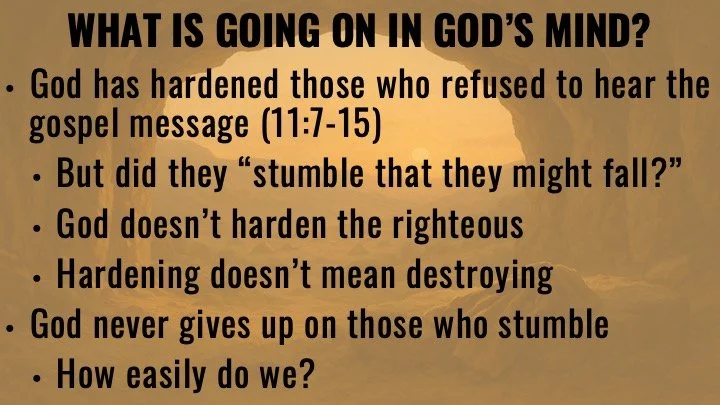
If God hasn’t fully rejected His people, what has happened? What is going on in the mind of God, and how should the Christians in Rome view the hostility of the Jews towards them? The next section gives us a glimpse.
Romans 11:7–15 (ESV) — 7 What then? Israel failed to obtain what it was seeking. The elect obtained it, but the rest were hardened, 8 as it is written, “God gave them a spirit of stupor, eyes that would not see and ears that would not hear, down to this very day.” 9 And David says, “Let their table become a snare and a trap, a stumbling block and a retribution for them; 10 let their eyes be darkened so that they cannot see, and bend their backs forever.” 11 So I ask, did they stumble in order that they might fall? By no means! Rather, through their trespass salvation has come to the Gentiles, so as to make Israel jealous. 12 Now if their trespass means riches for the world, and if their failure means riches for the Gentiles, how much more will their full inclusion mean! 13 Now I am speaking to you Gentiles. Inasmuch then as I am an apostle to the Gentiles, I magnify my ministry 14 in order somehow to make my fellow Jews jealous, and thus save some of them. 15 For if their rejection means the reconciliation of the world, what will their acceptance mean but life from the dead?
He reiterates that Israel has failed to obtain what they were seeking. They stumbled over the stumbling stone. They rejected the truth of the gospel and refused to believe. Then, notice what God did. He hardened them. They refused to accept His grace, and he didn’t just write them off. He gave them over to their sins and let them become extremely foolish.
I want to point out something briefly right here that I plan to explain further tonight. God doesn’t harden them to destroy them. He hardens them with hope that they will see their error, become jealous of the Gentiles, and submit to God’s will. He doesn’t harden them against their will. He hardens them in accordance with their will. This is the same thing we see God say He was doing in Chapter 1.
The point of what Paul is saying is that God never gives up on those who stumble. Paul doesn’t see the Jewish people as beyond hope. They have stumbled, not fallen, and God can use that to bring the Gentiles in. But God can also use the Gentiles coming in to make the Jews jealous.
If you or I were living in that time, we would have no concept of this. The Jewish hostility would be so confusing to us. We would ask, “Why do your own people reject you, God?” How quickly do we write off people who reject the gospel and move on. But Paul is telling the Gentiles and Jews in Rome to trust that God is still working on the hearts of the rebellious to turn them back to Him. That’s who He is and what He does. The gospel is for every disobedient soul.
Conclusion
The words in this section reassure us that God is the one who knows and gets to decide who will be saved, but also that God wants everyone to be saved.
Do you?
There have been times in my life where I have taken rebellion and a refusal to hear the message as a sign that someone is done. They just aren’t going to listen. They made fun of me, cussed me out, or laughed in my face, and I decided not to throw my pearls before swine. I thought that once their heart is hardened, there’s no coming back from that. But Paul doesn’t have that attitude at all. He believes God can bring the Jews back.
In the book of Acts, Paul makes it clear that he will preach to the Jews one more time even if they kill him and they nearly do. He keeps going back because his love drives him to do so. We started this section with Paul stating that he greatly desires Israel to be saved, and now we see God does too.
Someone is on your mind right now. You love them. You fear for them. You have prayed and waited. Take courage. God has not walked away. He is patient beyond what we can imagine. He kept reaching for Israel. He kept reaching for Paul. He kept seven thousand for Himself when Elijah saw no one. He may be closer to reaching your loved one than you think.
Don’t give up on them. Don’t write them off. Don’t be Elijah in the cave thinking that there is no hope. God says to Elijah, “What are you doing here Elijah?” Get back to work and don’t give up because God hasn’t. There are souls to rescue, there are souls to save. Perhaps they have just stumbled and not fallen.