
Convinced (Romans 8:31-39)
Have you ever doubted God’s love for you or spoken to someone who has? Typically, the root of our concern is that He lets bad things happen. If God is all good and all powerful, why did He let me suffer this tragedy or let me experience this extreme pain? It just doesn’t seem like the type of thing a loving God would do. Then, someone tries to explain how God is really using this event to help you grow or to make you stronger. In some cases, this is true. But, other times, the event or the pain is having the opposite effect. It’s making us weaker and removing a source of strength we once relied on. Why would God do that if He really loved me?
We don’t really know all that is going on in the mind of God in every situation. There are too many factors that he is aware of, which we have no idea about. But one thing is for certain. He has proven that He loves us. The gospel proves it beyond a shadow of doubt.
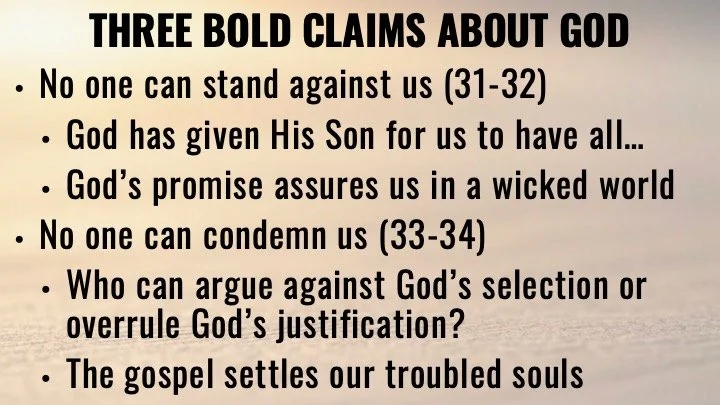
Today’s study is going to ask questions that are based upon the truth of the gospel. If we believe the gospel message is true, that Jesus died for the ungodly, enemies of God to be saved, then we have to believe these three things. 1. No one can stand against us. 2. No one can condemn us. 3. Nothing can separate us from God’s love. What do these statements mean, and do you believe these three things?
No One Can Stand Against Us (8:31-32)
The first claim is bold and sounds a bit unreal.
Romans 8:31–32 (ESV) — 31 What then shall we say to these things? If God is for us, who can be against us? 32 He who did not spare his own Son but gave him up for us all, how will he not also with him graciously give us all things?
Paul asks, “If God is for us, who can be against us?” We know that people will turn against us and hurt us. They will make us feel as though we are losing and helpless. They have transformed the culture and the world around us so that many people are trying to stand against us. But God has chosen to save us through Jesus, and He has decided to make us His children. What does this mean for us? It means that those who are against us should be very afraid.
“He who did not spare his own Son but gave him up for us all, how will he not also with him graciously give us all things?” When they see what God gave up for us, they should know that they will lose. These words indicate how far God will go for you. God did not hold anything back. He’s not trying to convince you that He loves you by giving you temporary presents or verbal affirmations. He has sacrificed what He loved most of all to purchase your freedom. Does that not show that He wanted your heart more than anything? If that is true, which we believe it is, why would He then turn around and refuse to give everything He’s promised to you once you have chosen to love Him in return? He will not hold back.
But the real question is, “What has He promised?” Not riches and fame or a totally comfortable life. He never promised any of that. He promises peace, but not peace with the world. He promised hope, but not temporary hope. He promised riches and glory, but not on this earth. Those things are futile and vain in their current temporary state. When it says He will graciously give us all things, he’s not talking about all temporary and weak things. He’s talking about the good, eternal things. In the text we looked at last week, we saw how we along with all creation are groaning as we wait for the eternal, heavenly state. That’s what He’s promised. That’s the “All things” this text is talking about.
This text is telling us that no one can stop us from receiving these truly valuable things if God has decided to give them to us. God has promised them to us, and we are assured that He who gave us His Son will deliver them to us.
No One Can Condemn Us (8:33-34)
The second claim is so powerful that it has caused people to assume that once we are saved, we are always saved no matter what.
Romans 8:33–34 (ESV) — 33 Who shall bring any charge against God’s elect? It is God who justifies. 34 Who is to condemn? Christ Jesus is the one who died—more than that, who was raised—who is at the right hand of God, who indeed is interceding for us.
We all sin and fall short of God’s glory. We are still weak and we struggle to be what God calls for us to be. When we sin, we feel guilt and shame. We long to undo what we have done. Perhaps these struggles against sin convince you that God could never love someone like you. You could never be good enough to be called His son and enter His presence. So now you pray, “God, I just hope that maybe one day I might make it.”
Do you hear what this text says to you? Who is going to say you cannot enter God’s presence? Who is going to say you aren’t forgiven for your sins? If God justifies you, you stand justified. If Jesus intercedes for you, you stand innocent, holy, and righteous. This text tells us all the elect have no need to worry about the judgment day. Satan’s power to condemn us has been taken away by the blood of Jesus.
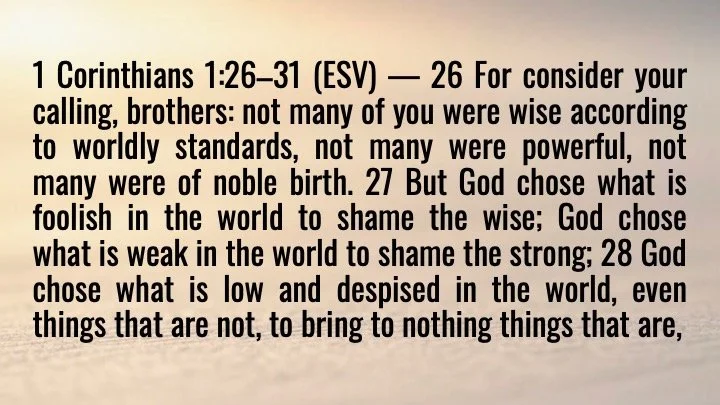
In this section, Paul calls God’s children, “Elect.” That simple terminology throws some people off, but in the context of adoption, it makes perfect sense. Elect means that we meet the criteria God has selected to adopt as his children. We are, “poor in spirit,” “meek,” “mourning our sin,” and “hungering and thirsting for righteousness.” In another text, Paul points out that “not many wise according to worldly standards, not many noble, nor many powerful” received this salvation (1 Cor 1:26-31). Elect means you were humble enough to listen to the gospel message. That’s the type of person God foreknew He was going to save, and predetermined to be conformed to the image of Christ. Don’t be twisted around the axel with that terminology.
If you stand in humble submission to God’s will with a full reliance on the blood of Jesus, our Christ, you have no need to fear. Don’t let anyone unsettle you or trouble your faith. Instead, show gratitude and joy at the thought that God loves you and has provided total assurance. Our only fear is being deceived into giving up on God and doubting His goodness, or trusting in yourself and falling away from grace. Once saved, you are saved until you choose not to submit to God any longer.
No One and Nothing Can Separate Us From God’s Love (8:35-39)
The third claim is most powerful of all.
Romans 8:35–39 (ESV) — 35 Who shall separate us from the love of Christ? Shall tribulation, or distress, or persecution, or famine, or nakedness, or danger, or sword? 36 As it is written, “For your sake we are being killed all the day long; we are regarded as sheep to be slaughtered.” 37 No, in all these things we are more than conquerors through him who loved us. 38 For I am sure that neither death nor life, nor angels nor rulers, nor things present nor things to come, nor powers, 39 nor height nor depth, nor anything else in all creation, will be able to separate us from the love of God in Christ Jesus our Lord.
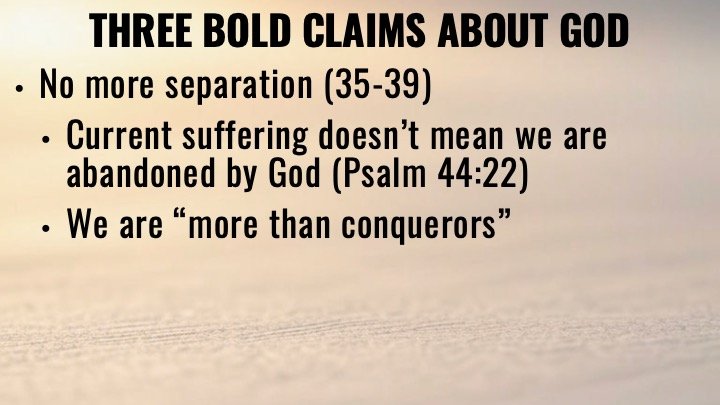
Adam and Eve experienced separation from God. Their sin caused them to lose their relationship and die spiritually. Jesus has made that separation a thing of the past. Paul gives us two lists in this text to try to persuade us that no one and nothing can separate us from God’s love. The blessing of Christ has totally removed the curse.
The first list includes struggles we might go through in this life. Tribulation, distress, persecution, or famine were all daily realities for first century Christians. Consider how alone you might feel while suffering in these ways. Then, Paul quotes Psalm 44:22, where the Psalmist is calling out to God for help in a time of serious trouble. After this verse, he says, “Awake! Why are you sleeping, O Lord? Rouse yourself! Do not reject us forever!” You see, when things get difficult, we tend to believe that God doesn’t see or know what’s happening. Paul is telling us God is not separated from you. He is still with you.
The second list is all inclusive. He brings up existential threats (life and death), Spiritual threats (angels or rulers), Temporal threats (things present or to come or powers), spacial threats (height or depth), and every other threat imaginable. Paul wants us to see that whatever anxiety or fear enters our minds and causes us to doubt God’s ability to help or see or be with us is preposterous. There is not one thing that can separate us from God’s love if we love Him and choose to seek His love.
One more point in this is really powerful. He says, “in all these things we are more than conquerors through him who loved us.” More than conquerors? How do you become “more than a conqueror?” I thought that being a conqueror made you top of the food chain. Nope. Think about it. Jesus is more than a conqueror. He stood before conquerors. He appeared to be conquered, but He was beyond their power. The worst they could do is kill his body. This phrase, “more than conqueror” doesn’t mean we defeat everyone by force. It means we defeat everyone by faith. We can be killed, but not truly conquered. Never conquered.
Are You Convinced?
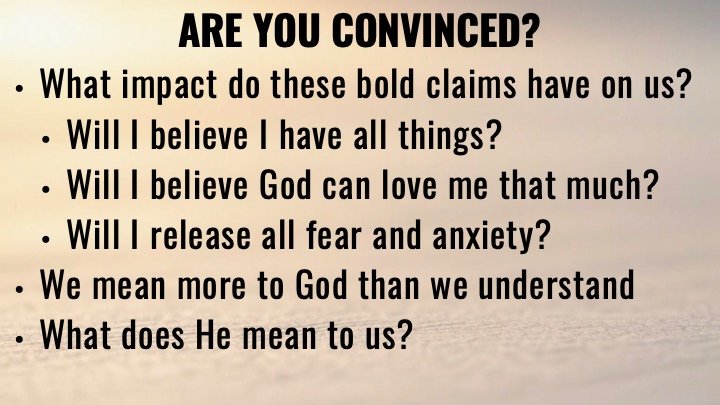
Do these three statements have any impact on you?
Does it help you at all to know that God is for you and able to give you all the things you desire? How does it help? Perhaps knowing this promise of being a child of God helps you let go of your vain desires in this world. We all need to center our hearts on God’s will. We need to let the world oppose us and do what is right and godly with great boldness.
Does it help you to know that you stand uncondemnable so long as you strive to serve God with faith in His sacrifice? Think about how much better life will be without fear. The perfect love God has shared with you casts out your fear. Now, we live to please him and strive against sin for His glory.
Does it help you to know that nothing can separate you from God and Christ? This should affect us all every day. God and Christ are with us. They never leave. They see every action and hear every thought. When we are in the lowest lows or the highest highs, they don’t abandon us. No one and nothing can cause them to do that. That’s not who they are.
We mean more to them than we could ever understand. Paul wants us to be convinced of that. Are you?