
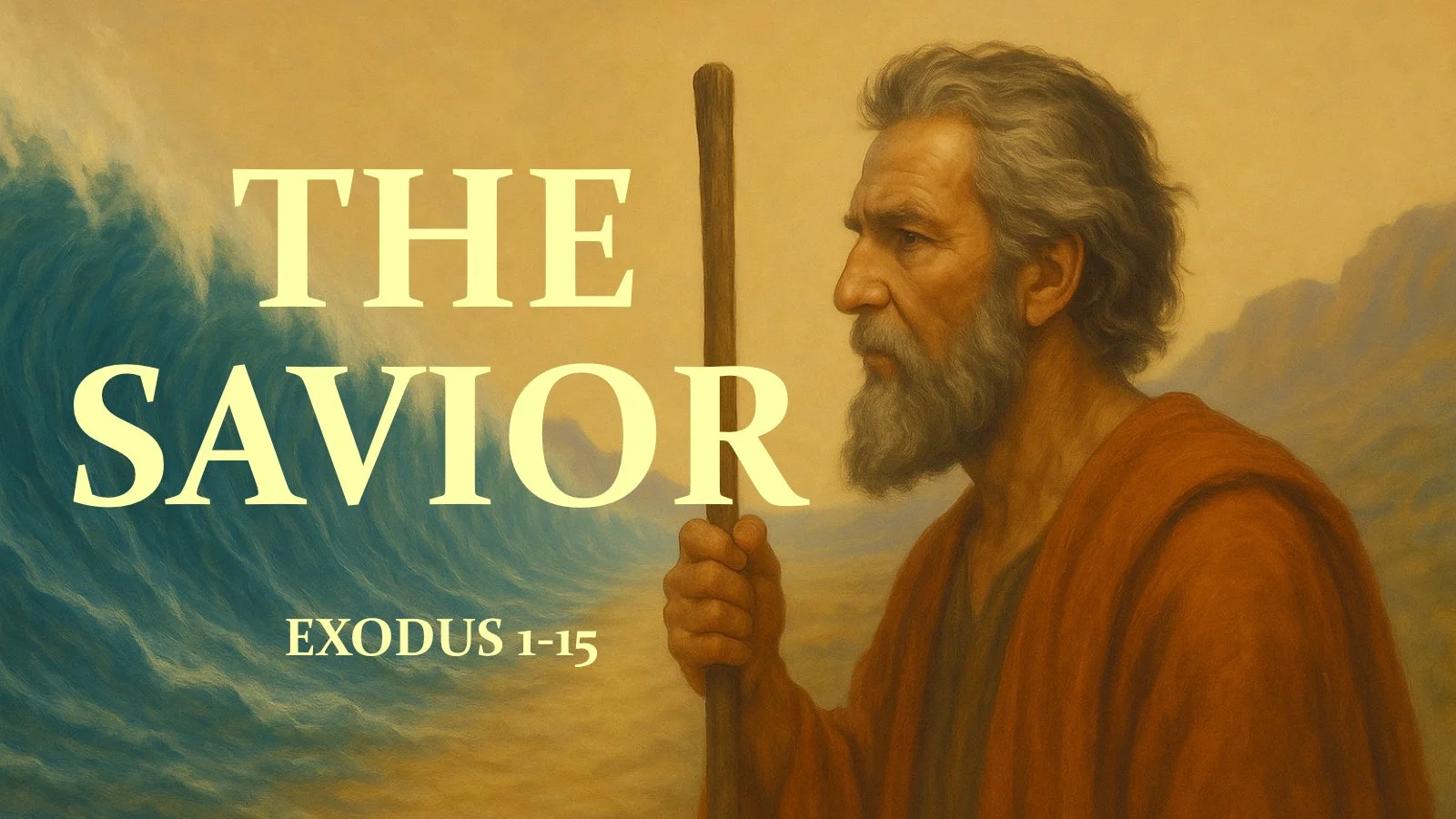
The Savior (Exodus 1-15)
The Opportunity and Failure of Moses (1-2)
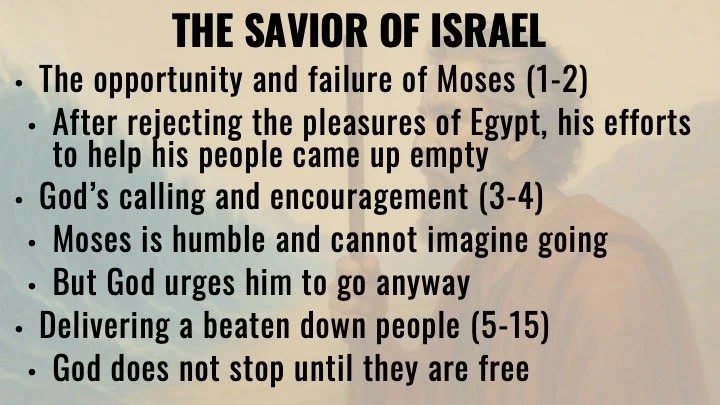
After the death of Joseph and all his brothers the people of Israel, (Hebrews), multiplied greatly in number. God was making them, in a short amount of time, into a great nation. They keep having babies to the point where the Egyptians start getting nervous. So, Pharaoh commanded all the midwives to kill all the babies that are boys. As soon as the sons are born, he orders them to be put to death in a seemingly discreet way. But the midwives rebel and refuse to kill the boys, saying, “These Israelite women have their sons before we get there. We cannot do it like you want.”
Afterwards, Pharaoh decided to be more obvious. He commanded all of the Hebrew sons to be cast into the Nile. Can you imagine living in that kind of society? We think our days are bad. Every young Hebrew mother was forced to kill their newborn sons. How corrupt and immoral can you be to enforce or abide by a law like that? This is murder!
But one day, a man named Amram and a woman named Jochebed chose to disobey. They put their third child, Moses, into the Nile but they put him in a little floating basket and kept him among the reeds. This would still be dangerous since the current of the Nile could increase at any time. Also, crocodiles could come and find him. But in one of the greatest ironies in scripture the baby was found by the daughter of Pharaoh and would end up being nursed by his own mother.
So Moses started out sentenced to death as the son of a slave and ended up the grandson of Pharaoh, growing up in the palace with all of the benefits of an Egyptian. Can you imagine living in the palace of the wealthiest king in the world?
Hebrews 11 tells us that he would reject the passing pleasures of Egypt and choose to join in the suffering of his people. He knew the Egyptians were treating his people unjustly. So one day, he went down to where the Hebrews were working, he saw an Egyptian man beating up a Hebrew, and he decided to murder the man for his cruelty. He saw himself as a justice warrior and savior. He hoped that this act would unite the Hebrews with him, but instead they bickered with one another and rejected him as a leader because they knew he had killed a man. Finding out that his murder was well known, he fled to the wilderness to escape punishment.
While in the wilderness, he chose to protect some young shepherdesses as they were watering their father’s flocks. This act of kindness resulted in Moses being given a home, becoming a husband, a son-in-law to a priest, and a role as a shepherd for forty years. Isn’t it interesting how one act of kindness set Moses up while he was on the run? God took care of him.
God’s Calling and Encouragement (3-4)
God was not finished with Moses. While in the wilderness, he noticed a fire up on Mount Horeb. It kept burning and didn’t go out. He had no idea where the fire came from or why it was continuing so he went up to investigate. When he got close, he heard the sound of God calling out to him, “Moses! Moses!” He said, “Here I am.” To which God told him not to come near and to take his sandals off of his feet because he is standing on holy ground. Then, God told him who he was, the God of Abraham, Isaac, and Jacob, and that God had seen the affliction of His people and that he wanted to give the promised blessing to them in the land of Canaan, and that he wanted Moses to lead them out.
This is great news! God is going to work to save His people! He heard their cries and witnessed the sufferings they have gone through. He has not abandoned them. However, Moses is meek and lowly at this point. He once thought that he was in a position where he could help the people, but now? Who is he to save anyone? We see that he has given up those foolish and childish dreams. He is content to live out his days in the wilderness tending sheep. But God has a mission for him to fulfill, and his humility makes him the perfect candidate.
This is one of the more interesting conversations in all the Bible. Moses is told what God wants him to do, but he is reluctant to do it. He doesn’t seem to doubt that God can do this, but he doesn’t consider himself worthy or able to accomplish this. He says, “I am not eloquent, either in the past or since you have spoken to your servant, but I am slow of speech and of tongue.” (4:10). He sees himself as broken and worries about messing things up.
So, God allows Moses’ brother Aaron to help him in this and he promises to demonstrate miraculous power to solidify his words to Pharaoh and the people. But, what is more interesting, is the fact that God tells Moses Pharaoh will refuse to listen to you because God will harden his heart. So this is not going to be an easy mission, but God wants Moses to do it anyway.
Pause a moment. Do you know that God calls all of us to do something scary? He calls us to be salt and light in a dark world. Consider how Moses responds with humility and still God pushes him to do what he cannot do on his own. Understand that God always expects us to fulfill that opportunity with faith.
Delivering A Beaten Down People (5-14)
By the time Moses returns to Egypt all of those who had previously sought to capture him and imprison him have died. So he and Aaron go to the people, perform signs, and convince the people that the Lord was going to save them. They bowed and worshiped God in response.
But after Moses and Aaron went to Pharaoh and commanded him to let the people go, things took a sharp turn in the wrong direction. Pharaoh did not like the idea of letting his free slave force go anywhere. Moses did signs in front of him, like turning his stick into a snake and then picking it up again, but Pharaoh wasn’t persuaded. His magicians could do the same. So Pharaoh accused the people of Israel of being lazy and called for heavier loads to be placed on their backs. The people heard this and were dismayed. They blamed Moses and Aaron for their suffering and thought they were going to die at the hands of the Egyptians. Moses, himself, asked God why He had ever sent him to this place. All it has done is brought pain and suffering.
How often do we give up too early on a work that we feel like we can do? We fault the Israelites and Moses for giving up and not waiting, but do we do the same?
But all they really needed to do was wait and trust in God. God reinforced His promise to Moses. He told him to get ready because he is about to do something that has never been done before. He is about to redeem them, save them, and bring them into the land He has promised them. The people refused to listen because they had a broken spirit due to the harsh slavery they had been in.
So God told Moses and Aaron to go to Pharaoh and show him miracles. But Pharaoh would not listen. He had his magicians perform similar signs. So God turned from miracles to plagues, and still Pharaoh would not listen. So the plagues increased in severity. Moses would continually go before Pharaoh and announce the plague before it happened. But every time, Pharaoh refused to listen. Moses would come back after the plague had taken place, listen to the begging of Pharaoh, and plead for the plague to stop after Pharaoh promised to let the people go. But Pharaoh always went back on his word.
This repeated nine times, but on the tenth time, God killed all the firstborn children and firstborn livestock in the land. He passed over the Israelites who obeyed and put blood on their doorposts, but killed the Egyptians. Once that happened, they were free to go. Everyone was giving them all of their riches and telling them to get out. So they quickly left Egypt.
But God had one more twist up his sleeve. He had Moses lead them toward the Red Sea instead of down the road toward the promised land, knowing that Pharaoh would once again harden his heart. When the army of Pharaoh came to capture the Israelites and bring them back, the people panicked: “We would rather serve them than die out here!” God brought a fog to confuse them. He had Moses lift his staff and God brought a strong wind to blow the sea to the side so He could lead his people across the Red Sea on dry ground. Then, when Pharaoh’s army tried to pursue them, he brought the sea crashing down on them, killing them all.
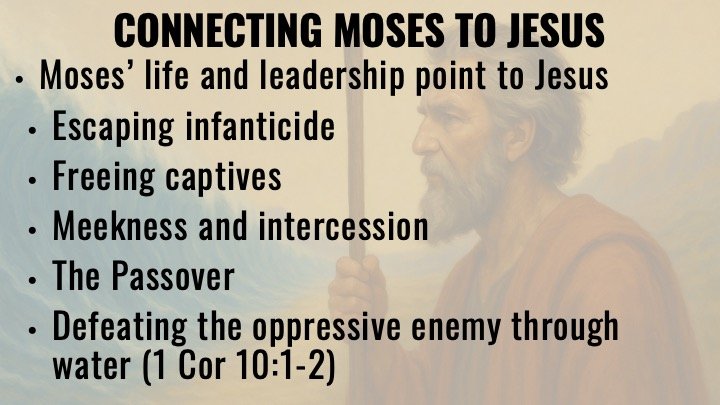
Connecting Moses to Jesus: The Greater Deliverer
Moses’ story points to Jesus, the true Savior (Hebrews 3:1–6). Like Moses, Jesus escaped a king’s infanticide (Matthew 2:13–16), frees from slavery to sin (John 8:34–36), and intercedes for God’s people (Hebrews 7:25). The Passover lamb spared Israel; Jesus, the Lamb of God, spares us from death (1 Corinthians 5:7; John 1:29). Where Moses faltered, Jesus obeys perfectly. Scripture exalts Him: “The law came through Moses, but grace and truth through Jesus Christ” (John 1:17).
The salvation from Egyptian bondage is a major marker in all of history that our God reigns over the universe. But Jesus’ death and resurrection is the most important event ever, signifying a defeat of all mankind’s greatest enemy—death.
Application: Trusting God to Save
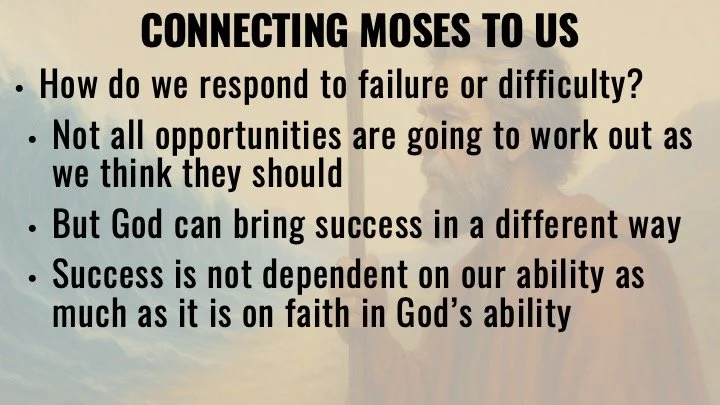
As we look at Moses in the first part of his story, it’s important for us to see that he was an ordinary man who was given a great opportunity. But it turned out that things didn’t go how he thought they would. Have you ever had that happen in your life? Have you ever believed that something was going to work out one way in your head, just to find out that it wouldn’t. But notice how God brought it about in a totally different way. He used a broken and humble Moses instead of the proud and powerful Moses.
In a world that is growing increasingly oppressive, violent, proud, and immoral, we might be inclined to dominate those around us. But God didn’t operate like that in the New Testament. Jesus could have dominated everyone around Him, but he sought to help them. He loved, forgave, taught, and lifted them up. He made a way for them to be saved at great pain to himself. It’s not about how strong we are. It’s about how strong our faith in God is.
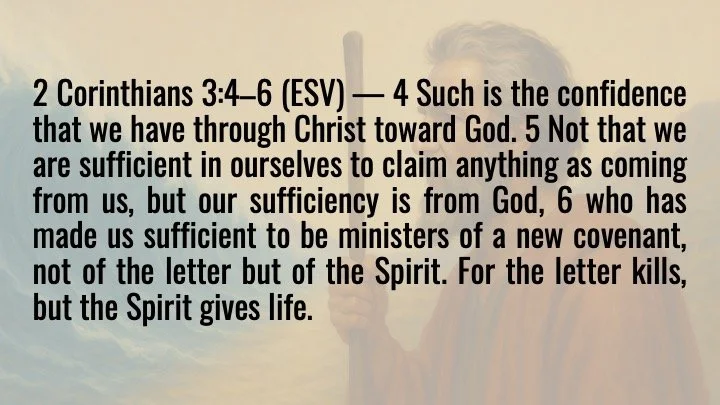
God calls us to trust His deliverance. Like Moses, you might feel unqualified, but He chooses to work through the weak and unqualified. Paul said, “Who is qualified to teach these things?” (2 Cor 3:4-6) When seas block your path, stand firm and watch for Him to make a way.