
Submit To One Another (Ephesians 5:21)




Today, we are looking at a command that might get a lot of funny looks.
Ephesians 5:21 (ESV) — 21 submitting to one another out of reverence for Christ.
Paul tells us all to submit to one another. Jesus and Peter tell us the same thing in different ways. Do you struggle to submit to someone else? Is the thought of submission cringe to you? For years our culture today has been trying to create a generation of rebellious dictators who submit to no one. That doesn’t mean all young people have taken the bait. In fact that is changing rapidly, but many have no clue what submission is about because no one talks about it or emphasizes it. It’s taboo and not politically correct. People who value submission are called archaic and old school or some derogatory term.
Why is that? Because submission was given a bad reputation. Today, I hope to clarify and correct this with four brief points. We will look at what submission is, why it’s hard to submit, who should submit, and why.
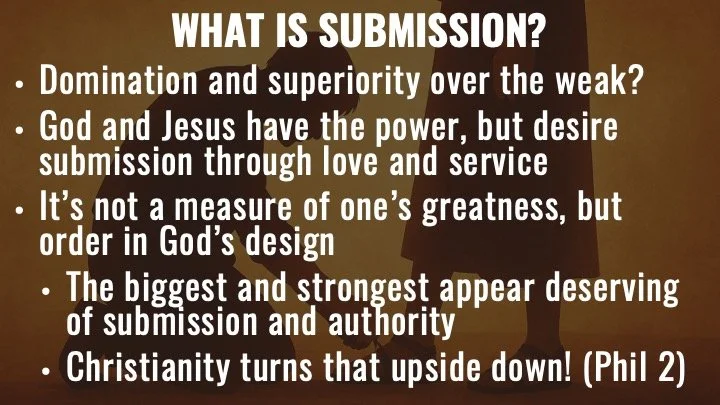
What is submission?
To many this word assumes inferiority and superiority. Submission is not about value, but about order and fulfilling roles within God’s design. Everyone in every position is taught to submit to someone else. No one is above submitting, from the ruler to the slave. In the book of Daniel, we read about the great king Nebuchadnezzar considering himself to be over all and submitting to no one, but his pride led him to suffer until he recognized that God is over all and submitted to Him.
Submission is seen as a measure of greatness or weakness. It’s a picture of one dominating the other. But is that the order that God has established on the earth? Christianity is not about the weak being dominated by the strong, but about the strong serving and exalting the weak. Following Christ is about submitting to God and one another “out of reverence for” what Christ has done on our behalf.
Consider, God is over all, but he is most often portrayed as a loving God who alters His will for the betterment of those who submit to Him. He listens to them and provides them with what they ask for and need. Submission, then, can look totally different than a powerful domination of one person over another. God always has the ability to dominate, but it’s not His desire. He gave His Son in hopes that He could convince everyone to submit willingly.
So, if you believe submission is about domineering and leading by force, you are dead wrong. God avoids that system of rule in favor of steadfast love. Jesus exemplifies it.
Philippians 2:1–11 (ESV) — 1 So if there is any encouragement in Christ, any comfort from love, any participation in the Spirit, any affection and sympathy, 2 complete my joy by being of the same mind, having the same love, being in full accord and of one mind. 3 Do nothing from selfish ambition or conceit, but in humility count others more significant than yourselves. 4 Let each of you look not only to his own interests, but also to the interests of others. 5 Have this mind among yourselves, which is yours in Christ Jesus, 6 who, though he was in the form of God, did not count equality with God a thing to be grasped, 7 but emptied himself, by taking the form of a servant, being born in the likeness of men. 8 And being found in human form, he humbled himself by becoming obedient to the point of death, even death on a cross. 9 Therefore God has highly exalted him and bestowed on him the name that is above every name, 10 so that at the name of Jesus every knee should bow, in heaven and on earth and under the earth, 11 and every tongue confess that Jesus Christ is Lord, to the glory of God the Father.
He calls for us to set aside selfish ambition or conceit and lift up those around us with humility. He calls for us to look out for the best interest of one another. This is what Christ did. He could have forced mankind to bow down to Him. He deserved submission, but He sacrificially gave Himself for those who rebelled against His rule.
We don’t submit to governments, elders, husbands, parents, or masters because we are weaker than them or inferior to them. We submit to them because our God calls us to. We submit to them because Jesus was submissive even though He was greater than everyone he came into contact with.
Why Don’t We Submit?
Have you ever been in a situation where you did not want to submit? Maybe your boss at work was unjust and showed favoritism to another employee. He put a heavy burden on you for some reason, and you wanted to ruin his reputation. You wanted to bring him down a notch. Or maybe it was your husband who was acting foolishly, and you wanted to set him in his place. The elders made a decision you disagreed with. The government failed to pass a law, or passed something wicked. Or maybe it’s just a brother out sister in Christ who is acting ungodly. In this same text, he points out some obstacles we have to overcome: Selfish ambition, vain conceit, pride, complacency, and a failure to trust in God’s timing.
Do you see that going on within yourself? Do you know that raging against those who are placed over you is raging against the order that God has set for your life?
1 Peter 2:18–21 (ESV) — 18 Servants, be subject to your masters with all respect, not only to the good and gentle but also to the unjust. 19 For this is a gracious thing, when, mindful of God, one endures sorrows while suffering unjustly. 20 For what credit is it if, when you sin and are beaten for it, you endure? But if when you do good and suffer for it you endure, this is a gracious thing in the sight of God. 21 For to this you have been called, because Christ also suffered for you, leaving you an example, so that you might follow in his steps.
When we are defiant and rebellious against God’s established order and we suffer for it. That’s to be expected. But Peter says, when we overcome our selfish ambition, conceit, and pride, choosing to submit and honor those in authority, we are acting as Christ acted on this earth. We are starting to know the suffering of Christ more fully. But he also says, “This is a gracious thing.” Notice that the greater is being gracious towards the inferior. Your position does not indicate inferiority.
Rebelling against those who are in authority over us is common.
Psalm 2:1–3 (ESV) — 1 Why do the nations rage and the peoples plot in vain? 2 The kings of the earth set themselves, and the rulers take counsel together, against the Lord and against his Anointed, saying, 3 “Let us burst their bonds apart and cast away their cords from us.”
This is the opposite of submission. Men try to dominate God. They rebel against His authority and order. We struggle to submit because submission means I don’t get to do what I want to do.
Choosing to submit means humbly denying yourself and relinquishing control or power that you have for the good of someone else. Submission can be about humbling yourself and exalting the will of someone lesser than you just because they are in a position of authority over you. When we think that submission indicates weakness, we are missing out on the more beautiful form of submission that exists.
Let’s be clear here. We aren’t talking about merely complying with commands and giving in to the will of someone who has proven themselves stronger than us out of fear of them. We are not talking about begrudging giving up our will. Those who submit with a heart to merely avoid punishment will rebel when they no longer fear punishment. We give up our will and our desires to serve a greater cause, to demonstrate love toward God and love toward the one we submit to.
Who should submit to whom?
Submitting happens when people have authority over other people, but the one in authority must submit to the one higher up than they are. We all submit to someone.This means that in our society, submission should be happening across the board. Wait, who is supposed to submit to whom? Who is the submitter and who is the submittee and how would their submission look?
Examples
To help us understand this better, I want us to look at the examples that Paul uses in our text. He speaks about submitting as husbands and wives, children and parents, a slaves and masters. These are all examples for us to use to grasp the concept of submission. The first one is husbands and wives.
Ephesians 5:22–33 (ESV) — 22 Wives, submit to your own husbands, as to the Lord. 23 For the husband is the head of the wife even as Christ is the head of the church, his body, and is himself its Savior. 24 Now as the church submits to Christ, so also wives should submit in everything to their husbands. 25 Husbands, love your wives, as Christ loved the church and gave himself up for her, 26 that he might sanctify her, having cleansed her by the washing of water with the word, 27 so that he might present the church to himself in splendor, without spot or wrinkle or any such thing, that she might be holy and without blemish. 28 In the same way husbands should love their wives as their own bodies. He who loves his wife loves himself. 29 For no one ever hated his own flesh, but nourishes and cherishes it, just as Christ does the church, 30 because we are members of his body. 31 “Therefore a man shall leave his father and mother and hold fast to his wife, and the two shall become one flesh.” 32 This mystery is profound, and I am saying that it refers to Christ and the church. 33 However, let each one of you love his wife as himself, and let the wife see that she respects her husband.
In this text, we see the dual nature of submission.
Wives
Wives are supposed to submit to their husbands, as to the Lord. Remember, it’s not a matter of the lesser serves the greater. Paul compares their type of submission to the church’s submission to Christ. There is obviously a greatness difference there, but that’s not the point. Christ is in the headship role in the church. He is the one who leads the house of God, and we are the bride of Christ whose role is to submit.
Can you imagine a church where we collectively tell Christ what He’s supposed to be doing? Where we collectively decide that loving and serving others is optional, that we can operate like a country club, or that we should worship God in an idolatrous way? The church should strive to discern the will of God. Wives also are supposed to recognize the authority God gives the man in the family, submit their own desires and will, and to support the leadership of the man.
Wives, I’m not saying you simply comply without questioning. I’m not saying you stay silent and let the husband lead you to an early grave or financial ruin. That wouldn’t be submission or honoring him in the right sense. That’s submitting without care or concern for the wellbeing of our husbands or our family. This submission relinquishes final control and authority to the husband’s will but works to influence that will in a positive way.
This might appear to be over the top in our society. For years egotistical male domination in the home has made our society fearful of men leading the home. But this is God’s design. If men lead well, the home is a better place for everyone. Women have to encourage them to lead and submit to their role, not because men are necessarily going to be good at it, but because God calls them to it. Ladies, don’t you want a man who provides, protects, cares and leads for you and your children? No woman wants a dead beat for a husband.
Husbands
Husbands, do you see yourselves needing to submit to anything in this context? I hope so. Husbands are compared to Christ. What did Christ submit for His bride? He submitted His life. The one who is the more authoritative role, has the greater burden and responsibility to serve others. Jesus lived His own words where He said, “The greatest among you will be your servant.” He washes feet! He submits his desires, comfort, time, attention, and everything he enjoys to the service of his people.
Husbands, in your leadership do you submit to God and listen to the needs of your wife? This is your command, that you love her as Christ has loved the body. Now, that doesn’t mean you are a “Yes Man.” There are requests and needs that you might see as detrimental to your spouse at the time. But men, we are supposed to be laying our lives down for our family. That means, I don’t buy video games, TV screens, new tech devices, enjoy boys night, or even a round of golf while our finances are in chaos. I don’t push my wife with more responsibility than any human could handle while I take it easy on the recliner. We submit ourselves to making her holy and honored.
We are commanded to listen to our wives and to speak the truth to them in a loving way. We need to spend some time thinking about how our role as leaders has been affected by our society. What do we expect of our wives? Do we lead them to greater holiness and love? Do we provide for them? This is what it means to submit to them. It’s not about relinquishing control, but it’s about humbling yourself to seek their best interest over your own.
Children and Parents
Now, take all that we have just understood how husbands and wives submit, let’s apply it across the board. Paul points to children and parents. Children are supposed to obey their parents. This is the same as the wife submitting her will to her husband. Children, your parents will tell you to do things that you won’t agree with. Sometimes they will be wrong. Again, it’s not about who is right or who is stronger, smarter, or better. But God calls for you to submit to their authority. That’s your role in the family.
Parents, your responsibility is to lead with submission to God, providing what the child’s needs. This is why Paul says in verse 4, “Fathers do not provoke your children to anger.” Our desire is not to give them everything they want, nor is it to use them to make ourselves happy. We don’t burden them beyond what they are able to bear. We lead them with love and tenderness, but with children we also have commands to discipline and instruct because of their youthfulness. We train them in the way of the Lord.
Members and Elders
Members are supposed to submit to elders in the same way as wives submit to husbands (Heb 13:17). There should be respect and honor given, but also there should be a willingness to follow their leadership. We must learn the difference between our preferences and God’s clear commands. If elders are failing to lead in a way we like, we need to clarify our needs and relinquish control.
Elders, your responsibility is not to give us everything we want, but to give us what we need to fulfill our purpose and glorify God. Good elders are watching out for our souls (Heb 13:17). To do this, you have to listen and understand the needs, put yourself last and lift others up.
Message
We could go through example after example, but the point remains the same. It’s not a matter of greatness, but a matter of humbling yourself towards others. If you find yourself in a position of authority, be careful to submit to the needs of those in your care. If you are under authority, which all of us are in some sense, be careful not to be self-promoting or rebellious against that authority.
Why?
To close today’s lesson out, I want to talk about why we would choose to live this way. Maybe you are reluctant to submit. Where should we draw the line on submission? You know of situations where submitting to those in authority would put you at odds with your submission to God. That’s an obvious situation where we must obey God rather than man. There are other situations where we see Christians avoiding capture by authorities. It’s not that we are called to suffer needlessly. But there are situations where disciples submit to authorities for the opportunity to preach the gospel. There is something that drives us more than survival or self preservation.
We submit to one another because Jesus submitted everything to us. He deserved recognition as the greatest, but he absorbed malicious hate and violence so we could have what we ultimately need, forgiveness of sins. This is why Paul tells us to submit to one another in all of our situations.
Ephesians 5:21 (ESV) — 21 submitting to one another out of reverence for Christ.
Make the decision today to stop living a stubborn, selfish, self-exalting life. Stop promoting your way, and submit to God’s way. His way is better.