
A Heart For The Lost (Romans 9:1-24)

How much time do you lose sleep over the lost souls around you? Do their names echo in your prayers like a relentless ache? When we first grasp the truth of salvation, it ignites a fire: we share it boldly, only to feel the sting of rejection. Our joy in Christ clashes with heartache for those blind to it—their coming judgment weighs heavy, unchangeable. Doesn't that shatter you?
We might tempt ourselves to soften the edges: "They're good people; surely God will bend the rules." But today's text in Romans 9 shatters that illusion. It reveals a God whose mercy is not a matter of partiality or sentimentality. It’s not swayed by man’s will or desire. It is based firmly on God’s desire.
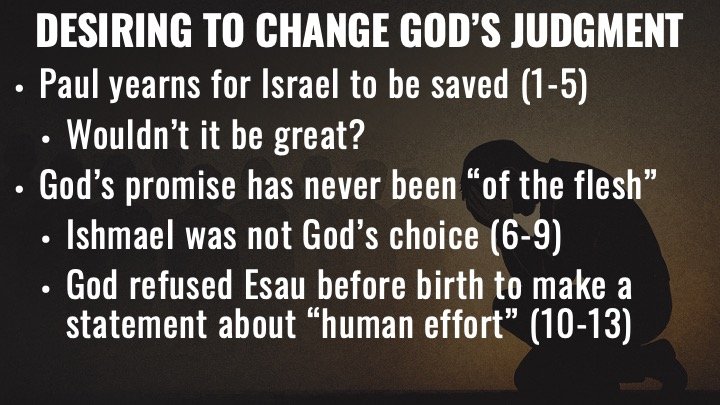
Paul’s Desire
Romans 9:1–5 (ESV) — 1 I am speaking the truth in Christ—I am not lying; my conscience bears me witness in the Holy Spirit— 2 that I have great sorrow and unceasing anguish in my heart. 3 For I could wish that I myself were accursed and cut off from Christ for the sake of my brothers, my kinsmen according to the flesh. 4 They are Israelites, and to them belong the adoption, the glory, the covenants, the giving of the law, the worship, and the promises. 5 To them belong the patriarchs, and from their race, according to the flesh, is the Christ, who is God over all, blessed forever. Amen.
Have you ever felt that? We wish that our friends and relatives would believe the truth, but consider Paul’s situation. He was brought up around people who were diligently studying scriptures and sacrificial serving God. They knew the promises of God and were hoping for God's deliverance. You will struggle to find a group of religious people more zealous than they were. But, after they spent all that time looking for the Messiah, He came and they killed Him. Then, He offered them salvation anyway and they refused to believe it. The situation with the Jewish people in the first century is one of the most tragic of all.
Paul says, “I have great sorrow and unceasing anguish in my heart.” He even wishes that he could somehow give up his own salvation so that his kinsmen could be saved. He has just gone through this detailed explanation of how great our salvation is. He has made it clear that we now have been adopted as children of God and God is on our side. Now, he says, “I would sacrifice that wonderful blessing if I could change the hearts of the Jews.”
Is this the type of heart you have? In this Paul is aware of how evil they have been. He knows that they deserve judgment, but so did he. If they would just open their hearts and believe in Christ, they could receive all the things they are longing for. But imagine the glory if they'd repent: God's wisdom on display, mercy cascading to the world. Instead, rejection breeds chaos and sin. Is your heart this tender? Paul's zeal wasn't naive; it mirrored God's own longing, even amid human hardness.
Not of the Flesh (6-24)
Israel's unbelief can rattle us: "If God couldn't save them—with all their heritage—how can He save anyone?" Paul anticipates this, echoing chapter 3: "What if some were unfaithful? Does their faithlessness nullify the faithfulness of God?" No. God's Word stands firm.
Romans 9:6–9 (ESV) — 6 But it is not as though the word of God has failed. For not all who are descended from Israel belong to Israel, 7 and not all are children of Abraham because they are his offspring, but “Through Isaac shall your offspring be named.” 8 This means that it is not the children of the flesh who are the children of God, but the children of the promise are counted as offspring. 9 For this is what the promise said: “About this time next year I will return, and Sarah shall have a son.”
Paul is pointing out that God has never given His blessing based on man’s desire. Abraham and Sarah chose to have Ishmael through Hagar, and tried to make him the promised child. God did not go with their plan. He chose Isaac over Ishmael and the next section tells us he also chose Jacob over Esau.
Romans 9:10–13 (ESV) — 10 And not only so, but also when Rebekah had conceived children by one man, our forefather Isaac, 11 though they were not yet born and had done nothing either good or bad—in order that God’s purpose of election might continue, not because of works but because of him who calls— 12 she was told, “The older will serve the younger.” 13 As it is written, “Jacob I loved, but Esau I hated.”
“God chose Jacob before he was born.” Now, this has been taken to mean that God makes choices arbitrarily. Notice that’s not the point of Paul’s argument. His point is that the blessing doesn’t come as men would expect or desire. In the story of Isaac and Rebekah, Isaac wants Esau to receive the blessing because he is the first born. But God, knowing how men might choose, created Jacob soft and tender and chose to make him the son of promise. it’s obvious God gives it to whoever He wishes. We cannot dictate who receives His promise.
It Depends on God (14-24)
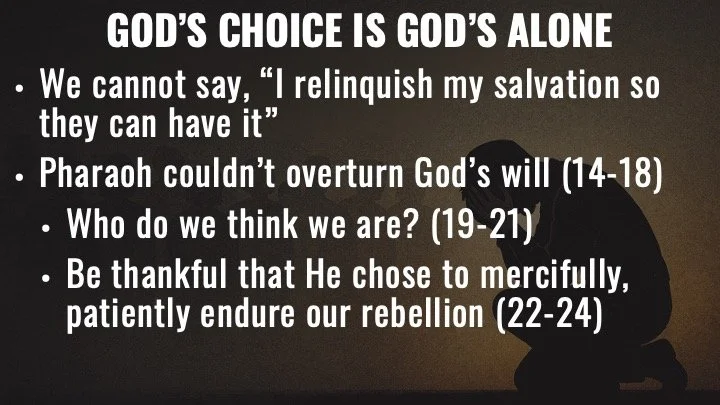
We cannot say, “I give up my salvation for my family to be saved.” No, salvation is about the graciousness of God toward mankind based on HIS SELECTION CRITERIA. We cannot assume that God will save based on what we want or that He will make exceptions to what He has promised. God has to dictate the terms because it’s His salvation to give.
Romans 9:14–18 (ESV) — 14 What shall we say then? Is there injustice on God’s part? By no means! 15 For he says to Moses, “I will have mercy on whom I have mercy, and I will have compassion on whom I have compassion.” 16 So then it depends not on human will or exertion, but on God, who has mercy. 17 For the Scripture says to Pharaoh, “For this very purpose I have raised you up, that I might show my power in you, and that my name might be proclaimed in all the earth.” 18 So then he has mercy on whomever he wills, and he hardens whomever he wills.
The most powerful man on the earth, Pharaoh, could not overturn God’s decision. He points to the Exodus and says, “I raised up Egypt and Pharaoh for the purpose of demonstrating my power and ability to save the children of promise.” God can give mercy to whoever He wants and He can overpower whoever He wants. It’s all for His glory. In this instance, we see that God has a greater purpose behind His choosing. Throughout the OT, we learn that God ties His reputation among the nations to Israel. He wants them to see His ability to save an ungodly and rebellious people and bring them to the promised land. He can do whatever He wants and no one can stop Him.
Romans 9:19–24 (ESV) — 19 You will say to me then, “Why does he still find fault? For who can resist his will?” 20 But who are you, O man, to answer back to God? Will what is molded say to its molder, “Why have you made me like this?” 21 Has the potter no right over the clay, to make out of the same lump one vessel for honorable use and another for dishonorable use? 22 What if God, desiring to show his wrath and to make known his power, has endured with much patience vessels of wrath prepared for destruction, 23 in order to make known the riches of his glory for vessels of mercy, which he has prepared beforehand for glory— 24 even us whom he has called, not from the Jews only but also from the Gentiles?
This last part really summarizes the right God has to do as He wills. He has the right to judge and to provide mercy. We should all be grateful that He chooses to show mercy. I love verses 22-23, “What if God, desiring to show his wrath and to make known his power, has endured with much patience vessels of wrath prepared for destruction, in order to make known the riches of his glory for vessels of mercy, which he has prepared beforehand for glory…” He depicts God as the one who is in complete control, but chooses to show mercy to people who deserve wrath.
This is what God is doing. Israel has rebelled against His Messiah and God is holding back wrath, just like He always has, in hopes that they will repent. Those who do repent, even among the Gentiles are being saved. But those who refuse to repent and trust in Jesus will be judged.
What Is Your Desire?
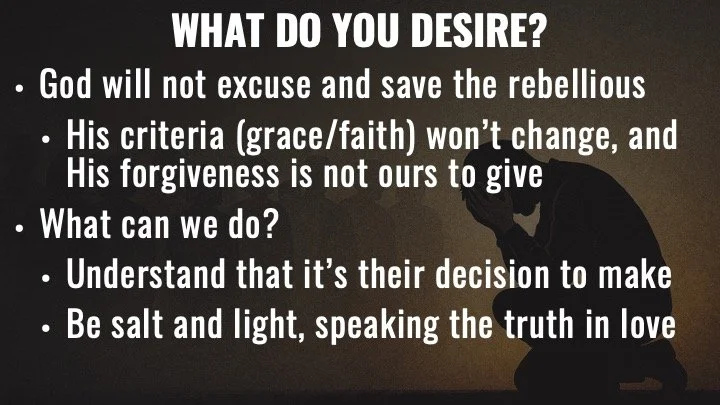
What do we learn from this section of Romans? When we have feelings of heartache and pain over the lost state of someone else, we are getting a taste of what God feels. But God will not bend the rules to save those who remain rebellious. He will only save those who submit to Him, turn from their sins, and put their faith in Jesus. He shows no partiality. It doesn’t matter if you have been brought up in a good home or if you were brought up in a crack house. God will accept all who repent and reject all who refuse.
How does this information affect you? Are you like Paul, longing so deeply for the salvation of someone you love that you would give up your salvation to save them? I’m sorry to tell you, but that’s not possible. Forgiveness of sins is not ours to give. We cannot make someone repent. We cannot make God forgive someone who refuses to repent. Nor should we claim someone is forgiven who never gives their life to God.
When we raise our children, it is critical for us to impress upon them their own responsibility for their faith and their salvation. At some point they will get old enough to understand what sin is and what Christ has done for them. They will have to choose to accept or reject the truth. You cannot save them, but you can prepare them. This is why we don’t baptize infants. They aren’t aware enough to repent of anything and to submit their lives to Christ. We aren’t saving anyone by forcing them to be baptized. Baptism means nothing without faith and repentance.
When we interact with people in our family, our spouse, cousins, brothers, sisters, parents, grandparents, etc. We cannot do anything to force them to believe the truth. They have to make that decision on their own. I have known many people put pressure on their family members to be baptized as though that will do anything without that person’s submission, repentance, and faith. But, what can we do? We can impress upon them the importance of truly giving God their heart. We can talk about spiritual things often enough that it gets them thinking about things differently than they ever have before. We can invite them over and over and over again to show them that what we do in this building and in smaller group Bible studies is valuable to us.
The same goes with friends and coworkers. Be the person who is outspoken about your faith. Be the person who encourages others to trust in Jesus. If you really love them, if you heart breaks to think of them in a lost state, open up to them about the truth of the Bible in a loving way and try to encourage them to join you in Bible study. God will not save them because you are faithful and you really like them. He will not save them even if you offer your own salvation as a sacrifice. That’s not the basis of salvation. We will see this more next time, but understand this right now.
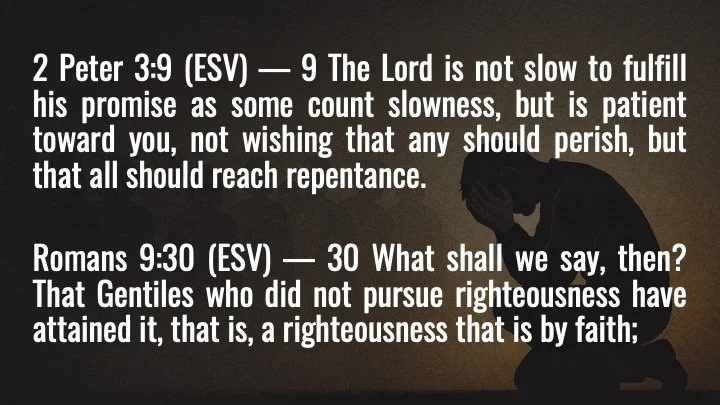
Romans 9:30 (ESV) — 30 What shall we say, then? That Gentiles who did not pursue righteousness have attained it, that is, a righteousness that is by faith;
The only way to be saved is for them to put their trust in Jesus and receive His salvation. The same goes for you.
The Lord is not slow to fulfill his promise as some count slowness, but is patient toward you, not wishing that any should perish, but that all should reach repentance. (2 Peter 3:9; ESV)