
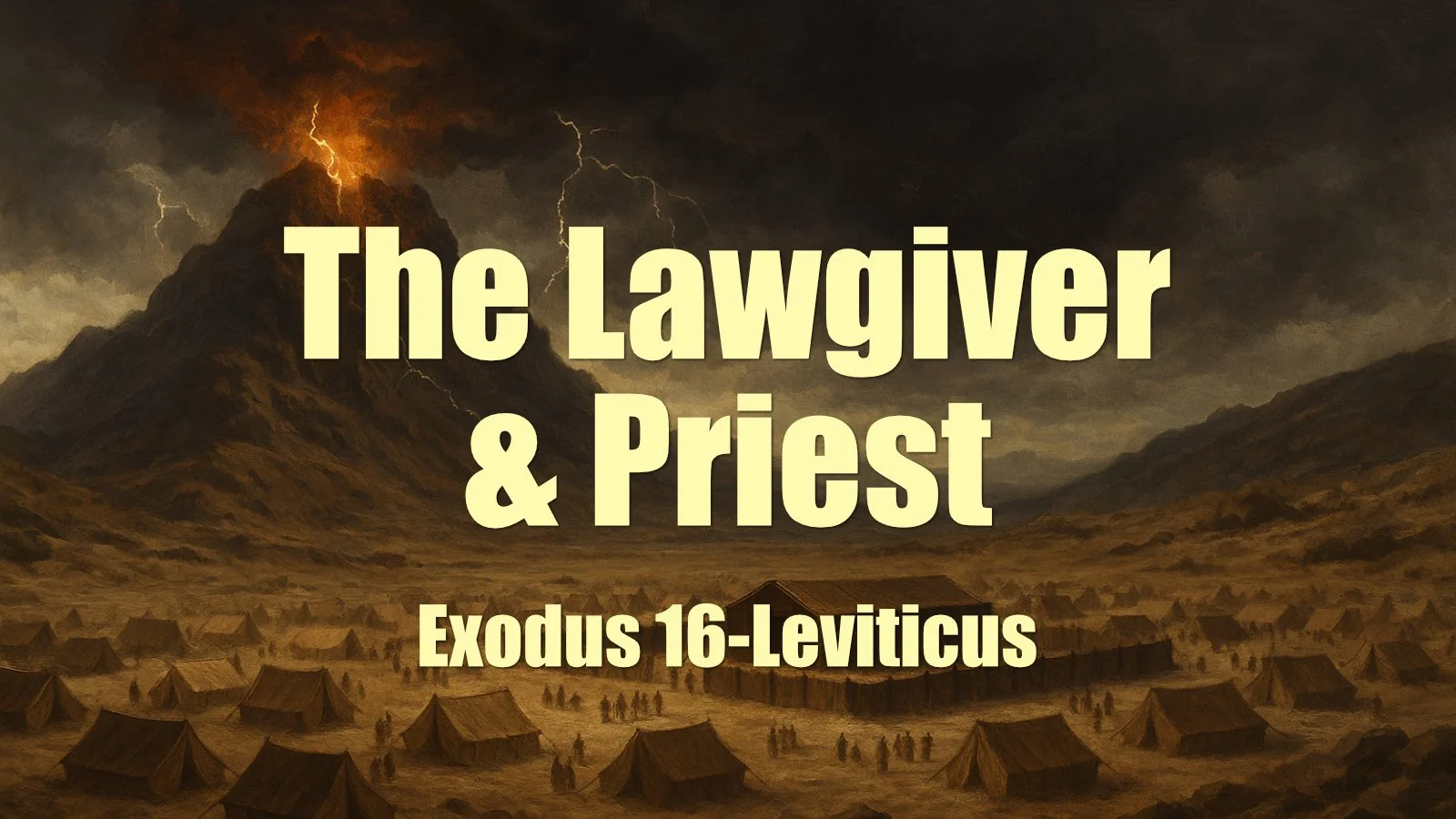
When we look at the life of Moses, it can be broken up into three forty year periods. The first forty year period is when he was in Egypt living in Pharaoh’s palace. The second forty year period was after he murdered an Egyptian and escaped to the wilderness, living as a shepherd. In the third period we have seen God empower Moses to save the people of Israel from Egyptian captivity. Today, we will look at what happens next, Moses’ leadership on the way to Sinai and what happened when he got there. Next week, we will finish with a look at what happened after Sinai.
Picture yourself as Moses' aide, dusty from the march, heart pounding as Pharaoh's chariots vanish behind you.
Leading To Sinai (15-17)
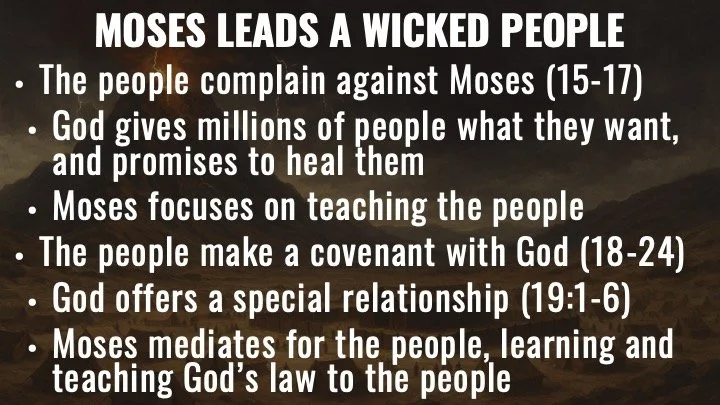
Three days out from the Sea, no water in sight. Imagine over a million souls—men, women, kids, elders—stumbling across the Sinai peninsula. Throats raw, regrets bubbling. They hit Marah, but the water's bitter as gall. "What are we gonna drink?" they lash out at Moses.
You feel the heat and wonder, “What are we going to do?” Moses cries out, and God hands him a log to toss in, and it turns sweet. Then comes the promise: Obey me, and I'll be your healer, not your curse. To seal it, they camp at Elim: twelve springs, seventy palms shading the weary.
But the cycle spins again. Bellies growl because there is no food in this waste. "At least Egypt had pots of meat!.” God tells Moses, "Watch this." Manna rains each dawn like coriander seed—bread from heaven. Quail flutter in at dusk, plump and ready. Gather only what you need; learn dependence, day by day.
Again, think about the craziness of these events. First, people grumble because they are running out of tasty food, then God brings food from the dew every morning! Can you imagine witnessing all of this?
Then they moved deeper into the wilderness and didn’t have water again! So they complain again, but this time they are ready to stone Moses to death! Instead, God tells Moses to strike a rock and water comes streaming out of the rock for all the people.
God is obviously able to take care of the more than one million people, but they get in trouble and blame Moses for their pain. Moses is going through a lot at this time, and he never seems to call for God to destroy them or retaliate against them.
But there is even more stress going on than what it seems. As they were approaching the mountain where Moses had seen the burning bush, his father-in-law came out to meet him with his wife and sons. Over a meal, Jethro sizes up the strain: Moses is juggling prophetic duties (teaching God's ways), priestly mediation (pleading with God), and endless judging (settling squabbles for a million). "You're burning out," Jethro warns. "Delegate—appoint godly men for the small stuff. You handle the big: God's word to the people." Smart counsel. It frees Moses to focus as prophet and budding priest.
All this happened on the way to Sinai.
Arriving at Sinai (18-24)
When they got to Sinai, they came there to offer a sacrifice to God, but first, God wanted to offer them an opportunity to be in a special relationship with Him. If they would keep a covenant agreement with God, He would protect them like He did in Egypt. He would make them his treasured possession, a kingdom of priests and a holy nation (19:4-6). The people all agreed to this so God wanted to meet with them. That’s an amazing idea, isn’t it. God wanted to be clear about this covenant. He is not an imaginary god of the nations. This is the one, true, and living God. Up to this point, Moses has met with God, but no one else has entered into HIs presence.
God tells Moses to prepare the people for this. They need to wash themselves and be completely set apart for the Lord’s presence to come down on the mountain. The language surrounding this event give us the impression that God takes His holiness very seriously.
Exodus 19:21–25 (ESV) — 21 And the Lord said to Moses, “Go down and warn the people, lest they break through to the Lord to look and many of them perish. 22 Also let the priests who come near to the Lord consecrate themselves, lest the Lord break out against them.” 23 And Moses said to the Lord, “The people cannot come up to Mount Sinai, for you yourself warned us, saying, ‘Set limits around the mountain and consecrate it.’ ” 24 And the Lord said to him, “Go down, and come up bringing Aaron with you. But do not let the priests and the people break through to come up to the Lord, lest he break out against them.” 25 So Moses went down to the people and told them.
Imagine a dark cloud descending on the mountain with flashes of lighting and the sound of a trumpet. The mountain starts smoking and a voice comes out speaking, thunderously booming, the ten commandments.
You shall love and serve no one and nothing more than me.
You shall not make any images to worship.
You shall not take my name in vain
You shall remember the Sabbath day and keep it holy
You shall honor your father and your mother
You shall not murder
You shall not commit adultery
You shall not steal
You shall not bear false witness against your neighbor
You shall not covet anything that belongs to your neighbor
This causes the people to tremble and ask for Moses to speak to God for them and let God speak to Moses so they do not die. They are terrified of the voice of God. Moses tells them not to fear, but to understand the seriousness of this covenant they are entering into with God. Then, Moses walked upon the mountain’s thick darkness to speak to God and receive other commands. When he came down, all the people agreed to the covenant and chose to serve God and receive His blessings.
Worship and Sacrifice (Exo 25-Leviticus)
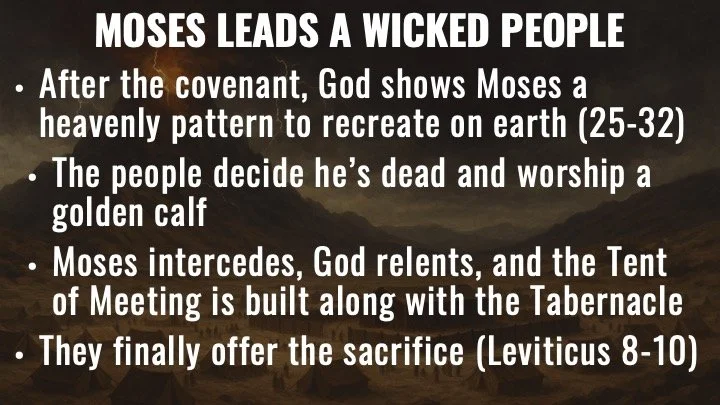
After the covenant was confirmed in Chapter 24, we read about God commanding Moses to build a Sanctuary or Tabernacle where He could meet with His people and they could offer their worship. He gave specific instructions to Moses by showing him a pattern in heaven itself. This place would resemble God’s home on earth and it could become the central focus of the nation. God told them every detail about how to make the Tabernacle and He even inspired some men so that they could create intricate artwork that would resemble the heavenly realities. As God was explaining all of this to Moses and showing it to him over the course of 30 days on the mountain, the people became impatient.
They decided that Moses must be dead. There is no way he could have survived going up on that mountain and being there for 30 days.. So they exalted Aaron and Aaron had them give all their jewelry to sacrifice it to God. This is totally made up off of the top of Aaron’s head, by the way. They threw the gold into the fire and the melted metal resembled a golden calf so they started worshipping it like they had worshipped Egyptian gods.
All they had to do was wait! But they failed to wait and they worshipped an image, the very thing they had agreed not to do. God told Moses what they were doing and Moses had to intercede for the people to prevent their destruction. What they had done showed that they weren’t going to be able to keep a covenant relationship with God. After Moses interceded for the people, the Lord relented and didn’t kill them all. But he did send a plague as he said he would when they disobeyed Him.
From this point on, Moses would receive instruction at a tent of meeting where the people could see him every day. He would enter, God’s glory would fill the tent and speak to Him, then he would leave with a veil over his face because he was shining. God renewed His covenant with the people and promised to bless them after Moses interceded for them.
Then, we read about them finally establishing the Tabernacle and priesthood so they can offer their sacrifice to God as He had commanded them. They did all of the construction to the exact specification that God commanded. Of course, the actual sacrifice takes place in Leviticus and it didn’t go perfectly. Fire came out and consumed the sacrifice to everyone’s delight, but priests disobeyed God and fire came out and consumed them. But they offered their sacrifice and now they were ready to go to the promised land.
Application & Conclusion
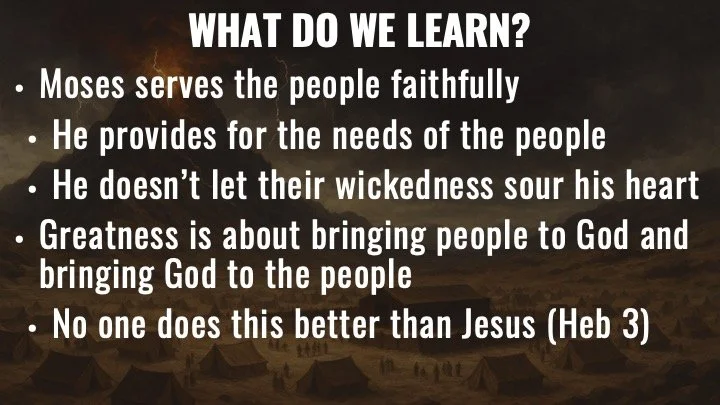
When we see Moses lead the people to Sinai and witness what unfolds there we notice that Moses has a special relationship with God. He has the proper respect and awe, but he also draws near with faith. Moses is constantly providing for the needs of the people. He goes to God and ensures that their needs are met. He intercedes for them when they have greatly sinned against God. He even gets stuck trying to judge between them when they sin against one another, but he finds his way out of that, thanks to his father-in-law.
As we see this part of the story unfold, Moses becomes a true leader of the people. When they look at them, they understand how great and loved by God he is. They hear his words and want to obey the Lord and uphold the covenant. It’s really only when he goes away that they devolve into chaos. His meekness and faithfulness to the people made him a great servant leader, even though the people were very evil and unappreciative of the Lord’s blessings.
What do we learn from this part of the story of Moses? We see in this that greatness is not found in dominating others. Greatness is found in bringing people to God and bringing God to the people. He sets a great example for us to follow in that.
But we also learn that God is holy and He is worthy of reverence and awe. We learn that He wants people to be his treasured possession. He wants His kingdom of priests. Moses, unfortunately, couldn’t make that happen. God’s work to save them from Egypt did not convince the people to be faithful and Israel will not ultimately become what God envisioned them to be.
Do you know that all of this is a shadow for us? The Hebrew writer tells us that we have a greater Moses who provides more for us than Moses did.
Hebrews 3:1–6 (ESV) — 1 Therefore, holy brothers, you who share in a heavenly calling, consider Jesus, the apostle and high priest of our confession, 2 who was faithful to him who appointed him, just as Moses also was faithful in all God’s house. 3 For Jesus has been counted worthy of more glory than Moses—as much more glory as the builder of a house has more honor than the house itself. 4 (For every house is built by someone, but the builder of all things is God.) 5 Now Moses was faithful in all God’s house as a servant, to testify to the things that were to be spoken later, 6 but Christ is faithful over God’s house as a son. And we are his house, if indeed we hold fast our confidence and our boasting in our hope.
He will go on to say that Jesus has entered into the true presence of God to offer himself as a sacrifice on our behalf. He makes us a kingdom of priests, a holy nation, a royal priesthood (1 Pet 2:9-10).
Israel resembles us in the story and Moses resembles Christ. The question, then, becomes will we hold true to our covenant? We have a new law, the law of Christ. Will we submit to it? Will we seek to honor God and His Messiah with our faithful obedience?
There is one more text I want us to consider.
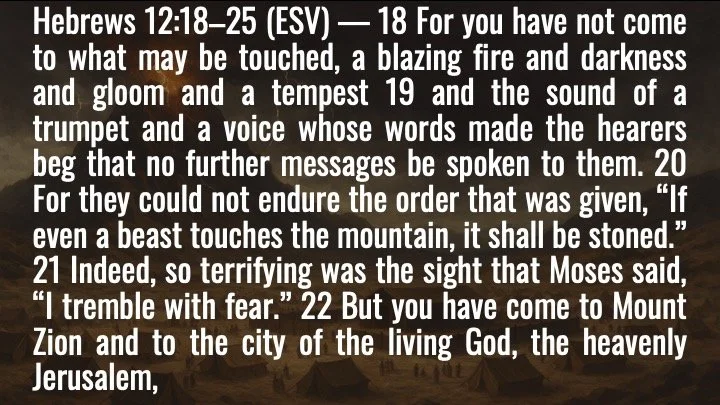
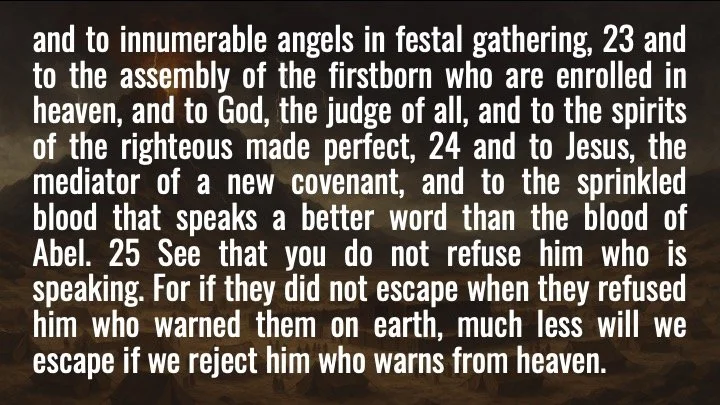
Hebrews 12:18–25 (ESV) — 18 For you have not come to what may be touched, a blazing fire and darkness and gloom and a tempest 19 and the sound of a trumpet and a voice whose words made the hearers beg that no further messages be spoken to them. 20 For they could not endure the order that was given, “If even a beast touches the mountain, it shall be stoned.” 21 Indeed, so terrifying was the sight that Moses said, “I tremble with fear.” 22 But you have come to Mount Zion and to the city of the living God, the heavenly Jerusalem, and to innumerable angels in festal gathering, 23 and to the assembly of the firstborn who are enrolled in heaven, and to God, the judge of all, and to the spirits of the righteous made perfect, 24 and to Jesus, the mediator of a new covenant, and to the sprinkled blood that speaks a better word than the blood of Abel. 25 See that you do not refuse him who is speaking. For if they did not escape when they refused him who warned them on earth, much less will we escape if we reject him who warns from heaven.
Will we appreciate the mountain we are approaching in worship? Will we offer our worship with reverence and awe? This is a much greater mountain than Sinai. This is Mount Zion, the heavenly Jerusalem. Take it seriously.