
Who Will Be Saved (Romans 9:14-10:4)

Who will be saved? That’s the question every soul eventually faces. You can ignore it for a while, you can debate it endlessly, but at the end of the day, everything comes down to that one question.
Last week, we heard Paul’s heart break for his people. He said he would trade his own salvation if it meant Israel could be saved. He loved them deeply—but love doesn’t rewrite God’s plan. Paul reminds us that God’s mercy doesn’t follow our family lines or our moral résumés. He chose Isaac, not Ishmael. Jacob, not Esau. Before they were even born, before they could do good or evil, God made His choice. Why? Because God’s choice of who to save is not about us. It’s about God and His willingness to show mercy.
That truth can be unsettling. It shakes our sense of control. But in today’s text, Paul shows us who God has chosen to have mercy on and who ends up hardened. It’s no mystery, in fact it has been true throughout history. He explains this by walking us through some Old Testament moments that reveal God’s heart.
Mercy Toward the Rebels
Abraham, Isaac, Jacob, and Pharaoh are all events in the OT that prove God has the power to save who He wants to save. Starting in verse 14, he brings in a quote from Moses.
Romans 9:14–15 (ESV) — 14 What shall we say then? Is there injustice on God’s part? By no means! 15 For he says to Moses, “I will have mercy on whom I have mercy, and I will have compassion on whom I have compassion.”
Do you know where that comes from?
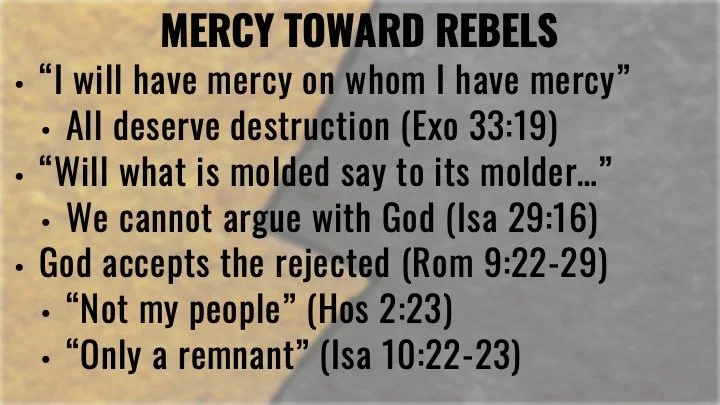
“I will have mercy on whom I have mercy, and I will have compassion on whom I have compassion.” (Exodus 33:19)
Israel has just built a golden calf. They’ve betrayed the very God who rescued them from Egypt. God could have wiped them out. But Moses pleads on the basis of God’s reputation, and God responds by judging some and having mercy on others. Then, Moses asks God to reveal His glory, His very nature. And what does His glory look like? Mercy. Compassion toward the undeserving.
That’s why Paul quotes this passage—to show that God is not unjust to choose mercy. Mercy, by definition, is undeserved. The rebels, people like Aaron, people like us, receive mercy not because they’ve earned it, but because God is glorified when He gives it.
So, who will be saved?
Not necessarily the best of the bad.
Not the ones who sinned less.
But those who receive God’s mercy.
Resisting God’s Will
Second, notice the OT allusion from Isaiah.
Romans 9:19–21 (ESV) — 19 You will say to me then, “Why does he still find fault? For who can resist his will?” 20 But who are you, O man, to answer back to God? Will what is molded say to its molder, “Why have you made me like this?” 21 Has the potter no right over the clay, to make out of the same lump one vessel for honorable use and another for dishonorable use?
Paul knows what people are thinking: “If God’s in control, how can He blame anyone?”
That question comes straight out of human pride. The person who asks this question is essentially claiming, “If we are all bad, it’s your fault because you created us this way!” His words here resemble what he said earlier in Romans 3:5-8, where they might say, “God is unrighteous to inflict wrath on us.”
That’s not a question of curiosity—it’s a question of rebellion. It’s the same tone Israel had in Isaiah 29:16, when they tried to turn the tables and shape God into their image. They treated the Potter like He was the clay.
You turn things upside down!
Shall the potter be regarded as the clay,
that the thing made should say of its maker,
“He did not make me”;
or the thing formed say of him who formed it,
“He has no understanding”? (Isaiah 29:16, ESV)
Paul’s answer?
“Who are you, O man, to answer back to God?”
When we accuse God of being unfair, we reveal how little we understand His holiness. Justice would destroy us all. Mercy saves some.
Who will be saved?
Whoever God wants to save. We have no say in the matter.
Not My People Are My People
The third, fourth, and fifth OT texts tell us very similar things to the previous two.
Romans 9:24–29 (ESV) — 24 even us whom he has called, not from the Jews only but also from the Gentiles? 25 As indeed he says in Hosea, “Those who were not my people I will call ‘my people,’ and her who was not beloved I will call ‘beloved.’ ” 26 “And in the very place where it was said to them, ‘You are not my people,’ there they will be called ‘sons of the living God.’ ” 27 And Isaiah cries out concerning Israel: “Though the number of the sons of Israel be as the sand of the sea, only a remnant of them will be saved, 28 for the Lord will carry out his sentence upon the earth fully and without delay.” 29 And as Isaiah predicted, “If the Lord of hosts had not left us offspring, we would have been like Sodom and become like Gomorrah.”
Paul then turns to Hosea, that heartbreaking story of mercy.
Hosea’s wife betrayed him again and again, yet God told him to go love her. Why? Because that’s what God does. He loves the unfaithful. He calls “Not My People”—His people.
Then Paul quotes Isaiah: even though Israel’s numbers were vast, only a remnant would be saved.
The pattern is consistent: God’s only option is to save from the pool of rebels and rejects.
He turns the rejected into the redeemed.
He welcomes the outsiders, Jew or Gentile alike, because salvation was never about pedigree or worthiness.
Stumbling In Pursuit of Righteousness (9:30-10:4)
The last section we will look at today unveils a very important text to understand who God will save. This text and all of the words around it explain who God will save and who He will reject.
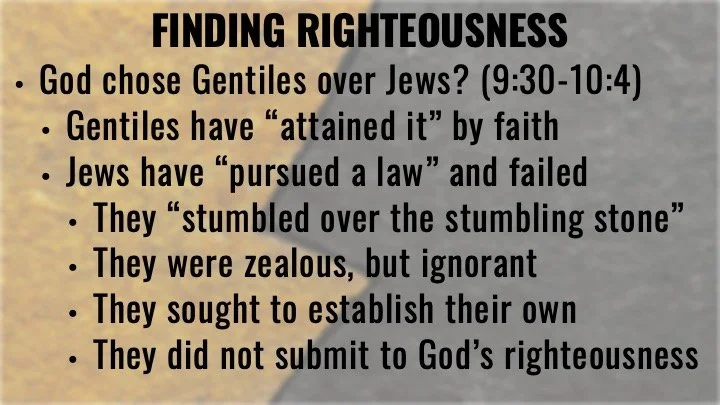
Romans 9:30–10:4 (ESV) — 30 What shall we say, then? That Gentiles who did not pursue righteousness have attained it, that is, a righteousness that is by faith; 31 but that Israel who pursued a law that would lead to righteousness did not succeed in reaching that law. 32 Why? Because they did not pursue it by faith, but as if it were based on works. They have stumbled over the stumbling stone, 33 as it is written, “Behold, I am laying in Zion a stone of stumbling, and a rock of offense; and whoever believes in him will not be put to shame.” 1 Brothers, my heart’s desire and prayer to God for them is that they may be saved. 2 For I bear them witness that they have a zeal for God, but not according to knowledge. 3 For, being ignorant of the righteousness of God, and seeking to establish their own, they did not submit to God’s righteousness. 4 For Christ is the end of the law for righteousness to everyone who believes.
Paul now comes to the heart of it.
“The Gentiles who did not pursue righteousness have attained it… but Israel, who pursued a law that would lead to righteousness, did not succeed.” (Romans 9:30–31)
Imagine two runners. One has trained his whole life, following every rule. The other is unhealthy and hasn’t run unless a bear was chasing him. The trained runner got to the race early and started as soon as he could. He has been running for longer and pushing himself as hard as he can, but he can’t seem to find the finish line. The other shows up late, takes one step and he’s arrived at the finish. That trained runner was going the wrong way.
That’s Israel’s tragedy. They had zeal, but not understanding. They worked tirelessly to prove themselves righteous, never realizing that righteousness was standing right in front of them, Christ Himself.
God put a big rock to help them see which way to go, but they stumbled over the very stone God placed to save them. Those who believed, who rested their hope not on their performance, but on His promise, were lifted up.
“Whoever believes in Him will not be put to shame.”
Conclusion
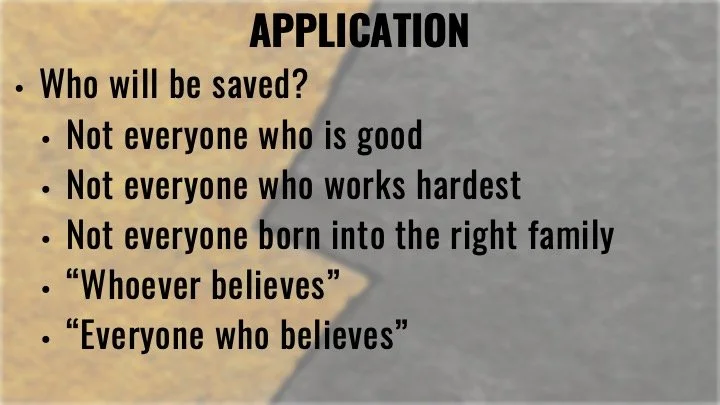
Who will be saved? Note we have the answer to our question.
Not everyone who works hardest.
Not everyone who prays the longest.
Not everyone born into the right family or the right nation.
Everyone who believes in Jesus as the foundation of their righteousness.
The Israelites stumbled because they trusted in themselves. But they have never been able to maintain righteousness. They didn’t last forty days in the wilderness. The Gentiles were made righteous because they trusted in Christ. The difference is faith.
So today, you stand at that same crossroads. Will you stumble over the stone—or will you build your life on Jesus Christ?
God’s mercy isn’t limited to a select few. It’s offered to all. But few will accept it.
If you believe, if you’re ready to put your trust in Him, the invitation is open:
Turn from self-reliance. Be baptized into Christ.
Let Him be your righteousness.
Let Him make you into His child forever.