
Rejected By His Own (Numbers)

Moses had devoted his life to God and to his people. He gave up the palace for the desert. He gave up the comfort for a calling. He faced down Pharaoh, led Israel through the sea, and met with God on Sinai until his face glowed.
He wasn’t perfect, but he was faithful. He carried the burden of a nation on his shoulders — a people who never seemed to understand the cost of what he was doing for them. And in the end, the people he loved most rejected him.
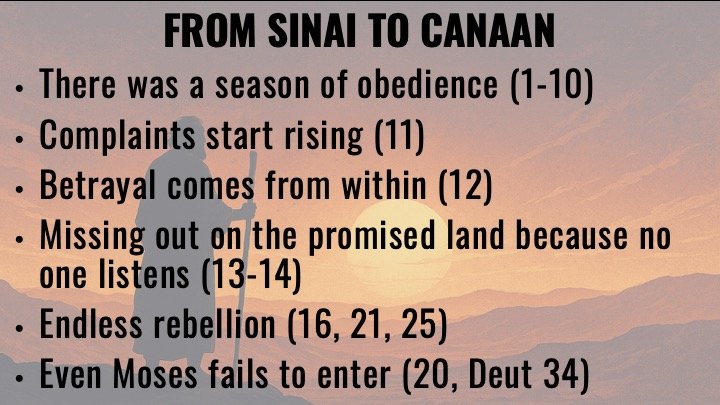
1. The Season of Obedience (1-10)
For nearly a year, everything looked right in Israel’s camp.
Every morning, the people woke to find the ground dusted with manna—soft, white flakes like dew from heaven. The children would run out laughing, scooping it up like snow. Every evening, quail descended, filling the camp. When they were thirsty, Moses struck the rock and water gushed out.
Life was steady. Predictable. Peaceful.
When the cloud of God rose, they marched. When it stopped, they rested. At night, they could see the glow of fire over the tabernacle—proof that God Himself was in the middle of their camp. Imagine the comfort of that! You could tuck your kids in at night, glance toward the flickering light of God’s glory, and whisper, “He’s with us.”
For eleven months, they lived in step with God. Whenever it was time to leave, they still had God leading them. The ark would set out and Moses would raise his voice over the camp:
“Arise, O Lord, and let Your enemies be scattered!”
And when it rested, he’d say,
“Return, O Lord, to the ten thousand thousands of Israel.”
2. The Cracks Begin to Show
But their hearts grew restless as they suffered some discomfort.
Soon the complaints began. There were whispers in the dark that turned into open grumbling. Traveling with two million people was no small task. Tempers flared. The food bored them. The routine wore thin.
“We remember the fish in Egypt,” they said. “The cucumbers, the melons, the garlic…”
They were willing to be enslaved again to enjoy some seasoning on their food. Moses heard the crying from every tent — a low, rising roar of dissatisfaction. He’d led them out of slavery, but he couldn’t seem to lead them into gratitude.
The pressure broke him. Listen to his words:
“Did I conceive all this people? Did I give them birth? Where am I supposed to get meat for them? I can’t carry them anymore, Lord. The burden is too heavy. If this is how it’s going to be, just kill me now.”
That’s not a man giving up — that’s a man collapsing under weight no one else could carry.
God answered — not by killing him, but by sharing the load. Seventy elders were filled with His Spirit to help. And to the people craving meat, He sent so much quail that it piled knee-deep around the camp — until their greed became their judgment. They engorged themselves, and God struck them with a plague.
The wilderness had exposed their hearts.
3. Betrayal from Within
Miriam and Aaron, Moses’ own sister and brother, started murmuring behind his back.
“He married a Cushite woman,” they said. “Does God only speak through Moses? Doesn’t He speak through us too?”
It wasn’t about his wife—it was about his authority.
Moses said nothing. The text says, “He was the meekest man on the earth.”
He had every reason to defend himself—but he didn’t.
So God defended him.
A cloud descended, and the Lord said,
“When I speak to a prophet, I speak in dreams and visions. But not so with My servant Moses. With him I speak face to face. Why then were you not afraid to speak against him?”
When the cloud lifted, Miriam was covered in leprosy. White as snow.
Aaron panicked, begging Moses to forgive them.
And the man they wounded prayed for their healing.
“Lord, please heal her.”
That’s meekness, compassion, and love.
It’s hard enough to be rejected by strangers. But when it’s family, people who should have your back, it cuts deeper.
4. When No One Listens
Eventually, they arrived at the edge of the Promised Land. The spies returned, carrying fruit so large two men had to carry it on a pole. The land was everything God promised. But there were giants.
That night, the people wailed.
“We’re going to die! Our children will be taken as slaves! Let’s choose a leader and go back to Egypt!”
Moses and Aaron fell facedown in the dirt, speechless.
God’s anger burned. He said, “I will wipe them out and start over with you, Moses.”
But once again, Moses stood in the gap:
“Lord, if You destroy them, the nations will say You failed. Show mercy—not because they deserve it, but because Your steadfast love is great.”
And God relented. He spared the nation—but not without consequence. Everyone over twenty years old would die in the wilderness.
Now pause for a moment. Let that sink in. That’s roughly two million people. That means for forty years, about fifty thousand people died every year. Every tent saw death. Every family buried loved ones. Every sunrise was a reminder of what rebellion costs.
5. Rebellion Without End
Even after all that, the rebellion didn’t stop.
Some tried to enter the land anyway and were crushed by their enemies.
- Korah’s family rose up to seize control, and the earth swallowed them whole.
- The people complained again, and God sent fiery serpents into the camp.
- They gave in to Moab’s idols and immorality, and God struck them down again.
It’s a downward spiral—sin, judgment, mercy, repeat. The people wouldn’t submit to God from the heart. And eventually, even Moses himself reached a breaking point—he struck the rock in frustration instead of speaking to it as God commanded.
That one act cost him entry into the Promised Land.
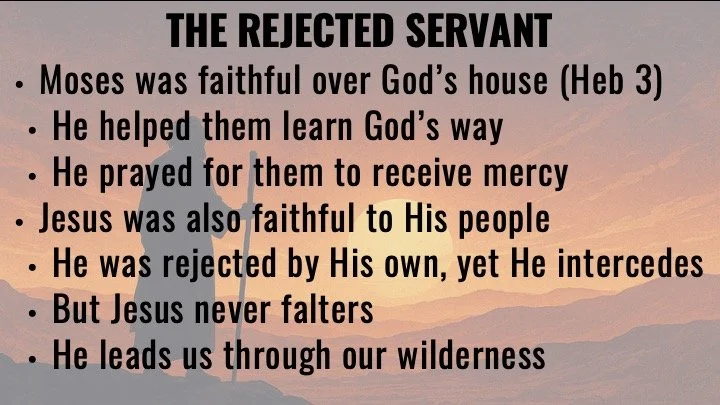
The Rejected Servant
By the end of his life, Moses stood on a mountain overlooking the land he’d longed for. He could see it—but he could not enter it. He had carried those people for forty years, prayed for them, fought for them, loved them—and they rejected him.
It’s one of the saddest and most beautiful moments in Scripture. Because Moses’ story points to someone greater.
Like Moses, Jesus came to deliver His people.
Like Moses, He interceded for those who sinned.
Like Moses, He was rejected by His own.
But unlike Moses, He never faltered.
He bore the rebellion of men, and through His rejection, brought redemption to us who accept Him.
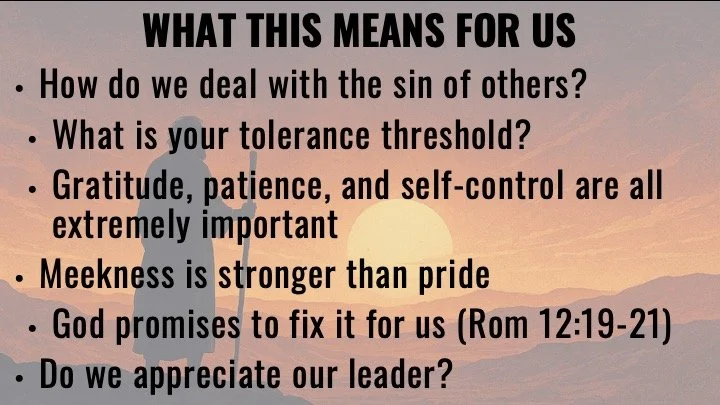
What This Means for Us
Gratitude must replace grumbling.
We must learn from the failure of the Israelites. God’s people are not meant to complain about what they lack. They ought to rejoice in what He provides. Our wilderness reveals what’s in our hearts. Israel’s unbelief cost them forty years of wandering and countless lives. Failing to trust in God and pursuing shortcuts always leads to death. Believe in God’s promises and walk by faith, not by sight.Meekness is stronger than pride.
Moses teaches us that silence under attack often speaks louder than defense. The meek will inherit the earth—not the loud. I love how Moses remained quiet and God spoke up for him. We are told in the NT to do good for our enemies because God will give them the judgment they deserve if they don’t repent (Romans 12:19-21)Christ is the greater Moses.
Moses is one of the greatest men to ever live, but he could only do so much to help the people of Israel draw near to God. He was able to enter God’s presence and his face shone, but Israel was outside. Consider how much greater Jesus is. Jesus brings us in. He intercedes even now for those who once rejected Him and makes a way for them to enter God’s presence.