
God Fills His House (Luke 14:1-24)

Have you ever walked into a room and immediately realized something was wrong? Everyone looks up. The conversation stops. You can tell that you do not really belong there. Or perhaps it is the opposite. Everyone in the room seems comfortable doing something that you know is wrong, and suddenly you feel out of place.
In Luke 14, Jesus walks into a room like that. It is a dinner party, but something about the table is deeply corrupt.
The Table of Corruption (14:1–6)
In Luke 14, Jesus enters the house of a Pharisee on the Sabbath. But we quickly learn that this is not a friendly invitation.
Luke 14:1–6 (ESV)
One Sabbath, when he went to dine at the house of a ruler of the Pharisees, they were watching him carefully. And behold, there was a man before him who had dropsy. And Jesus responded to the lawyers and Pharisees, saying, “Is it lawful to heal on the Sabbath, or not?” But they remained silent. Then he took him and healed him and sent him away. And he said to them, “Which of you, having a son or an ox that has fallen into a well on a Sabbath day, will not immediately pull him out?” And they could not reply to these things.
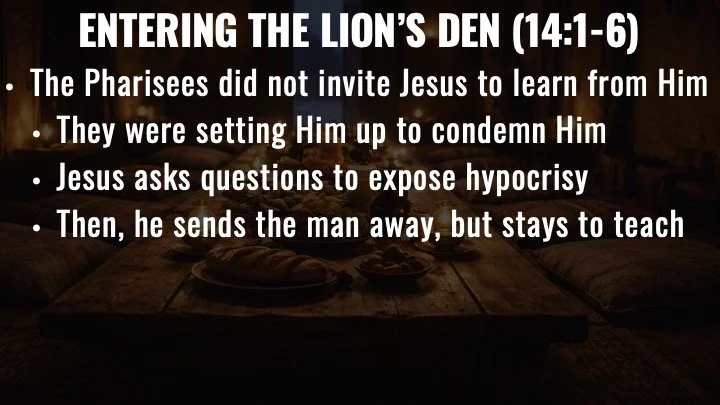
The Pharisees and lawyers did not invite Jesus because they wanted to learn from Him. They invited Him because they wanted to condemn Him. They placed a suffering man directly in front of Him, a man with dropsy, not because they cared about him, but because they wanted to trap Jesus.
Think about how cruel this is. The only reason this man is allowed into the room is because of his disease. He is being used as bait. But Jesus is not trapped. Before He heals the man, He asks a question that exposes their hypocrisy: “Is it lawful to heal on the Sabbath?” They remain silent.
Notice how Jesus approaches the moment. He does not shout or accuse. Instead, He asks a question that reveals the truth. “Which of you, having a son or an ox that has fallen into a well on a Sabbath day, will not immediately pull him out?” The question is simple. If your child fell into a well, you would not leave him there because it was the Sabbath. If your animal fell in, you would rescue it immediately. If mercy is acceptable for animals and property, why not for a suffering man?
They cannot answer Him—not because the question is difficult, but because the answer exposes them.
Jesus heals the man and sends him away. You can almost imagine the relief of that man leaving the room. His joy over being healed would have been overshadowed by the cold hostility of everyone else at the table.
The healed man leaves the room, but the sickness in the room remains. The table is still filled with pride, ambition, and manipulation, and Jesus begins to expose it.
Reversing the Status (14:7–14)
Appropriate Actions of Those Invited (7–11)
Luke 14:7–11 (ESV)
Now he told a parable to those who were invited, when he noticed how they chose the places of honor, saying to them, 8 “When you are invited by someone to a wedding feast, do not sit down in a place of honor, lest someone more distinguished than you be invited by him, 9 and he who invited you both will come and say to you, ‘Give your place to this person,’ and then you will begin with shame to take the lowest place. 10 But when you are invited, go and sit in the lowest place, so that when your host comes he may say to you, ‘Friend, move up higher.’ Then you will be honored in the presence of all who sit at table with you. 11 For everyone who exalts himself will be humbled, and he who humbles himself will be exalted.”
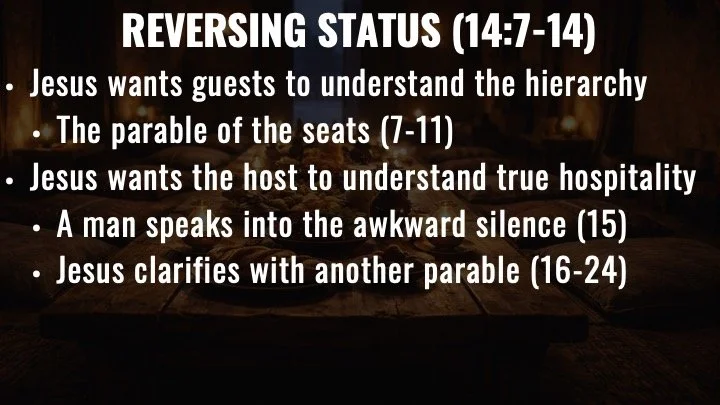
Jesus noticed something happening at the dinner table. The guests were scrambling for the seats of honor. In that culture, where you sat at a banquet communicated your importance. The closer you sat to the host, the greater your honor. Everyone wanted the best seat.
Jesus tells them a parable. When you are invited to a wedding feast, do not take the place of honor. Someone more distinguished may arrive, and the host may ask you to give up your seat. Then you will be forced, in shame, to take the lowest place. But if you take the lowest place first, the host may come and say, “Friend, move up higher.” Then you will be honored in the presence of everyone.
Pride always assumes more honor than it deserves. Jesus summarizes the lesson with a principle that runs throughout Scripture: “Everyone who exalts himself will be humbled, and he who humbles himself will be exalted.” This is not merely social advice; it reflects how God governs His kingdom. God brings down the proud and lifts up the humble.
Yet how many people today are still trying to elevate themselves? How many push for greater recognition, greater influence, and greater control? Jesus teaches us to do the opposite. Seek the lower place and let God be the one who exalts.
Appropriate Actions of Those Hosting (12–14)
Jesus then turns to the host.
Luke 14:12–14 (ESV)
He said also to the man who had invited him, “When you give a dinner or a banquet, do not invite your friends or your brothers or your relatives or rich neighbors, lest they also invite you in return and you be repaid. 13 But when you give a feast, invite the poor, the crippled, the lame, the blind, 14 and you will be blessed, because they cannot repay you. For you will be repaid at the resurrection of the just.”
The host had carefully chosen his guest list. He invited the upper echelon—the people who mattered, the people who could benefit him. Jesus tells him he should have invited the poor, the crippled, the lame, and the blind. Why? Because they cannot repay you.
What the host had done looked like generosity, but it was really strategy. It was not generosity; it was networking. It appeared to be kindness, but it was actually manipulation—inviting people who could increase your status.
Jesus teaches that true generosity expects nothing in return. God Himself will repay those who give without expecting repayment.
At this point, Jesus has effectively offended everyone at the dinner party. The guests have been exposed for their pride, and the host has been exposed for his manipulation. The room grows quiet.
God’s Invitation (14:15–24)
In the awkward silence, someone tries to rescue the moment with a safe religious statement.
Luke 14:15 (ESV)
“Blessed is everyone who will eat bread in the kingdom of God!”
The statement is true. It will be a great blessing to eat bread in the kingdom of God. However, the man likely assumed that everyone sitting at that table would be there. Jesus responds with a parable.
Luke 14:16–24 (ESV)
16 But he said to him, “A man once gave a great banquet and invited many. 17 And at the time for the banquet he sent his servant to say to those who had been invited, ‘Come, for everything is now ready.’ 18 But they all alike began to make excuses. The first said to him, ‘I have bought a field, and I must go out and see it. Please have me excused.’ 19 And another said, ‘I have bought five yoke of oxen, and I go to examine them. Please have me excused.’ 20 And another said, ‘I have married a wife, and therefore I cannot come.’ 21 So the servant came and reported these things to his master. Then the master of the house became angry and said to his servant, ‘Go out quickly to the streets and lanes of the city, and bring in the poor and crippled and blind and lame.’ 22 And the servant said, ‘Sir, what you commanded has been done, and still there is room.’ 23 And the master said to the servant, ‘Go out to the highways and hedges and compel people to come in, that my house may be filled. 24 For I tell you, none of those men who were invited shall taste my banquet.’ ”
The feast is prepared, and everything is ready. The invitation goes out, but the invited guests begin making excuses. One has purchased a field and needs to inspect it. Another has bought oxen and must test them. Another has just gotten married.
Notice something important. None of these excuses are sinful. Buying land is not sinful. Working with oxen is not sinful. Marriage is not sinful. The problem is not immorality. The problem is preference. They simply want something else more than they want the banquet.
They are polite, but they are rejecting the host. He had prepared everything for them, yet they undervalued the invitation.
When the servant reports this, the master responds by sending his servant into the streets to bring in the poor, the crippled, the blind, and the lame. When there is still room, the servant is sent farther—to the highways and hedges—to invite everyone he can find.
The master says, “Go out and compel people to come in, that my house may be filled.” But the parable ends with a warning: “None of those men who were invited shall taste my banquet.” Those who had the first opportunity will miss it entirely.
Presuming on Kindness
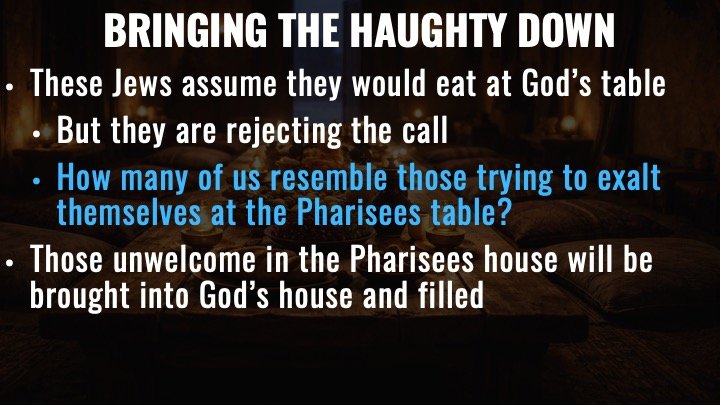
The purpose of this parable is to expose the danger of presumption. The people listening to Jesus assumed they would eat bread in the kingdom of God. They believed they had first rights to the table. Jesus warns them that being invited does not guarantee participation, and refusing the invitation has consequences.
Those who rejected the call had reasons and priorities, but they valued other things more than the banquet itself. Those who elevate their own priorities above God’s invitation will not enter the kingdom. Yet those who appear unworthy—the outsiders, the poor, and the forgotten—will be welcomed. God delights in exalting the lowly and humbling the proud.
God Fills His House
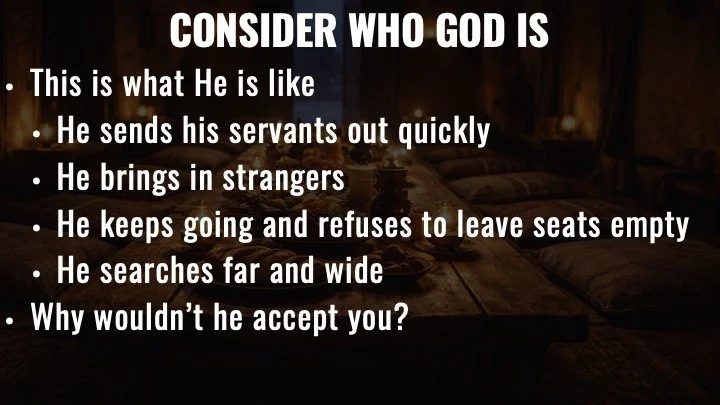
When we look closely at this parable, we learn something powerful about God. Look at the determination of the master. He sends his servants out quickly. He tells them to bring people in. When there is still room, he sends them farther out. This host refuses to leave seats empty.
This is what God is like. God wants His house filled.
He sends His servants into the streets and then into the highways and hedges. He searches for those who seem least likely to attend the banquet. Some people think God is reluctant to accept them, believing they must clean themselves up before they can come to Him. But the picture in this parable shows the opposite. God is searching the streets and highways, looking for people to bring in.
If you are here today thinking that God would never accept you, look at this parable and be persuaded. God will accept anyone who humbles themselves and comes to Him.
Jesus was surrounded by people who would never have invited you into their homes, but Jesus invites you into His Father’s house. The feast is ready.
Do not disregard this opportunity. Do not prioritize things that do not matter. Jesus calls this opportunity a treasure worth selling everything to obtain.
Receive it.
And if you have accepted the invitation, you are not just a guest. You are a servant of the Host. The master said, “Go out and bring them in.” God still wants His house full, so go and invite someone.