
Manipulating God (Judges 10-11)
God’s relationship with Israel is descending into complete apostasy. Since God has allowed the people of the land to remain within the country, Israel has taken up worshipping any god they can find. Eventually, God sells them into the hand of an evil nation. They feel the weight of disobedience. Then, they cry out for help, and God sends a judge to deliver them. We have been seeing this cycle on repeat for weeks. Now, it’s time for things to change a little.
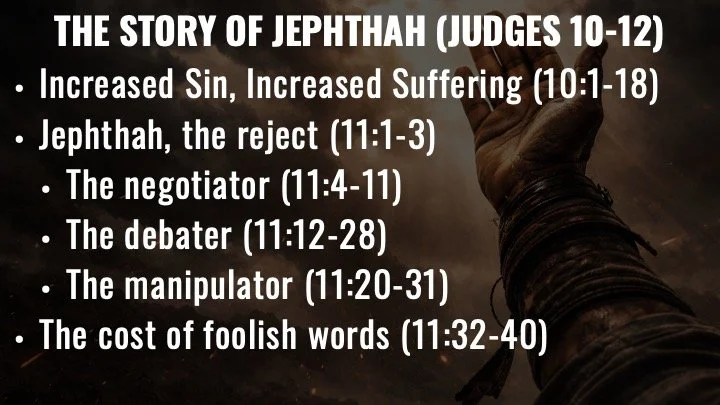
Increased Sin, Increased Suffering (10:1-18)
Judges 10:6–7 (ESV) — 6 The people of Israel again did what was evil in the sight of the Lord and served the Baals and the Ashtaroth, the gods of Syria, the gods of Sidon, the gods of Moab, the gods of the Ammonites, and the gods of the Philistines. And they forsook the Lord and did not serve him. 7 So the anger of the Lord was kindled against Israel, and he sold them into the hand of the Philistines and into the hand of the Ammonites,
We have the same set up, but notice this time that Israel has chosen all the gods. They are opening themselves up to every god in the surrounding nations. This makes God angry enough to sell them into the hands of two nations: The Philistines from the west and the Ammonites from the east. If they were going to increase their rebellion, God would increase their oppression.
The next stage in the cycle is also different. They cry out to God. He says, “No.” God never says that. He always raises up a deliverer, fills him with the Spirit and defeats their enemies. But this time He lets them rely on their fake gods to save them. This is the point in the story where we say, “Ha! Serves them right!” But as the Philistines and Ammonites start to oppress Israel, it would become a very sad scene. The people respond to God’s rejection by relying on God more. They put away all the foreign gods. They submit themselves to whatever God wills. They say, “We have sinned; do to us whatever seems good to you. Only please deliver us this day.”
God’s heart was affected by their turn and he grew impatient watching them suffer for their sin.
The Man Nobody Wanted (11:1-11)
The solution to this oppression was not to give up. They would fight back. The problem is that the Ammonites were coming in and posing some major issues and they needed someone to lead them. Additionally, they seemed to struggle finding someone who would be willing and able to lead the fight.
This is where Jephthah the Gileadite comes into the picture. Jephthah was described as a mighty warrior, but also the son of a prostitute who was rejected by his own family. Apparently, Jephthah’s brothers chased him off. He surrounded himself with worthless men and was probably known for raiding.
The elders of Gilead decided that Jephthah was their only hope. So, they called for him to be their leader in the fight. But Jephthah doesn’t immediately jump on the opportunity. First, he questions them, “Did you not hate me and drive me out of my father’s house? Why have you come to me now when you are in distress?” He sounds hurt by the rejection. But notice that these words aren’t a refusal, but a negotiation tactic. The result is that they swear an oath to the Lord that he will be their head if he was successful against the Ammonites. They agree.
The Negotiator (11:12-28)
Jephthah’s approach to handling the Ammonites started with asking a simple question, “What do you have against me, that you have come to me to fight against my land?” Notice the self focus.
The king of the Ammonites claimed that Israel had taken the land from Ammon when they came up out of Egypt. This resulted in some discussion where Jephthah proves that he knows Israel’s history and the Ammonites are liars. However, Jephthah also reveals some twisted thinking about how gods work. He claims that Ammon’s god should be able to provide them with their land like Israel’s God.
When the king of Ammon doesn’t give up his pursuit, Jephthah declares that he is in the right and they are wrong. Then, he calls for the Lord to decide the fate.
The Manipulator (20-31)
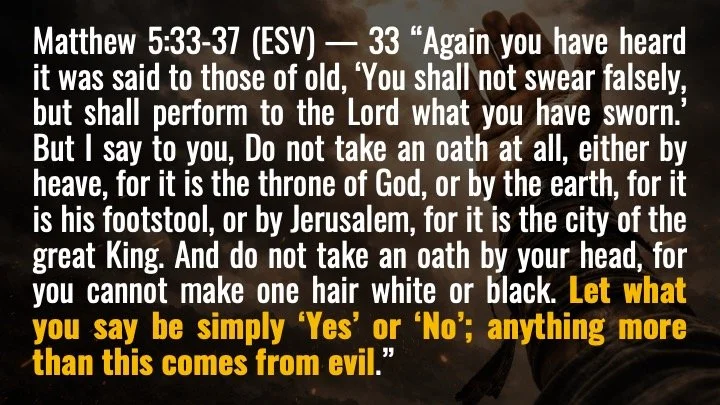
In verse 29, we read that the Spirit of the Lord was upon Jephthah. Up to this point, he was just selected by the people. Now, God has clearly chosen to strengthen him and give him success. When he comes to the Ammonite army, though, something comes over him. He decides to make a vow to the Lord, saying, “If you will give the Ammonites into my hand, then whatever comes out of the doors of my house to meet me when I return in peace from the ammonites shall be the Lord’s, and I will offer it up for a burnt offering.”
When we read this vow, the whole story shifts. Why would Jephthah offer what comes out of his house as a burnt offering? Does he let the sheep and goats live in his house? It’s a bizarre vow to have after claiming to believe God would judge the Ammonites through him.
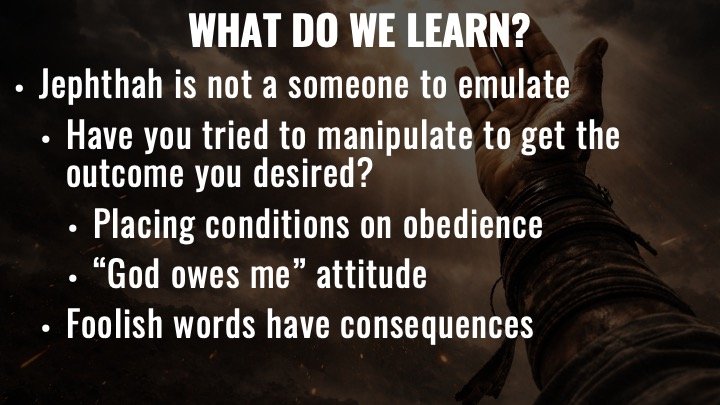
He looks at God as though He must be persuaded and blessings must be purchased. As though God needs something from us that we can provide. He thinks that offering a sacrifice will force God’s hand. We do this too. We say, “God, if you will help me, I promise…” We don’t trust His grace. Instead, we try to manage the outcome by gaining spiritual leverage.
The Cost of Trying To Control God (32-40)
Jephthah wins the battle. When he gets home we could just imagine his only daughter’s excitement. She comes running out of the door first to wrap her arms around her father. But Jephthah is not happy. His mouth was his greatest weapon, but now he has hurt himself with it. Jephthah’s daughter takes it better than she should have. She doesn’t try to negotiate or manipulate. All she asks for is two months to mourn for the fact that she wasn’t able to have children. This is Jephthah’s only child, so this would result in the end of Jephthah’s line.
Verses 39 tells us that he did with her according to his vow that he had made. Some try to claim that he didn’t really kill his daughter and offer her up to be a burnt sacrifice. The remaining a virgin could indicate that she was just devoted to the Lord and unable to have children for that reason, but the text says he did according to his vow.
What Do We Learn?
You know, Jephthah would go on to fight again against Israelites. He ends up killing 42,000 from the tribe of Ephraim because they were mad at him for going up against the Ammonites without them.
Jephthah is not a good guy. Offering your child as a burnt sacrifice seemed like a devoted and righteous thing to do in the sight of the people of his day, but it was an abomination to the Lord
Deuteronomy 12:31 (ESV) — 31 You shall not worship the Lord your God in that way, for every abominable thing that the Lord hates they have done for their gods, for they even burn their sons and their daughters in the fire to their gods.
But God is able to use him to save his people, and God even has him listed among the men of faith in Hebrews 11 along with Gideon and Samson.
So, what do we learn from this man’s life?
We Don’t Need To Bargain
When I read the story of Jephthah it strikes me that the Spirit of the Lord is given to him before he makes the vow. After he makes the vow and all the way through the rest of the story of Jephthah, we read nothing from God. His silence speaks volumes.
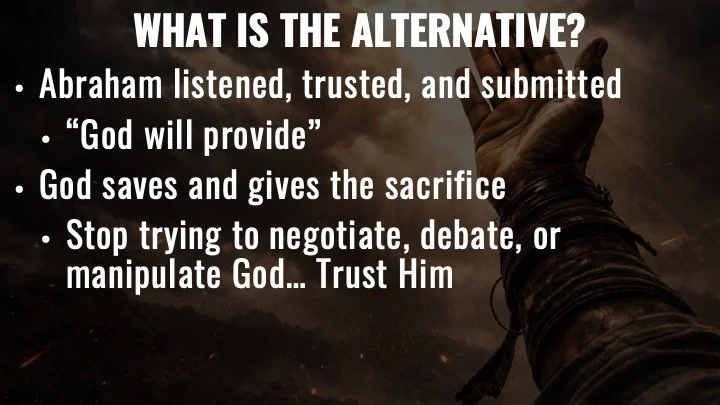
Think of Abraham. In Abraham’s story, God told him to sacrifice Isaac. Abraham didn’t bargain with God or try to manipulate. He just submitted to whatever God wanted. Then, when he was raising the knife, God spoke and stopped him. This did not happen for Jephthah. He is the opposite of Abraham in this foolish act. He decides to vow this because he wants to control the outcome.
When we do the same thing, we are trying to bargain with God. We don’t need to do that. Instead, we need to trust him. When I think I must control things I’m showing God I don’t trust him. He was going to deliver the Ammonites without the vow.
God Pays The Price, Not Us
There is one other father who chooses to sacrifice his only child. Think for a moment about Jesus. He doesn’t make a vow or bargain for his life in Gethsemane. He submits his will freely. He doesn’t offer up someone else. He offers himself up. Jephthah says, “If you will give me victory, I will sacrifice.” Jesus says, “Your will be done.” Jephthah’s vow leaves people grieving. Jesus’ submission brings great joy.
This is a reminder that we don’t save ourselves. Trying to bargain with God is foolishness. We don’t have to promise him enough, earn enough, or control the outcomes enough because He has already given us what we need. Before we were born he decided to love people like us. People who humble themselves and submit their will like Jesus has.
Conclusion
So, stop negotiating with God. Stop saying, “If you do this, I will follow,” or “Once things feel safe, I’ll surrender.” Faith is not about controlling God. It’s not about manipulating him to make our lives better. Don’t let your fear lead your faith.
Trust God and find hope in his goodness and strength. The question is not what you will offer to secure a place in heaven with God. The question is whether you will trust that He has done what you cannot do and offered you salvation freely.