
The God Who Stops (Luke 10:25-37)

Today, we will begin to look at parables. If you are not familiar with the parables of Jesus, they are stories intended to teach a lesson to the hearers. The purpose of parables is to simultaneously conceal the point from those who refuse to investigate further and reveal truth on a deeper level to those who pay attention.
Luke 8:10 (ESV) — “He said, ‘To you it has been given to know the secrets of the kingdom of God, but for others they are in parables, so that “seeing they may not see, and hearing they may not understand.”’”
When people hear these teachings, they cannot remain neutral. Parables are not bedtime stories, they are invitations and confrontations. They either draw a person in to seek deeper understanding or push them away in resistance. The parable presses the listener to respond.
But we aren’t going to study the parables merely to understand what parables are. I am choosing these specific parables because they give us insight into the mind of God. I believe that a clearer understanding of God will help us become who we are supposed to be.
In this series, I want us to understand the purpose of the parable and then take some time to consider how this teaching reflects God’s character. Today, we will look at the parable of the Good Samaritan.
The Lawyer Tests Jesus
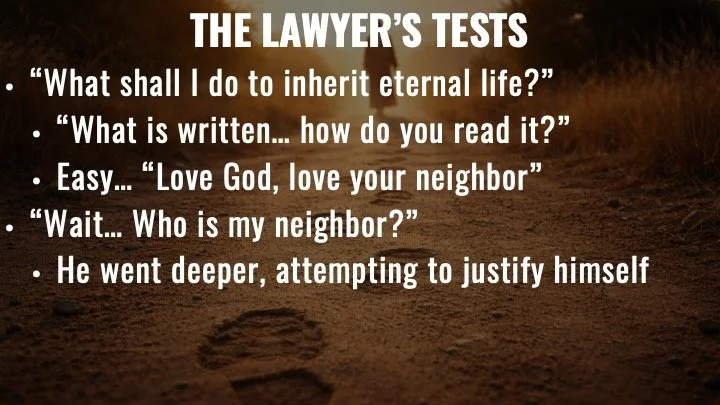
“What shall I do to inherit eternal life?”
“Behold, a lawyer stood up to put him to the test, saying, ‘Teacher, what shall I do to inherit eternal life?’” (Luke 10:25)
To inherit something is to receive what belongs to the family. So this man is asking, “How do I make sure I belong in God’s family when the age to come arrives?”
When the lawyer asked this question, Luke tells us it was a test. The lawyer already has an idea, but he wants to see if Jesus teaches the truth. In response, Jesus turns the tables and says, “What is written in the Law? How do you read it?”
Notice that Jesus’ question is twofold. First, He asks this expert to recount what the Law says, what is written, after dedicating his life to studying it. Then He asks him to give his interpretation, how he reads it. The lawyer responds, “Love the Lord,” and “Love your neighbor.” Jesus agrees with him.
So, all one must do to inherit eternal life is love the Lord and love their neighbor. That sounds simple enough. But is it? What does it mean to love God? What does it mean to love your neighbor?
The question beneath the question
This is what the lawyer starts to wrestle with, because the text tells us his follow-up question was an attempt to justify himself. He asks, “And who is my neighbor?”
Have you ever sought the answer to a question, only to realize your original question didn’t go deep enough? The answer didn’t satisfy the curiosity within you. But can we handle the deeper truth? We all struggle with accepting the truth. It’s like a barrier we have to break through. I truly appreciate the weight of the question he asks, even if his motives are wrong. Are we willing to ask deeper questions? May we all have that level of scrutiny.
It would be commendable for the lawyer to go deeper, if we didn’t already know his motive. He knows these commands are not simple. So he seeks to justify himself and continues testing Jesus.
The most dangerous people in the room are not always the openly rebellious. Often, they are the ones trying to justify themselves. Everything they say becomes an attempt to shift blame and avoid fault. The lawyer isn’t seeking clarity, he’s seeking boundaries. He wants to know how far his obligation goes, and where it can safely stop.
The road of exposure
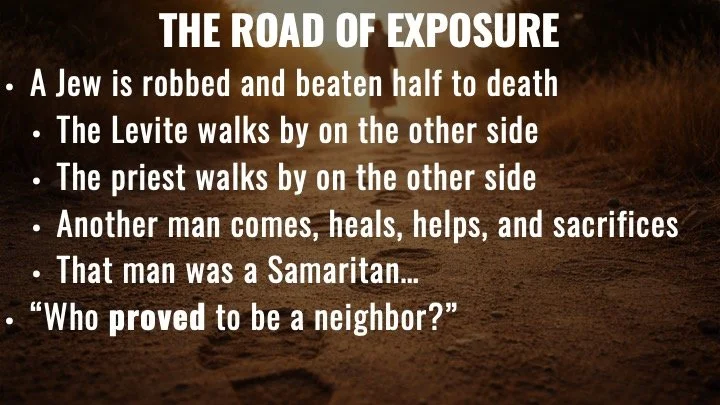
In response, Jesus tells him a story, a parable, that paints a picture for everyone listening. There was a Jewish man traveling down a dangerous road, and he was attacked by robbers. He was beaten half to death and left alone on the side of the road.
But, as it happened, a Levite was traveling the same way. Surely this Levite would stop to help. No, he passed by on the other side of the road. Then a priest came down the same path. He also passed by on the other side.
Both of these men went about their business. They did not take the time to care for the man who had been beaten nearly to death.
They saw him.
They distanced themselves.
They ignored him.
Then another man came down the same road. He saw the man who had been beaten half to death, and he came up to help. When he understood how badly the Jewish man was hurt, he treated his wounds and lifted him onto his own animal. He took the injured man to an inn and paid for him to be cared for, even promising more payment when he returned.
The twist is that this third man was a Samaritan. When Jesus said, “a Samaritan,” the air in the room would have changed. That would be like telling this story and saying the hero was the person you least expect, the one you’ve been taught not to trust. In the eyes of many Jews, Samaritans were religious outsiders, people with compromised worship and a history of conflict with Israel. They were viewed with suspicion and hostility, not as faithful participants in the promises of God.
This Samaritan touched blood.
He risked ambush.
He paid.
He promised more.
Now Jesus drives the point home, asking, “Which of these three, do you think, proved to be a neighbor to the man who fell among the robbers?” Instead of simply asking, “Who loved their neighbor?” Jesus asks, “Who proved to be a neighbor?” The emphasis is clear.
Pay careful attention to the response. The lawyer doesn’t even say the word “Samaritan.” He says, “The one who showed him mercy.” To admit it was a Samaritan would be to concede the whole point, and he can barely bring himself to do it. Jesus tells him to go and be like that man… the Samaritan.
Will you become a neighbor?
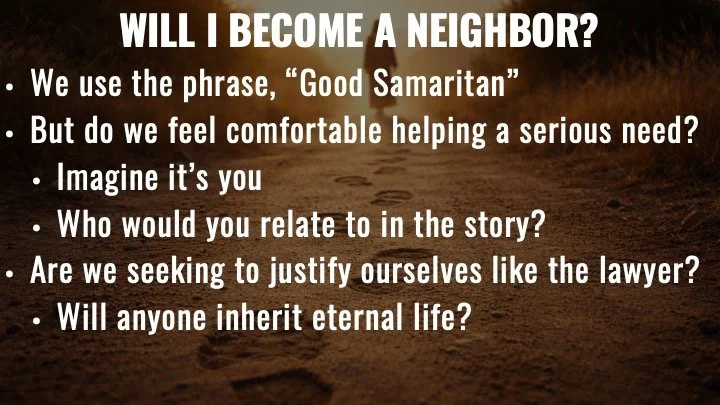
This parable is so memorable that we’ve turned it into a phrase: “Good Samaritan.” It refers to someone who does an act of kindness for someone in need. But in our society, we even created laws to protect the “Good Samaritan.” In emergency situations, people have tried to help after a wreck, and then the person being helped sued the person who tried to save them.
But do we feel comfortable helping someone who appears to be in serious need? I’m not talking about someone who ran out of gas. I’m talking about someone who is badly hurt. In recent years, there have been public incidents where someone was stabbed and people did nothing but stare, act like nothing was happening, and keep their distance. The worst part is that we have video. People will pull out a phone to record, but they won’t step in to help or even call an ambulance. You can watch a crowd pretend they don’t see what’s happening. They don’t rush over. They don’t call for help. They just mind their own business, or record the events so they can benefit from the recording.
This parable teaches us what God desires from us. He wants us to reach out and show love for others the way we would want someone to love us. It is not okay to pass by on the other side and act like you don’t see someone in severe need. If someone is half-dead, there is no world where it is acceptable to cross the road and keep walking.
Imagine it’s you lying on the side of a road, bleeding.
You hear footsteps.
You want to lift your head, but you can’t.
Someone sees you.
And then… keeps walking.
How would it feel to be left like that by someone who was supposed to be your fellow countryman?
The Greater Samaritan
So how would the man who asked Jesus the question hear this, and what should he learn? The fact that the men are described as a Levite, a priest, and a Samaritan matters. The Levite and priest know and claim to follow the Law, just like the lawyer. They are supposed to be righteous, but they revealed themselves to be hypocrites.
Would that be true of the lawyer? Will he be like them, or will he choose to be like the Samaritan and show mercy to the one in need?
If we look closely, there is a direct parallel to us. We can resemble the lawyer more than the Samaritan. We can be so focused on learning the truth and protecting ourselves, and so comfortable in our own righteousness, that we overlook those who need help.
The Samaritan, whom many would have suspected to be spiritually inferior, proved more righteous than the religious men everyone assumed were closest to God. Jesus wants this man to grasp that he has not met the requirements for inheriting eternal life. He was trying to justify himself, but Jesus makes it clear that he cannot. He, a Jew, would not naturally care for a hurt Samaritan like this. His prejudice won’t allow it.
And we fall into the same problem. Somewhere, at some time, we have deemed someone unworthy of our love, maybe because of the color of their skin, the way they talk or dress, their background, or our own selfish desires. There is not a person here who can honestly say they have loved God with all their heart, soul, mind, and strength and loved their neighbor as themselves. We can try to justify ourselves, but Jesus’ parable shows we have failed to prove ourselves worthy of such an inheritance.
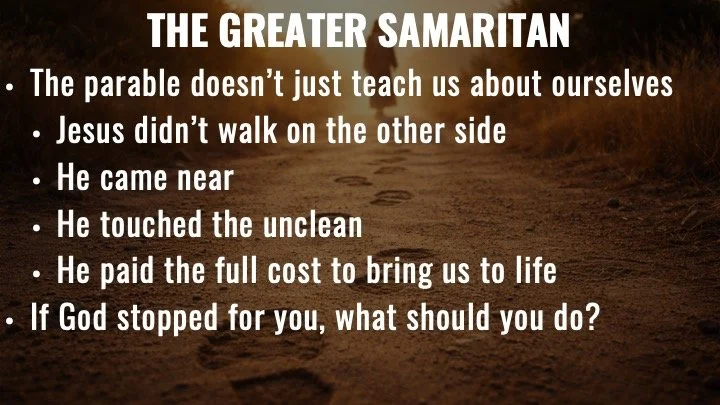
Thankfully, this parable isn’t only about us. As I said at the beginning, it is also about God. This parable reveals God’s heart. And Jesus fulfills it. He is not saying, “I am the Samaritan,” but when you read the Gospels you can’t miss the point: This is what fulfilling the law looks like.
He is the one who came near.
He is the one who touched the unclean.
He is the one who paid the full cost.
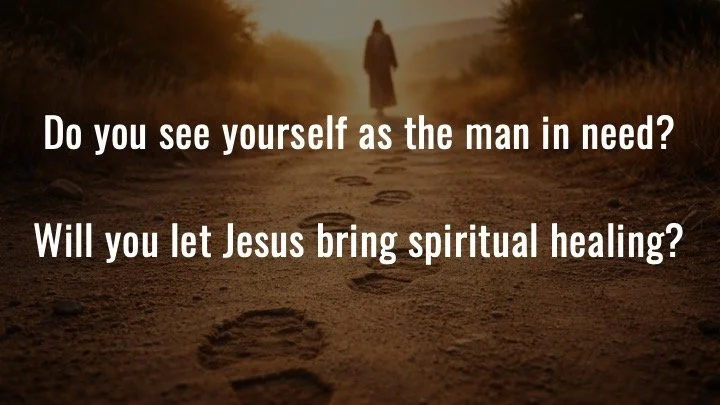
God saw us in our spiritually dead state and chose not to pass by on the other side. He stopped. He bound up our wounds. He brought healing. He paid what we could not pay.
If God stopped for you…
If that’s who God is, what does this mean for you and me? When we are treated unfairly, when we are beaten down by the world, when sin and selfish passions leave us for dead, God is there. He doesn’t act like we don’t exist. He comes near. He binds up wounds. He heals brokenness.
How? At times, through the hands of others who have been changed by Him. The Word of God, the gospel of our salvation also heals us. God uses many means at His disposal. His grace and mercy are abundant, and able to heal completely.
The point of this study is for us to understand who God is so that we will change. We must let what God and Jesus have done for us reshape us. Or will we keep becoming the same self-preserving, unloving people the world urges us to be? Don’t listen to them.
The story commands us to love like this. But the cross shows us God loved us like this first.
So become like God in His pursuit of the wounded and needy. Our God stops to help us. See that. Choose to stop what you’re doing, even in your busy life, to move toward those who are hurting and in need of spiritual guidance. Pay it forward.
To do that, we have to keep our eyes open to the desperate spiritual needs of the people around us. See the hurt, and don’t cross the road to the other side.