
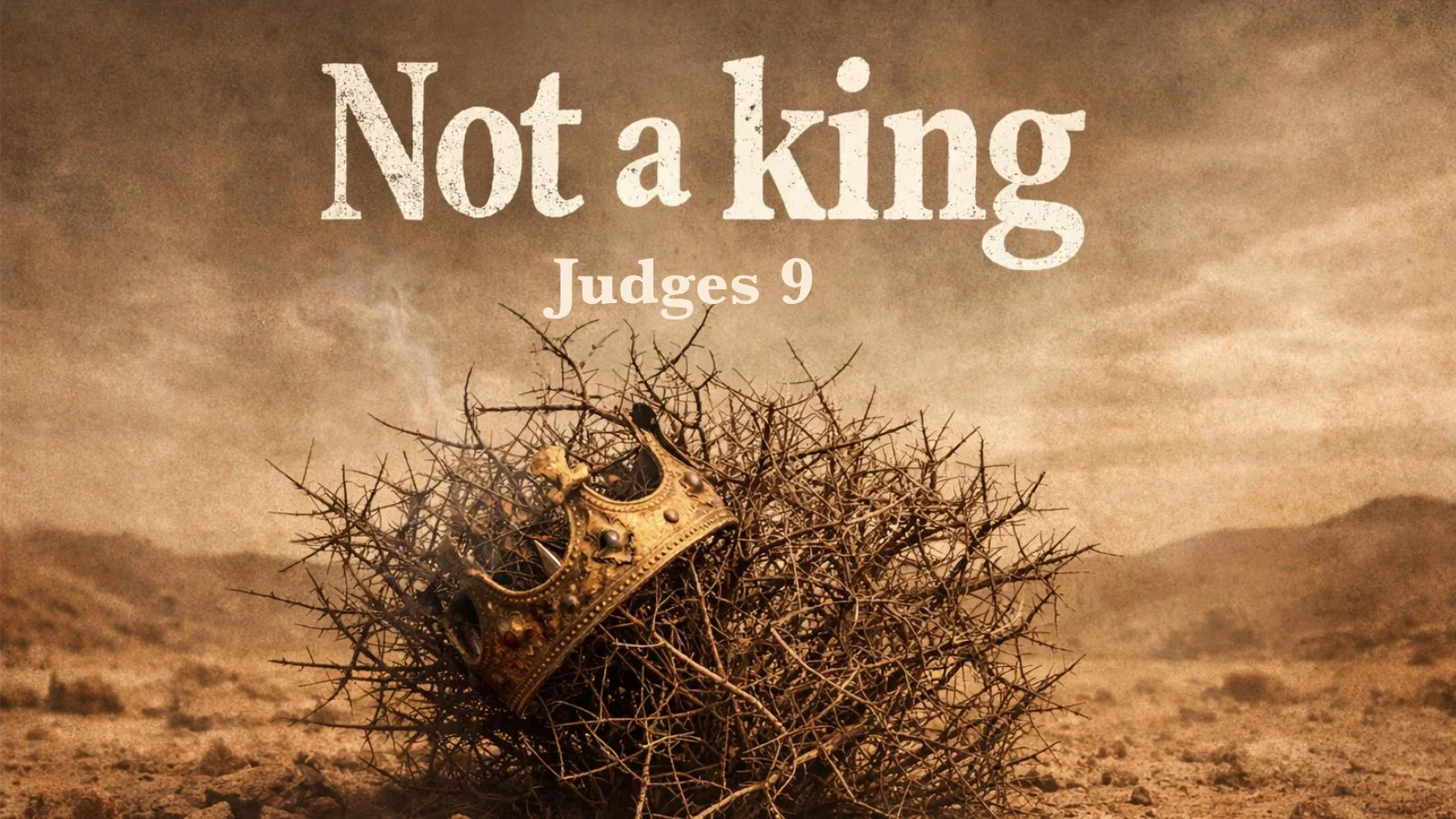
Not A King (Judges 9)

In the book of Judges, we repeatedly see God show compassion to deeply stubborn people. Israel turns to idols again and again—not because they lack evidence, but because they lack trust. They follow the nations around them. They chase what they can see. They prefer superstition to submission.
God rescues them anyway.
Last time we studied Gideon. God reduced his army to 300 men so Israel would know who won the battle. One hundred and thirty-five thousand Midianites fell—not because of Gideon’s brilliance, but because of God’s power.
But when the dust settled, it was Gideon who received the praise.
The people asked him to be king.
Gideon said the right thing: “The LORD will rule over you.”
But his actions told a different story.
Gideon’s Quiet Drift
Gideon punished fellow Israelites who refused to help him. He executed captured kings and tried to have his son perform the execution, something royal heirs did in that culture. He fashioned a golden ephod that became a shrine. He took many wives. He had seventy sons.
Those are not the actions of a reluctant servant.
Those are the signs of royalty without the title.
Judges tells us the ephod became a snare to Gideon and his family. Chapter 9 shows us exactly how.
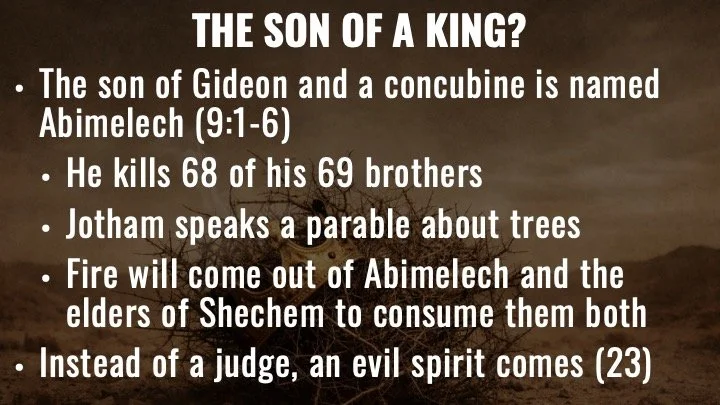
Abimelech’s Rise (Judges 9:1–6)
Names matter in this story.
Gideon’s father’s name, Joash, means “The LORD gives.” Gideon’s name likely means “one who cuts down.” God gives. Gideon cuts down. That was the pattern. Then comes Abimelech. His name means “My father is king.”
Let that settle.
Gideon refused the crown, but named his son like royalty. Abimelech grew up watching his father live like a king. He wanted the status. But he was the son of a concubine. He would never inherit leadership naturally.
So he created it.
He went to Shechem, his mother’s hometown, and asked: “Is it better that seventy rule over you, or one?” It’s a clever manipulation. The seventy sons weren’t ruling. But fear is persuasive. The leaders went into the temple of Baal-berith, “Baal of the covenant,” and funded him with silver. Idolatry financed murder. Abimelech hired mercenaries and slaughtered his brothers on one stone.
Only one escaped: Jotham.
His name means “The LORD is upright.” We can be sure that contrast is intentional.
Jotham’s Parable (Judges 9:7–21)
From Mount Gerizim, Jotham calls out to Shechem. He tells a story of trees trying to establish a ruler over them.
The olive tree refused kingship because it was fruitful.
The fig tree refused because it was sweet.
The vine refused because it produced wine.
Finally, they asked the bramble.
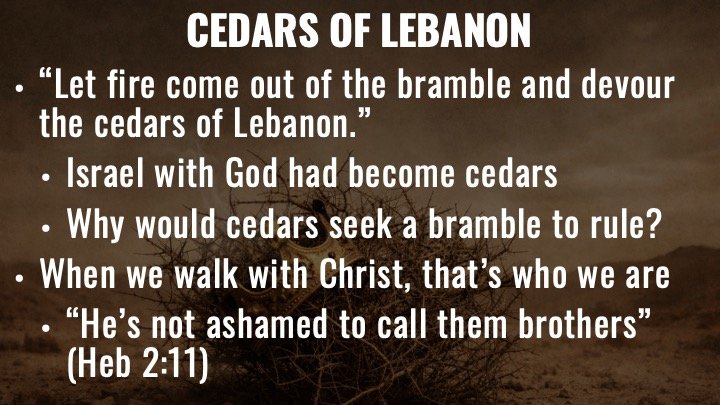
The bramble produces nothing. It offers no shade. It has no fruit. Yet it accepts the throne. And it promises protection or fire. To make this more odd, the trees are the cedars of Lebanon. Why would towering cedars of Lebanon seek a thornbush to rule them? This is ridiculous and that is the point.
Jotham condemns them. He declares that fire will come from Abimelech and from Shechem, and they will consume each other. Then he leaves, and God begins to act.
The Downfall of Abimelech (9:22-55)
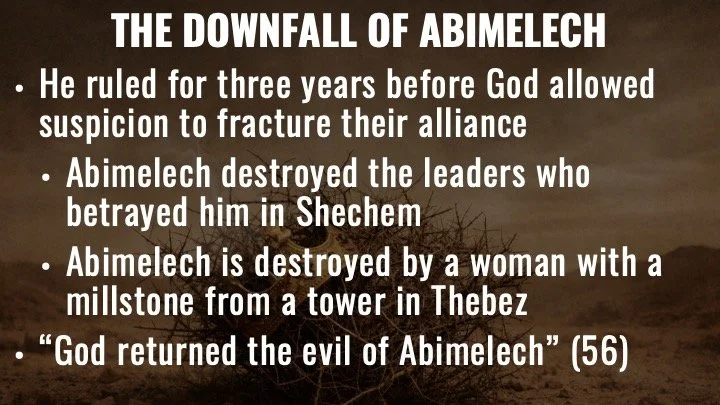
Abimelech ruled for three years. Unlike the judges before him, God did not clothe him with His Spirit. God did not raise him up as a deliverer. Instead, the text says that God sent an evil spirit between Abimelech and the leaders of Shechem. God allowed their alliance to fracture. He let suspicion and betrayal take root. Shechem turned against Abimelech. Abimelech retaliated. He destroyed the city. He sowed it with salt. He burned a thousand people alive in a tower. The bramble produced fire exactly as Jotham warned.
Then Abimelech went to Thebez. The text does not tell us why, but the pattern is clear. Tyrants never feel secure. Violence becomes their only method of control. He attacked another city and drove the people into a tower again, intending to burn it as he had done before. But this time, a woman dropped an upper millstone from the tower, and it crushed his skull. The man who killed his brothers on one stone was brought down by another. In his final moments, he called to his armor-bearer and begged to be killed so that no one would say a woman struck him down. Even in death, he was concerned with image. And yet Scripture records the detail forever.
The chapter ends with clarity: “God returned the evil of Abimelech.” There was no deliverer raised up. There was no heroic judge. God simply allowed evil to consume itself. That is the theological anchor of the story.
From Self-Exaltation To Devastation
When we place Gideon and Abimelech together, we see the devastation of self-exaltation. The snare begins when we lift men into the place that belongs to God. Israel could not live with invisible kingship. They wanted someone they could see. They preferred efficiency over faith. They empowered a bramble.
And this is not just ancient Israel. We still look for visible rulers to solve our problems. We exalt personalities. We rally around strength and charisma. We think it would be easier if someone else would just take control and make the decisions. It feels safer to let someone rule so we do not have to wrestle with trust and responsibility. But bramble leadership always burns. When men are lifted beyond their place, pride grows. When pride grows, destruction follows.
Judges 9 creates longing. Abimelech seized power through bloodshed. Jesus refused to seize power and shed His own blood instead. Abimelech killed his brothers. Jesus calls us brothers. Abimelech burned towers. Jesus builds His church. Abimelech ruled through fear and image management. Jesus rules through humility and sacrifice. Israel struggled to see God as their King, so God gave us a King we could see — one who does not consume His people, but redeems them.
Israel struggled to see God as their King, so God gave us a King we could see — one who does not consume His people, but redeems them.
Cedars of Lebanon
And this is where Jotham’s parable turns from warning into identity.
Why would cedars of Lebanon seek a bramble to rule them?
Cedars are not weak plants scrambling for shade. Cedars tower. Cedars endure storms. Cedars provide shelter. Throughout Scripture, the cedar of Lebanon represents strength, stability, dignity, and beauty planted by God Himself. God’s people were never meant to live like frightened shrubs looking for someone to hide under. They were meant to stand tall because God Himself was their King.
Through Christ, that is exactly who you are.
You have been planted by God. You have been rooted in grace. You have been forgiven, adopted, and brought into His kingdom. You are not scrambling for security. You are secure. You are not searching for identity. You have one.
Cedars provide shade.
When you walk in Christ, your life becomes a place of refuge for others. Your steadiness becomes someone else’s comfort. Your faithfulness becomes someone else’s courage. Your fruitfulness becomes nourishment for someone still growing. You do not need a bramble to give you shade, because you have been strengthened to give shade.
And we rule — not by seizing control, but by reigning with Christ.
Scripture teaches that those who belong to Him share in His reign. Not through domination. Not through fear. Not through burning towers. We rule by serving. We reign by loving. We exercise authority by laying down our lives. The only crown we wear is the one placed on us by grace.
That is completely different from Abimelech.
Abimelech grasped and destroyed. Christ surrendered and saved.
Conclusion
You do not need a bramble to rule you. You are not weak shrubs looking to rule. You are cedars planted by God. He is your King. Jesus is your King. Elders shepherd under Him. Preachers serve under Him. We do not replace Him. We point to Him. There is nothing to fear. The same God who returned the evil of Abimelech still governs today. His reign does not scorch His people. It sustains them.