
Before The Cross
To finish our study on prayer, I want us to look at one of the most powerful prayers in all of scriptures.
Before the arrest.
Before the trial.
Before the cross.
There was a prayer.
Jesus is the most important Biblical figure for us to learn prayer from. His prayer habits should instruct us and mold our prayers. What does He do? How does He think when He prays? These are the questions we will seek to answer in our study this morning.
This may be the most instructive moment. He is about to drink the cup. In Scripture, the cup is not just suffering. It is judgment. It is wrath. Jeremiah says the nations must drink the cup of God’s fury (Jer 25). Isaiah speaks of the cup of staggering (Isa 51). He can see what is about to take place. He knows what’s coming, and he chooses to pray in front of his closest disciples. He wants them to see what He does when the weight is unbearable. He wants them to understand what obedience is costing Him personally so they can share it with us.
His prayer is unconventional. What I mean by that is, He doesn’t pray like we typically pray.
In this prayer, we see three patterns that shaped Jesus’ life:
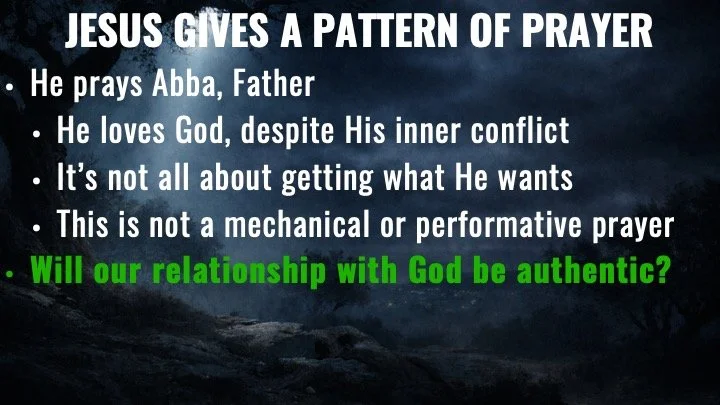
He prays from relationship.
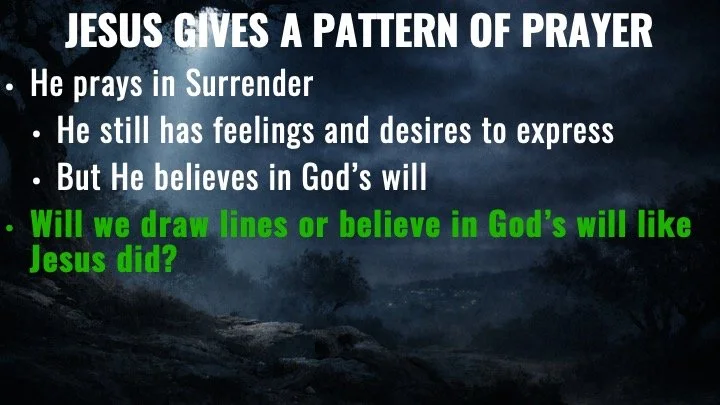
He prays for alignment.
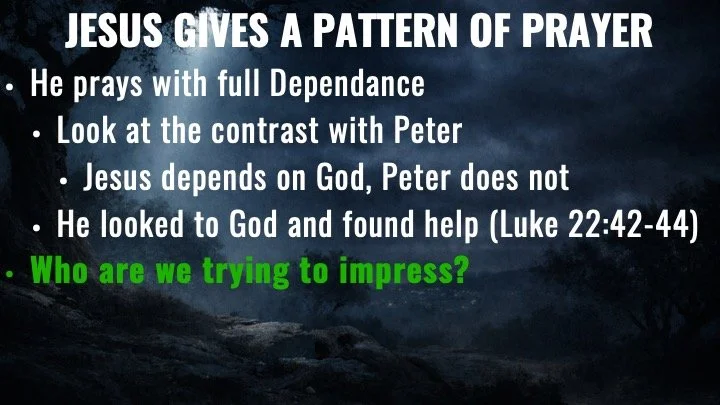
He prays with dependence.
Praying From Relationship
In the three accounts of the prayer, Jesus always starts with “Father.” But notice the words in Matthew and Mark.
Matthew 26:39 (ESV) — 39 And going a little farther he fell on his face and prayed, saying, “My Father, if it be possible, let this cup pass from me; nevertheless, not as I will, but as you will.”
Mark 14:36 (ESV) — 36 And he said, “Abba, Father, all things are possible for you. Remove this cup from me. Yet not what I will, but what you will.”
In Matthew, Jesus says, “My Father.” In Mark, he says “Abba, Father.” These words indicate warmth, familiarity, and intimacy. They are deeply personal and this is a loving way to refer to your Father. Jesus is addressing God in a close relational sense. He does not approach God as a soldier reporting for duty. He approaches Him as a Son speaking to His Father. Jesus knows that his Father wants Him to do something impossibly difficult to do. He asks God to remove it from him, but He still loves Him and calls out to God with an intimate relationship.
Sometimes our prayers become mechanical. We repeat phrases without thinking. We perform instead of commune.
But Jesus is not performing a ritual in Gethsemane. He is speaking to His Father.
Throughout Jesus’ life, He has always spoken about God as His Father and He makes it clear that His purpose is to do the Father’s will like a good, obedient Son. In the Garden, he turns to God. Not out of obligation. Not just to get what He wanted from God. He turns to God because He belongs to Him. At this moment, no one understands the weight He is carrying — but His Father does.
So, the first pattern we see is Jesus praying in relationship with God. I know that some of us learned to pray with “Thee,” “Thou,” etc. We feel a need to be formal or reverent towards the sovereign, creator of the universe. I don’t want to bash those who do that. That’s who God is, but I want to open us up to a different way. A way that Jesus prayed. A way that Jesus taught us to pray.
As children of God, we can rely on that relationship we have with God and speak out of it.
The King might expect His subjects to revere Him, but His children call Him Abba.
Praying In Alignment
I’ve mentioned this multiple times in this sermon series, but it bears repeating. Jesus put God’s will ahead of His own.
These words need to be heard on repeat, “Not my will, but yours be done.” He cares about God’s will. Jesus is not looking to escape obedience. His words indicate a willingness to do whatever God has in mind.
Also, notice that Jesus doesn’t hold back His feelings on the matter. He is not denying His desires, suppressing them, or pretending that they don’t exist. He is human. He has feelings on this matter and would rather not go through the painful scenario.
But He trusts in God enough to do something that goes against every fiber of His being. The cup represents wrath (Jer 25, Isa 51). This is not just pain. This is judgment that resembles the judgement God gives to his enemies.
He names the desire honestly — “Let this cup pass.”
Then He surrenders it completely — “Not my will.”
Where have we drawn lines and said, “God, you can have this… but not that”? That is not surrender. That is negotiation. When we do that, we are showing a lack of trust in His wisdom. He can take away everything. He can allow the absolute worst thing to happen to us, and use it for the good of all who love Him. That’s what Jesus shows us in His prayer. Trust God enough to share your feelings completely. Then, trust Him enough to obey and do the exact opposite of what you want to do. Believe, like Abraham, that God will provide.
Align your will to His will.
Dependence
The third part of Jesus’ prayer I want to focus on is related to the first two. Jesus depended on God to do this. I find it interesting to trace Peter’s events beside Jesus’. Jesus tells the disciples, in Matt 16:21, that He must suffer, be crucified, and raised from the dead. Peter boldly proclaims in 26:35, “If I must die with you, I will not forsake you.” Then, Jesus goes to God in prayer over these events and tells Peter to pray with Him so that he won’t fail when tempted. He tells him, “the spirit is willing but the flesh is weak.”What happens next? Jesus goes to the cross and Peter denies knowing Jesus.
The message is clear. Jesus went to God in prayer. Peter didn’t. Jesus could do what He said He would do. Peter could not.
Prayer is about dependence. Jesus was human, like us. But in His humanity, He chose to rely on the Father every step of the way.
Sometimes, I feel like we have a superhero mentality. We want all the glory and fame. We want to do it ourselves. That’s not the way Jesus lived. He relied on God and His prayer life showed that dependence. Notice in Matthew and Mark’s accounts that Jesus goes to God in prayer three times. He asks the same thing three times. But notice what Luke records.
Luke 22:42–44 (ESV) — 42 saying, “Father, if you are willing, remove this cup from me. Nevertheless, not my will, but yours, be done.” 43 And there appeared to him an angel from heaven, strengthening him. 44 And being in agony he prayed more earnestly; and his sweat became like great drops of blood falling down to the ground.
In this case, Jesus pours himself out to God, asking for God to remove this cup. In response, God sends an angel to strengthen Him.
What do you think that means to Jesus? The cup might not be removed, but God can provide him with the strength to face it. His agony increased and He prayed more earnestly. There were great drops of blood falling down to the ground. Everything inside of him was struggling to accept this reality. He wasn’t ready. He needed more strength so He prayed again.
When we pray, we aren’t trying to impress God with our greatness. He knows how weak we really are. Maybe we put on a show of greatness before others, but we aren’t fooling Him. The best thing we can do when we pray to God is open up and be real.
John said in 1 John that those who walk in fellowship with God must walk in the light. They have to be open and honest about their sin and failures. We must see how weak we are and call out for God to help us, strengthen us, to obey.
Finding Strength and Reward
When He finishes praying, Judas comes. In John’s gospel, we read that He goes out to meet His betrayer and the soldiers. He speaks to those coming to betray Him and says, “Whom do you seek?” His words are so powerful that the men fall back. Something is different about Jesus as he approaches these men. He tells them that He is the one they are seeking.
There’s no fear or timidity in His voice.
The anguish of prayer becomes the resolve of obedience. When Peter pulls out a sword and attempts to kill one of the servants of the high priest, cutting off his ear, Jesus heals the man. Then tells Peter, “Shall I not drink the cup that the Father has given me?”
The prayer of Jesus had not taken away the cup of suffering and punishment Jesus was to receive. But it had given Jesus what he needed to face it.
Application
Think for a moment about how this prayer and its effects should alter our prayer lives.
We pray to control outcomes. We hope to escape the difficulties, and convince God to fix the bad situations we are facing as we could imagine him doing.
- Jesus prayed to surrender outcomes.
When things are going bad for us, we avoid prayer because we think we are strong enough on our own to face it. When the moment comes, we resort to sin instead of having faith and remaining focused on God’s will.
- Jesus turns to God knowing the most likely outcome
Praying like Christ means we pray to commune with the one who is all powerful, all knowing, and ever present. We shouldn’t be seeking to manipulate him. That’s not the relationship He wants to have with His child. Instead, trust that whatever His will is will be good. Pour out your desires and feelings, but trust Him and do what is right even at great cost. He will give you the strength to do the right thing.
Before the nails pierced His hands, prayer surrendered His will.
If we want strength for obedience, we must first kneel in surrender.