
When God Wins (Judges 6-8)
Have you been afraid of something you know you shouldn’t be afraid of? Are you currently afraid of something you know you shouldn’t be afraid of? Maybe you are scared of the dark, scared of financial ruin, scared of negative opinions about you, or scared of something bad happening. Where do these fearful thoughts come from and how can we overcome them? This is a continual problem in Israel. Their oppressors instill fear in them when they really have nothing to be afraid of. If God is on their side, they cannot lose.
But really the problem is that God is often not on their side. They repeatedly break covenant with God and chase after other gods. Their fear shouldn’t be directed toward their oppressors. It should be directed toward God who brought the oppressor.
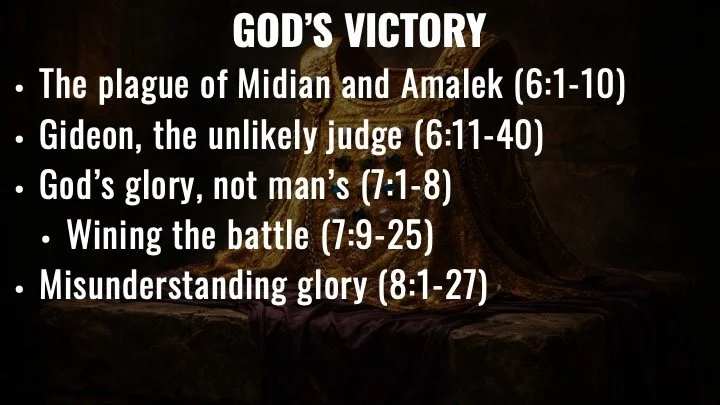
The Plague of Midian (6:1-10)
The people of the land experienced rest after God’s victory with Deborah, Barak, and Jael. Rest for forty years. Forty years is a long time. But it did not last. The people of Israel again did what was evil in the sight of the Lord, and the Lord gave them into the hand of Midian for seven years.
The Midianites, along with the Amalekites, were like a plague of locusts on the people of Israel. They would come from the east and the west as uninvited guests and eat up all of the produce of the land along with their livestock. They just moved right in and would fight with any Israelites who tried to stop them.
So, the people saw their failure and called out to the Lord for help. In response, God sent a prophet.
Judges 6:8–10 (ESV) — 8 the Lord sent a prophet to the people of Israel. And he said to them, “Thus says the Lord, the God of Israel: I led you up from Egypt and brought you out of the house of slavery. 9 And I delivered you from the hand of the Egyptians and from the hand of all who oppressed you, and drove them out before you and gave you their land. 10 And I said to you, ‘I am the Lord your God; you shall not fear the gods of the Amorites in whose land you dwell.’ But you have not obeyed my voice.”
God reveals to his people that they have failed by fearing the gods of the Amorites and failing to obey God’s voice. These men of Israel believe that the false gods of the land are powerful and they have been worshipping and offering sacrifices to those gods.
The Unlikely Judge (6:11-8:27)
Like with Deborah, God sent a prophet who told the people their error, but he did not abandon them. This time, he will raise up a man to defeat the Midianites, and it’s not a man who has an army already. He chooses Gideon, a man who is secretly beating out the wheat in his father’s winepress cowering in fear of the Midianites. The angel of the Lord calls out to him, “The Lord is with you, O mighty man of valor.”
This is a joke, right? The man who is hiding in the wine press to keep Midianites from knowing about his wheat is a mighty man of valor? Gideon picks up on the phrase, “The Lord is with you” and wonders if it’s true. He respectfully asks, “If the Lord is with us, why then has all this happened to us?” He thinks that God has forsaken them because he brought the Midianites in to oppress Israel.
The text tells us, “The Lord turned to him and said, ‘Go in this might of yours and save Israel from the hand of Midian; do I not send you?’” But Gideon replies incredulously, “Please, Lord, How can I save Israel? My clan is the weakest in Manasseh, and I am the least in my father’s house.” God doesn’t care about that.
God has chosen to be with Gideon and that is all that matters. Hearing that, Gideon goes and makes an offering. The Lord extends his staff and consumes it with fire. At the sight, Gideon knows who He is, “Alas, O Lord God! For now I have seen the angel of the Lord face to face!”
Tearing Down Baal (6:25-32)
God wants Gideon to start at home. He commands Gideon to cut down the idolatrous altars that his own father has and build an altar at the site. He did it that night and when the men of the town saw it, they were upset. They knew it was Gideon and wanted him to die. But Joash, his father said, “Will you contend for Baal? Or will you save him? Whoever contends for him shall be put to death by morning. If he is a god, let him contend for himself.” They then renamed Gideon from “Cuts down” to “Let Baal contend against him.”
God Shrinks the Army (7:1-8)
After this event, the Spirit of the Lord clothed Gideon and he gathered the men of Asher, Zebulun, and Naphtali to prepare for battle. But Gideon was still unsure. He asked God for two signs. The first was that He make the fleece wet and all the ground dry early in the morning. The second was that He make the fleece dry and the ground wet early in the morning. He wanted to test to see whether God would truly do the impossible and save Israel through him.
God meets his request, and then he strips down his army two times. The first time Gideon commands everyone who is scared to leave. The second time he commands everyone who doesn’t lick up water like a dog to leave. This results in the army going from 22,000 men to 300. For God wanted it to be known that this victory was God’s and not Israel’s. Baal cannot contend for himself, but the Lord God can.
God Wins The Battle (7:9-25)
The 300 men gathered near the swarm of Midianites and Amalekites, 135,000 of them. Once again Gideon was terrified. God told him to go down into the camp and defeat them because God had given it into his hand. Can you imagine that? 300 men defeating 135,000? God just tells him to do it like it is no big deal. But God said, “If you are afraid, go down to the camp with your servant and see what they are saying.” He does and he finds that they have had a dream about him coming and destroying them. So, Gideon divided the men up, giving them empty jars with torches inside and trumpets. At his command they would blow the trumpets, smash the jars, and shout, “A sword for the Lord and for Gideon.” When they did this, their enemies started to flee, but many were killing each other. The 300 men pursued them and killed many. Then, other men from the surrounding tribes also came down and helped with the slaughter.
Cracks Appear (8:1-27)
On the way, Gideon and his men were hungry and they tried to receive assistance from men of Succoth and Penuel, but they would not help. So, after they defeated the Midianites and Amalakites, they came back and killed the men and elders of those towns.
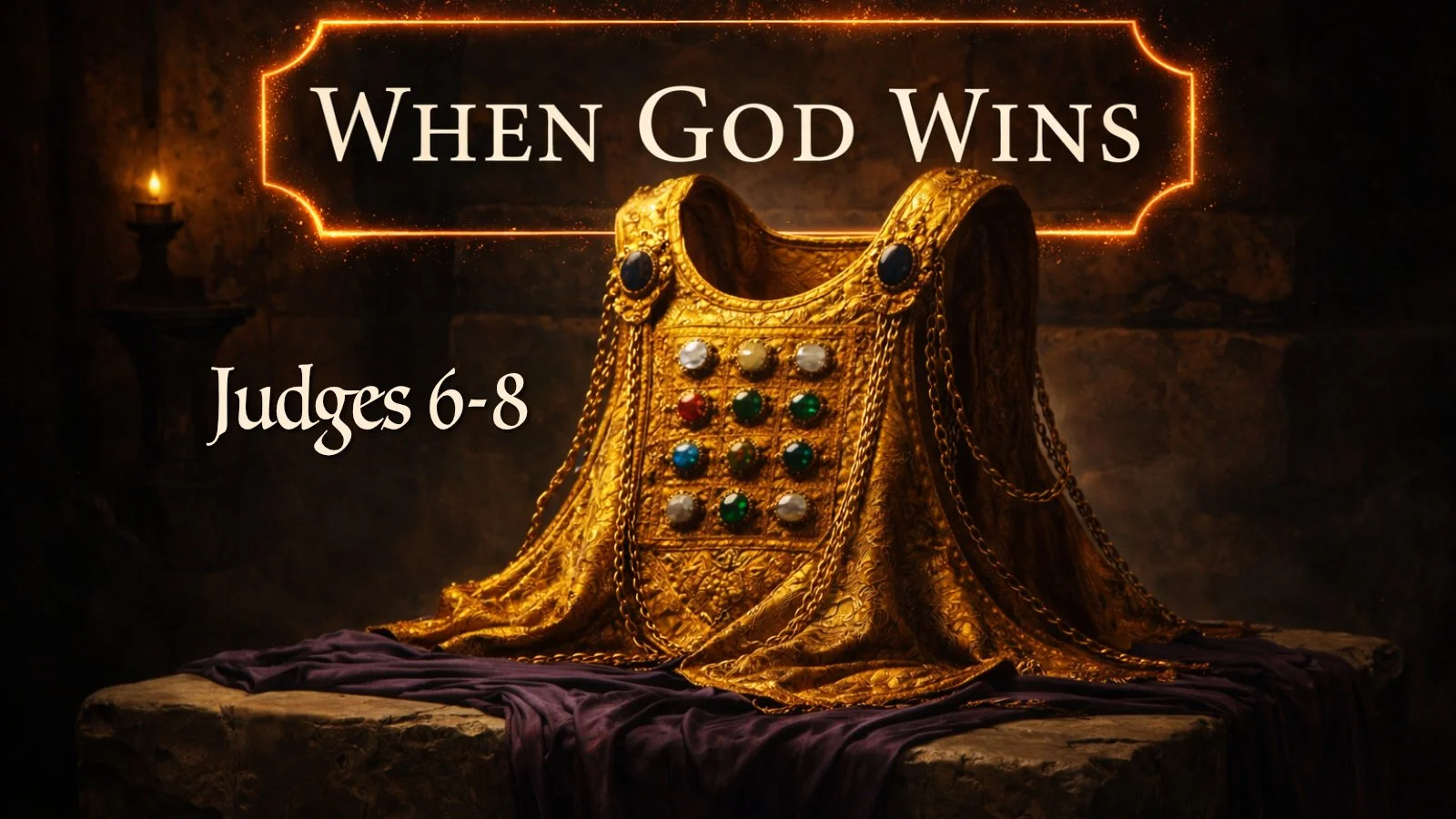
Then, the men of Israel wanted to make Gideon a king, but he refused. He wisely said, “The Lord will rule over you.” But then, he foolishly asked them to give him their earrings and purple garments so he could use them to make a golden ephod and put it in his city. All Israel whored after it there, and it became a snare to Gideon and to his family.
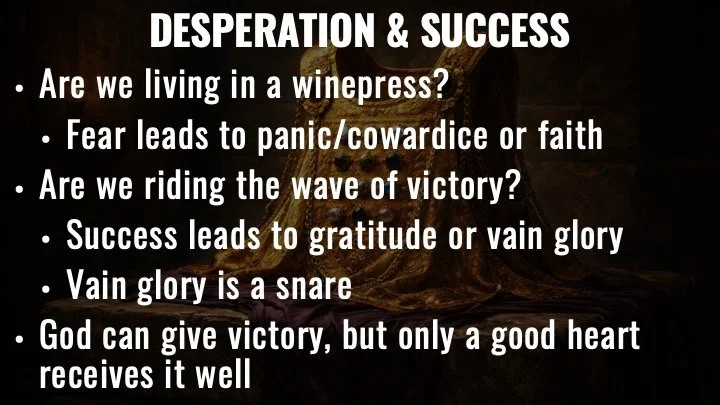
Desperation & Success
Foolish idolatry brought suffering to Israel because idols can’t do anything. But God brought peace and prosperity. We could see the contrast in God who defeats his enemies with .002% of the men and idols who cannot save themselves.. God can defeat through floods, through hailstones, through fire from heaven, or he could even defeat them through blowing trumpets, breaking jars, and shouting. There is nothing God cannot do. If all 135,000 of the men would have risen up against Gideon and his 300, God would still have defeated them.
But the lesson I want us to focus on tonight is the contrast from the beginning of this story to the end. In the beginning we see Gideon as the least of the weakest clan. He’s a nobody who is hiding in the windpress so the Midianites don’t steal his wheat. In this time of desperation, Gideon was willing to trust in the Lord and rely on him for success. God proved himself to Gideon and he worshipped God on multiple occasions. Then, he defeated the enemies and became hungry for glory. His vindictive actions and the golden ephod show that something is wrong.
Fear can lead to panic and cowardice or faith and prayer. In times of desperation, are we clinging to false security that cannot help us? Like Gideon, we may doubt that God would be with us. We might even have hard feelings toward him. But when we put our faith in Him, He is able to bring us out of the mire. He can save us from any situation.
When we experience success, what will we do with it? Will we have gratitude? If we choose vain glory, we will suffer the consequences. Gideon honored God, but he also sought to honor himself and his children paid the price, as we will learn about next week.
God can give victory, but only a rightly ordered heart can receive it well.
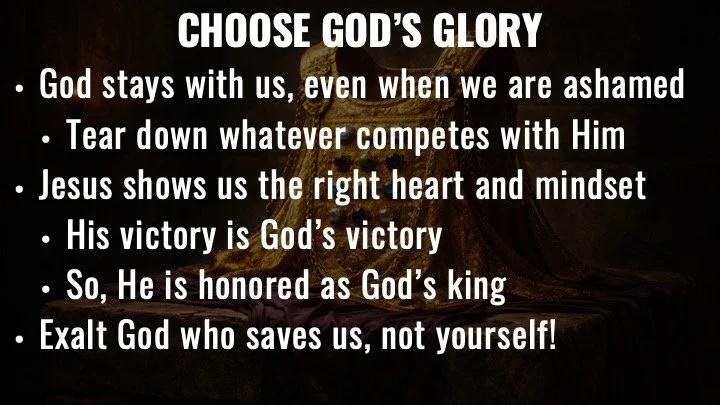
Choose God’s Glory
Tonight, some of us are living in a winepress—hiding, anxious, tired, trying to protect what little we think we have. And God is not coming to shame you. He’s coming to call you out of it. He tells us what He said to Gideon: “I will be with you.”
So we can bring our fears into the light. Tear down whatever competes with God. Gideon teaches us that victory doesn’t test our strength. It tests our heart. Jesus shows us what a heart looks like that can receive God’s victory without being ruined by it: a heart that loves the Father, trusts Him fully, and worships Him alone. Jesus has risen up to deliver us from the lowliest of towns. He stood, not with 300 but, alone against our greatest foe to save us from the oppression of sin. He is not satisfied with man’s honor. He seeks God’s glory.
The lessons of Gideon should be our own. Nothing on earth can save us. No god we create. No strength we can muster. Our victory comes through the Lord. He came to earth to show us the truth about God. He’s not found in statues or golden Ephods. He’s seen in the image of Jesus our Messiah and king.
Will we make Jesus our king?
If God gives you victory (if He gives you relief, provision, momentum, influence) then worship Him harder. Hold success with open hands. Refuse vain glory. Don’t build an ephod. Don’t create a “religious substitute” that steals your trust. Don’t seek your own exaltation.
Because the LORD can save by many or by few. And the safest place in the world is not the absence of enemies.
It’s the presence of God.