
Strong Man, Weak Heart (Judges 13-16)

Strength impresses us. We admire people who seem powerful—the athlete who dominates the field, the leader who commands a room, the person who appears confident, gifted, and spiritually capable. Strength tends to earn our respect because it makes people look secure. When someone appears strong, we assume they are stable. We assume they are safe.
But the story of Samson forces us to question that assumption.
Samson is remembered as the strongest man in the Bible. His feats sound almost unbelievable. At one point he tears a lion apart with his bare hands. In another moment he defeats an entire army. Later he kills a thousand men with nothing but the jawbone of a donkey. In another scene he lifts the massive gates of a city and carries them up a hill.
Yet the story of Samson is not really about strength. It is about weakness. More specifically, it is about the danger of having great power while living with an undisciplined heart. Samson is strong in body but weak in character. He wins every fight with his enemies, but he loses the war inside himself.
If we listen carefully, his story becomes more than an ancient tragedy. It becomes a warning. It becomes a mirror. And ultimately, it becomes a sign pointing us to the kind of deliverer we truly need.
A Promised Child with a Holy Calling
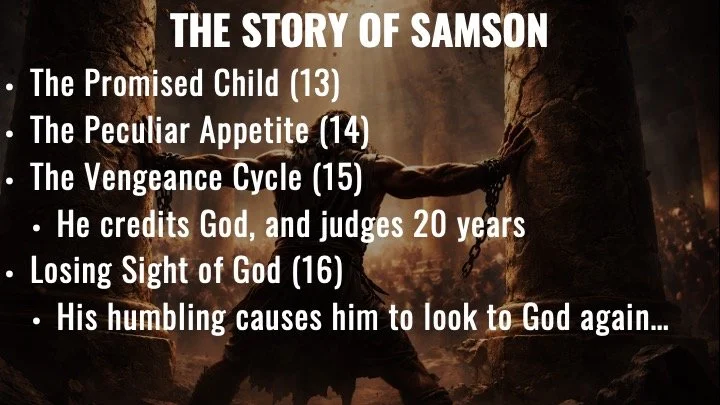
Samson’s story begins with hope. Judges tells us that Israel had once again done what was evil in the sight of the Lord, and because of that the Lord gave them into the hand of the Philistines for forty years. The nation is under oppression. Their enemies dominate them. The cycle of Judges continues.
But this time, the people don’t cry out to God. God intervenes with a promise. The angel of the Lord appears to a barren woman, the wife of a man named Manoah. She has never been able to have children, yet the messenger announces that she will conceive and bear a son. This child will not be ordinary. He will be set apart to God from the womb.
The angel explains that the child will be a Nazirite. That meant his life would carry visible signs of consecration. He was not to drink wine or strong drink, and a razor was never to touch his head. His life would symbolize separation and devotion to the Lord.
Then the angel says something very important: “He shall begin to save Israel from the hand of the Philistines.”
Before Samson ever performs a miracle of strength, before he ever fights a battle, his identity is defined by one word—consecrated. His strength was never supposed to define him. His devotion to God was.
The chapter ends by telling us that the child grew, the Lord blessed him, and the Spirit of the Lord began to stir him. Everything about Samson’s beginning is filled with promise. But a good beginning does not guarantee a faithful life.
This reminds us of something important: calling does not replace character. A person can be chosen by God and still drift. A person can be gifted and still careless. Samson was set apart by God, but he still had to live faithfully within that calling.
A Strong Body with Unchecked Appetite
The first adult decision we see Samson make immediately reveals the direction of his life. Samson travels down to the Philistine town of Timnah and sees a woman there. When he returns home, he tells his parents, “Get her for me, for she is right in my eyes.”
That phrase should sound familiar. Later in Judges we read that “everyone did what was right in his own eyes.” Samson, the man who was supposed to deliver Israel, is already beginning to look like the rest of the nation. Instead of asking what is right in God’s eyes, he follows what feels right in his own.
From that point forward the story unfolds with a strange mixture of power and compromise. On the way to Timnah, a young lion attacks Samson. The Spirit of the Lord rushes upon him, and he tears the lion apart with his bare hands. Later he returns to the carcass and finds bees and honey inside it. He scoops out the honey, eats it, and even gives some to his parents without telling them where it came from.
Even in small details the story reveals Samson’s character. He crosses boundaries and then hides what he has done. He moves through life following appetite and protecting himself with secrecy.
His wedding soon becomes another disaster. Samson turns the celebration into a riddle contest. When the Philistines threaten his bride to force her to betray him, she presses him until he reveals the answer. When Samson discovers what has happened, his anger explodes and he kills thirty men to settle the bet.
From there the conflict escalates quickly. Fields are burned, families are killed, and armies gather. At one point the Philistines come looking for Samson, and the men of Judah do something shocking. Instead of standing with Samson, they bind him with ropes and hand him over. They say to him, “Do you not know that the Philistines rule over us?”
Israel has become comfortable living under oppression. They would rather keep the peace than confront their enemies.
But when the Philistines approach, the Spirit of the Lord rushes upon Samson again. The ropes fall from his arms like burned threads. He grabs the jawbone of a donkey and defeats a thousand men.
Samson keeps winning battles. Yet every victory hides a deeper problem. He is strong enough to defeat armies, but not strong enough to restrain his desires.
This is the danger of power without discipline. Samson wins every external conflict, but he cannot control the appetites inside his own heart.
The Night He Didn’t Know
By the time we reach Judges 16, Samson’s weakness has become painfully clear. He travels to Gaza and spends the night with a prostitute. Later he falls in love with a woman named Delilah. The rulers of the Philistines approach her with a large sum of money and ask her to discover the secret of Samson’s strength.
Three times Delilah asks him about it. Three times Samson lies. Three times she tests his answer while Philistines wait nearby in ambush.
Anyone watching the story can see the danger. But Samson continues to play with it. Eventually Delilah presses him so persistently that he finally reveals the truth. A razor has never touched his head because he has been set apart to God from birth. If his hair is shaved, his strength will leave him.
That night Delilah cuts his hair while he sleeps.
When Samson wakes up, he says to himself, “I will go out as at other times and shake myself free.” Then the text tells us something terrifying: “He did not know that the LORD had left him.”
Samson had grown so accustomed to strength that he assumed it would always be there. He believed he could simply wake up and keep living the way he always had.
But the presence of God was gone.
The Philistines seize him, gouge out his eyes, and force him to grind grain in prison. The man who once tore lions apart is now blind and helpless. His physical blindness mirrors the spiritual blindness that had already taken hold of his heart.
This is one of the most sobering warnings in Scripture. Sin rarely announces itself loudly. Instead, it dulls the heart slowly. It convinces us that everything is fine. It allows us to keep functioning, keep working, and even keep appearing successful. Then one day we discover that the presence of God is no longer with us the way it once was.
The Final Prayer
Eventually the Philistines gather in the temple of their god Dagon to celebrate. They believe their god has defeated Samson and delivered their enemy into their hands. They bring Samson out to entertain the crowd.
Imagine the scene. The once-feared warrior is now a spectacle. Blind. Weak. Humiliated.
But something quiet has begun to change. The text mentions that Samson’s hair had begun to grow again. As the crowd celebrates, Samson asks the young boy guiding him to place his hands on the pillars that support the temple.
Then Samson does something we have rarely seen him do throughout the story. He prays.
“O Lord GOD, please remember me and please strengthen me only this once.”
For the first time in a long while, Samson acknowledges the true source of his strength. God answers his prayer. Samson braces himself against the pillars and pushes with all his might. The temple collapses, killing the rulers of the Philistines and many others gathered there.
The text says that the number Samson killed in his death was greater than the number he killed during his life. Even through Samson’s broken life, God demonstrates His power and defends His glory against the idols of the Philistines.
The Deliverer We Really Need
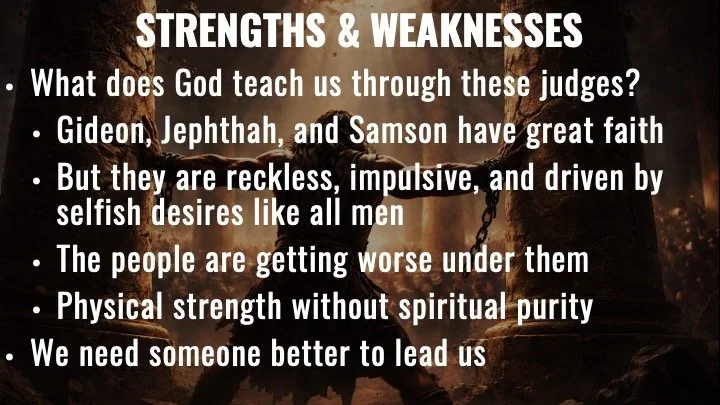
Samson’s story leaves us with complicated feelings. He is a man chosen by God, empowered by the Spirit, and capable of extraordinary strength. Yet he is also reckless, impulsive, and driven by desire.
Samson begins the deliverance of Israel, but he does not complete it. His story leaves us longing for a better deliverer.
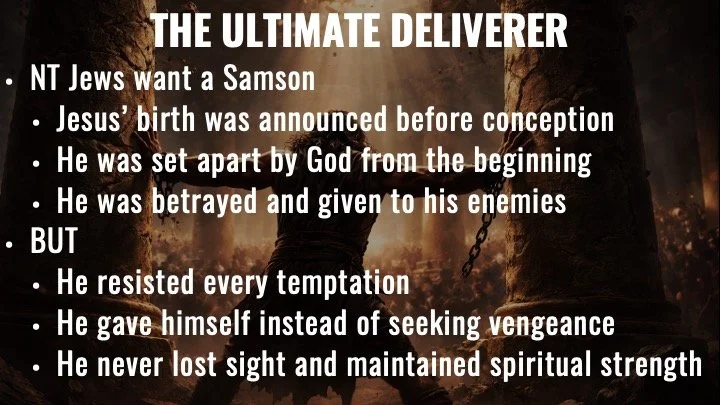
The Bible eventually introduces that deliverer in Jesus Christ.
Like Samson, Jesus’ birth was announced before He was conceived. Like Samson, He was set apart for God’s purposes from the beginning. Like Samson, He was betrayed and handed over to His enemies.
But the similarities end there.
Where Samson was ruled by desire, Jesus resisted every temptation. Where Samson acted out of anger and revenge, Jesus gave Himself out of love. Where Samson needed strength from God one last time, Jesus entrusted Himself to the Father and rose in resurrection power.
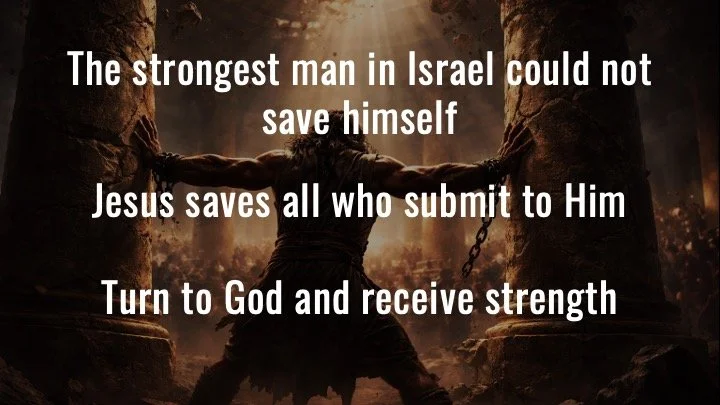
Samson points forward by contrast. The strongest man in Israel could not save himself. But the Son of God came to save the world.
Conclusion
Samson’s life warns us about a deeply dangerous reality. It is possible to experience God’s power and still drift away from His presence. A person can serve, lead, speak, and accomplish impressive things while slowly allowing compromise to dull their heart.
The most frightening moment in Samson’s life was not when his eyes were gouged out. It was the moment he woke up and did not realize that the Lord had left him.
Strength without consecration eventually collapses. But weakness that turns to God can still find mercy.
The question Samson’s story leaves us with is simple: where does your strength really come from?
Because the difference between Samson and Jesus is this: Samson trusted his strength, but Jesus trusted His Father.
And that makes all the difference.