
Healing In His Wings (Ruth)
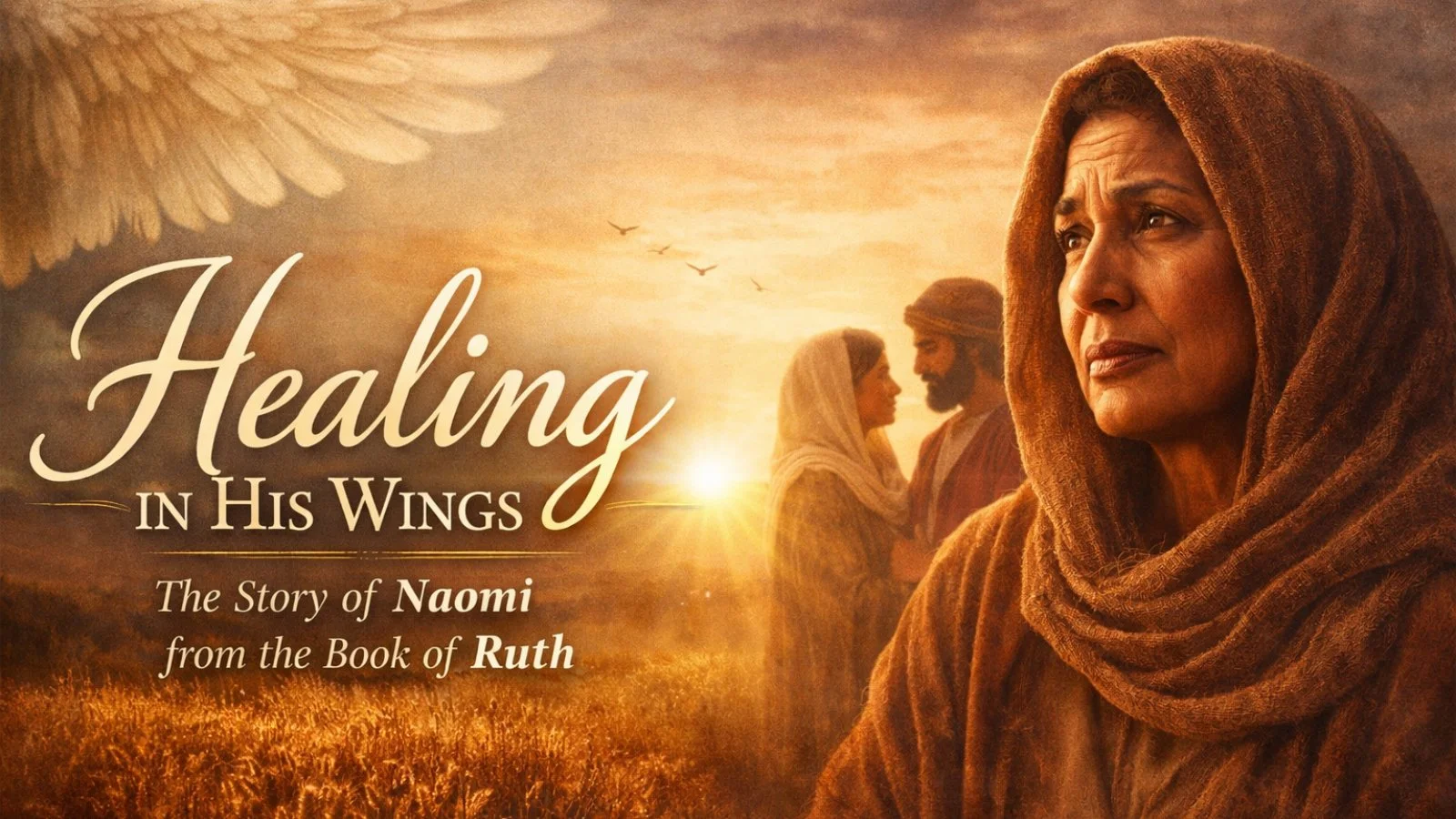
Some people do not come back to God strong. They come back tired. They come back ashamed. They come back confused. They come back after life has taken more out of them than they ever imagined. They come back with enough faith to head home, but the world has robbed them of joy
That is Naomi.
Naomi is not presented like some untouchable hero. She is wounded. She is bitter. She is a woman who has watched her life fall apart. And that is what makes her so helpful. Naomi shows us what it looks like to return to God when you are empty. She shows us that God does not only receive the strong and cheerful. He also receives the broken. He receives the bitter. He receives the one who limps home. And He is able to bring healing under His wings.
Naomi Returns Empty
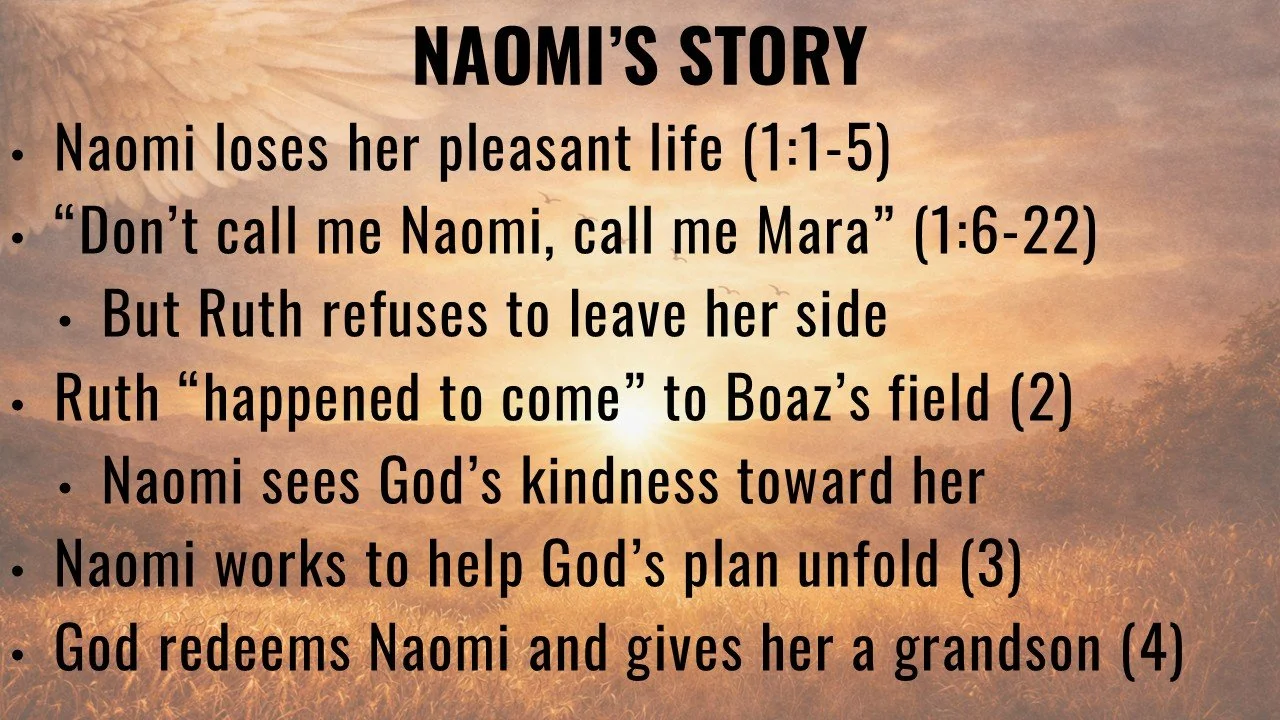
The story begins in the days of the judges, in dark and unstable times. Then famine strikes Bethlehem. Naomi’s family leaves the land and goes to Moab, looking for survival, looking for security, looking for a way to preserve what they have.
But what they tried to protect slipped through their fingers anyway.
Elimelech dies. Then Naomi’s two sons die. By the time chapter 1 settles in, Naomi is standing in a foreign land without a husband, without sons, and without any clear future. The woman who left looking for life has been crushed by loss.
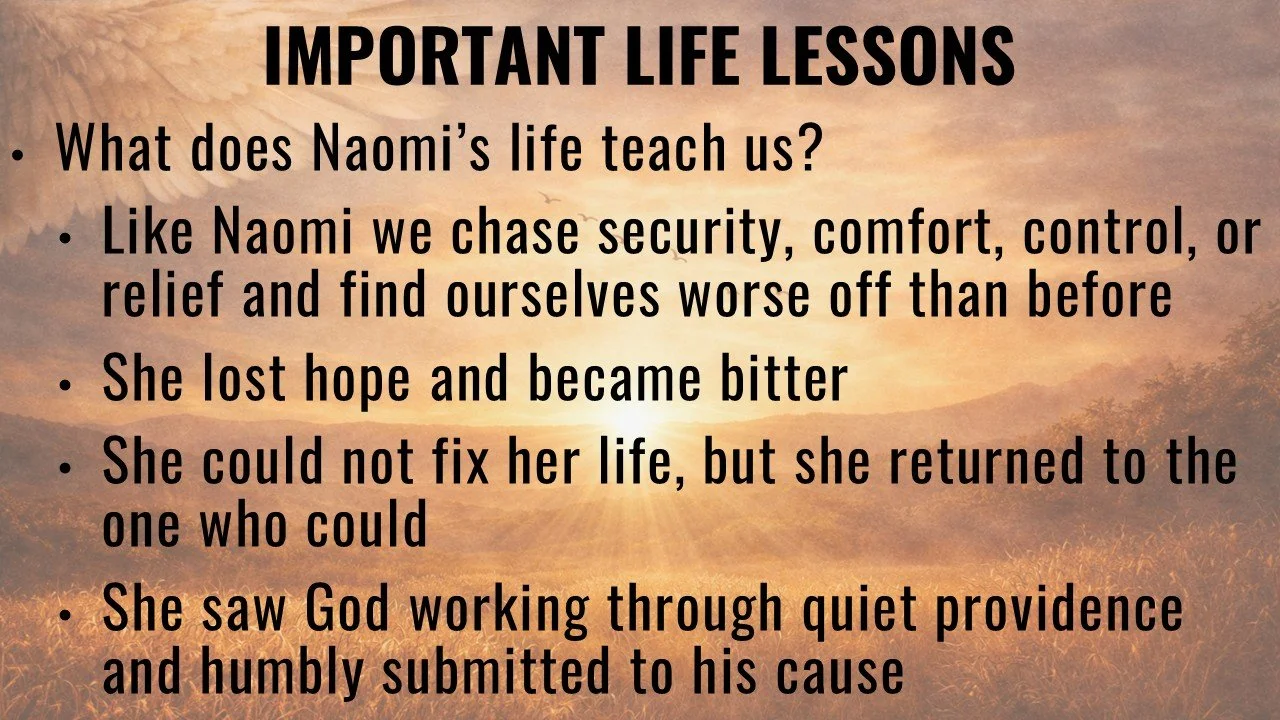
That is often how life feels. We chase fullness, security, control, or relief, thinking we can hold life together, making compromises, and instead we find ourselves emptier than before.
When Naomi hears that the Lord has visited His people and given them food, she decides to return. That’s important. However wounded she is, she knows where she needs to go. She heads home.
But she does not come home rejoicing. She comes home bitter. When the women of Bethlehem recognize her, she says, “Do not call me Naomi; call me Mara… I went away full, and the Lord has brought me back empty.”
That is brutally honest. Naomi is saying, “I am not pleasant anymore. I am bitter. I am not full anymore. I am empty.”
A lot of people know exactly what that feels like. Maybe not outwardly, but inwardly. You know what it is to look at your life and think, “I used to feel steady. I used to feel hopeful. But now I feel empty.”
And yet, even here, grace is already working. Naomi returns. Not cheerfully. Not confidently. But she returns. Sometimes coming back to God looks less like triumph and more like dragging your tired heart back into His presence.
Ruth Clings and God Begins to Work
As Naomi travels home, she tells Ruth and Orpah to go back. In her mind, she has nothing left to offer. No husband. No sons. No future. She sees herself as a dead end.
Orpah leaves, but Ruth clings.
And Ruth says, “Your people shall be my people, and your God my God.” Naomi sees emptiness. Ruth sees a God worth following. Naomi sees loss. Ruth sees covenant faithfulness. Naomi thinks she has nothing, but God has already placed mercy beside her in the form of Ruth.
That is one of the great ironies in the book. Naomi says she is empty while Ruth is standing right there.
Pain can do that to us. It can narrow our vision until we stop seeing the mercies God has already placed beside us. We can say, “There is nothing left,” while the kindness of God is already closer than we realize.
Then Ruth goes out to glean, and she happens to enter Boaz’s field. From our view, it looks accidental. From God’s view, it is providence. There is no dramatic miracle here. Just a field, a faithful woman, and the quiet hand of God guiding the whole thing.
Boaz notices Ruth. He protects her, feeds her, and speaks kindly to her. Most importantly, he says that she has come to take refuge under the wings of the Lord.
That line explains the whole story. Ruth is not just finding food. She is finding refuge. And Naomi, though she cannot see it yet, is about to discover that God’s wings are wider than her bitterness imagined.
When Ruth comes home with an abundance of grain and tells Naomi about Boaz, Naomi begins to wake up. She says, “Blessed be he by the Lord, whose kindness has not forsaken the living or the dead!”
That is a turning point. The woman who said, “The Almighty has dealt bitterly with me,” now begins to see that the Lord’s kindness has not left her after all. Healing begins there. Not with instant joy, but with the first flicker of hope.
God Brings Redemption
By chapter 3, Naomi is changing. She begins to seek rest for Ruth. Hope has awakened enough in her that she can think about future and blessing again.
Ruth goes to Boaz and asks him to spread his wings over her, because he is a redeemer. That reaches back to Boaz’s earlier words about refuge under the wings of the Lord. Ruth is asking Boaz to become the means of that refuge.
And Boaz responds with integrity. He does not exploit her vulnerability. He acts honorably. He handles the matter the right way. He redeems. He marries Ruth. The Lord gives a child.
And suddenly Naomi, who came home saying, “I am empty,” is holding fullness in her arms.
She could not fix her life.
She could not undo her losses.
She could not create redemption by her own strength.
But God could.
He did not erase the pain of her past, but He proved that her pain was not the end of the story. Naomi finds healing in His wings.
What Naomi Learns About God
Naomi learns that God is still working when bitterness blinds us. Her pain was real, but it was not the whole story. She said she was empty while Ruth stood beside her. She did not know Boaz was in the field. She did not know redemption was already moving toward her.
She learns that God often works through quiet providence. In this story, God works through a harvest, a field, a faithful woman, a righteous man, and the birth of a child. Quiet providence is still providence.
And she learns that God uses faithful people to bring restoration. Ruth’s loyalty matters. Boaz’s integrity matters. God often brings His kindness into broken lives through faithful hearts.
What God Can Do for Us
Naomi’s story is our story more than we may want to admit. We often leave God’s way looking for fullness. We chase security, comfort, control, or relief. And many times we end up emptier than before.
Then we lose hope. We get bitter. We stop seeing what we still have. We return to God, maybe, but with a bruised spirit.
Naomi teaches us that God still receives people like that. He can bless those who return. He can heal hearts that are bitter and disappointed. He can open our eyes to mercies we were too wounded to see. And He can redeem what we could never repair by ourselves.
That is the heart of the story. Naomi needed a redeemer. So do we.
How the Story Points to Christ
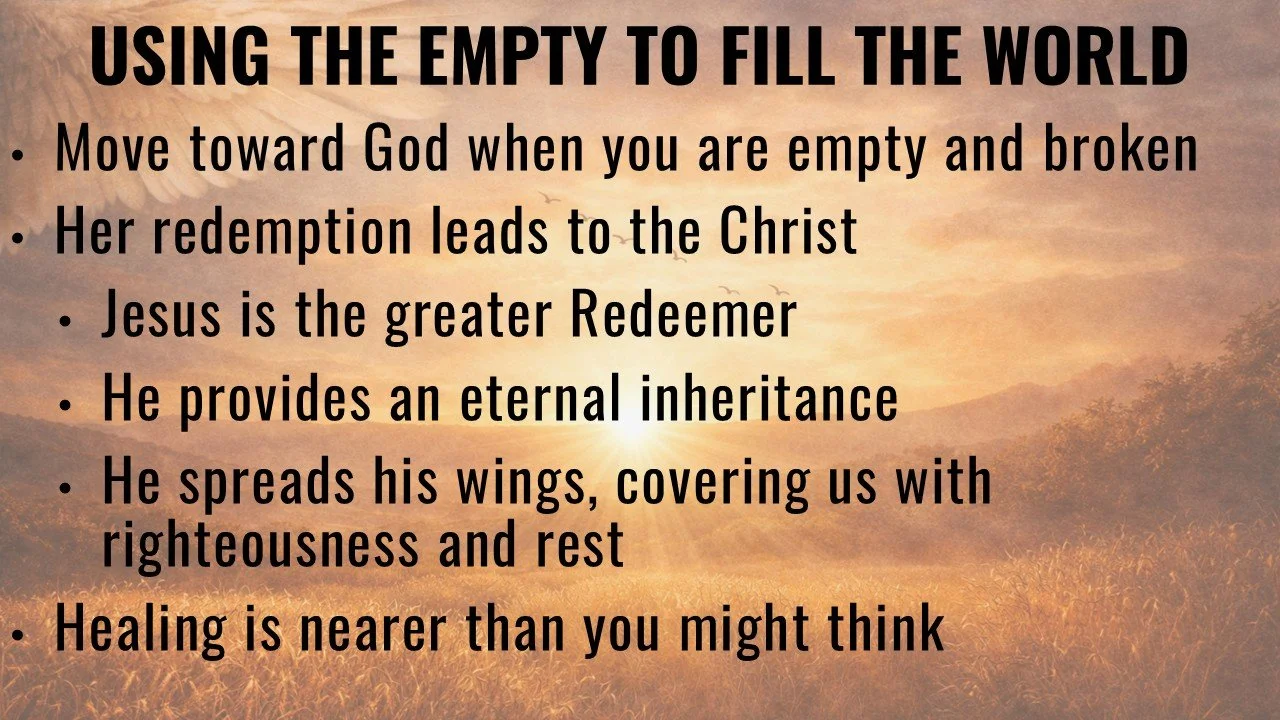
This story leads us straight to Jesus. Ruth ends by pointing forward to David, and David points forward to Christ.
Naomi’s emptiness points to our emptiness. Sin leaves us empty. Self-rule leaves us empty. We need more than improvement. We need redemption.
Ruth shows us the beauty of faith that clings to God when life is uncertain.
Boaz points us to the greater Redeemer. Boaz could redeem a field; Jesus redeems sinners. Boaz could provide a home; Jesus gives an eternal inheritance. Boaz could spread his garment over Ruth; Jesus covers us with righteousness.
And in Christ, we find final healing in His wings. He brings the empty near. He covers the guilty. He welcomes the bitter home. He gives rest to those who return to Him.
Conclusion
Naomi came home calling herself Bitter. She thought her life had collapsed beyond repair. She thought emptiness was the end of the story.
But Naomi did not know what God was already doing.
Healing was already walking beside her in Ruth.
Healing was already waiting in the field of Boaz.
Healing was already moving through quiet providence.
Healing was already unfolding under His wings.
And maybe that is where some of us are. Empty. Tired. Disappointed. Bruised by life. If so, Naomi’s story tells us something we need to hear: the Lord still knows how to fill the empty. His kindness has not failed. His wings are still open. And in Christ, the greater Redeemer, there is healing for all who return to Him.