
The God Worth Pursuing (Luke 16)




We have been studying how God pursues the lost through these parables in Luke. Last week we stood in Luke 15 and watched the father run to the son who had wandered far from home. But that parable was never just about the son who left. It was also about the son who stayed. The older brother stayed near the house, enjoyed the father’s blessings, and yet never learned the father’s heart. He would not go in. He would not rejoice. He would not share the father’s joy over the lost being found. That is where chapter 15 ends, and that is why chapter 16 matters so much. Jesus does not drop the conversation. He keeps going. He keeps pressing. He keeps exposing. The question at the end of chapter 15 is this: Will the Pharisees ever get the heart of God? Will they rejoice that the lost are being received? Or will they keep clinging to what they really love? Chapter 16 answers that question. It shows us what they are pursuing. And it warns us that if we pursue money, comfort, and self-justification instead of God, that road does not end well.
Managing God’s Possessions (1–13)
Luke 16:1–2 (ESV) — 1 He also said to the disciples, “There was a rich man who had a manager, and charges were brought to him that this man was wasting his possessions. 2 And he called him and said to him, ‘What is this that I hear about you? Turn in the account of your management, for you can no longer be manager.’
Jesus begins with a steward. He is not the owner. He is the manager. He handles what belongs to another. And he is accused of wasting his master’s possessions. That is the first thing this chapter puts in front of us. Everything we have belongs to God. Our money, our time, our opportunities, our marriages, our homes, our influence, our bodies, our breath. None of it is finally ours. We are all managers standing in someone else’s field, handling someone else’s goods, waiting on someone else’s evaluation.
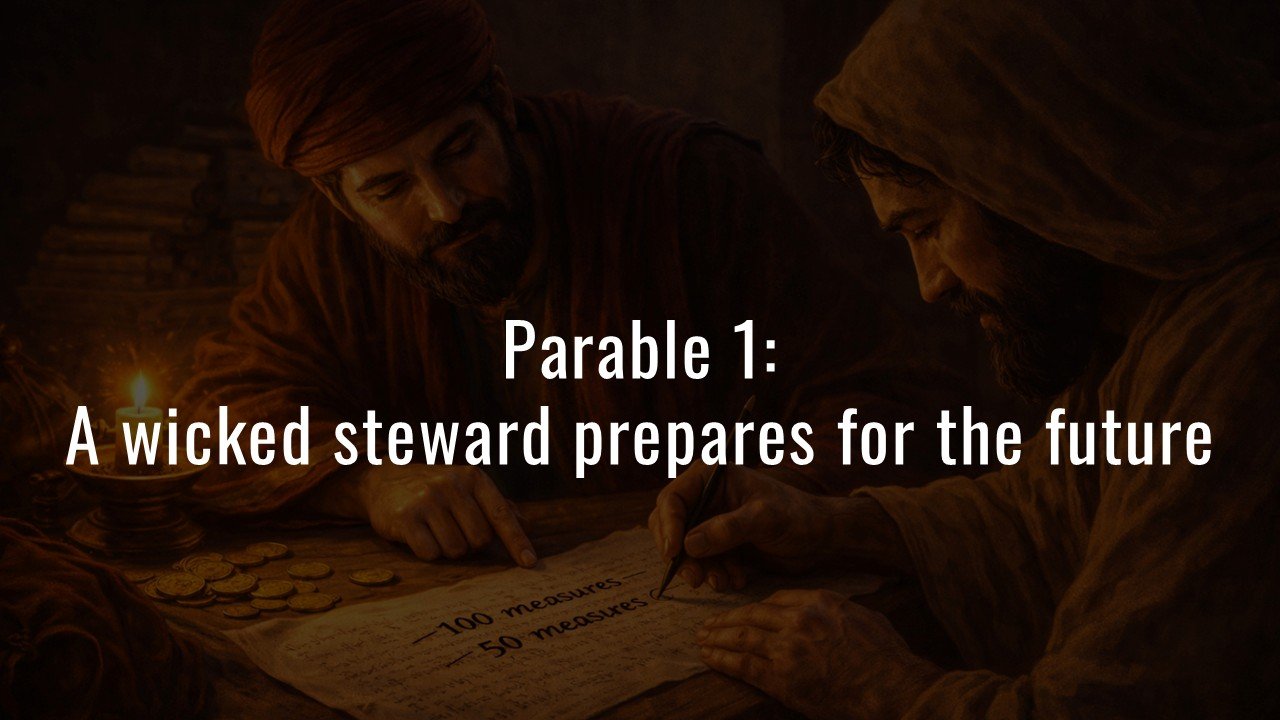
Luke 16:3–9 (ESV) — 3 And the manager said to himself, ‘What shall I do, since my master is taking the management away from me? I am not strong enough to dig, and I am ashamed to beg. 4 I have decided what to do, so that when I am removed from management, people may receive me into their houses.’ 5 So, summoning his master’s debtors one by one, he said to the first, ‘How much do you owe my master?’ 6 He said, ‘A hundred measures of oil.’ He said to him, ‘Take your bill, and sit down quickly and write fifty.’ 7 Then he said to another, ‘And how much do you owe?’ He said, ‘A hundred measures of wheat.’ He said to him, ‘Take your bill, and write eighty.’ 8 The master commended the dishonest manager for his shrewdness. For the sons of this world are more shrewd in dealing with their own generation than the sons of light. 9 And I tell you, make friends for yourselves by means of unrighteous wealth, so that when it fails they may receive you into the eternal dwellings.
This steward hears that the day of accounting is coming. He is about to lose his position. So what does he do? He starts thinking hard about the future. That is the part Jesus highlights. The man is not righteous. He is shrewd. He sees the wall coming and he starts acting in the present because he knows he will soon have to answer for what he has done. Jesus is not telling His disciples to be dishonest. He is saying that worldly people can be very sharp when their comfort is threatened. They can plan. They can move. They can sacrifice. They can act decisively when they think their future is on the line. But the sons of light can drift through life carelessly while eternity sits just ahead of them.
That is why Jesus says to use unrighteous wealth in light of eternal dwellings. In other words, use temporary things with eternity in view. Do not live as though money is the prize. Use it as a tool. Do not worship it. Do not waste what God has put in your hands chasing comfort now while neglecting what will matter forever.
Luke 16:10–13 (ESV) — 10 “One who is faithful in a very little is also faithful in much, and one who is dishonest in a very little is also dishonest in much. 11 If then you have not been faithful in the unrighteous wealth, who will entrust to you the true riches? 12 And if you have not been faithful in that which is another’s, who will give you that which is your own? 13 No servant can serve two masters, for either he will hate the one and love the other, or he will be devoted to the one and despise the other. You cannot serve God and money.”
Then Jesus makes the point plain. If you are faithful in little, you will be faithful in much. If you are dishonest in little, you will be dishonest in much. If you cannot be trusted with worldly wealth, why would God entrust true riches to you? And then He says it as clearly as it can be said: You cannot serve God and money.
That is the issue. It is not just whether we have money. It is whether money has us. It is not just whether we have comforts. It is whether comfort has become our master. The great danger is not that we will openly renounce God. The great danger is that we will quietly use God’s gifts to build a life around ourselves.
And that is exactly what the Pharisees were doing.
Failing to Serve God Over Self (14–18)
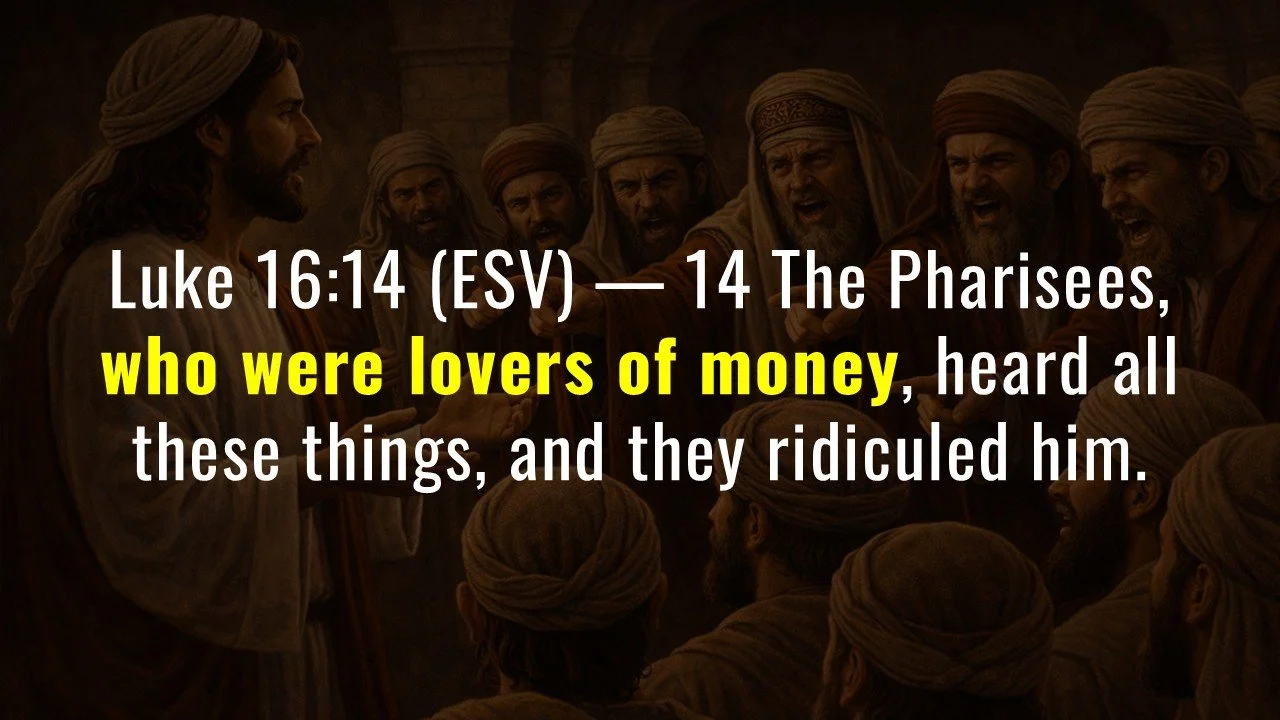
Luke 16:14–18 (ESV) — 14 The Pharisees, who were lovers of money, heard all these things, and they ridiculed him. 15 And he said to them, “You are those who justify yourselves before men, but God knows your hearts. For what is exalted among men is an abomination in the sight of God. 16 “The Law and the Prophets were until John; since then the good news of the kingdom of God is preached, and everyone forces his way into it. 17 But it is easier for heaven and earth to pass away than for one dot of the Law to become void. 18 “Everyone who divorces his wife and marries another commits adultery, and he who marries a woman divorced from her husband commits adultery.
Luke tells us plainly that the Pharisees were lovers of money. Then he tells us how they responded to Jesus. They ridiculed Him. That tells you what is in their hearts. When Jesus speaks against the thing they love, they do not repent. They sneer. When truth threatens an idol, truth starts sounding ridiculous.
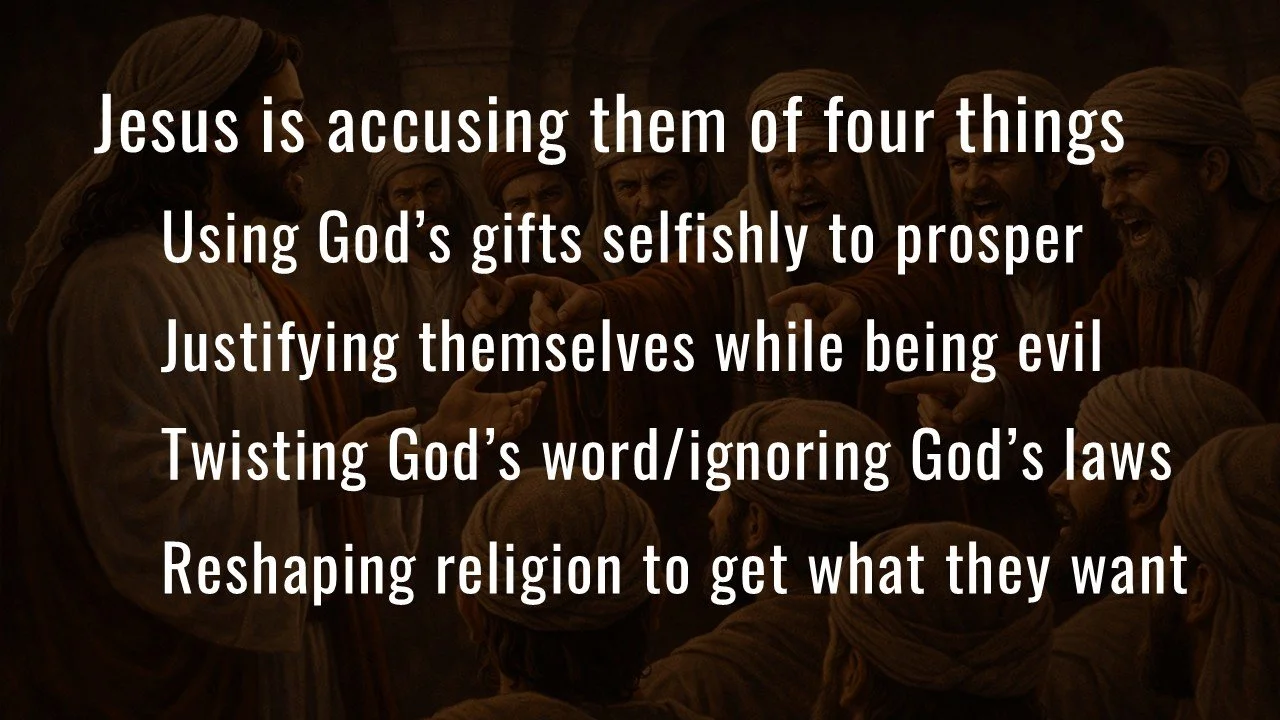
Jesus answers them with words that ought to shake every one of us. “You are those who justify yourselves before men, but God knows your hearts.” Men look at appearances. Men praise polish. Men admire success, image, and status. Men can be fooled by religious performance. But God knows the heart. God knows what is driving us. God knows what we are protecting. God knows when we are using religion to cover self-love. And then Jesus says something even stronger: “What is exalted among men is an abomination in the sight of God.” The very thing people clap for may be disgusting to God.
Then Jesus says that the Law and the Prophets still stand. God’s word has not failed. God’s standard has not changed. The kingdom is being preached, but that does not mean people can now bend righteousness into whatever shape they want. And that is why verse 18 is not random. The divorce statement is an example of the very thing Jesus is exposing. These men were willing to handle God’s word the same way they handled money. They would twist it when it served them. They would reshape obedience to get the outcome they wanted. They were not serving God. They were serving themselves with God’s things.
That is where this chapter digs into us. We may not call ourselves lovers of money, but how often do we do the same thing? We know what God says, but something else feels more practical. More useful. More manageable. So we compromise. We justify. We explain away. We pursue the outcome we want and try to drag Scripture along behind us. That is not serving God at all. That is serving self. That is taking what belongs to the Master and using it for our own ends.
And Jesus says God sees it all.
Justice in the End (19–31)
Luke 16:19–31 (ESV) — 19 “There was a rich man who was clothed in purple and fine linen and who feasted sumptuously every day. 20 And at his gate was laid a poor man named Lazarus, covered with sores, 21 who desired to be fed with what fell from the rich man’s table. Moreover, even the dogs came and licked his sores. 22 The poor man died and was carried by the angels to Abraham’s side. The rich man also died and was buried, 23 and in Hades, being in torment, he lifted up his eyes and saw Abraham far off and Lazarus at his side. 24 And he called out, ‘Father Abraham, have mercy on me, and send Lazarus to dip the end of his finger in water and cool my tongue, for I am in anguish in this flame.’ 25 But Abraham said, ‘Child, remember that you in your lifetime received your good things, and Lazarus in like manner bad things; but now he is comforted here, and you are in anguish. 26 And besides all this, between us and you a great chasm has been fixed, in order that those who would pass from here to you may not be able, and none may cross from there to us.’ 27 And he said, ‘Then I beg you, father, to send him to my father’s house— 28 for I have five brothers—so that he may warn them, lest they also come into this place of torment.’ 29 But Abraham said, ‘They have Moses and the Prophets; let them hear them.’ 30 And he said, ‘No, father Abraham, but if someone goes to them from the dead, they will repent.’ 31 He said to him, ‘If they do not hear Moses and the Prophets, neither will they be convinced if someone should rise from the dead.’ ”
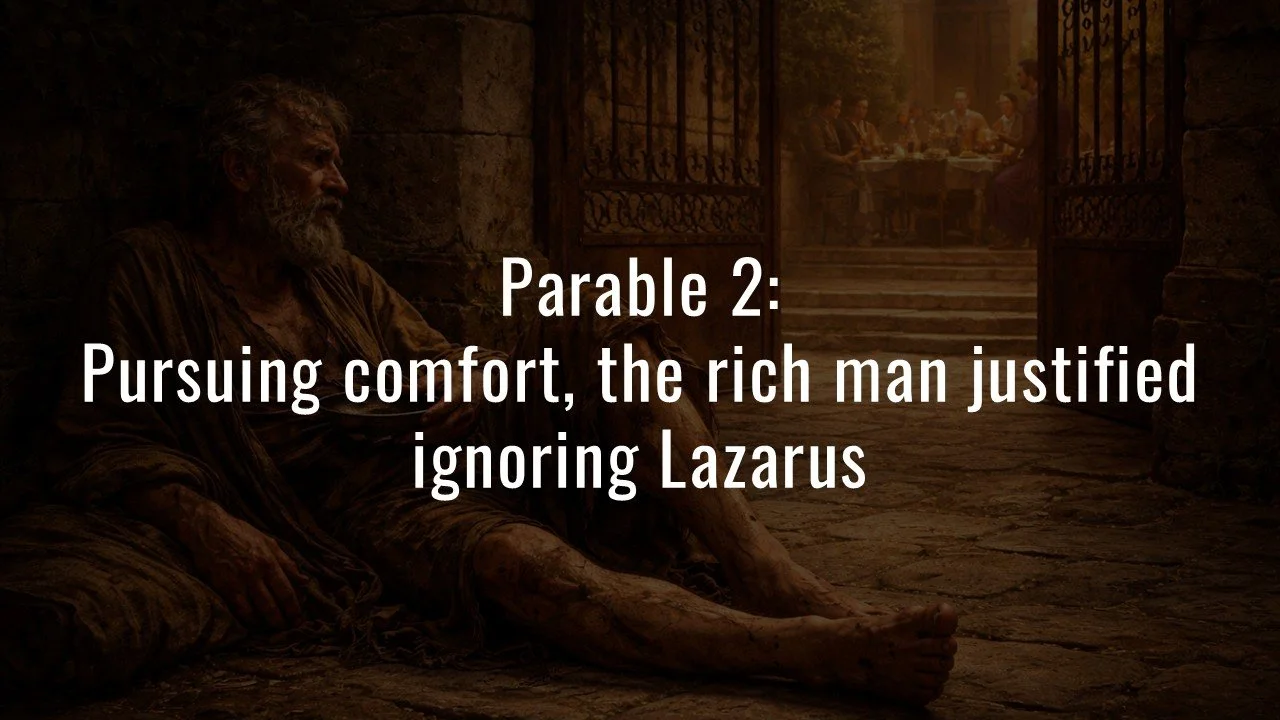
Then Jesus tells one final story. A rich man lives in luxury. Purple clothes. Fine linen. Feasting every day. Outside his gate lies Lazarus, poor, broken, covered in sores, longing for scraps. The rich man does not have to go searching for need. It is lying at his gate. He sees it and passes by it. Day after day. Meal after meal. Comfort after comfort. And then both men die.
That is when everything changes.
Lazarus is carried to comfort. The rich man is in torment. And now the man who had everything wants a drop of water. Now the man who ignored suffering cannot escape it. Now the man who had no room in his heart for mercy wants mercy for himself.
This is not Jesus saying that being rich automatically condemns and being poor automatically saves. This is Jesus showing that a life of self-indulgence, lovelessness, and disregard for God’s word ends in judgment. The rich man spent his life using what God gave him for himself. He had a gate, but no compassion. He had blessings, but no mercy. He had opportunity, but no repentance. And in the end, God’s justice finds him.
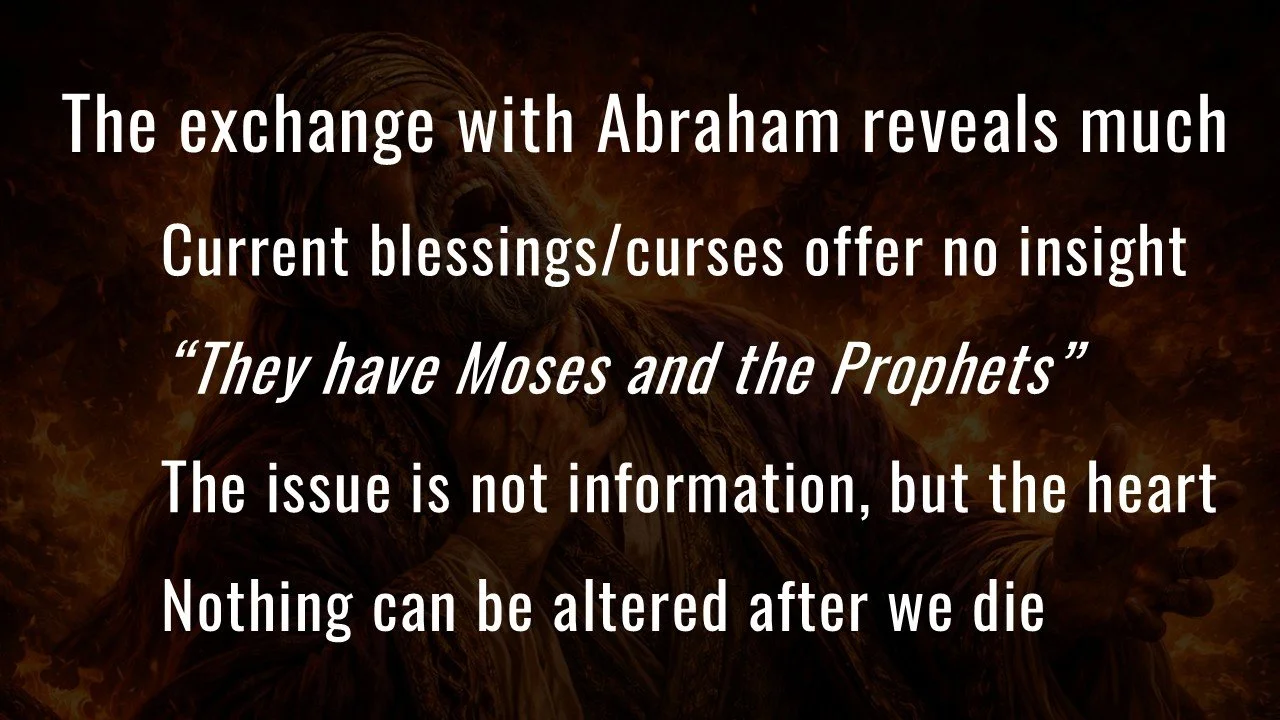
Then the rich man asks for his brothers to be warned, and Abraham says, “They have Moses and the Prophets; let them hear them.” That is the final blow. The problem was never lack of revelation. The problem was refusal to listen. He wants a dramatic sign. Abraham says they already have the word of God. And if they will not hear God’s word, they will not be convinced even if someone rises from the dead.
That is chilling. Jesus is saying that the issue is not information. It is the heart. People can have Scripture, hear truth, watch mercy, see need, and still pursue themselves right into eternal ruin.
Pursuing God
So what is Luke 16 saying to us?
It is saying that if we pursue anything above God, we will lose everything that matters. If we pursue money, comfort, image, and self-justification, we will begin using God’s gifts to serve ourselves. We will begin bending truth around our desires. We will begin stepping over people at the gate. And unless we repent, eternity will expose what we were really living for.
As Americans, we especially need to hear this. We live surrounded by abundance, comfort, excuses, and endless ways to justify ourselves. We are trained to prize what works, what pays, what protects peace, what preserves the image, what keeps life easy. But Jesus says what is exalted among men may be an abomination to God. That ought to stop us in our tracks.
So do not waste your life managing God’s possessions as though they were your own. Do not use His blessings to serve self. Do not justify what He condemns. Do not act like comfort now is worth torment later. Hear His word. Submit to it. Pursue Him. He is the only Master worth serving, and He is the only one who can give true riches that last forever.
And the good news is that Jesus does not only warn us here; He is able to save people exactly like the ones this chapter exposes. He receives the self-justifying. He pursues the lover of comfort. He pursues the one who has wasted what belonged to God. He pursues those who might finally stop defending themselves and come to Him empty-handed.
That is our hope. Our hope is not that we have managed everything well. Our hope is that Christ came for bad stewards, for idolaters, for people who have loved gifts more than the Giver. He died for our greed, our lovelessness, and our self-serving religion, and He rose to give new hearts to those who trust Him.
So repent, yes. But repent knowing there is mercy for you in Jesus. Turn from dead masters to a living Savior. Bring Him your divided heart, your misused gifts, your buried compassion, your excuses, and your sin. He is not only the Master worth serving. He is also the Savior who forgives, restores, and teaches His people to use their lives for what will last forever.