
The Father Who Runs (Luke 15:11-32)

Some stories do not need much help getting our attention. This is one of them.
Almost everybody knows something about the story of the prodigal son, even if they have not read it in a long time. They know there is a younger son who leaves home, wastes everything, and comes crawling back. They know there is a father waiting on him. They know there is a celebration when he returns, repentant.
But what makes this story so powerful is not just that it is memorable. It is that Jesus tells it for a reason. At the beginning of Luke 15, sinners are drawing near to hear Jesus. Tax collectors. Outcasts. People with stained reputations. People the religious world had already sized up and shoved into a category. And when they gather around Jesus, the Pharisees and scribes do not rejoice. They grumble. They cannot stand the fact that Jesus receives people like that.
That is the moment this story comes out of.
And Jesus is not just telling a touching family story. He is opening a window into the heart of God. He is helping us see what happens when someone is lost, what it means to come home, and why some people still cannot rejoice when grace fills the house.
So before we rush to the end because we know the story, slow down and walk through it carefully. Because this isn’t just a story about people living a long time ago. It’s a story about us.
A Son Who Wants Life Somewhere Else
Luke 15:11–13 (ESV) — 11 And he said, “There was a man who had two sons. 12 And the younger of them said to his father, ‘Father, give me the share of property that is coming to me.’ And he divided his property between them. 13 Not many days later, the younger son gathered all he had and took a journey into a far country, and there he squandered his property in reckless living.
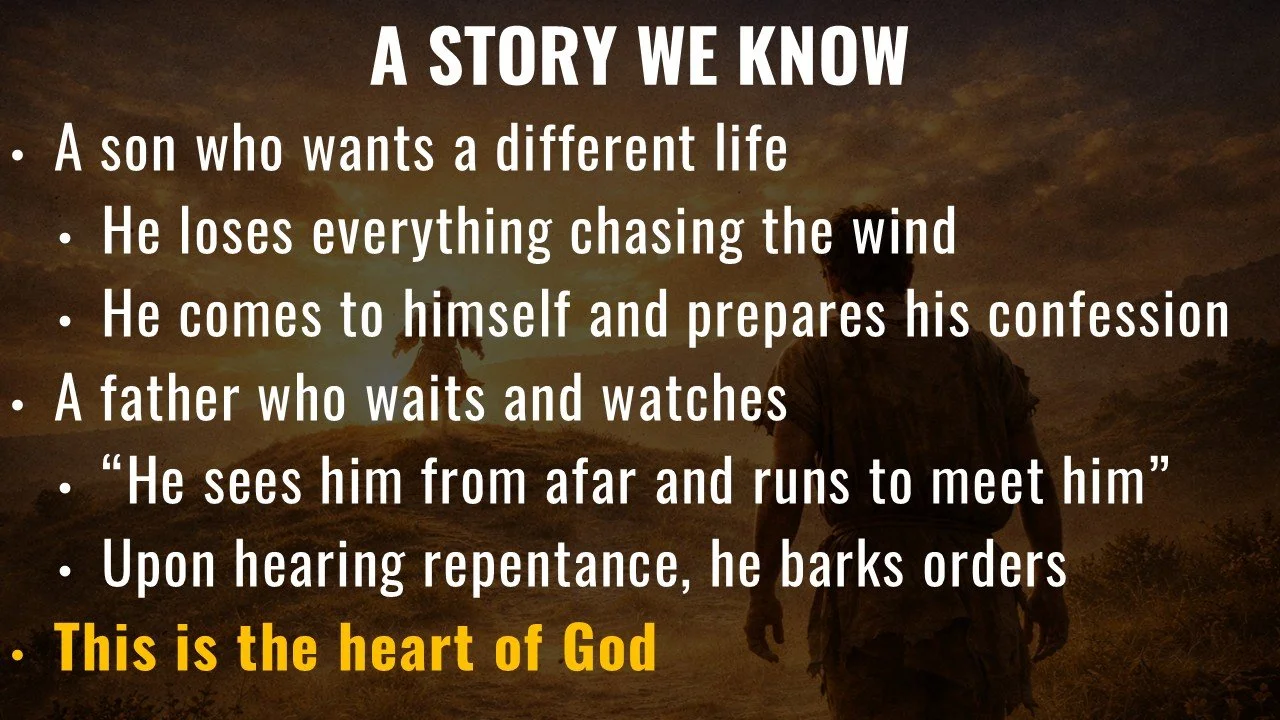
The younger son comes to his father and says, “Give me the share of property that is coming to me.” This is not just a request for money. It is a rejection of the father and everything he stands for. He is saying, “I’m tired of this life. It’s boring and empty to me. I’m sick of your ways and your rules. I want adventure. I want pleasure. I want what you can give me, but I do not want you.”
That is the heart of sin. It wants God’s gifts without God. It gets tired of the Father’s house. It starts believing life must be better somewhere else.
So the son leaves for a far country, and there he chases pleasure, freedom, and independence, and for a little while it may have looked exciting. But sin always lies. It promises life and leaves you empty. It promises freedom and makes you a slave. He wastes everything chasing the wind.
Luke 15:14–16 (ESV) — 14 And when he had spent everything, a severe famine arose in that country, and he began to be in need. 15 So he went and hired himself out to one of the citizens of that country, who sent him into his fields to feed pigs. 16 And he was longing to be fed with the pods that the pigs ate, and no one gave him anything.
Soon the money is gone. A famine comes, and he ends up feeding pigs, longing to eat what they eat. The son who thought he was too big for the Father’s house is now starving in a field. That is what the far country does. It takes and takes until there is nothing left.
I’ve heard parents say, “They have to sow their wild oats.” They have to experience the consequences of their own foolish actions and suffer the pain that follows. Some people are hard headed like this. We want to tell them what will happen, but they won’t listen. We just hope they don’t die in the process, and that they will eventually learn the lesson.
A Son Who Comes to Himself
Jesus tells us, “He came to himself.” That is one of the great turning points in the story. Sin had made him blind, but now he sees clearly. He remembers the wisdom of his father’s house. He remembers that even the servants there have bread enough and to spare.
So he says, “I will arise and go to my father.” He prepares his confession: “I have sinned against heaven and before you. I am no longer worthy to be called your son.” That is repentance. It is not just feeling bad. It is turning back.
That is what an honest heart looks like. No excuses. No blame-shifting. No attempt to defend himself. He knows he has sinned, and he knows he has no claim to make. He just wants to come home. How many people are guilty of sin, claim to repent, and then try to justify themselves? Not here.
The Father Who Runs
Meanwhile, the father hasn’t forgotten about his son. He’s not cold or callous. He didn’t go back to his work and talk like his youngest son never existed. He’s been walking a well worn path to a hilltop where he scans for his long lost son. One day, while he is still a long way off, the father sees him. He can tell by the way he walks. It’s him.
Can you imagine the emotion? He has been looking. Watching. Waiting. Hoping for the day his son would come home. And when he sees him, he does not stand there with crossed arms. He does not wait to hear the whole speech. He does not make the boy crawl the rest of the way.
He runs to meet him.
That would have shocked the hearers. Men like this did not run. But this father is not concerned with protecting his dignity. His son is coming home. So he runs to him, embraces him, and kisses him.
The son begins his confession, but the father quickly turns and starts giving orders. “Bring the best robe. Put a ring on his hand. Shoes on his feet. Kill the fattened calf.” Why? “For this my son was dead, and is alive again; he was lost, and is found.”
This is the heart of God. He is not reluctant to receive the repentant. He is not annoyed when sinners come home. He is not cold toward the broken. Jesus is showing us a Father who moves toward the lost with compassion. He brings them close.
That is the joy of this chapter. The shepherd rejoices. The woman rejoices. And now the father rejoices. Heaven does not grumble when the lost are found. Heaven celebrates.
This is what makes the story so appealing and it stands out to us because it shows us God’s gracious attitude toward the lost, but the story doesn’t end there. I like a happy ending. It would have ended here and had a happy ending, but Jesus is telling this story to teach a point to the Pharisees and scribes about the heart of God.
A Son Who Stayed Close But Stayed Cold
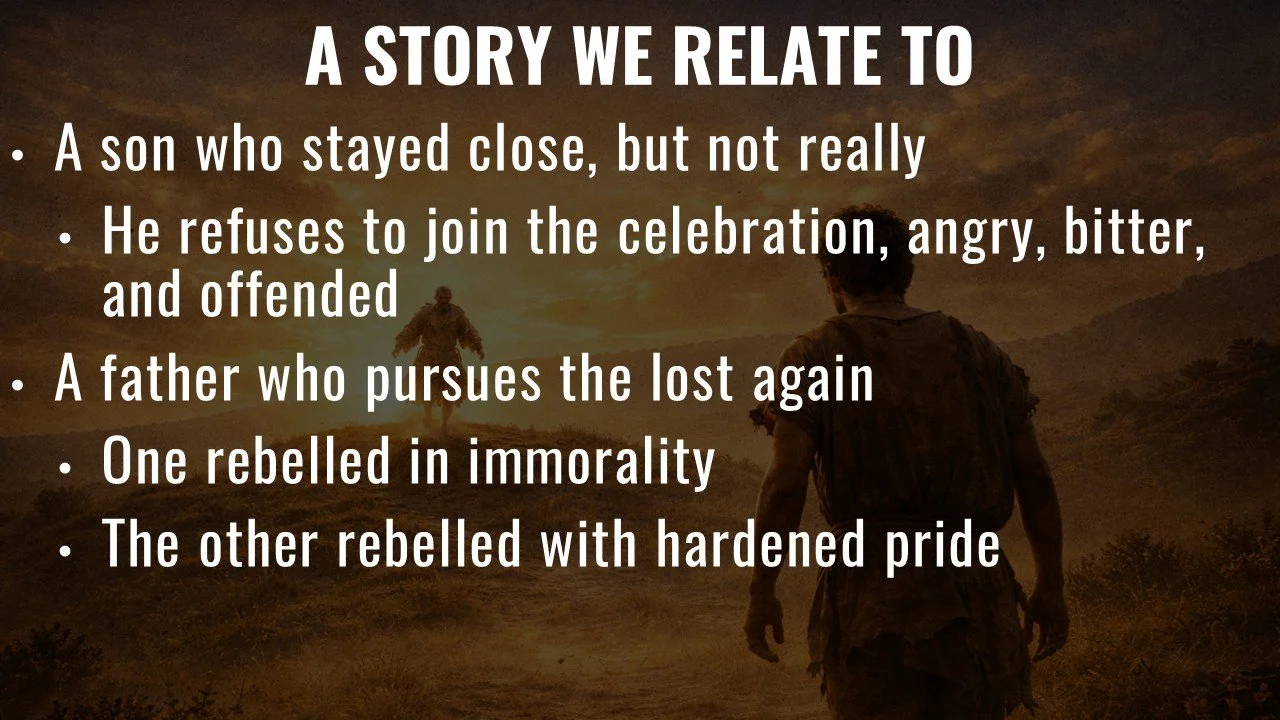
Then the story shifts. The older son comes in from the field and hears music and dancing. He asks what is going on, and when he finds out his brother is home, he refuses to go in.
That is the surprise of the parable. The younger son was easy to identify as lost. The older son looked faithful. He stayed home. He worked hard. He kept the rules. But when grace fills the house, his heart is exposed.
He is angry. Bitter. Offended. He says, “These many years I have served you.” He sounds less like a son and more like a slave keeping score. His relationship with God is not based on love, but merit.
Then he says, “This son of yours.” He will not even call him his brother. That is what self-righteousness does. It keeps records. It compares. It resents mercy. It cannot rejoice when grace is shown to someone undeserving, because it secretly believes blessing should be earned.
And that is exactly where the Pharisees are standing in Luke 15. They are angry that sinners are being received. They do not share the Father’s joy.
The Father Comes Out Again
But the father goes out to him too. That is one of the sweetest details in the story. He ran to the younger son, and now he comes out to plead with the older one. There is no favoritism here.
He says, “Son, you are always with me, and all that is mine is yours. It was fitting to celebrate and be glad, for this your brother was dead, and is alive; he was lost, and is found.”
The father is trying to pull him into his joy. He is saying, “If you love me, then love what I love. Know my heart. Rejoice in what makes me rejoice.”
This father pursues both sons. He pursues the rebellious son in the far country, and he pursues the resentful son outside the party. One is broken by sin. The other is hardened by pride. Both need the father.
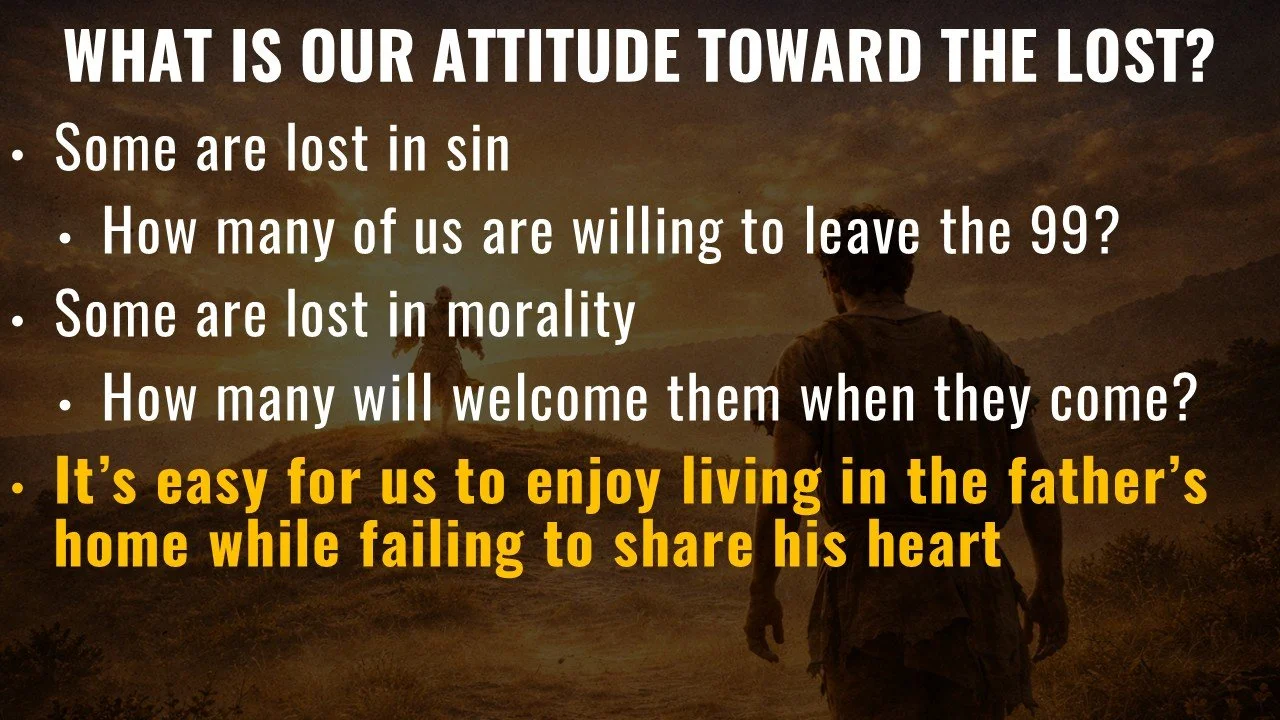
What Is Our Attitude Toward The Lost?
The attitude of the ninety-nine, the nine, and the one who stayed is the attitude of people who think they do not need grace as much as others do. They look at broken people and ask why they should be welcomed so warmly. They are not looking for the lost to return. They do not rejoice when sinners repent. They grumble.
That spirit shows up whenever we are more offended by someone’s past than moved by their repentance. It shows up whenever we sit coldly in our seats while visitors enter our building. It shows up whenever we act like grace should be rationed for those deserving.
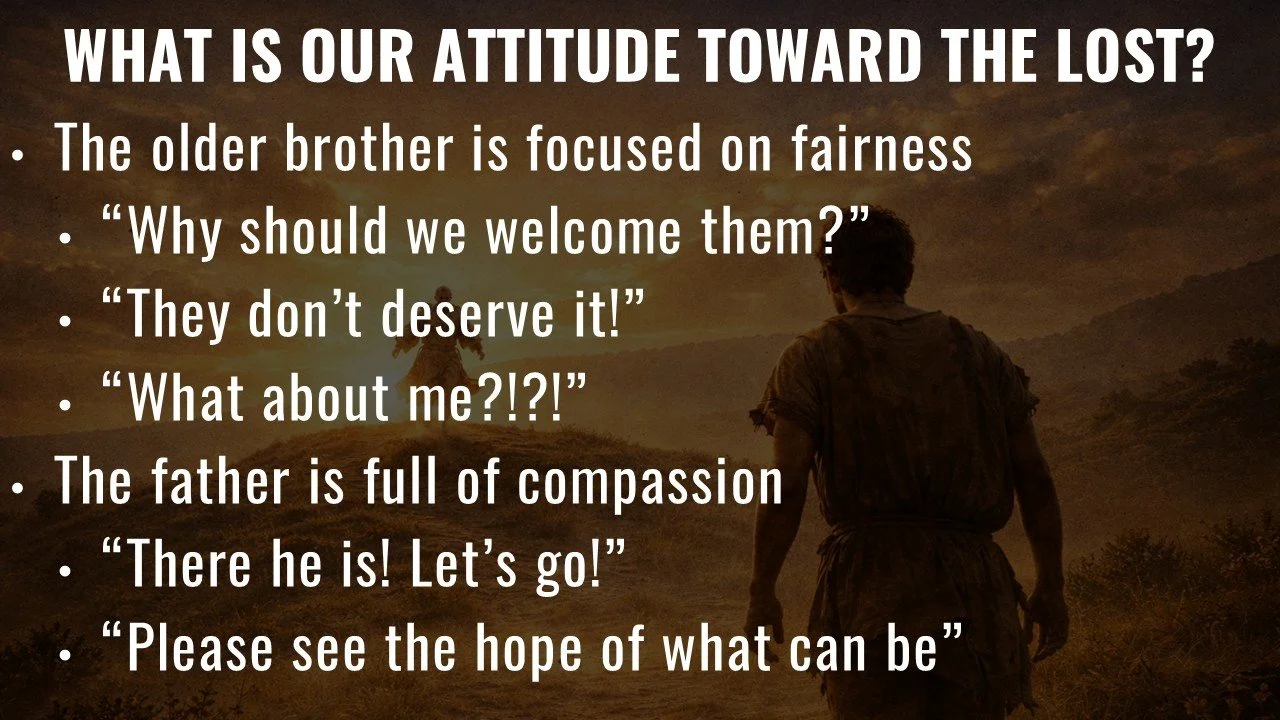
The father is full of compassion. He watches. He waits. He runs. He embraces. He restores. He celebrates. And then he pleads with the proud son too. That is what Jesus wants us to see. God is not like the grumbling Pharisees. He is full of mercy toward the sinner who turns.
The father sees with love, and the older brother sees with pride. The father is focused on restoration. The older brother is focused on fairness. The father rejoices over repentance. The older brother resents grace.
At the deepest level, the older brother does not understand that he needs mercy too.
How Can We Have The Same Heart As God?
We do not make the father more like the older brother. We let our hearts become more like the father’s.
That starts when we remember that none of us come to God by merit. Some of us ran farther. Some of us sinned more publicly. Some of us made a mess in ways everybody could see. But every one of us needs the mercy of the Father.
And if the Father ran to us, then we cannot stand at the door with folded arms when somebody else comes home.
Conclusion
The parable ends without telling us whether the older brother goes in. Jesus leaves it open because the question is aimed at the Pharisees, and it is aimed at us. Will you share the father’s heart? Will you come into the Father’s joy?
The great tragedy is not only wasting your life in rebellion. The great tragedy is standing outside the celebration of grace while pretending you have always been near God.
But the Father’s heart is clear. He rejoices when the lost are found. He welcomes the repentant. He pleads even with the proud.
He wants the house full of crippled, lame, poor, and broken people. Is that you?