
Self-Made Religion (Judges 17-18)
There are some chapters in the Bible that make you shake your head because of how strange they are. Then there are some chapters that make you uneasy because they feel too familiar. Judges 17 and 18 is one of those texts.
This story is not about atheists. It is not about pagans somewhere far away from the people of God. It is about Israelites. It is about people who know the name of the Lord. It is about people who want blessing. It is about people who want priests and shrines and spiritual reassurance. On the surface, it looks religious. But underneath it all, it is rotten.
That is what makes this story dangerous. The problem here is not that people stopped believing in something spiritual. The problem is that they started shaping religion into something useful, convenient, and profitable for themselves.
And that is still a danger. It is possible to talk about God, sing about God, pray to God, and still have a heart that is not surrendered to God. It is possible to want the benefits of God without actually wanting to bow before Him. It is possible to build a whole spiritual system around ourselves and then slap God’s name on it.
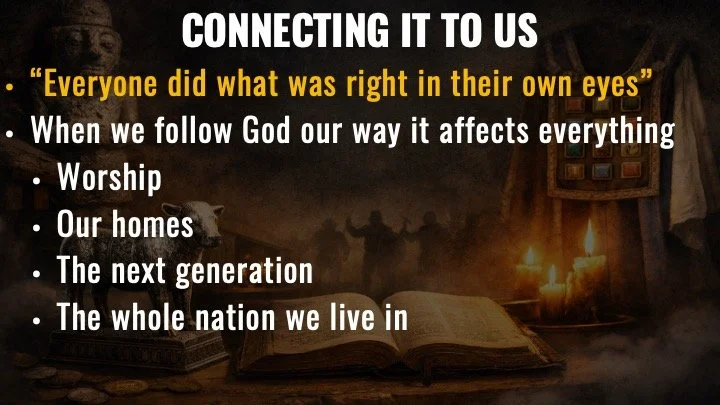
That is what is happening in Judges 17 and 18. The ending of Judges is showing us what life becomes when everybody does what is right in his own eyes. It does not just affect politics. It does not just affect the battlefield. It affects worship. It affects the home. It affects the next generation. It affects the whole nation.
So tonight I want us to walk through this story together and see what happens when religion goes wrong.
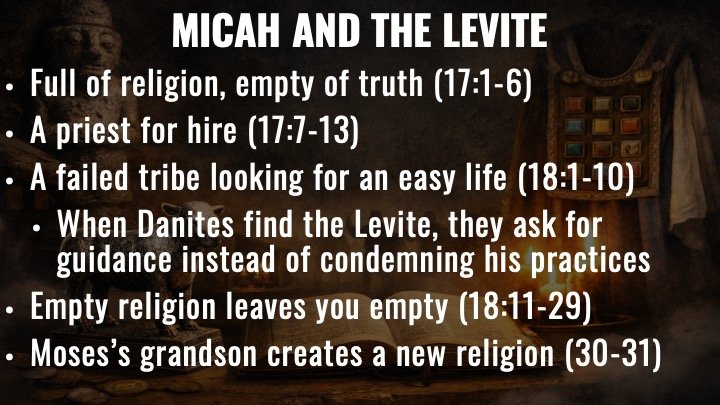
A House Full of Religion But Empty of Truth
The story begins with a man named Micah in the hill country of Ephraim. Right away, we are brought into a mess. Micah had stolen eleven hundred pieces of silver from his own mother. He hears her pronounce a curse on the person who took it, and suddenly Micah decides it is time to confess.
Now that tells you something already. Micah is not broken over his sin. He is scared of consequences. He is afraid the curse may come down on him. So he brings the money back and says, in effect, “I took it.”
And his mother responds, “Blessed be my son by the Lord.”
That sounds spiritual. It sounds warm. It sounds religious. But you need to watch this house carefully, because this house knows how to use the Lord’s name without actually honoring the Lord.
His mother says she had dedicated that silver to the Lord for Micah so that a carved image and a metal image could be made. Think about how upside down that is. She says this silver is dedicated to the Lord, and then she uses it to make an idol. She is using the name of the Lord while violating the very commandments the Lord gave.
This is not just ignorance. This is spiritual confusion. This is what happens when people want God close enough to bless them, but not close enough to rule them.
Micah takes those images and puts them in his house. Then he builds a little religious system of his own. The text says he had a shrine. He made an ephod. He had household gods. He even ordained one of his sons to be his priest.
Do you see what is happening? Micah is building his own version of faith. He has his own sanctuary, his own sacred objects, his own priest, his own setup. He is acting like he can engineer access to God however he wants.
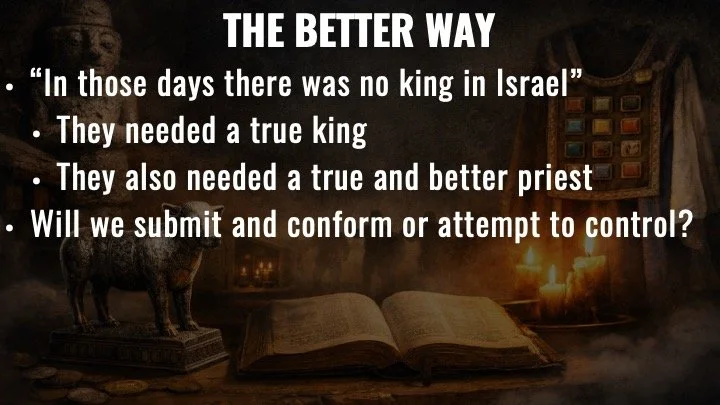
And then the writer gives us the line that explains the whole chapter: “In those days there was no king in Israel. Everyone did what was right in his own eyes.”
That verse is not there just to explain social chaos. It is there to explain spiritual chaos. Micah is not asking, “What has God said?” He is asking, “What seems right to me?” He is not submitting to divine revelation. He is creating a religion that fits his preferences.
And that is where false religion always starts. It starts when I stop asking, “What does God want?” and start asking, “What works for me?”
A Priest for Hire
Then the story gets worse. A young Levite from Bethlehem in Judah comes along. That should catch our attention because Levites were supposed to serve the Lord according to God’s law. They were supposed to help teach Israel, help preserve the distinction between holy and common, and assist in the worship God had actually commanded.
But this Levite is wandering. He is looking for a place. He is looking for opportunity.
Micah sees him and thinks, This is perfect. My homemade religion needs a little more credibility. So he offers the Levite a job. “Stay with me, and be to me a father and a priest, and I will give you ten pieces of silver a year and a suit of clothes and your living.”
Micah thinks he can hire spiritual legitimacy. He thinks if he can get an official-looking religious man in the house, then everything will be better.
And the Levite agrees.
He does not rebuke Micah. He does not say, “This shrine is unlawful. These idols are sinful. This is not the worship of the Lord.” He does not call Micah to repentance. He settles in. He takes the money. He takes the role. He becomes Micah’s priest.
Then Micah says one of the most revealing lines in the story: “Now I know that the Lord will prosper me, because I have a Levite as priest.”
That is the heart of the problem right there. Micah does not want God. He wants prosperity. He wants security. He wants blessing. He wants a setup that will work for him. He thinks religion is a system you arrange in order to get God to do good things for you.
That is not faith. That is superstition wearing a church face.
Micah thinks, I have the right objects now. I have the right man now. I have the right arrangement now. Surely the Lord will bless me now.
But when you treat God like a formula, you are not worshiping Him. You are trying to use Him.
And there are a lot of people who still do that. They do not ask, “How can I honor God?” They ask, “What do I need to do to get the outcome I want?” They do not come to God to surrender. They come to God to negotiate.
Micah’s house is full of religion, but empty of truth.
Dan Wants Something Easier
Then chapter 18 opens, and now the spotlight shifts to the tribe of Dan. The text says they were still seeking an inheritance to dwell in. That is important, because Dan had already been given an inheritance. God had assigned them territory. The problem was not that God had failed to provide. The problem was that Dan had failed to trust and obey.
Rather than fully taking what God had given them, they go looking for something easier.
They send out spies to search for a place. That language takes us back to earlier parts of Scripture, to the conquest, to the days when Israel was supposed to move forward by faith under God’s direction. But now the whole thing feels distorted. Dan is not walking in strong covenant obedience. Dan is looking for a convenient opportunity.
As those spies travel, they come to Micah’s house. They recognize the voice of the Levite and ask him what he is doing there. He tells them Micah hired him to be his priest. And then the men of Dan ask him to inquire of God for them, to see whether their journey will succeed.
That is remarkable. Nobody stops and says, “Wait a minute. This whole place is corrupt.” Nobody is bothered by the shrine, the idols, the counterfeit worship. Why? Because this kind of spiritual corruption had become normal.
And that is one of the most dangerous things that can happen to a people. When sin becomes normal, nobody even flinches anymore. Nobody asks whether something is true. They only ask whether it is useful.
The priest tells them to go in peace, that their journey is under the eye of the Lord. Again, the Lord’s name is being used freely in a setting that is completely out of line with the Lord’s word.
The men go on and find Laish, a quiet, unsuspecting people living in security. They are vulnerable, isolated, easy prey. So the spies return and tell Dan, “Let us go up against them, for we have seen the land, and behold, it is very good.”
Dan does not take the hard road of faithful obedience where God first placed them. They choose the easier target.
That is another mark of spiritual decline. When we stop trusting God, we often start rewriting obedience into whatever feels more manageable.
Stolen Gods and a Glad Priest
So six hundred men of Dan set out armed for battle. As they come near Micah’s house, the five spies tell the others about the shrine, the ephod, the household gods, and the carved image. Then they go in and take them.
They steal the whole religious system.
The Levite sees this happening and asks what they are doing. And their answer is basically, “Be quiet and come with us. Is it better for you to be priest to one man, or priest to a tribe and clan in Israel?”
That question exposes his heart.
The text says his heart was glad.
That tells you everything you need to know about this priest. He is not loyal to Micah. He is not loyal to truth. He is not loyal to the Lord. He is loyal to advancement. He likes the upgrade. This is a bigger platform, a bigger ministry, a bigger opportunity. So he takes the sacred objects and goes with them.
He is a priest for hire, and now he has gotten a promotion.
That is one of the saddest parts of the story. The man who should have brought clarity brings compromise. The man who should have stood for truth goes wherever the offer is better.
And before we move on too quickly, that should sober every teacher, preacher, and spiritual leader. It is possible to stand in religious service and still have a corrupt heart. It is possible to love position more than truth. It is possible to enjoy the appearance of serving God while actually serving yourself.
The Danites leave with Micah’s little religious empire in their hands. Later Micah realizes what happened, gathers some men, and chases after them. He catches up and cries out.
The Danites turn and ask, “What is the matter with you?”
And Micah says, “You take my gods that I made and the priest, and go away, and what have I left?”
There is so much irony packed into that sentence. “You take my gods that I made.” If you made them, they are not God. If they can be stolen, they are not strong. If your whole religion can be packed up and carried away by stronger men, then it was never anchored in the living God to begin with.
Micah says, “What have I left?”
That is the tragedy of false religion. When it is stripped down, there is nothing there. No real power. No real hope. No real salvation. Just objects, systems, titles, and empty confidence.
The Danites threaten him, Micah realizes he is outnumbered, and he turns back home.
His religion cannot save him. His priest cannot protect him. His gods cannot defend him.
Private Corruption Becomes Public Religion
The Danites go on to Laish. They strike the city with the sword, burn it, rebuild it, and rename it Dan.
Then the story reaches its darkest point. The tribe of Dan sets up the carved image for themselves, and Jonathan the son of Gershom, son of Moses, and his sons become priests there.
That detail hits hard. A descendant of Moses is caught up in this idolatrous mess. Heritage was not enough. Family background was not enough. Being close to great things was not enough. He still had to choose whether he would honor the word of God or sell himself to something corrupt.
And the text says this arrangement continued while the house of God was at Shiloh.
That means while the true place of worship stood in the land, Dan maintained their counterfeit version. While God’s appointed house was there, they preferred the version they could manage.
That is the story. It starts with one man in one house. One shrine. One priest. One carved image. One family religion. But it does not stay there. It grows. It spreads. It becomes tribal. What started as private corruption becomes public worship.
And that is how sin often works. We like to pretend private compromise stays private. It does not. It shapes homes. It shapes children. It shapes churches. It shapes cultures.
What Micah did in miniature, Dan institutionalized.
What This Story Is Showing Us
So what is the Spirit of God showing us here?
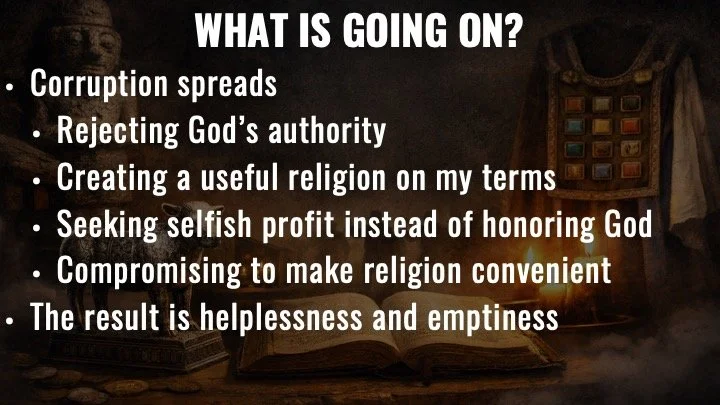
He is showing us that the problem in Israel was not just military weakness. It was not just poor leadership. It was not just social instability. The problem was that people still wanted religion while rejecting God’s authority.
They still wanted blessing. They still wanted assurance. They still wanted sacred things. But they wanted all of it on their own terms.
Micah made religion useful. The Levite made religion profitable. Dan made religion convenient. And all of them used the Lord’s name while doing what was right in their own eyes.
That is the danger of this text. It is not about people who hate religion. It is about people who remake religion.
And we need that warning, because it is possible for us to do the same thing in more polished ways. We may not carve an idol out of silver. But we can still create a version of faith that serves our desires. We can still choose what parts of God’s word we like and ignore what cuts against us. We can still want a Jesus who blesses us without a Jesus who rules us. We can still build a comfortable spiritual life that looks respectable while our hearts stay stubborn.
There are people who want church because it helps their marriage, helps their children, helps their reputation, helps their business, helps their peace of mind. But that is not the same as wanting God.
There are people who want just enough religion to feel secure, but not enough truth to be transformed.
There are people who think if they get the right preacher, the right church atmosphere, the right songs, the right routine, then everything will work out. But God has never been manipulated by setups. He is not impressed by arrangements. He is looking for hearts that tremble at His word.
This story is showing us what happens when religion becomes something we manage instead of a reality we submit to.
The Better Priest, the Better King, the Better Way
And this is where the story leaves us longing for something better.
Judges keeps telling us, “In those days there was no king in Israel.” That does not just mean they needed political structure. It means they needed righteous rule. They needed somebody who would not do what was right in his own eyes, but what was right in the eyes of the Lord.
They needed a true king.
They also needed a true priest. Not a man for hire. Not a man who could be bought, moved, upgraded, and used. They needed a priest who would be faithful to God and faithful for the people.
And that is exactly what we have in Jesus.
Micah had a priest he paid for. We have a Priest God appointed. Micah had gods he made with his own hands. We have the true image of the invisible God. Micah had a shrine in his house. We have access to God through the true temple, Jesus Christ. Micah wanted prosperity. Jesus came to bring reconciliation.
Jonathan used religion to advance himself. Jesus gave Himself to save sinners.
Dan established a false center of worship. Jesus tears down false worship and brings us into the presence of God in truth.
Judges 17 and 18 show us a world where everybody is shaping faith around themselves. The gospel shows us God stepping into the world in His Son to save us from ourselves.
And let’s be honest. We are not just watching Micah in this story. We are seeing our own temptation. The temptation to control instead of surrender. The temptation to edit God. The temptation to use religion instead of being changed by the living God.
But Jesus did not come to decorate our self-made religion. He came to call us to repentance, cleanse us from our idols, and reign over us as the true King.
Come Out of Self-Made Religion
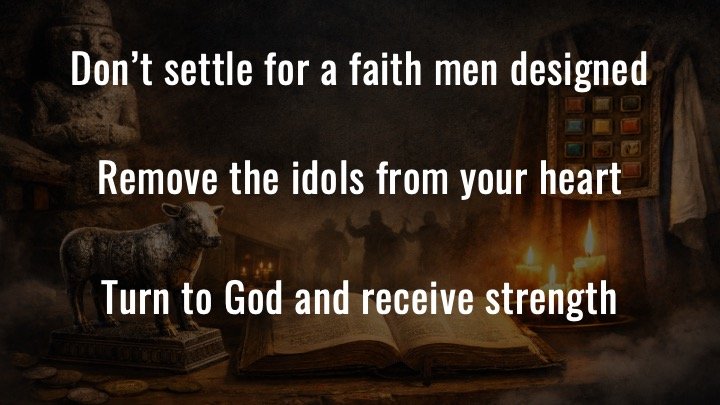
So the call of this is text, “Do not settle for a faith you designed.” Do not trust a religion built on preference, convenience, tradition, appearances, or human management. Do not confuse spiritual language with spiritual reality. Do not think closeness to sacred things is the same as surrender to God. And do not imagine that because something feels religious, it must be right.
Come out of self-made religion. Come to the living God on His terms. Come to the true Priest who does not serve Himself but gave Himself. Come to the true King who does not flatter your rebellion but calls you to submit and live. Come to Jesus Christ.
Because when religion goes wrong, people are left saying, “What have I left?”
But when Christ is your King and Priest, you are never left empty. In Him there is forgiveness. In Him there is truth. In Him there is access to God. In Him there is a kingdom that cannot be stolen, a priesthood that cannot fail, and a salvation that cannot collapse when pressure comes.
Micah’s religion could be carried away. Christ’s kingdom cannot. Micah’s priest could be bought. Christ never will be. Micah’s gods were made by human hands. Christ is the Son of God who made the world.
So do not build your life on what seems right in your own eyes. Bow before the King God has given. Trust the Priest God has appointed. And worship the God who has truly made Himself known in Jesus Christ.
Amen.