
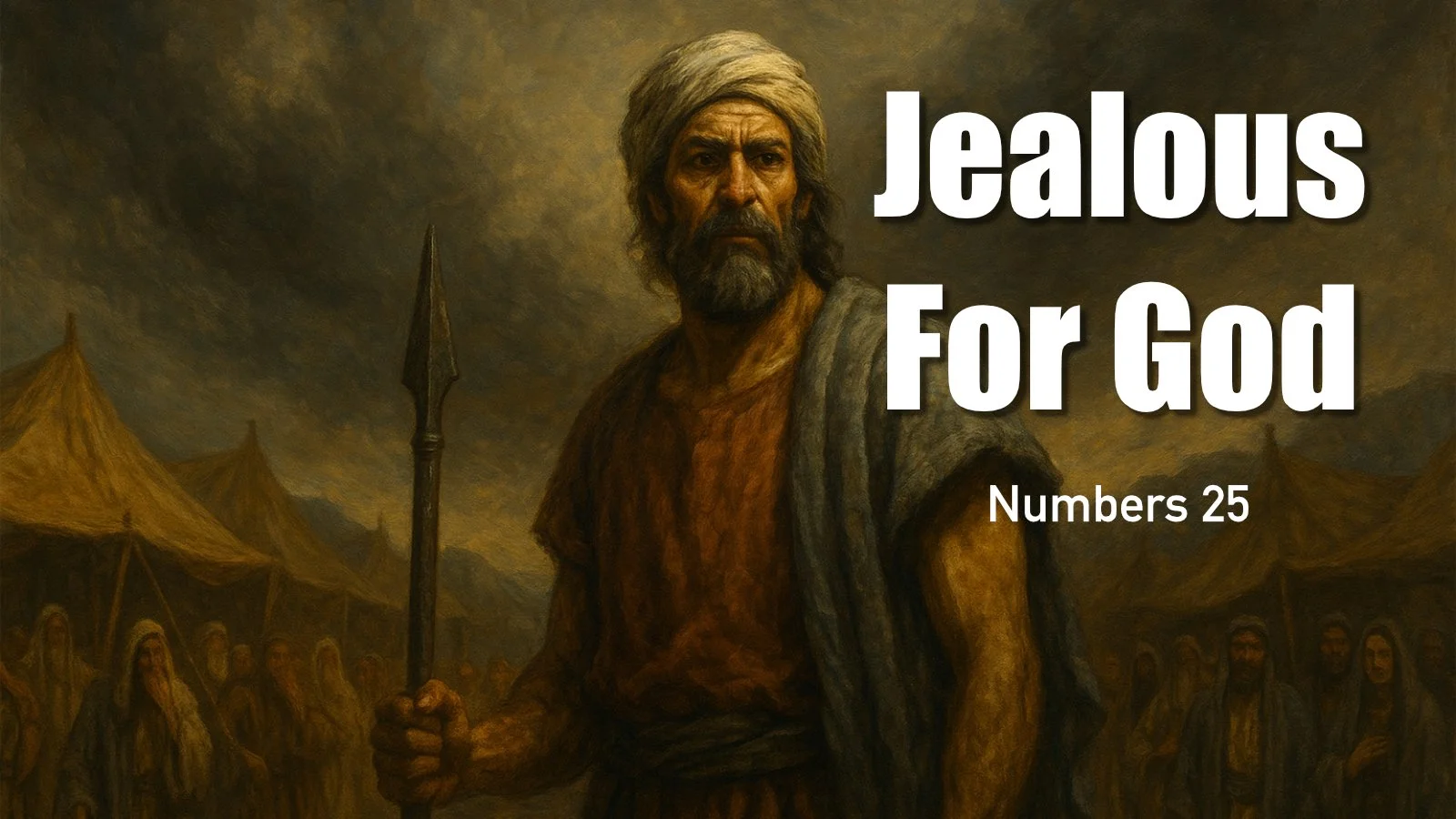
Jealous For God (Numbers 25)
“Because the sentence against an evil deed is not executed speedily, the heart of the children of man is fully set to do evil.” (Ecc 8:11) Have you ever seen this happen? I have. I was at a church with weak and practically non-existent leadership that refuses to address an issue when it comes up. Someone was in an adulterous situation. It was one of the leading man’s brothers. That sin is bad enough. But it’s made worse when no one does a thing to address it. Everyone knows, but they act like it doesn’t exist.
When this happens, it does something to everyone. Slowly, it eats away at their zeal. It’s like we start thinking, “What’s the point? This is all a ruse. We aren’t serious.” We die inside.
Today, we will be learning about an event like this which happens in Israel. But I want us to see that it relates closely with us. We are told in the New Testament that the events which happened to Israel were written down for us to learn their lessons and make the right choices (1 Cor 10)
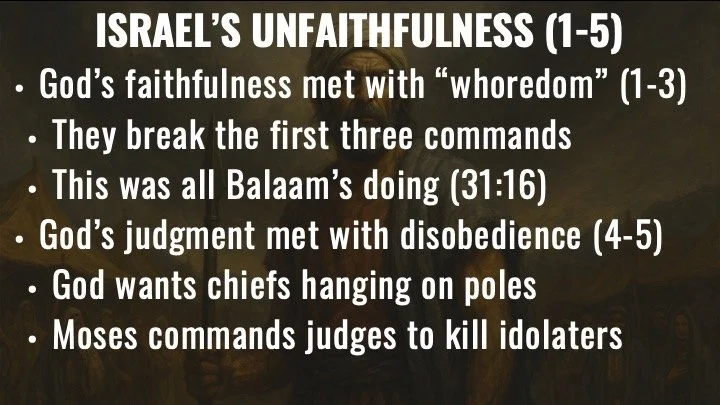
Israel’s Unfaithfulness (Num 25:1-3)
At the time of these events, God has already saved his people from Egypt. He has brought them to the mountain and spoken His ten commandments. He has also brought them to the promised land, but they refused to go in. So, he has let them wander for 40 years in the wilderness, allowing everyone over the age of 20 to die off. All the while, he has provided for them with manna, quail, and water from a rock. Their shoes haven’t worn out. They have had everything they needed the whole time.
Recently, God has given Israel great victories in battles outside of the promised land. He has helped them defeat the Amorites and the Amalakites, and everyone is terrified of this huge hoard of people in the wilderness. Moab’s king was so scared he tried to hire a prophet to curse the people. Instead all he could do was bless the people and we get a sense of how much God loves them and how much He will provide for them. They are beautiful in God’s eyes, “How lovely are your tents, O Jacob, your encampments, O Israel.” Each prophecy is like a love song God wrote for them to hear. God has great plans for them to rise above all the nations and be to the praise of His glory.
The faithfulness of God stands out in stark contrast to what we read about Israel in Numbers 25.
Numbers 25:1–3 (ESV) — 1 While Israel lived in Shittim, the people began to whore with the daughters of Moab. 2 These invited the people to the sacrifices of their gods, and the people ate and bowed down to their gods. 3 So Israel yoked himself to Baal of Peor. And the anger of the Lord was kindled against Israel.
Israel began to whore. This is a crude term that we don’t use, but it shows us how vile and evil Israel’s actions are. This indicates that Israel prostituted itself out and became adulterous. They left God for Moab’s gods, something God commanded them not to do.
It’s interesting that when we teach our children about the commands of God, we tend to overemphasize the need to not murder, steal, or lie. However, in God’s commandments to the people, He emphasizes staying away from idolatry. He doesn’t want them to marry people of the land because they will turn their hearts away from God. The people of the land don’t recognize how much greater the God of Israel is than their made up idols. So God wants Israel to stay away from them, lest they be deceived.
That’s what has happened here. “Israel yoked himself to Baal of Peor. And the anger of the Lord was kindled against Israel.” We learn elsewhere that this is how Balaam, the wicked prophet, got his money from Balak. He told him that God would not curse Israel unless they rebelled against Him. They were totally protected from outside. The only problem they had to worry about was within. And he was right.
God’s Judgment (Num 25:4-5)
Now, God speaks to Moses about how to address this issue, and He says something that seems really harsh.
Numbers 25:4 (ESV) — 4 And the Lord said to Moses, “Take all the chiefs of the people and hang them in the sun before the Lord, that the fierce anger of the Lord may turn away from Israel.”
He commands Moses to take the chiefs, and hang them in the sun. That most likely means they should break their hands and feet, then impale them on a stick for all Israel to see. This is a cruel and harsh judgment from God. Why would he say that?
Notice that Moses thinks it is cruel. He disobeys and does what he thinks is just.
Numbers 25:5 (ESV) — 5 And Moses said to the judges of Israel, “Each of you kill those of his men who have yoked themselves to Baal of Peor.”
He tells the men who have been assigned as judges to give the death penalty to all of those who are engaging in this idolatry. That is, after all, exactly what God had commanded earlier. Finding someone engaged in idolatry was supposed to carry the death penalty. So, I imagine they started going throughout the camp and looking for people engaged in idolatry to kill them. But the camp got wise. They hid what they were doing. Then, after a while the judges slacked off. They didn’t want to kill people for idolatry. It seemed like such a small thing to them.
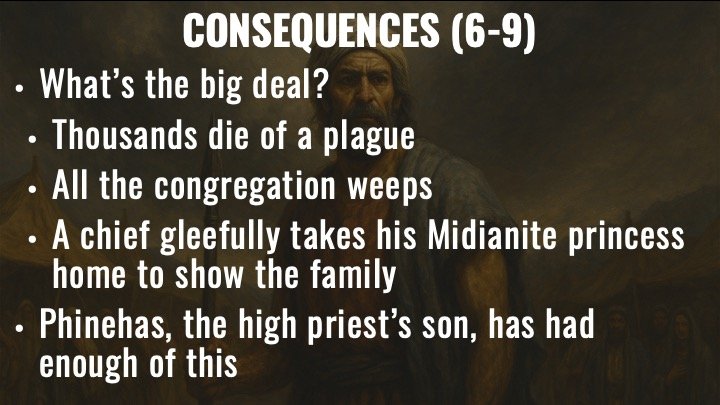
Consequences (Num 25:6-9)
But it wasn’t a small thing to God. He sent a plague upon the Israelites. A sickness that started taking the lives of thousands of people. Everyone was dying.
All Israel gathered at the tent of meeting to weep and pray for God to have mercy and heal them of the sickness. While they are there weeping, one of the chiefs of the people walks by. His tent is close to the center because he is a head of the people of Simeon. Following behind him was a woman of Midian (the group that joined with Moab to overthrow Israel). This chief was bringing a foreign, idolatrous woman, a princess of the Midianite people, in to meet his family while all of Israel was suffering the consequences of this unfaithfulness. Imagine yourself in the crowd that witnesses this happen. Everyone looks around to see if anyone will respond. They look to Moses and Aaron. They look to the other chiefs. No one does anything. They have made the chiefs of the people untouchable even though God said to hang them for all to see.
Numbers 25:6–9 (ESV) — 6 And behold, one of the people of Israel came and brought a Midianite woman to his family, in the sight of Moses and in the sight of the whole congregation of the people of Israel, while they were weeping in the entrance of the tent of meeting. 7 When Phinehas the son of Eleazar, son of Aaron the priest, saw it, he rose and left the congregation and took a spear in his hand 8 and went after the man of Israel into the chamber and pierced both of them, the man of Israel and the woman through her belly. Thus the plague on the people of Israel was stopped. 9 Nevertheless, those who died by the plague were twenty-four thousand.
The grandson of Aaron doesn’t stand around feeling paralyzed. He gets up, walks over to the tent, and steps inside. He walks into the tent with his spear, walks right up to this chief and his bride and impales them both with one thrust.
“Thus the plague on the people of Israel was stopped.” I imagine that they went through all the chief camps and did the same. They finally decided to obey God’s commands in God’s way. The blood of the leaders was required. They were at the heart of the problem, and they were the ones God held accountable.
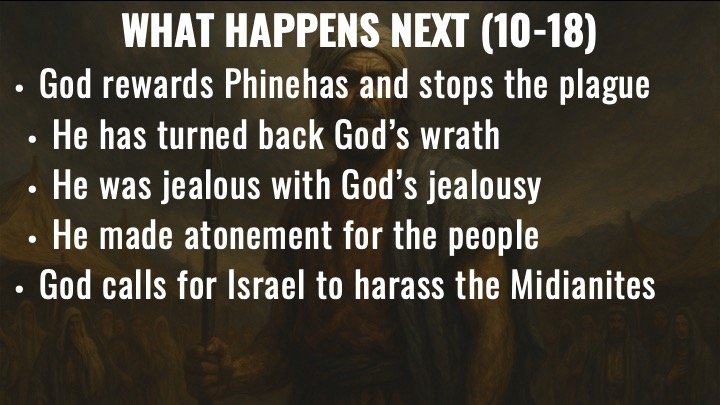
What Happened Next
After Phinehas did what God had commanded him to do, God spoke to Moses and revealed that Phinehas turned back God’s wrath by being jealous with God’s jealousy.
Numbers 25:10–13 (ESV) — 10 And the Lord said to Moses, 11 “Phinehas the son of Eleazar, son of Aaron the priest, has turned back my wrath from the people of Israel, in that he was jealous with my jealousy among them, so that I did not consume the people of Israel in my jealousy. 12 Therefore say, ‘Behold, I give to him my covenant of peace, 13 and it shall be to him and to his descendants after him the covenant of a perpetual priesthood, because he was jealous for his God and made atonement for the people of Israel.’ ”
God then rewards Phinehas by giving him God’s “covenant of peace.” This covenant is one of the great covenants of the Bible, although it is hardly recognized. It resembles David’s covenant for an eternal king. This is about a perpetual priesthood. His descendents would always serve as the high priest.
What Does This Mean?
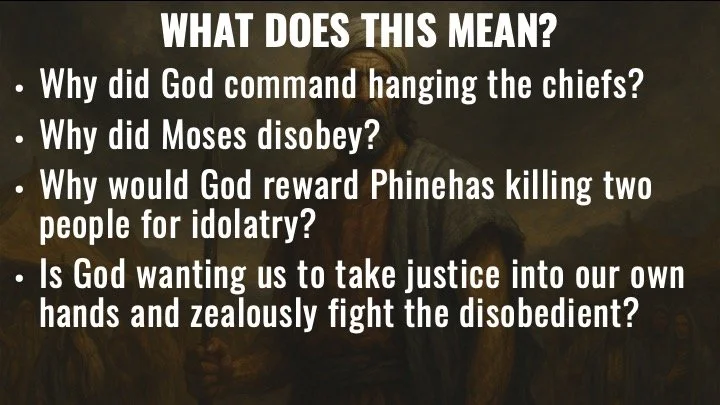
As we learn this story, we might wonder at the fact that God commanded Moses to hang these men up on a pole, that Moses tried to do it differently, and that God rewarded Phinehas for killing two people for idolatry. These are all uncomfortable truths we find in the Bible. But what does all of this mean?
Is God rewarding some random person taking justice into his own hands and killing someone who didn’t deserve it?
Comfortable With Idolatry
What we see in this story is that the people have become lukewarm to the idea of idolatry. They engage in it without considering what it really means. Their God has saved them from slavery and saved them from enemies. He provides what they enjoy. Yet, they want to honor and worship a piece of wood or a piece of metal? Is God really supposed to let that go?
When we see how much God has revealed about himself and given to His people, it becomes obvious that they have committed the greatest crime of all. These are commands number one, two, and three. They have broken God’s heart and rebelled against Him in a way that is very evil. He has shown himself to be full of mercy and compassion, but also unwilling to clear the guilty.
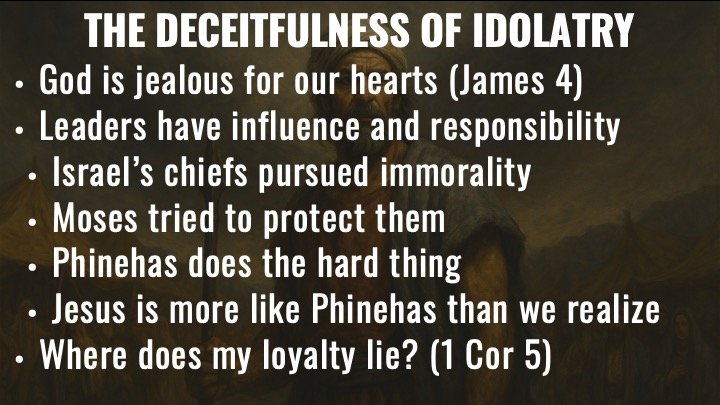
The first lesson we learn is that God wants to be in the primary place in our lives and in our hearts. Nothing comes close. Don’t pursue any good thing as the ultimate thing. Keep God in His rightful place. Idolatry is making good things the ultimate thing. Attributing god-like attributes to people, tools, pleasures, or anything in this world. God is a jealous God. He does not tolerate our worship of other gods.
Failed Leadership
Another aspect of this story is the failed leadership of Moses and the chiefs of the people. Their failure to make God their ultimate spread throughout the people and they were the ones who God held responsible.
The chiefs had “whored after” these foreign women. They fell to the temptations of the world and drug Israel down with them.
Moses failed to see the importance of making an example of these men. He failed to be jealous with God’s jealousy. He tried to find another way to address the problem. Why? We are told that he was married to a Midianite woman back in Exodus. She was a worshipper of God, but this made him sympathetic to the Midianite people who were just as idolatrous as the Moabites.
Jealous Zeal
When we look at Phineas, we see a young man who could see through the bias and compromises that the leaders were making. But he wasn’t just any young man. He was a young man of the high priestly line. The responsibility would fall on him after Moses because Aaron had passed away. Phineas was the high priest at this time. His actions weren’t just judgment. God says Phineas has made atonement for the sins of the people. This is fascinating because it connects the death of the chief and his wife with the death of Jesus.
I see typology in the chief and Midianite. Like Jesus, this chief was pierced and hung on a pole. His death atoned for the sins of the people. I also find it interesting that all people are represented, the Jew and the Gentile, in the chief and the Midianite princess.
I also see typology in Phineas. Like Jesus, he was making atonement for the people and stopping death through the plague of sin. His actions resulted in a covenant of peace, but Jesus’ actions gave that covenant of peace to all the people. Phineas’ zeal and jealousy for God’s glory and honor also serve as a type for us. We are all part of a royal priesthood, we are supposed to be renewed in our hearts and minds so that we have a heart for God and a desire to honor him.
This jealous zeal should motivate us to remove sin from the camp. God wants a people who are holy and righteous. He wants a people who love Him more than this world. I don’t recommend getting a spear and stabbing people. But I do recommend following the pattern in the New Testament for dealing with those engaged in blatant and rebellious sin.
In 1 Corinthians 5, we read…
1 Corinthians 5:9–13 (ESV) — 9 I wrote to you in my letter not to associate with sexually immoral people— 10 not at all meaning the sexually immoral of this world, or the greedy and swindlers, or idolaters, since then you would need to go out of the world. 11 But now I am writing to you not to associate with anyone who bears the name of brother if he is guilty of sexual immorality or greed, or is an idolater, reviler, drunkard, or swindler—not even to eat with such a one. 12 For what have I to do with judging outsiders? Is it not those inside the church whom you are to judge? 13 God judges those outside. “Purge the evil person from among you.”
Will we learn from Israel’s mistakes? Will we purge the evil from among us, regardless of what is politically correct? Will we be jealous for God’s glory and remove evil from our own lives?