
Harmonize With Each Other (Romans 12)
You’re sitting across the table from someone, and they choose to open up. They’re vulnerable. They trust you with something deep. A pregnancy announcement—while you’re begging God for a child. A cancer diagnosis—while you don’t even know what to say. A job promotion—while you’re wondering how to pay next month’s bills.
How do you respond in those moments?
We would all like to think we know. But real life exposes us. Our emotions don’t always cooperate. Sometimes joy feels out of reach when someone else is celebrating. Sometimes grief feels too heavy to enter. Sometimes our pride whispers, “Why them? Why not me?”
Paul knows this tension well. For eleven chapters in Romans he laid out the power of the gospel—how God rescues broken people, unites Jews and Gentiles, breaks down centuries of hostility, and creates one family out of strangers. And then he says in Romans 12:16:
“Live in harmony with one another.”
Right before it, a phrase you could stitch on a pillow—but much harder to practice:
“Rejoice with those who rejoice; weep with those who weep.”
So today we’re answering two questions:
- What does it mean to live in harmony?
- How do we actually do it?
What Does Harmony Mean?
A definition I’ve come to appreciate:
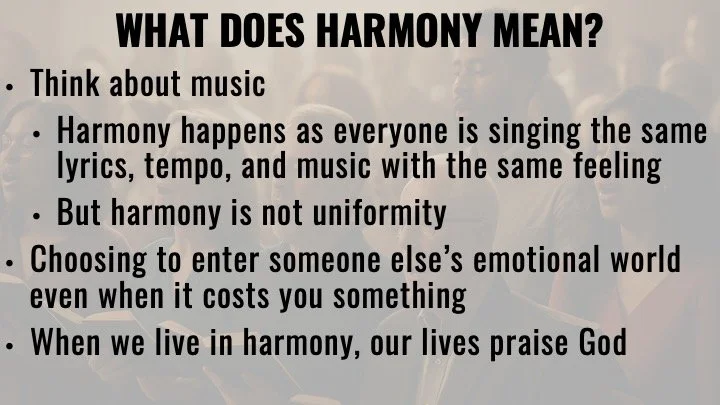
Harmony is choosing to enter someone else’s emotional world— even when it costs you something. It’s choosing to be in sync with the lives around you. It’s choosing to care when caring is inconvenient. It’s choosing connection over comfort.
A Picture From Worship
If you grew up in congregational singing, you already know harmony is more than hitting the right notes.
I remember the first time I ever visited a church of Christ as a teenager. The whole room lifted their voices—no instruments, no production—just people. And behind me stood a sister who had the voice of an opera singer. I’d never heard anything like it.
It took me a while to learn that what I was hearing wasn’t just singing—it was parts blending together. Sopranos soaring. Basses anchoring. Altos weaving inside. Tenors carrying the melody.
No one person made that sound beautiful.
It was the togetherness that made it powerful.
Singing the Same Song
Harmony happens when everyone is working from the same sheet of music—same lyrics, tempo, key, and direction. If even one part drifts into a different song, everything sounds off.
That’s the picture Paul is painting for the church.
A congregation lives in harmony when its people are walking the same road—same convictions, same mission, same desire to please Christ. When someone gets off-tempo, we adjust. When someone stumbles, we slow down. When someone lifts their voice in praise, we lift with them.
Paul isn’t calling us to uniformity. The beauty of four-part harmony is that we’re singing different notes. Different strengths. Different perspectives. Different experiences.
But all serving the same song.
Harmony means:
- I don’t need to be you.
- You don’t need to be me.
- But we both need to aim our lives at Christ.
When we do, heaven sees a community singing the gospel—not with music—but with their lives.
This is how God’s glory is exploding with praise before the spiritual beings who are all around us. Not just when we live a God-focused life in the good times and the bad times, but when we do that together. This harmony is like singing a song in harmony with our actions.
How Do We Live In Harmony?
Paul gives three practical steps in Romans 12 that make harmony possible.
Without them, the church sounds like everyone warming up at once—noise instead of praise.
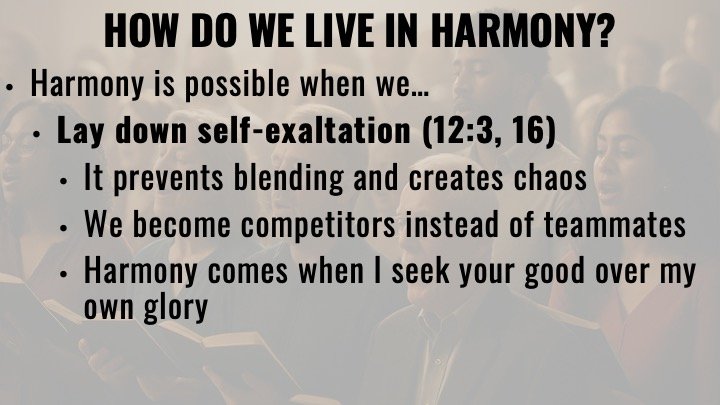
A. Lay Down Self-Exaltation (12:3, 16)
Nothing breaks harmony like someone singing louder than everyone else.
Romans 12:3 reminds us to stop thinking too highly of ourselves. We all come to the cross the same way—empty-handed. There is no “first soprano” in the kingdom. No divas. No soloists demanding the spotlight.
Then Paul says in verse 16:
“Do not be haughty… Never be wise in your own sight.”
Self-exaltation destroys relationships because it kills our ability to blend with others. It makes us stiff, impossible to correct, quick to judge, and slow to understand.
And when one person elevates themselves, others instinctively rise to defend their place:
“Who does she think she is?”
“I’m just as important as he is.”
Suddenly the song has become a competition, not a chorus.
But harmony returns the moment we decide: I will exalt Christ, not myself. I will seek your good, not my glory. When everyone is working to honor someone else, the beauty of the body comes alive.
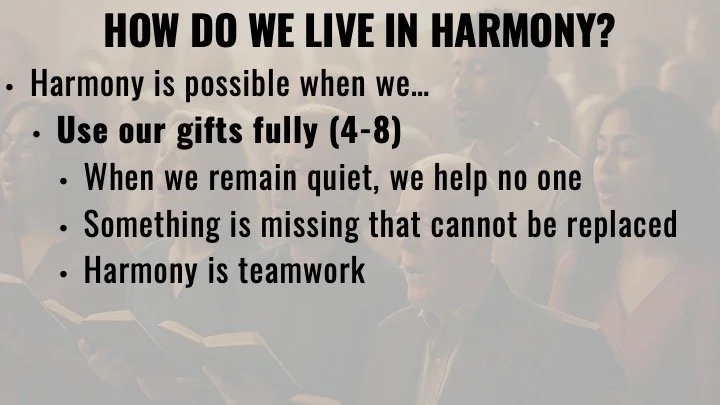
B. Use Your Gifts (12:4-8)
Harmony is only possible when we use our gifts.
Romans 12:4–8 (ESV) — 4 For as in one body we have many members, and the members do not all have the same function, 5 so we, though many, are one body in Christ, and individually members one of another. 6 Having gifts that differ according to the grace given to us, let us use them: if prophecy, in proportion to our faith; 7 if service, in our serving; the one who teaches, in his teaching; 8 the one who exhorts, in his exhortation; the one who contributes, in generosity; the one who leads, with zeal; the one who does acts of mercy, with cheerfulness.
Consider the parallel to people singing out. If you refuse to sing, you aren’t in harmony with anyone. If you refuse to sing, you will create a silence that is heard, a silence that spreads. No one wants to sing when no one is singing around them. The louder we sing, the louder we sing.
If we don’t do what we can to build up the body, the body won’t be built up and we are the reason why. When I first got here, I tried to do everything. I’m not sure if it was COVID or just my own immaturity, but I saw things that needed to happen and that no one was doing it. So I did it. I was trying to do everything, but I did nothing well. I finally realized this and stepped back so some of you can step forward and use your gifts. You have. You are stepping up and doing what is needed for this body to grow stronger. But we need more of you to use your gifts and honor God with your bodies as “living sacrifices” (Rom 12:1-2)
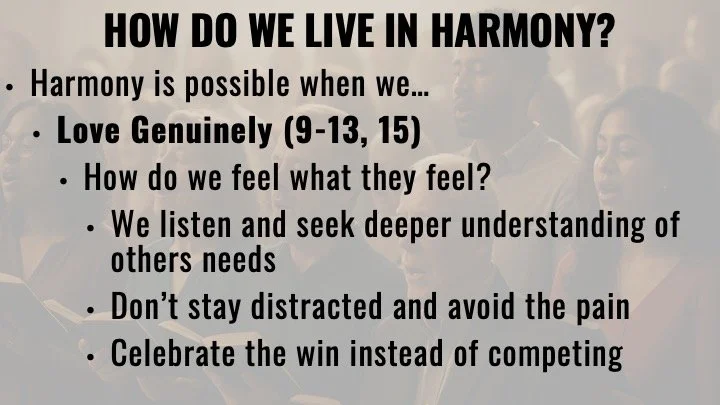
C. Listen Before Speaking (12:9–13, 15)
“Rejoice with those who rejoice, weep with those who weep.”
We cannot do that from a distance. We cannot do that while distracted. We cannot do that without caring.
Harmony begins long before you speak—it begins when you listen.
Paul’s commands leading to verse 16 all push us deeper into each other’s lives:
- Genuine love
- Brotherly affection
- Showing honor
- Contributing to needs
- Hospitality
We cannot do those things if we’re skimming the surface of someone’s story. You know what I struggle with? When someone is hurting, my first instinct is to fix it. Offer advice. Provide solutions. Patch the wound. But Paul doesn’t say, “Fix with those who are broken.” He says, weep with them.
That means I slow down long enough to feel it. To enter their world. To let their grief touch me.
And rejoicing? That’s hard too—especially when someone receives the blessing you’ve been praying for. Someone else’s engagement. Someone else’s promotion. Someone else’s answered prayer.
Harmony means I celebrate even when my season is different.
Because in Christ, their win is our win. The body moves together.
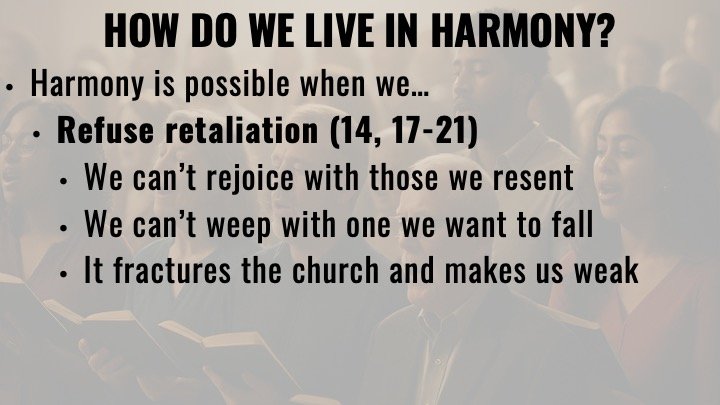
D. Refuse Retaliation (12:14, 17–21)
Nothing destroys harmony faster than payback.
Paul says:
- “Bless those who persecute you.”
- “Repay no one evil for evil.”
- “Never avenge yourselves.”
- “Do not be overcome by evil, but overcome evil with good.”
You can’t sing harmony with someone you secretly want to see fail. You can’t rejoice with someone you resent. You can’t weep with someone you’ve written off.
Retaliation fractures the church into adversaries instead of family. Paul’s remedy? Let God be the Judge. Lay down the weapons. Stop rehearsing the hurt. Treat your enemy like someone worth feeding and serving. This is not weakness. This is Christlikeness.
And it is the only way a fractured church becomes a harmonious one.
Conclusion
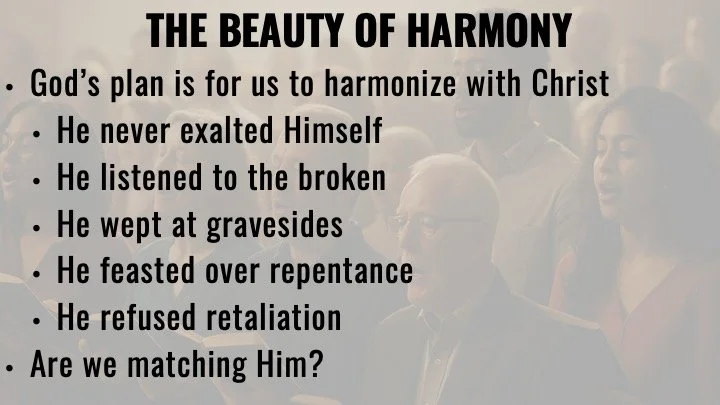
At the end of the day, harmony is simply imitation.
We harmonize with each other because we are learning to harmonize with Jesus.
- He never exalted Himself.
- He used His gifts to fulfill His purpose
- He listened to the broken.
- He wept at gravesides.
- He rejoiced in repentance.
- He refused retaliation—choosing the cross instead.
- His life is the melody.
We’re learning the parts.
So this week, when someone shares their joy or sorrow with you, ask:
What note is Christ singing here—and how can I match it?
- This is our story.
- This is our song.
- Let’s sing it together.