
Were You Predestined (Romans)
What does it mean for God to foreknow or predestine? How does God predestine or preselect a destination for those people whom He foreknows?
Calvinism is the most popular way to understand these ideas. It says that God foreknows and predestines or chooses every individual who is saved and who is lost. Their claim is that God is sovereign over all and must be in total control of this because we are totally depraved and cannot make the decision to be saved on our own. So, we are “elected” unconditionally, meaning there is nothing we can say or do that will make us a part of God’s elect. It is 100% Him and 0% us.
I don’t believe this is correct. It is close to correct, but not completely correct. Perhaps you don’t really care about this. Maybe you just want to move on to something else. This is important. Believing that God foreknows and elects individuals is, perhaps, the most popular view historically, and adopting that view will have consequences.
So today we will understand “those whom he foreknew he also predestined” by asking three questions: 1. What was God’s plan? 2. Who is predestined? 3. How do we have faith? Each question takes us down to a deeper level of understanding.
What Was God’s Plan?
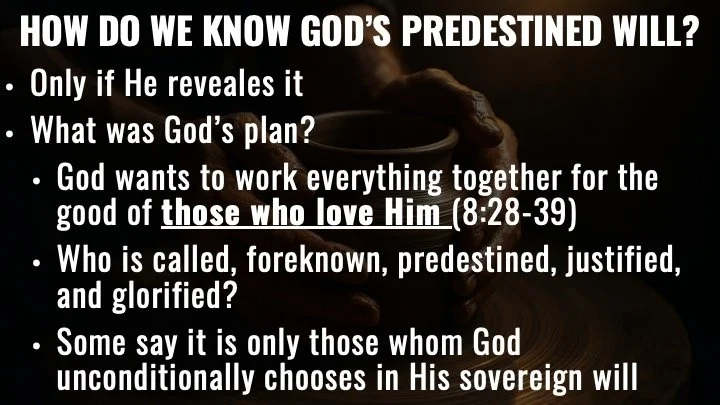
Romans 8:28–30 (ESV) — 28 And we know that for those who love God all things work together for good, for those who are called according to his purpose. 29 For those whom he foreknew he also predestined to be conformed to the image of his Son, in order that he might be the firstborn among many brothers. 30 And those whom he predestined he also called, and those whom he called he also justified, and those whom he justified he also glorified.
This text in Romans is supposed to provide assurance that the Romans are a part of God’s special people, His family, when they chose to love God. Those who love God have God on their side, working all things together for their good.
But there’s more to this text. We also see that they have become a part of God’s purpose because they were called according to it. God had a plan to save mankind through the gospel call. The words “foreknew” and “predestined” mean that something was planned out and determined before it took place. In this case, God knew and determined that He was going to take those who love God and have them conform to the image of Jesus. God's plan for you is that you would be like Him.
Now, verse 30. What is that verse saying? This verse describes a sequence of events. It starts with God’s predestination and ends with our glorification. It is saying that everyone who loves God, loves Him because God predestined, called, justified, and glorified them. That’s what it says. Notice the emphasis of this text is on God, God planned to call us, justify us, and glorify us. Notice the conclusion is stated in verse 31, “If God is for us, who can be against us?”
We should not deny the fact that God is the reason we are saved. Do you know that your love for God was a part of God’s plan? Do you know that He has worked in your life to call or draw you to Himself? God wanted you to love Him so He called you.
You might say, “Wait a minute, Casey, I’m the one who heard the call and decided to follow Christ.” This is true. We’ll talk about that decision soon. But for now, understand that God is the focus of this text. God has always worked to save a group of people who would love Him and whom He would love. He knew that He was going to bring Christ and create the gospel call. Listen to His words 600 years earlier.
Jeremiah 31:31–34 (ESV) — 31 “Behold, the days are coming, declares the Lord, when I will make a new covenant with the house of Israel and the house of Judah, 32 not like the covenant that I made with their fathers on the day when I took them by the hand to bring them out of the land of Egypt, my covenant that they broke, though I was their husband, declares the Lord. 33 For this is the covenant that I will make with the house of Israel after those days, declares the Lord: I will put my law within them, and I will write it on their hearts. And I will be their God, and they shall be my people. 34 And no longer shall each one teach his neighbor and each his brother, saying, ‘Know the Lord,’ for they shall all know me, from the least of them to the greatest, declares the Lord. For I will forgive their iniquity, and I will remember their sin no more.”
So God fore-knew that He would have a covenant people in Christ and predestined that whole group to adoption and glory. God has predestined that group to bring Him glory and praise by keeping God’s law. He puts it in them, writing it on their hearts. They belong to Him and He belongs to them. This covenant people won’t be born into the covenant and taught the laws they ought to obey. They will “know the Lord” because He will have forgiven their sins.
Foreknew doesn’t mean God simply saw the future and picked favorites. It means He set His love on a people before time began — a people who would come to Him through faith. You see, God had always planned to send Jesus, reveal Himself as the definition of love, forgive the sins of the poor in spirit, and change the hearts of a people who would belong to Him. God did this.
Who is Predestined?
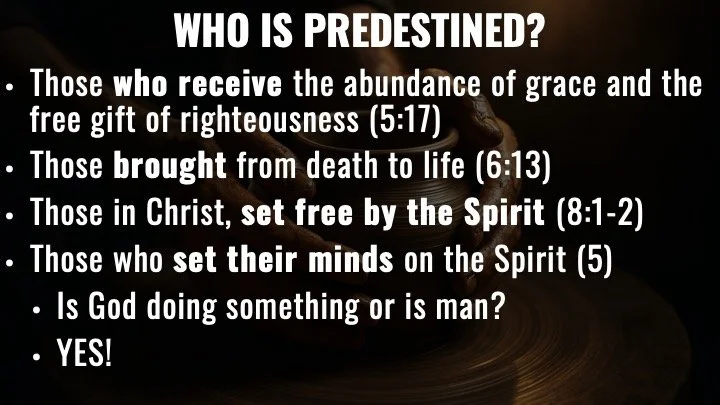
We know that God foreknew and predestined a people to be like Christ, to be called, to be justified, and to be glorified. This much we can all agree on. But does that mean He selects these people unconditionally? In other words, does that mean we are elected whether we want to or not, or that we are rejected regardless of what we do? Unconditional means there is not one condition one must meet to be saved or rejected.
What about the person who says, “I decided to follow Jesus?” Is it true that salvation is a choice which depends on our acceptance? What we see as we study Romans is that
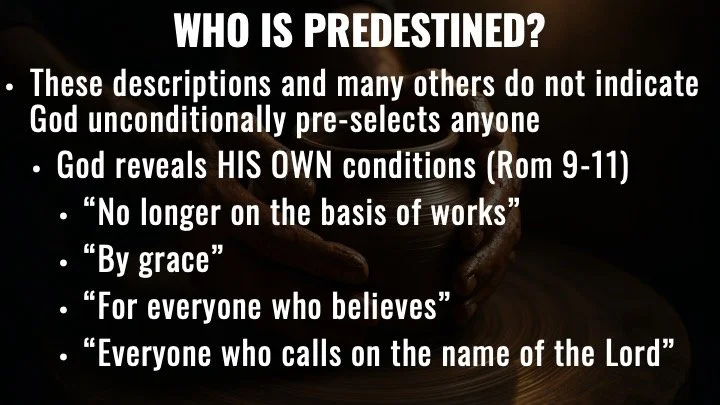
In Romans 9, we read that God did not predestine everyone born an Israelite to be saved. In other words, God did not create the condition, “If you are an Israelite, you will be saved.” We also read that salvation is not a matter of human will or exertion. God did not create the condition, “If you do everything right according to the Law or if you try really hard to be righteous, you will be saved.” We see in this chapter all the way through chapter 11 that God rejects people who pursue God by Old Covenant status and works of law. He rejects those who are proud and boastful. In the first century, he hardened Israelites who rejected the gospel and saved the Gentiles who accepted it, choosing to pursue God by faith.
Paul is clear that the predestined, foreknown, later he will call them “elect” people of God are those who believe. He is emphatic that “Everyone who believes,” “everyone who calls on the name of the Lord will be saved.” This is a condition. To say there is no condition is to ignore the conditions described.
So, this answers the question, “Does God choose who to draw to Him and who to harden without considering anything they have done or what they have failed to do?” No. If they choose to have faith in Christ, they have accepted God’s call and will be saved. Salvation is not unconditional. It is conditioned on faith.
The context doesn’t allow for any other interpretation. So, when we look at passages that mention God’s predestination, it’s important for us to see that God has not predetermined who will be saved individually. He has predetermined to have a group of saved people who have chosen to love Him in response to the gospel call. Those who would receive His love by faith, being justified and glorified because they are in Christ.
How Do We Get Faith?
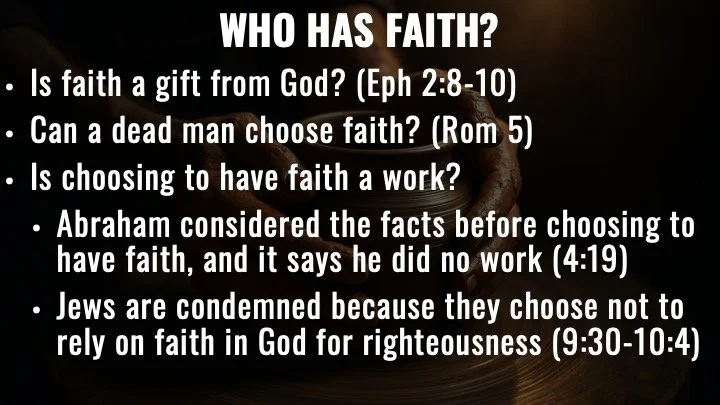
But, wait one minute. We need to take this one more level deeper. As counterintuitive as it is, there are some who claim that faith is not something we choose to have. Faith, they say, is a gift from God.
Let’s evaluate this. Election is based on faith, but how does one get faith? Is faith something we can develop on our own, or is it something given to us by God?
One might look at Romans 5-7 and say, “Casey, you are claiming that man must do what man is unable to do. Don’t you know that Paul says we were dead in the trespasses and sins in which we walked? Dead people can’t do anything. Even the very act of having faith in Christ is a gift that God gives you, not a decision you make.”
If you have ever heard someone say this, it sounds reasonable. The argument is: If faith were something we ultimately generate or contribute, it is a work and worthy of boasting. Faith must be a gift from God because anything you do is a work. They claim that faith is the gift of God. We are so totally depraved and dead in our sins that we couldn’t even choose to believe without God’s help. Salvation is 100% God and 0% you. Furthermore, if you do one thing then you are creating a works based system of salvation.
This is a falsehood wrapped in truth. Think about it. Were you a horrible sinner unable to save yourself? Yes. Would you have ever decided to believe in God without Him providentially working in your life? Would you have ever believed in Christ without God’s word showing you the way? No way. There is no denying that “faith comes from hearing the word of Christ.” (Rom 10:17). Without the word of Christ, we would still be dead. But we choose whether we hear the word or not. Plus, John 6 tells us that God must draw us to Christ for us to come to Him. But, the fact that God has to draw us does not mean we have to listen.
We need to be thoughtful when answering the question, “How do we get faith?”
- First, we need to understand that faith or believing and trusting in God is an act we are doing. These are verbs.
- Second, we can go back to chapter 4 and see how Abraham chose to believe and it was credited to him as righteousness. In those texts, he contrasts the faith Abraham has and works of Jews according to the Law. Think about this. If faith is a gift from God, then it can’t count for anything. It’s not his faith. But Romans 4 specifically says that he considered the deadness of Sarah’s womb and he still chose to put his confidence in God.
- Third, even in the difficult chapter 9, we see that the Jews were “pursuing righteousness as though it can be obtained through law keeping.” It says, “they did not pursue it (righteousness) by faith, but as if it were based on works.” When we pursue righteousness by faith, we find it, and that is not works based righteousness. Believing, having faith, calling on the name of the Lord, is not about me. It’s about accepting what God has done for me.
Think about what is happening at the moment one believes. There is an internal shift that happens. They go from living for themselves and pursuing empty things that never satisfy, to humbly accepting the gospel message of Grace. Did you do that or did God do that? The answer is, “Yes!” Don’t create a false dichotomy. They are both true. God is ultimately one one responsible, but we have to choose to accept this for ourselves. The seed and the soil were good and the Spirit was able to create new life through a spiritual resurrection you submitted to.
Implications
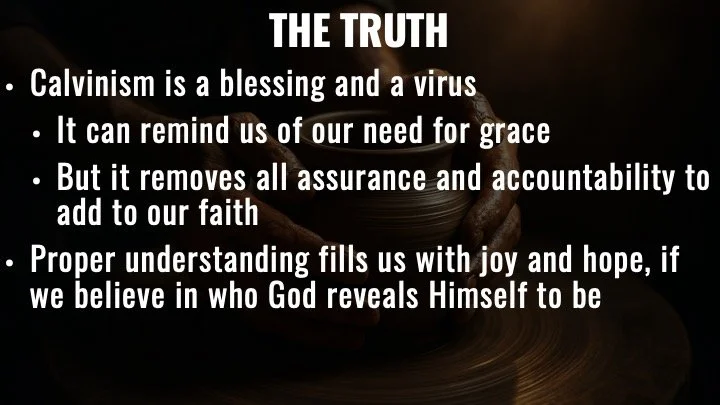
What you believe about this topic has big implications. What are they? If you believe that God predestines people to be saved or to be condemned, how do you know His will for you? If salvation depends on God’s random choice, assurance disappears — but if salvation depends on God’s unchanging promise to save all who believe, then assurance is anchored forever. They don’t believe the common refrain throughout scripture that “everyone who believes will be saved.” Really, it’s everyone He chooses to make believe will be saved.
On the other hand, viewing God as urging people and letting them reject Him shows the level of love He carries toward His enemies. This means that God is providentially working in everyone’s life. In every instance, the hearer is being drawn by God. In some cases, God’s word pierces a heart of stone, or tenderizes it so it is receptive to the message (Ezek 36). In other cases, it doesn’t because those who hear reject the message.
The greatest assurance comes in knowing that God will be faithful to you and will desire your salvation like a father longing for his prodigal son. When we choose to believe in His grace, surrendering our lives to Him, we have full assurance that we are one of the elect. Upon being baptized God circumcises our hearts (Col 2). As we look at Jesus, our inner selves are being transformed in His likeness (2 Cor 3:18). So we know that God is working all things together for our good, so long as we love Him.
Conclusion
What about you? Have you let God’s word penetrate your heart? If you have chosen to love God and give your life to Him, be baptized into Christ, receive His grace, and become a part of God’s special people. He wants you to be His child. Do you want to be His son or daughter?