
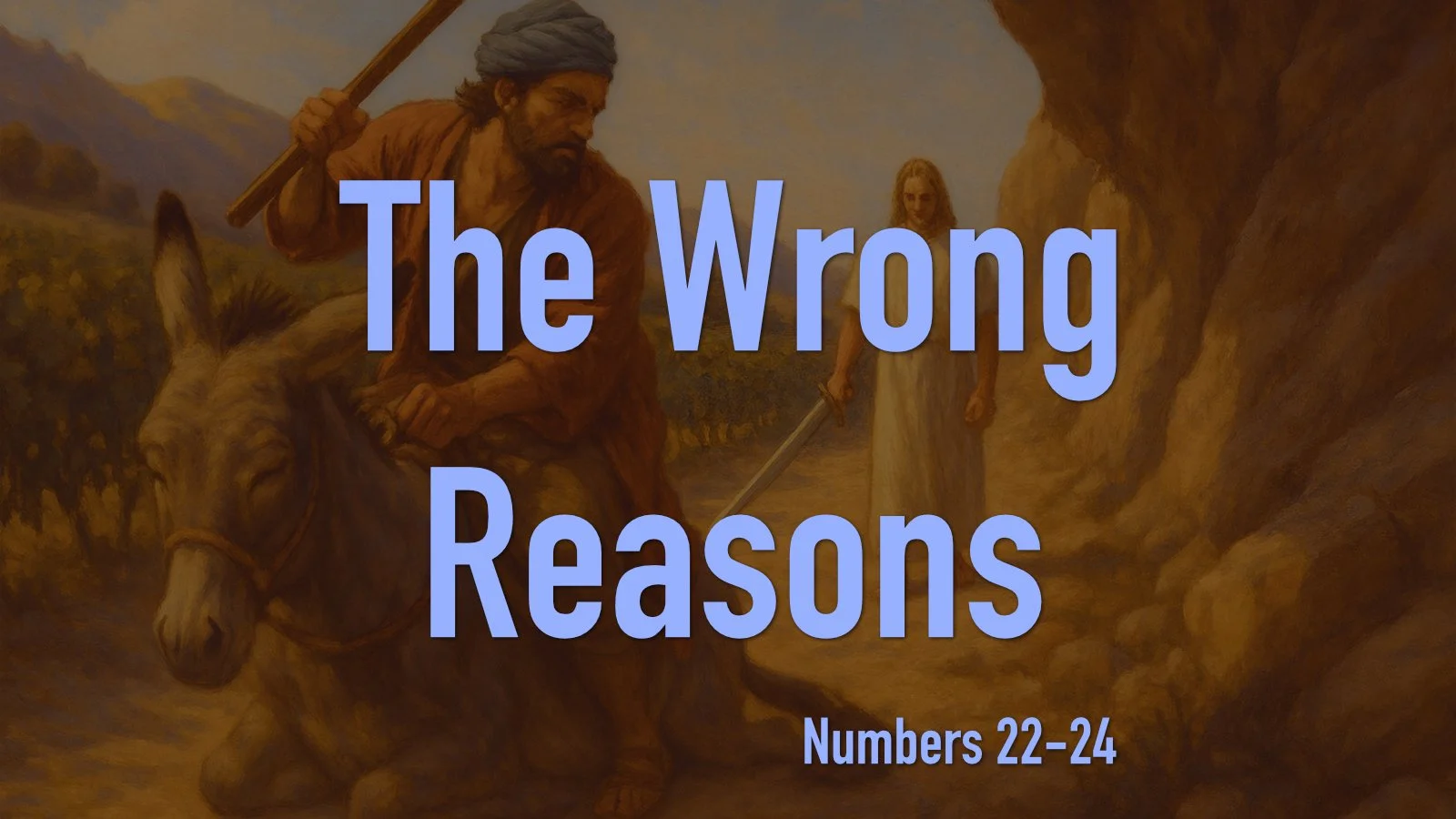
The Wrong Reasons (Numbers 22-24)
Have you ever done all the right things for the wrong reasons?
Today, we are going to look at a story of two men and a nation which will help us understand how our desires and our requests from God can be totally wrong.
Balak’s Fear
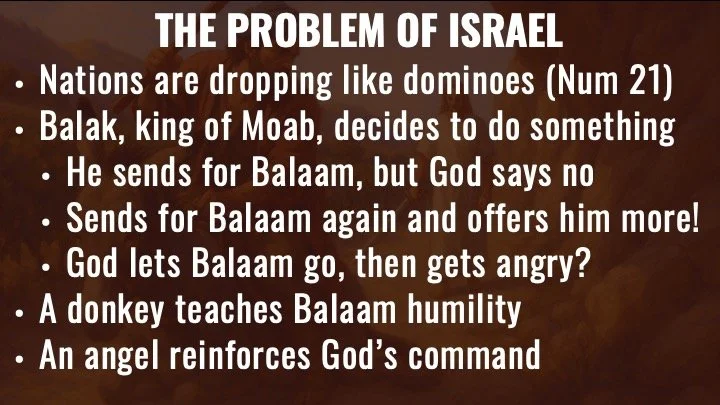
Israel is on a role in Numbers 21. They are near the end of their forty years of wandering in the wilderness, and all the surrounding nations are starting to get uncomfortable as they consider Israel. Canaanites and Amorites think that they can come out in battle against Israel and defeat them, but they find out that God is fighting for them. Israel took all their cities and defeated their kings.
One nation that became really nervous about Israel was Moab with their king, Balak. Balak had been defeated by the Amorites and now Israel had defeated the Amorites. They knew Israel was a huge nation capable of wiping Moab off the map. So, Balak got together with the elders of Midian and convinced them to seek out help from a man named Balaam. Balaam was called many things: a “soothsayer,” a “diviner,” and a “seer.” He was a man well known for his ability to communicate with the gods and pronounce curses on people. It seems that whoever Balaam cursed was cursed and whoever Balaam blessed was blessed. This terminology is interesting because that appears to be God’s promise to Abraham, “whoever curses you, I will curse” and “whoever blesses you I will bless.”
Anyway, the plan was accepted by the Midianites and they sent word to Balaam with the typical fees of divination.Balaam hears their request and tells them to rest while he goes and tries to communicate with Yahweh. It is interesting that he goes to Yahweh and God speaks to him. They talk about who has come to Balaam, and he lays out their request. But God refuses, telling Balaam that the people they want to curse are blessed by God.
Balak, the king, is upset about this response from Balaam. He needs these people cursed so he will stand a chance at defeating them. So he sends more princes and more money to entice Balaam to come. Now, this is where the story takes an interesting turn. Balak says, “Don’t let anything hinder you from coming to me, for I will surely do you great honor, and whatever you say to me I will do. Come curse this people for me.” (22:17) Balak is going to pull out all the stops. He wants Balaam really badly. Balaam’s answer is honorable. He says the right thing, “If Balak gives me his house full of silver and gold, I could not go beyond the command of the Lord my God to do less or more.” Then, he speaks to God again that night and God says, “Go with them, but only do what I tell you.”
Balaam’s Odd Situation
Now, this is very odd. Balaam appears to be fully devoted to God’s message. God has blessed these people and Balaam cannot curse them, but he’s going to see Balak anyway. Why? Is God going to change His mind and curse Israel? It gets even more interesting.
As Balaam was on his way, God became angry with Balaam for going. He sent the angel of the Lord with a sword because Balaam was “an adversary.” This is a startling turn of events. God has told Balaam to go, but now He will kill him for going. Is God two faced? No. God didn’t change, Balaam did. The prospect of having a lot of money changed him internally. God knew that Balaam wanted to go see Balak and receive the reward. God knew about the plan that Balaam was cooking up in his mind, and He was ready to kill Balaam for those evil thoughts.
Of course we know that Balaam is not killed by the angel. God decides instead to give Balaam a lesson on humility. He allowed Balaam’s donkey to see the angel with its sword drawn, but only the donkey could see it. Imagine being Balaam, riding along and conspiring how you can give Balak what he wants and receive what you want. Then, all of a sudden, your old trusty donkey starts veering off the road and he heads out into a vineyard. You have a stick so you start beating the donkey, bringing him back into the road where the angel is. The donkey sees the angel again and immediately veers to the side, but this time there is no where he can go. In his fear he squishes Balaam’s foot against the wall. So Balaam beats the donkey again. When the donkey saw that there was no way to avoid the angel, he laid down. At this point, Balaam is irate! He’s beating the donkey, but the donkey looks up at him and starts speaking. God gives the donkey the ability to see the angel and the ability to speak. He uses this ability to ask a question. He says, “Am I not your donkey, on which you have ridden all your life long to this day?” The donkey is so confused by all this. He is trying to save the man, but Balaam says, “I wish I had a sword so I could kill you because you have made a fool of me.”
After this interchange God opened Balaam’s eyes to see the angel. The angel has a sword and tells Balaam, “I would have killed you if it had not been for your donkey.” Balaam was saved by his donkey who he rejected and hated for making him look like a fool when he actually was being a fool.
God tells Balaam once again, “Go with the men, but speak only what I tell you.” In other words, stop conspiring and coming up with ways to get money and honor for yourself. Be my mouthpiece and nothing else.
Israel’s Irrevocable Blessing
When Balaam arrives at Balak’s city, the king comes out to meet him and starts laying it on thick. “Balaam, Balaam, Balaam, what kept you? You know I’m going to take care of you and treat you with honor.” Balak is laying it on thick. But Balaam seems ready to speak only what God has said.
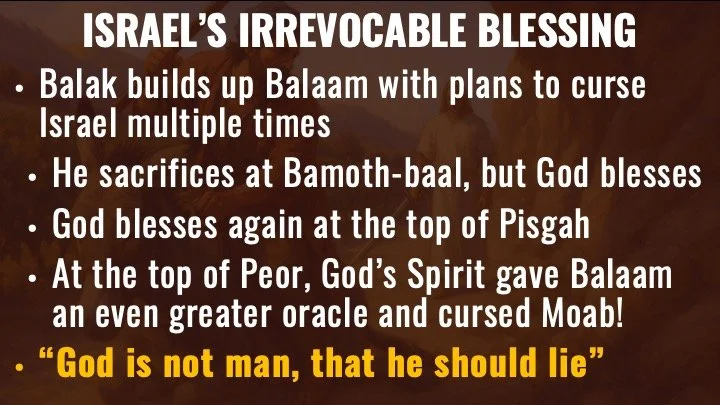
In chapters 23-24, we read about Balak taking Balaam up to a high place, Kiriath-huzoth, where they would worship God or their pagan gods. Balak offers up an ox and a sheep. The next day, they go to a high place that only shows part of the people called “Bamoth-baal.” Balak offered up seven bulls and seven rams, hoping to make God happy with him, so happy that he would grant him his wish of cursing Israel and blessing him. Balaam went and talked to God, but when he came back he said, “How can I curse whom God has not cursed? How can I denounce whom the Lord has not denounced?” He goes on to talk about how innumerable Israel is and how he wishes his end could be like Israel’s end.
Balak was not too happy about this. “What have you done! I told you to curse them and you blessed them!” Balaam responded, “I can only say what God tells me to say.”
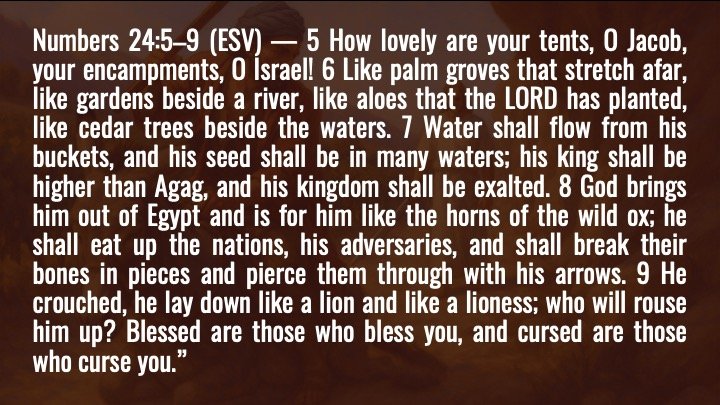
So, they moved to the next mountain and offered up seven more bulls and rams as they looked at another section of Israel. This time Balaam says, “God is not man that He would lie, or the son of man that He should change His mind. He will do what He has said and fulfill His promise. The Lord, their God is with them.” God makes it totally clear to Balak that this aint working. Israel was brought out of Egypt by their God and their king, and He is for them. He will make them devour their prey.
This is not going at all as Balak had planned. So, he takes Balaam to one more high place. Once again, Balaam tells Balak to offer seven bulls and seven rams. But Balaam did not go look for omens. He looked upon all of Israel and the Spirit of God came upon him so that he prophesied a third time in favor of Israel.
Balak becomes angry and strikes his hands together. “I called for you to curse my enemies and you have blessed them three times! Get out of here! God has kept you from receiving silver or gold today.”
To this, Balaam responds with another prophesy. This time his words are greater than before. He tells Balak that “a star shall come from Jacob and a scepter from Israel that will crush the forehead of Moab.” Then, he foretells the destruction of all the nations through this star of Jacob who rules over all.
What Do We Learn?
The story is hilarious, but also very informative. It’s hilarious because the men in the story are so oblivious to who Israel is and what God has done for Israel. They are failing to see what is going on at every part of the story, and they keep doing the same thing expecting a different outcome. God tells them no, but they just keep trying.
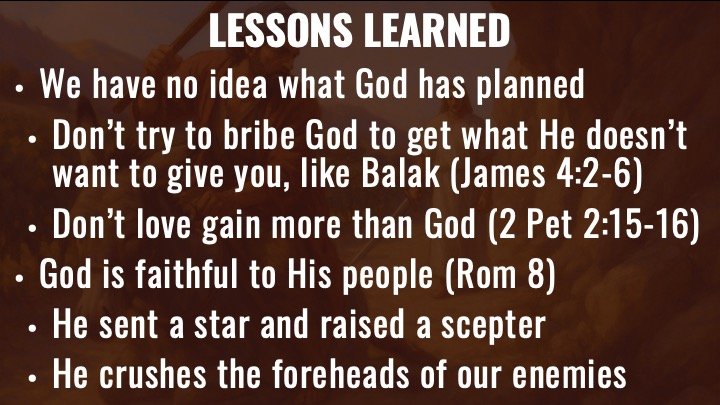
It’s informative because it shows us that God has determined to bless Israel, and He will not betray that promise he made to Abraham. He will raise one up to “crush the forehead of Moab.” It also shows us how dumb we can be.
- We resemble king Balak, wanting something that is totally opposite of what God is trying to do. We think we can buy God’s favor by offering sacrifices and make God change His mind for our lives. But what we really need to do is move over to His side and start wanting what he is wanting.
- We also resemble Balaam, trying to manipulate our situation so we can have our cake and eat it too. Balaam ends up conspiring a way to get his riches from Balak. We learn that he told Balak to corrupt Israel and make them curse themselves. God would protect them from outside, but Israel ended up cursing themselves by being lured away to temptations.
The most important lesson we should learn from these characters is that we can do all the right things for the wrong reasons and find ourselves on the opposite side of the battle from God. Balak offered tons of sacrifices. Balaam only spoke what God told him to (until he didn’t obviously). God is after our hearts. Always has been. Always will be.
James 4:2–6 (ESV) — 2 You desire and do not have, so you murder. You covet and cannot obtain, so you fight and quarrel. You do not have, because you do not ask. 3 You ask and do not receive, because you ask wrongly, to spend it on your passions. 4 You adulterous people! Do you not know that friendship with the world is enmity with God? Therefore whoever wishes to be a friend of the world makes himself an enemy of God. 5 Or do you suppose it is to no purpose that the Scripture says, “He yearns jealously over the spirit that he has made to dwell in us”? 6 But he gives more grace. Therefore it says, “God opposes the proud but gives grace to the humble.”
Conclusion
Thankfully, this story shows us a God who desires us, and is willing to protect us against the forces of evil that seek to destroy us. He has sent his star to crush the head of our greatest enemy, and the only things we have to fear are the lustful desires of this world which pull us away from God. Like Israel, we have received an eternal love, even though we are oblivious, gullible, and undeserving of it.God loves us because He is so good. Will we love Him in return? Will we choose to do the right things for the right reasons?