


I think many of us want to be leaders at one point in our lives. It starts in school where we all want to be the line leader. Then, it carries over into sports where everyone wants to be the captain. Eventually, we grow up and want to be the boss. This desire for prominence and exaltation is not something everyone experiences, but those who do want to lead need to recognize that the rewards are offset by the responsibilities.
It’s interesting to me that the people who don’t typically want to be leaders make the best ones. They have a good understanding of the responsibilities and work is not about them. On the other hand, the people who want to be leaders tend to have the wrong attitude about it. That’s why it’s so important for us to be raising young men and women who have the right heart and attitude. It’s not enough for them to be capable. They also need to possess the right heart and desires.
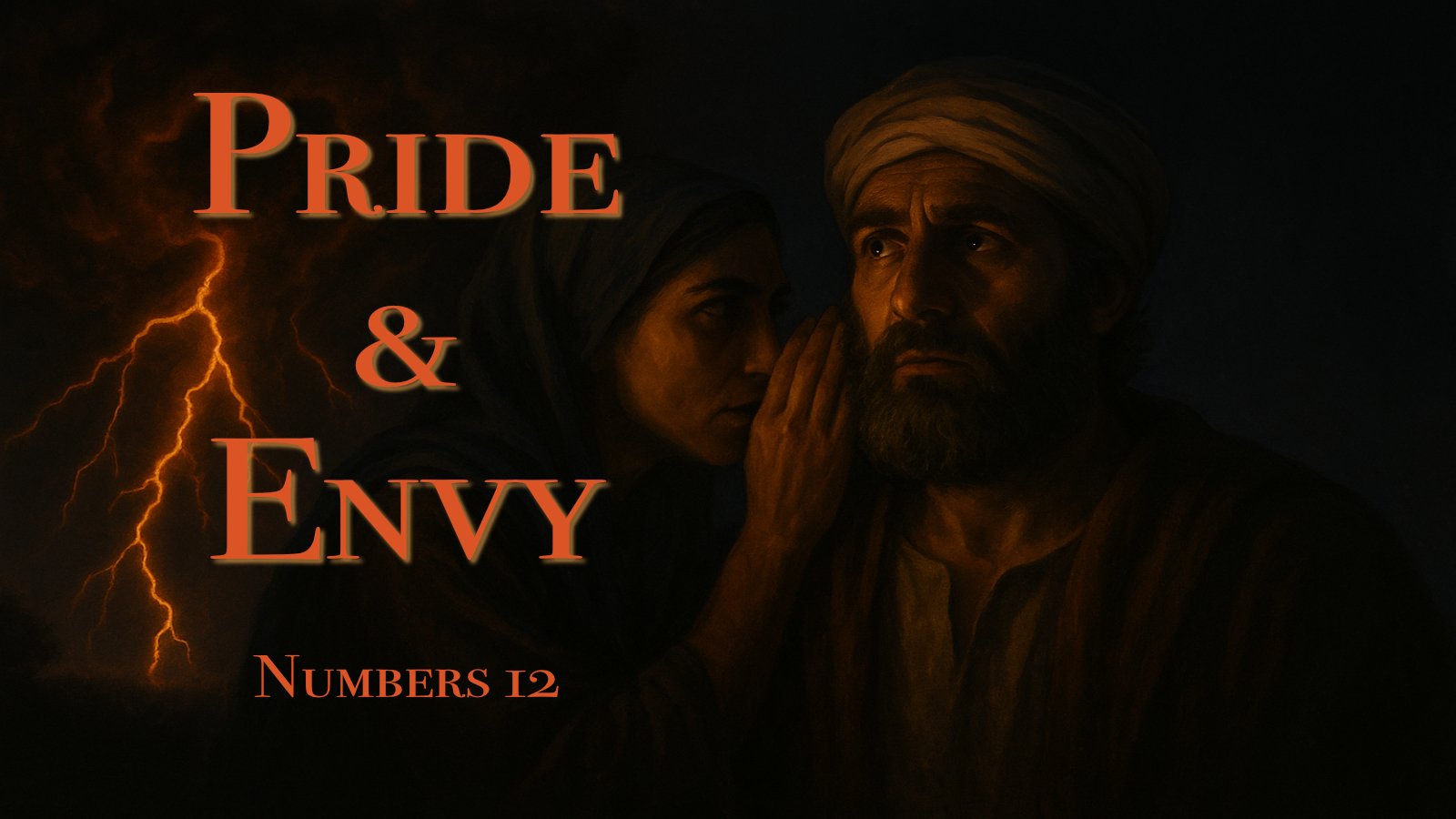
Today we learn about Miriam, a brave young girl, who became a zealous leader, the first recorded prophetess, and, eventually, a horrible sinner like everyone else.
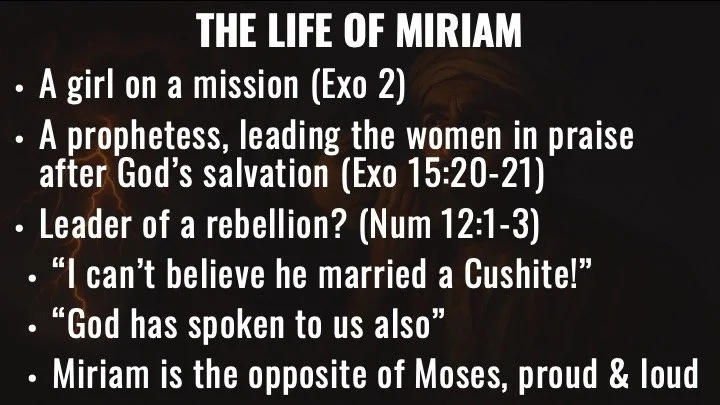
The Life of Miriam
MIriam’s story begins in Egypt, like so many we have looked at recently. She too was subject to a very hard childhood of slavery and injustice. I wonder how many brothers, cousins, or friends were killed due to the wicked laws of Egypt. “Throw your baby boys in the Nile!” they would command the Israelite women. Can you imagine women being forced to do that? Jochabed obeyed the command with her son, but she put the boy in a little boat that would stay afloat among the reeds.
Asking a Bold Question (Exo 2)
Imagine being Miriam. Maybe she’s seven or eight. She’s hiding in some bushes and watching her little brother float in the water to see what will happen to him. The princess of Egypt approaches the water and her servant retrieves the boy. Now, consider how risky it is to go up to the princess of Egypt. Who would be willing to go up and speak to her? Maybe she was just one of those kids who just spoke to anyone. Maybe she didn’t recognize that this was the princess of the land, but her question is still bold. She saw or heard the sympathy the princess had and asks, “Shall I go and call you a nurse from the Hebrew women to nurse the child for you?” This created the perfect opportunity for Moses to be raised by his own mother for a brief time, but it ultimately saved his life.
Leading the Women (Exo 15)
We don’t see too much of Miriam after this event, but I imagine she was there all along. The next time she is talked about is after they cross the Red Sea. We read about how God allowed them to walk through the Red Sea on dry ground. Again, imagine it: the terror of realizing that Egyptian soldiers were coming for you, the wonder of walking on dry ground that was once under water, the elation of watching the waters fall and crush your enemy as they ruthlessly pursue you. That whole event would bring a flood of emotions. After it happens, Moses writes a song and all Israel sings in praise to their God (Exo 15).
Exodus 15:20–21 (ESV) — 20 Then Miriam the prophetess, the sister of Aaron, took a tambourine in her hand, and all the women went out after her with tambourines and dancing. 21 And Miriam sang to them: “Sing to the Lord, for he has triumphed gloriously; the horse and his rider he has thrown into the sea.”
Here she is described as a prophetess. This means that she is a woman of faith who speaks on behalf of God like Aaron does. Many people believe that she took on a leadership role among the women in the camp and assisted her brothers in this way. But notice her zeal. She watches what God does and breaks out in her own song. She leads the women in playing a tambourine, dancing, and singing over God’s great work of salvation. By all accounts, she appears to be a very righteous and devoted person.
The Tongue (Num 12)
But devoted and righteous people make mistakes. They aren’t perfect, and the one area where that often shows up is with their tongues.
The tongue really hurts us, especially when everyone around us is misusing it. In Numbers 11, we learn that all the people had started complaining. None of them were happy with the leadership because they longed to eat good food again. God solved this problem by spreading His Spirit to seventy elders. Then, in Chapter 12, Miriam and Aaron started talking about Moses, saying things like, “I can’t believe he married a Cushite woman. A Cushite! I wonder what makes him so special that he gets to tell everyone what to do. God speaks to us too. We could probably do a better job than Him.”
Numbers 12:1–3 (ESV) — 1 Miriam and Aaron spoke against Moses because of the Cushite woman whom he had married, for he had married a Cushite woman. 2 And they said, “Has the Lord indeed spoken only through Moses? Has he not spoken through us also?” And the Lord heard it. 3 Now the man Moses was very meek, more than all people who were on the face of the earth.
Miriam is listed first, indicating that she is an instigator in this. Aaron really seems susceptible to a persuasion. Notice that Miriam is upset with Moses because he married a Cushite woman. There is rivalry between her and her sister-in-law. She is jealous and envious of her and of Moses’ extremely important role. Her goal is to use Aaron to help overthrow Moses. Moses is portrayed in this text as being extremely meek. In other words, he would never say anything like what Miriam and Aaron are saying. Meekness is about being humble and lowly. It’s not about weakness. It’s about willingly holding back your strength in love for others. So Moses wouldn’t do anything to stand up to them. Moses is the opposite of Miriam. Miriam is forceful and pushy. She makes demands and wants to get her way. So, she is proud, thinking much of her own way and her own thoughts.
God’s Responds
God hears this proud and jealous talk against Moses, and He decides to speak up.
Numbers 12:4–9 (ESV) — 4 And suddenly the Lord said to Moses and to Aaron and Miriam, “Come out, you three, to the tent of meeting.” And the three of them came out. 5 And the Lord came down in a pillar of cloud and stood at the entrance of the tent and called Aaron and Miriam, and they both came forward. 6 And he said, “Hear my words: If there is a prophet among you, I the Lord make myself known to him in a vision; I speak with him in a dream. 7 Not so with my servant Moses. He is faithful in all my house. 8 With him I speak mouth to mouth, clearly, and not in riddles, and he beholds the form of the Lord. Why then were you not afraid to speak against my servant Moses?” 9 And the anger of the Lord was kindled against them, and he departed.
God does what Moses wouldn’t do. He makes it clear that Aaron and Miriam are nothing like Moses. God, effectively, puts them in their place, exalting Moses and lowering Miriam in the process. But that’s not all.
Numbers 12:10–16 (ESV) — 10 When the cloud removed from over the tent, behold, Miriam was leprous, like snow. And Aaron turned toward Miriam, and behold, she was leprous. 11 And Aaron said to Moses, “Oh, my lord, do not punish us because we have done foolishly and have sinned. 12 Let her not be as one dead, whose flesh is half eaten away when he comes out of his mother’s womb.” 13 And Moses cried to the Lord, “O God, please heal her—please.” 14 But the Lord said to Moses, “If her father had but spit in her face, should she not be shamed seven days? Let her be shut outside the camp seven days, and after that she may be brought in again.” 15 So Miriam was shut outside the camp seven days, and the people did not set out on the march till Miriam was brought in again. 16 After that the people set out from Hazeroth, and camped in the wilderness of Paran.
Can you imagine the fear of being leprous when God’s cloud left? God sentenced her to the life of an outcast for being proud and jealous. For speaking against and desiring to overthrow Moses. Moses wouldn’t have done anything against her, but God made it clear that this attitude is not allowed in the camp.
Can you imagine the embarrassment of having all Israel wait for you to suffer shame for what you’ve done? Nearly 2 million people are going to hear about this little incident, and you are a leader among them. Women look to you for guidance, but you failed to remain righteous.
Application
So Miriam was a great example of a brave and righteous prophetess, but she was also an example of selfish ambition and a loose tongue. Her good work was overshadowed by her foolishness, much like her brother Aaron.
Self-Exaltation
This error of Miriam is one of the most common errors throughout the Bible, self-exaltation. We could go back to Cain or go forward to Absalom or the Pharisees in the New Testament. The primary issue here is self-exaltation. When we open our mouths, hoping to cut down someone else and complain about an innocent man, we are selfishly ambitious. When we push our own agenda and our own way instead of working diligently in the role we are given, we are proud and jealous.
Is God okay with that? Obviously not. This story really provides a contrast between Moses and Miriam. Moses is the meekest man on the earth at that time. He’s not wanting to be exalted. His goal is to serve God and help people get to the promised land. It’s not about him. Miriam is upset because she thinks that she needs to be on the same level as Moses. This text is showing us that God values and exalts the humble, those who are not self-seeking.
This is exactly what Jesus taught while he was on the earth. He wanted to create a whole nation of people who were humble and lowly. Blessed are the “poor in spirit.” We have a similar situation to this in the New Testament.
Mark 10:35–45 (ESV) — 35 And James and John, the sons of Zebedee, came up to him and said to him, “Teacher, we want you to do for us whatever we ask of you.” 36 And he said to them, “What do you want me to do for you?” 37 And they said to him, “Grant us to sit, one at your right hand and one at your left, in your glory.” 38 Jesus said to them, “You do not know what you are asking. Are you able to drink the cup that I drink, or to be baptized with the baptism with which I am baptized?” 39 And they said to him, “We are able.” And Jesus said to them, “The cup that I drink you will drink, and with the baptism with which I am baptized, you will be baptized, 40 but to sit at my right hand or at my left is not mine to grant, but it is for those for whom it has been prepared.” 41And when the ten heard it, they began to be indignant at James and John. 42 And Jesus called them to him and said to them, “You know that those who are considered rulers of the Gentiles lord it over them, and their great ones exercise authority over them. 43 But it shall not be so among you. But whoever would be great among you must be your servant, 44 and whoever would be first among you must be slave of all. 45 For even the Son of Man came not to be served but to serve, and to give his life as a ransom for many.”
James and John wanted to be better than everyone else. They were seeking to exalt themselves, but Jesus said his kingdom will not be like the common kingdoms of the land. Those who desire to be great among you must be slave of all. That’s the example that Jesus, himself provided for all of us. He did not come to be served, but to serve. He even washed the disciples feet.
Outdo One Another In Showing Honor
Our goal in the church is not to be exalted to a position of authority or honor among the group. Our goal is to exalt others and serve them so that God is glorified. We must stay focused and committed to helping one another be as faithful and honored as they can be.
When we speak out with complaints or in a way that belittles our elders or leaders, we are being envious and proud like Miriam and attempting to overthrow those who are over you. It’s one thing if they are actually sinning against someone, but it’s something entirely different if it comes from a selfish and self-exalting heart.
Conclusion
The thing I love most about the story of Miriam is the quick response of Aaron and Moses. There was no hesitation in forgiving them and calling for God’s mercy. Perhaps it is because she was their sister, but I think it is primarily because they loved their sister. There wasn’t a spiteful or vengeful bone inside of Moses. He didn’t even want her to suffer any punishment for going against him. But God knew that consequences were needed in this case. She needed discipline through shame.
We, like Miriam, might experience the same consequences when we become proud and selfishly ambitious. I know I have. Being saved doesn’t mean we are beyond reproach. Faithfulness can be undermined by pride, envy, or discontent with one’s God-given role.
But we have a mediator like Moses who loves us and wants us to suffer little. He wants us to be redeemed and restored. That’s who Jesus is.