
Suffering & Glory (Romans 5-8)
Some of the brethren here are going through hard times. There seems to be a slew of difficult days that they keep being bombarded with. So today I want us to look at some passages that have been on my mind about suffering.
Ecclesiastes 11:0-12:1 - 10 Remove vexation from your heart, and put away pain from your body, for youth and the dawn of life are vanity. 1 Remember also your Creator in the days of your youth, before the evil days come and the years draw near of which you will say, “I have no pleasure in them”;
Solomon gives advice at the end of the book of Ecclesiastes to enjoy your youth and make the most of those early years because they will soon pass away and “evil days come” when you will say, “I have no pleasure in them.” The longer we live the more likely it is that we will go through suffering. As we get older, it is important for us to have the right understanding and attitude about suffering.
Job was a great man because he knew to remain faithful to God in the suffering, but as the trials lingered he was missing a key understanding that we have been given. He didn’t know why God lets the righteous suffer. We do. We have Jesus.
So today, I want us to look at a few passages that Christians ought to know which will prepare them for suffering and glory.
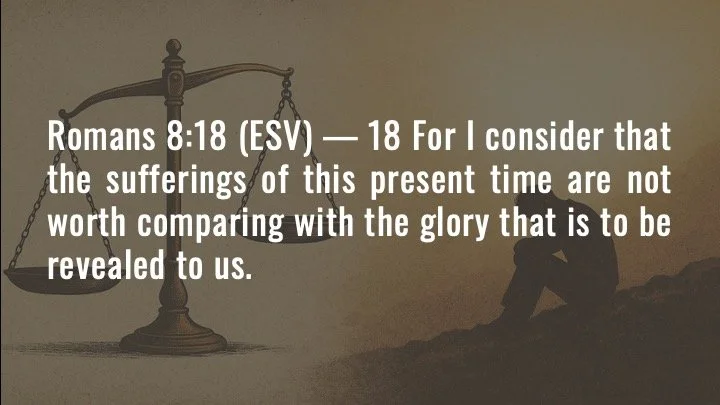
Romans 8:18 (ESV) — 18 For I consider that the sufferings of this present time are not worth comparing with the glory that is to be revealed to us.
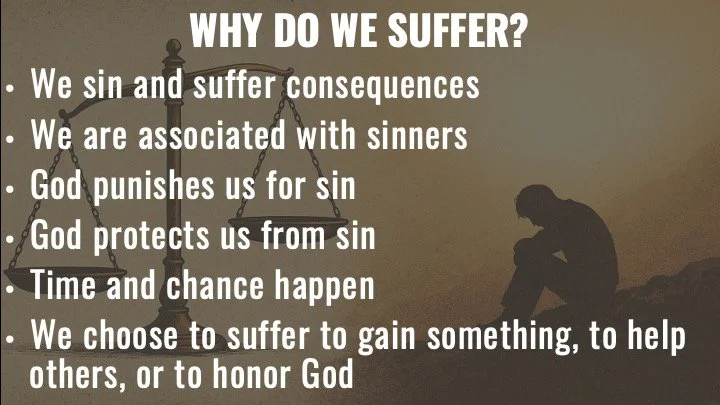
Why do we suffer in this present time?
Paul wrote this to Christians in Rome who faced hard times. They dealt with beatings, unfair arrests, and constant criticism from people who didn't believe. Paul knew this firsthand. He had been whipped five times with thirty-nine lashes, beaten with rods three times, stoned once, and shipwrecked (2 Corinthians 11:23-27). But he still said that our current pain is small compared to the glory God will show us one day.
Sources of Suffering
When we study the Bible, we see many different occasions that lead to suffering.
- It can come from our own wrong choices, like when King Saul disobeyed God and lost his kingdom (1 Samuel 15).
- It can happen because we're around sinful people, like when David had to run from his son Absalom during a family betrayal (2 Samuel 15).
- God might allow it to teach us and bring us back to him, as he did with Israel in the wilderness for forty years (Numbers 14).
- It can be God's way to keep us humble, like Paul's "thorn in the flesh" that he described in 2 Corinthians 12:7-10.
- Sometimes it's just the result of living in a broken world, what Ecclesiastes 9:11-12 calls time and chance.
- We might choose it for a good reason, like training hard as an athlete does (1 Corinthians 9:27).
- Or we accept it to help others or honor God, just as Jesus did on the cross (Hebrews 12:2).
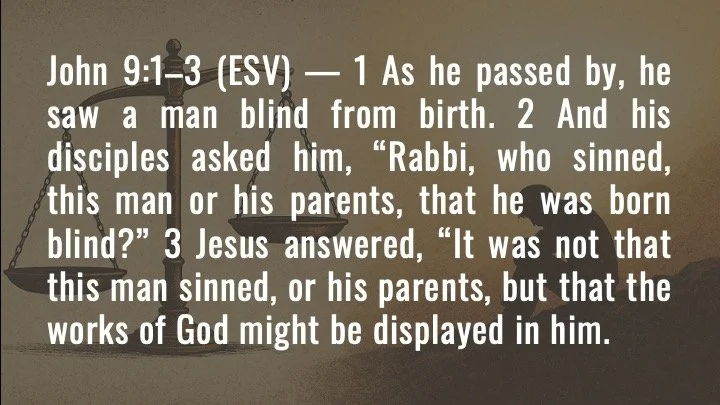
It's natural to ask, "Why is this happening to me?" We often think first, "Is God punishing me for something?" But that's not always the case. Remember John 9, where Jesus heals a man blind from birth? The disciples asked whose sin caused it—his or his parents'? Jesus said it was neither. It happened so God could show his power through that man (verse 3). Suffering often doesn't have a clear reason we can see, but it always has a purpose God can use.
Responding To Suffering
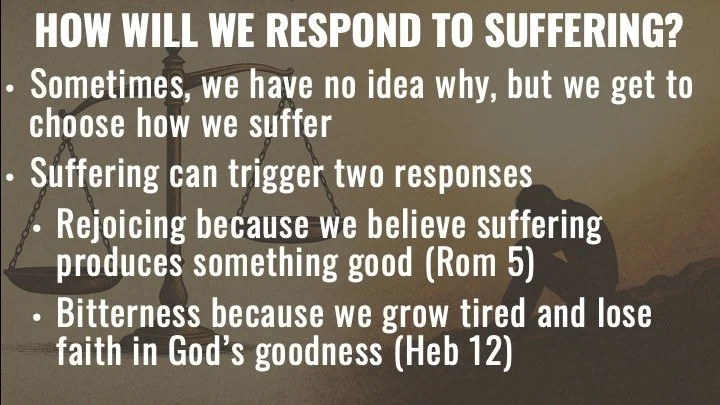
Most of the time, we won't know exactly why we suffer. A better question to ask is, "How can I grow through this?" Not every hardship has an obvious explanation, but we can always find ways to make it count. I understand if that sounds hard to accept. What good comes from losing a brother or sister? Or a parent when you're young? Or a spouse or child? What about ongoing pain, losing a job, or fights at work? Those things hurt deeply, and it's okay to feel that.
But Paul teaches us to see suffering differently. He says it can lead to good things. Listen to Romans 5:3-5.
Romans 5:3–5 (ESV) — 3 Not only that, but we rejoice in our sufferings, knowing that suffering produces endurance, 4 and endurance produces character, and character produces hope, 5 and hope does not put us to shame, because God’s love has been poured into our hearts through the Holy Spirit who has been given to us.
When we go through trials and periods of suffering, we learn to endure. The pain of suffering can do one of two things.
First, it can build us up. It helps us learn to keep going—that's what Paul calls endurance. And endurance builds character. Character builds hope. Think of it like this: In tough times, we try to find comfort in other things first—maybe distractions or anger. Those don't last. Eventually, we turn to God, and that's when we grow. We get stronger against hard situations. We trust God's promises more. Peter said trials test our faith to make sure it's real, like fire tests gold (1 Peter 1:6-7). After the difficulty passes, we see the change in ourselves. The writer of Hebrews put it this way: Discipline feels painful at first, but later it brings peace and righteousness to those who learn from it (Hebrews 12:11).
Second, suffering can make us bitter if we let it. If we expect God to make life easy all the time, we'll get angry when he doesn't. That kind of faith is weak—it falls apart under pressure. The book of Hebrews warns us not to ignore God's discipline or get tired of his correction. If we do, bitterness can grow and hurt us and others (Hebrews 12:12-15).
So when suffering comes, we have to decide: Will it make our faith stronger, or show us where it's weak? We choose to trust God and his Word. That way, the pain helps us stand firmer.
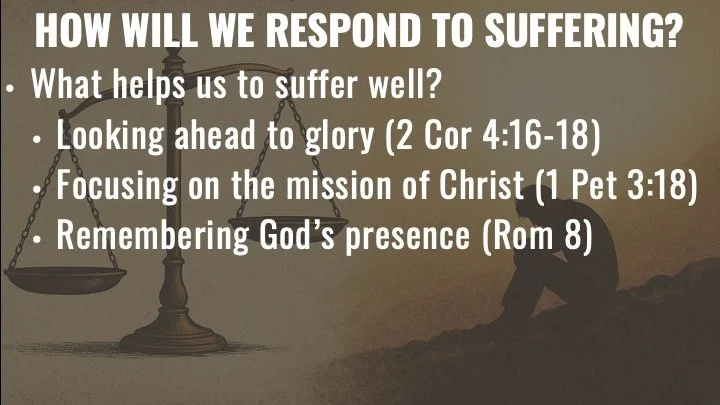
What Helps Us Suffer Well?
Finally, I want us to think about what it would look like to suffer well. Some suffering comes from our mistakes or from God teaching us. But there is also suffering we choose on purpose. Why would we do that?Look at the disciples in the New Testament. At first, when Jesus was arrested, they ran away to avoid trouble. But later, in the book of Acts, they faced arrest and beatings without backing down. What changed them? They saw Jesus rise from the dead. That gave them confidence in the future God promised. It made them willing to suffer for others.
Looking Ahead To Glory
That's why Paul could write in Romans 8:18 that our sufferings now are nothing compared to the glory we'll see. No matter how much pain you've had—or will have—it won't seem important when you experience what God has ready for you.
Those early Christians didn't worry about saving money for retirement. They weren't stressed about the best schools for their kids or sports teams. They didn't care if they missed a promotion at work. Their main focus was the hope of heaven.
2 Corinthians 4:16–18 (ESV) — 16 So we do not lose heart. Though our outer self is wasting away, our inner self is being renewed day by day. 17 For this light momentary affliction is preparing for us an eternal weight of glory beyond all comparison, 18 as we look not to the things that are seen but to the things that are unseen. For the things that are seen are transient, but the things that are unseen are eternal.
They accepted suffering because they knew it prepared them for something much better. When we keep our eyes on that future, today's problems feel smaller.
Focusing On The Mission
Finally, we suffer well when we are so focused on the mission God has given us that we become fanatical about it. This is what we see in the disciples in the first century. They walk willingly into a hostile environment because they are so focused on saving lost souls. They have prepared themselves thoroughly and they want to make a difference so badly that they don’t care if they suffer. They see the mission of Christ and they see the lost souls with hearts wide open.
1 Peter 3:18 (ESV) — 18 For Christ also suffered once for sins, the righteous for the unrighteous, that he might bring us to God, being put to death in the flesh but made alive in the spirit,
I have noticed this about myself. When I become fanatical about something, I really get a lot of work done on it. My problem is that I jump from one fanatic thing to another. Have you ever noticed that in yourself? Maybe you are all about photography, then all about videography, then all about web design, or all about Alabama football, then all about 3d printing, then all about reading, or all about coaching soccer, then all about dieting, then all about budgeting, and it just goes on and on and on. The disciples were all about Christ and the spread of His kingdom. If they were fanatical about something else, it served the purpose of spreading the seed of Christ’s salvation to as many people as possible. If you want to suffer well, suffer with this purpose. John Piper wrote a book entitled, “Don’t waste your cancer.” Don’t waste your suffering. Use it to reach the lost and you will suffer well.
Remembering God’s Presence
One of the most comforting truths in Romans is that God doesn't leave us alone in suffering—He chooses to be right there with us. Paul makes this clear in chapter 8. He says that nothing can separate us from God's love: not trouble or hardship, not persecution or famine, not danger or sword (Romans 8:35). In fact, Paul quotes Psalm 44 to remind us that we might feel like sheep for the slaughter, but in all these things, we are more than conquerors through Him who loved us (Romans 8:36-37).
What does this mean for us? God isn't distant, watching from afar while we hurt. His Spirit knows our thoughts and feelings and intercedes for us. And in Romans 8:28, Paul promises that for those who love God, all things, even the worst sufferings, work together for good, because God loves us and considers us to be His children.
God is a God of comfort. He comforts us in all our affliction (2 Cor 1:3-7). He works through us to comfort one another. Think of times when, in the middle of pain, you've sensed God's comfort through a friend, a verse, or a quiet assurance. That's Him staying.
This changes how we face the dark: We're not abandoned; we're accompanied. God walks the road with us, just as He did with Israel in the wilderness or with Jesus in Gethsemane.
Conclusion
Next time suffering hits, remember Paul's words, “The suffering of this present time is not worth comparing to the glory to be revealed.” Don't rejoice in the pain itself, but in what it can produce: endurance, character, and hope. Keep looking to the glory God promises. And hold tight to this: God stays with you, turning even the hardest moments for good. Love God and others well. What hard thing in your life right now could you start seeing as a chance to grow closer to God? Let's pray about that, and then go live it out. Amen.