
Praying When You’ve Blown It (Psalm 51)


Most people don’t plan to ruin their lives.
They don’t wake up one morning intending to cross a line they can’t uncross. It usually starts smaller than that. A desire goes unmet. A wound goes unhealed. A restlessness sets in. And we tell ourselves we’re just trying to feel whole again. We’re desperate people. We’re trying to quiet the ache. We’re trying to feel alive. We’re trying to fix what feels broken inside of us. And for a moment, it feels like it works. Until it doesn’t.
That’s when guilt shows up.
Guilt has a way of pressing in on us. It tells us we’ve gone too far. It tells us we can’t undo what we’ve done. It tells us we’ve damaged something—maybe our integrity, maybe our family, maybe our relationship with God. And once that weight settles in, every person faces the same question:
What do you do when you’ve blown it?
Some people bury the guilt and keep going. Others try to outrun it with distraction or religion. But a few people do something different. They stop hiding. They come clean. They go to God.
Psalm 51 is the prayer of a man who has done serious damage and knows it. Luke 11 reminds us why a sinner like that can still pray at all. Together, they show us that God is not repelled by honest repentance—He is waiting for it.
Today, we’re going to walk with a man who crossed a line he never thought he would cross, felt the crushing weight of guilt, and discovered that God’s mercy is deeper than his failure.
The Greatest Sin (2 Samuel 11–12)
David is one of the most prominent people in Scripture. He is not a nobody. He is not ignorant. He is not unacquainted with God. God has been with him for a decade while he has struggled against Saul. Now, he’s the king of Israel and no foe can stand against him. And that’s part of what makes his collapse so sobering.
While his army is away at war, David is at home. He sees a woman bathing and decides to take her—knowing she is Uriah’s wife. Then comes the panic. She becomes pregnant. David tries to cover his sin with more sin, and before long he’s arranging the death of a loyal man and pretending it’s just the fog of war. His one choice becomes a chain. Lust becomes deception. Deception becomes manipulation. Manipulation becomes bloodguilt.
And for a moment it looks like he got away with it. Life keeps moving. The palace keeps functioning. The rumors quiet down. The marriage happens. The future seems manageable.
Then God sends a prophet.
Nathan approaches David, not with an accusation first, but with a story. A rich man has a visitor. Instead of taking from his own flock, he steals the one treasured lamb of a poor man—the little lamb that ate from his hand and lay in his arms and was like a daughter to him. The rich man snatches it, kills it, and serves it.
David is enraged. Something in him still knows right from wrong. He thunders with judgment. “That man deserves to die.” And then Nathan turns the blade with five words that can stop a heart: “You are the man.”
2 Samuel 12:7–12 (ESV) — Nathan said to David, “You are the man! Thus says the Lord, the God of Israel, ‘I anointed you king over Israel, and I delivered you out of the hand of Saul… Why have you despised the word of the Lord, to do what is evil in his sight? … For you did it secretly, but I will do this thing before all Israel and before the sun.’”
Notice what the Lord says through Nathan. God doesn’t start with what David did. God starts with what He gave. “I anointed you. I delivered you. I gave you. I would have given you more.” David’s sin is not merely that he broke a rule. He despised the word of the Lord. He treated God’s generosity as if it were nothing. He reached for what was forbidden as if God had starved him.
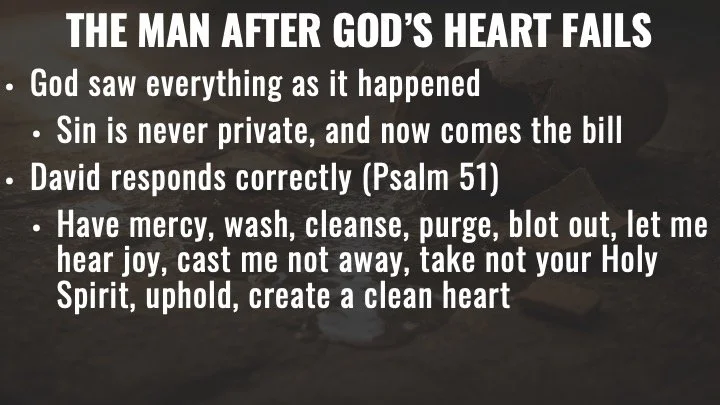
And God makes something else clear. David did it secretly, but God saw it openly. God watched the whole chain unfold—the look, the desire, the decision, the coverup, the letter, the death. David may have hidden it from the nation, but he never hid it from the Lord.
That is a terrifying thought when you’re living in sin. And it is a merciful thought when you’re ready to come clean. Because it means you can stop pretending. You can stop performing. You can stop acting like God needs to be informed. He already knows. The question is whether you will agree with Him about what you’ve done.
When you have blown it, what did you think was happening? Did you think God wouldn’t see? Did you think you could manage the consequences? Did you think your private life wouldn’t touch your public life? David teaches us something we don’t like to learn: sin never stays contained, and God never loses track.
God’s judgment on David is severe, and it is warranted. David’s sin shattered trust, abused power, and spilled innocent blood. The consequences will reach into his home for years.
And then David finally speaks with the only sentence a guilty person can say without lying.
“I have sinned against the Lord.”
That sentence is the hinge of this entire sermon.
God’s Desire: A Broken, Contrite Spirit (Psalm 51)
When you read Psalm 51, you are listening in on what happens after “You are the man.” This is what repentance sounds like when it’s real. David isn’t bargaining. He isn’t spinning. He is collapsing before God.
He begins exactly where Jesus teaches us to begin: with who God is.
“Have mercy on me… according to your steadfast love… according to your abundant mercy.”
David is not asking God to be something God is not. He is appealing to what God has revealed Himself to be. Mercy. Steadfast love. Abundant compassion. And then the verbs pour out of him like a man scrubbing blood from his hands:
Wash me.
Cleanse me.
Purge me.
Blot out my transgressions.
Let me hear joy again.
Cast me not away from your presence.
Take not your Holy Spirit from me.
Uphold me with a willing spirit.
Create in me a clean heart.
That list matters because it shows what David understands. He doesn’t just need a second chance. He needs cleansing. He doesn’t just need consequences reduced. He needs his heart remade. He doesn’t just need God to overlook him. He needs God to hold him up.
And David says the sentence that explains why his sacrifice won’t fix this:
“You will not delight in sacrifice… The sacrifices of God are a broken spirit; a broken and contrite heart, O God, you will not despise.”
That is not David rejecting God’s instructions about worship. That is David rejecting the idea that worship can be used to cover sin. He knows you can sing while lying. You can give while hiding. You can offer a sacrifice and still be proud. You can keep your schedule full of “religion” and still refuse to repent. David says, “God, I don’t have an offering big enough to buy my way back. But I can give You what You actually want—truth in the inward being. A crushed heart. No deceit.”
And that is where Luke 11 becomes so precious. Because the moment you become broken and contrite, you start to wonder: will God reject me anyway?
Jesus answers that fear. He says when you pray, you say, “Father.” And then He teaches persistence—ask, seek, knock—because God is not irritated by repentant people who keep coming. He is not sitting in heaven saying, “If you were really sorry, you’d stop bothering me.” Jesus says the opposite. If a reluctant neighbor can be moved by persistence, how much more will your Father respond?
And then Jesus lands the plane with a promise that sounds like it was written to sit beside Psalm 51: “How much more will the heavenly Father give the Holy Spirit to those who ask him!” David prays, “Take not your Holy Spirit from me… uphold me.” Jesus says, “Ask your Father. He gives the Spirit.” In other words: when you’ve blown it, you don’t come to a clenched fist. You come to a Father who gives what is good—especially what is necessary for a changed life.
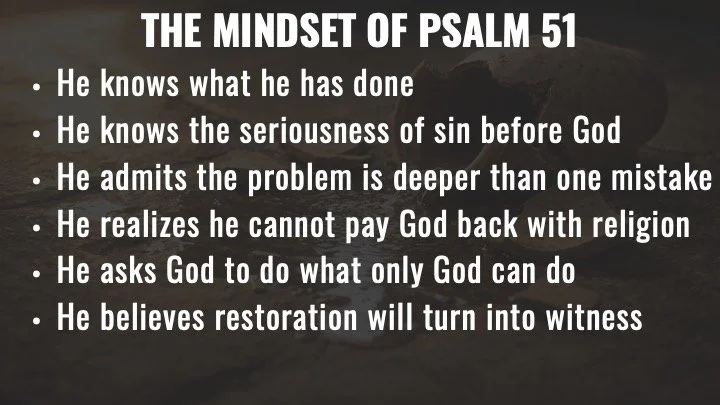
Here is the mindset Psalm 51 teaches, stated plainly.
David knows what he has done.
David knows the seriousness of sin before God.
David admits the problem is deeper than one mistake.
David knows he cannot pay God back with religious effort.
David asks God to do what only God can do: cleanse him and remake him.
David trusts that God does not despise the broken.
And David believes restoration will result in worship and witness—“Then I will teach transgressors your ways.”
That last piece matters. True repentance isn’t only sorrow; it’s reorientation. It’s a man being turned back toward God so that his life becomes useful again.
So the question becomes personal.
When you blew it—when you crossed the line you never thought you’d cross—did you hide? Did you justify? Did you minimize? Did you keep offering God religious activity while refusing Him honesty? Or are you ready to be broken and truthful before Him?
Because God isn’t asking you to impress Him. He is asking you to come clean.
The Joy of Undeserved Forgiveness (Psalm 32)
Psalm 51 is the cry of repentance. Psalm 32 is the song of the forgiven.
David’s consequences were painful and lasting. His sin damaged people. It damaged his home. It damaged his credibility. And in terms of what he deserved, the truth is simple: David deserved death.
But God let him live. And God forgave him.
Listen to the joy that comes out of a man who has been pulled up from drowning.
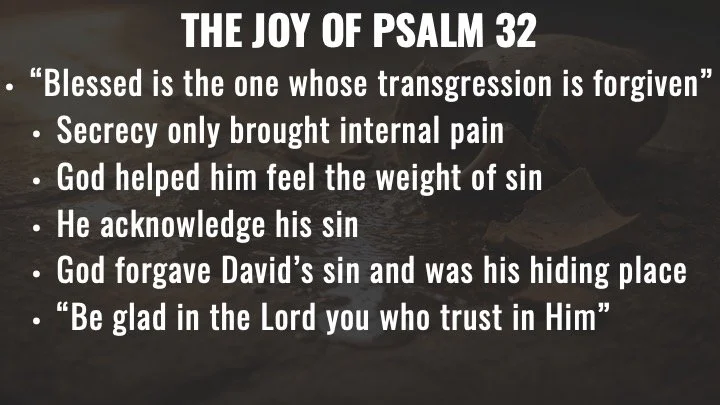
Psalm 32:1–5 (ESV) — “Blessed is the one whose transgression is forgiven… For when I kept silent, my bones wasted away… day and night your hand was heavy upon me… I acknowledged my sin to you… I said, ‘I will confess…’ and you forgave…”
David says silence was killing him. Hiding was a slow death. Not because God was cruel, but because guilt is a kind of internal collapse when you refuse the truth. His strength dried up. His bones wasted away. He lived with God’s hand heavy upon him.
But then confession happens. Not performance. Not spin. Confession.
And forgiveness comes.
And the way David describes God is one of the sweetest lines in all the Psalms: “You are a hiding place for me.” Think about that. The God you sinned against becomes the refuge you run to. The Judge you deserve to fear becomes the shelter you are safe in—when you stop lying and start confessing.
That is what God wants for you. He wants you surrounded with steadfast love. He wants your groaning replaced with deliverance. He wants joy to return. Not cheap joy. Not “I got away with it” joy. The joy of being clean.
And this is exactly what Jesus came to accomplish. Not merely to give advice, but to open a way for sinners to come home to the Father. He pours Himself out to make forgiveness possible, and He gives the Spirit to sustain a life that no longer has to chase sin for comfort.
Acquiring joy: a sinner at Jesus’ feet (Luke 7)
The New Testament gives a scene that feels like Psalm 51 in living color.
A sinful woman walks into a dinner where Jesus is present. She doesn’t come to defend herself. She doesn’t come to negotiate. She doesn’t come to prove she’s worthy to be in the room. She comes broken. She weeps. She clings. Her shame is public. Her repentance is not quiet.
And Jesus does not crush her.
He exposes the coldness of the self-righteous and welcomes the one who knows she needs mercy. He speaks forgiveness over her, and He sends her away in peace.
That story is a New Testament picture of what Psalm 51 has been teaching all along. God does not despise the broken and contrite. God is not impressed by the polished and proud.
She didn’t fix herself first and then come to Jesus. She came because she needed to be fixed.
And that’s the invitation for you.
Closing call: what do you do with the weight?
If you’ve blown it, you have two options.
You can keep silent and let your bones waste away. You can keep covering, keep justifying, keep pretending, keep reaching for sin to numb the ache that Ecclesiastes says will never be satisfied under the sun. You can do that. And it will hollow you out.
Or you can do what David did. You can come to the Father the way Jesus taught you. You can ask. You can seek. You can knock. You can confess with no deceit. You can pray Psalm 51 with your whole heart and trust the promise of Luke 11 that your Father is good, and He gives what you need—cleansing, restoration, and His Spirit to uphold you.
Just because you’ve blown it does not mean it’s over.
But you must stop covering it.
Bring it into the light. Confess it. Turn from it. Ask your Father for mercy. And then receive the joy of forgiveness—the kind of joy that doesn’t come from getting what you want, but from being brought back to God.