
It’s Not Worth It (Joshua 7)

The God of Israel has shown Himself faithful to His promises. He delivered Jericho—the first major city in the promised land—into the hands of Joshua and His people. All they had to do was obey Him and trust His power. They watched as the walls of a fortified city collapsed without a single battering ram. Jericho was not won by Israel’s strength or strategy. Jericho was handed over by the LORD.
But before they entered the city, God gave them one clear instruction.
Joshua 6:17–21 (ESV) — And the city and all that is within it shall be devoted to the Lord for destruction… all silver and gold, and every vessel of bronze and iron, are holy to the Lord; they shall go into the treasury of the Lord.
Jericho wasn’t just a victory—it was devoted. Everything living in the city was placed under God’s judgment, and the metals were declared holy to the LORD. They were not Israel’s to keep. They belonged to God. Jericho was the firstfruits of the land, the first proof that God was fighting for His people, and God claimed it for Himself.
If God gives the victory, God sets the terms.
This makes sense when you consider what lies ahead. God is about to give Israel the whole land the same way He gave them Jericho. The victories east of the Jordan were only a preview. Rahab already told them the people of the land were melting in fear. No one could stand against them when God went before them. So the first major victory inside the land was devoted entirely to Him—because He is worthy of it.
Unfortunate Events
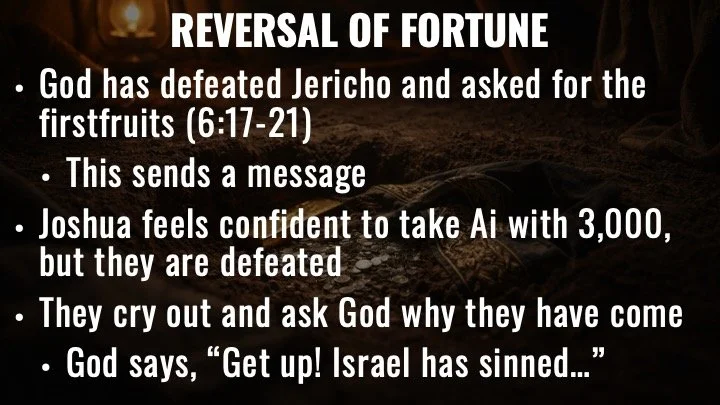
After Jericho, Israel’s confidence rises quickly. They feel unstoppable. Just up the hill sits a smaller city—Ai. Joshua sends spies, and they return full of confidence. “We don’t need many men for this.” So Joshua sends about three thousand soldiers.
Instead of an easy victory, Israel is routed. Thirty-six men are killed. Thirty-six may not sound like many, but remember this: when God fights for Israel, no one falls. That’s what makes this loss so alarming. This isn’t just a military setback—it feels like God has withdrawn.
Joshua and the elders tear their clothes and fall on their faces before the LORD. Joshua cries out, “Why bring us over the Jordan just to be defeated? Now the people of the land will hear of it and destroy us.” And the text tells us the hearts of the people melted and became like water. The fear that once gripped Canaan is now creeping into Israel.
God responds, not with comfort, but with clarity.
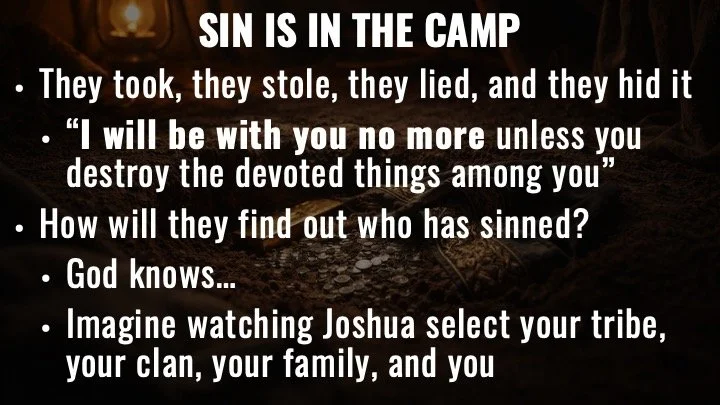
Joshua 7:10–12 (ESV) — “Get up! Why have you fallen on your face? Israel has sinned… therefore the people of Israel cannot stand before their enemies… I will be with you no more, unless you destroy the devoted things from among you.”
God doesn’t tell Joshua to adjust his strategy. He tells him something is wrong in the camp. Someone has taken what was devoted to the LORD. God piles up the language: they took, they stole, they lied, they hid it among their belongings. This wasn’t an accident. It was deliberate.
God’s presence is not optional.
What makes this unsettling is that God speaks as if the whole nation is accountable. These are more than a million people—how could they possibly keep God in their midst if sin exists among them? But God is not demanding sinless perfection. He is exposing a specific kind of sin: covenant treachery—stealing what was holy and hiding it as if God cannot see.
Can you imagine how foolish you must be to steal from the God who just tore down walls in front of you?
That isn’t weakness.
That is defiance.
The Searchlight Falls
Joshua rises early and brings Israel forward tribe by tribe. Judah is taken. Then the Zerahites. Then Zabdi. Household by household, man by man, the circle tightens until the lot finally falls on Achan.
Joshua 7:19–21 (ESV) — “My son, give glory to the Lord… tell me what you have done.” And Achan answered, “Truly I have sinned… when I saw… then I coveted… and took… and hid them.”
Achan’s confession gives us the anatomy of temptation: I saw. I coveted. I took. I hid. That is how sin grows when it is left alone. It moves from the eyes, to the desires, to the hands, and finally into the dark.
Now imagine standing there as the lot narrows—tribe, clan, household, man—knowing you’re the only one who did this. And here’s what makes it even heavier: thirty-six men are dead because of what Achan buried under his tent floor.
Achan is not remembered for courage. He is remembered for a secret he thought God wouldn’t see.
He valued the treasure of a condemned city over the greatest treasure Israel had been given—the presence of the living God.
Judgment That Offends Us
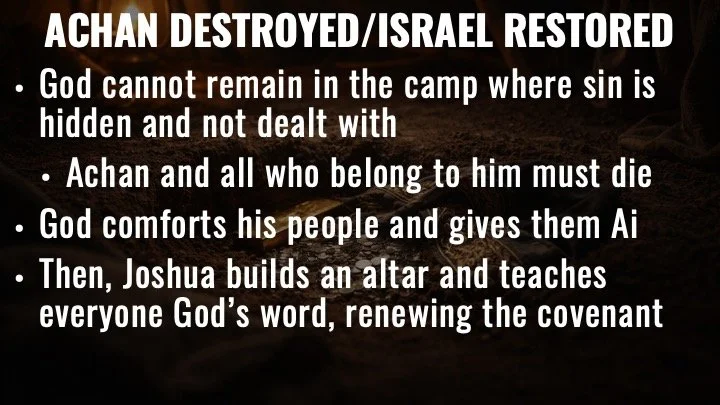
The judgment is severe. Achan is stoned and burned, and his household is included. That is difficult for us to read, especially when children are mentioned. But the narrative is teaching something essential about life with a holy God in the midst of His people.
Jericho was not ordinary spoil. It was devoted. The devoted things were holy to the LORD. Achan didn’t just break a rule—he violated something sacred and hid it in the center of his home, right in the middle of the camp. God is making something unmistakably clear: when I dwell among you, I will not be treated as small.
You cannot host holiness and hide rebellion under the same roof.
Israel raises a pile of stones over Achan, and the place is called the Valley of Achor—Trouble. And then we read the line that explains everything:
“Then the LORD turned from his burning anger.”
Restoration
Immediately, Joshua 8 shows the restoration. God tells Joshua not to fear. He gives them a plan. Israel ambushes Ai and destroys the city. This time, God allows them to take the plunder for themselves. Jericho was unique. Jericho was firstfruits. Jericho belonged to God.
After the victory, Joshua builds an altar on Mount Ebal. Burnt offerings and peace offerings are made. The law is written and read aloud so that everyone hears it—men, women, children, and sojourners alike. The covenant is renewed.
The message could not be clearer: if Israel wants God in their midst, they must take His word seriously.
When Sin Is in the Camp
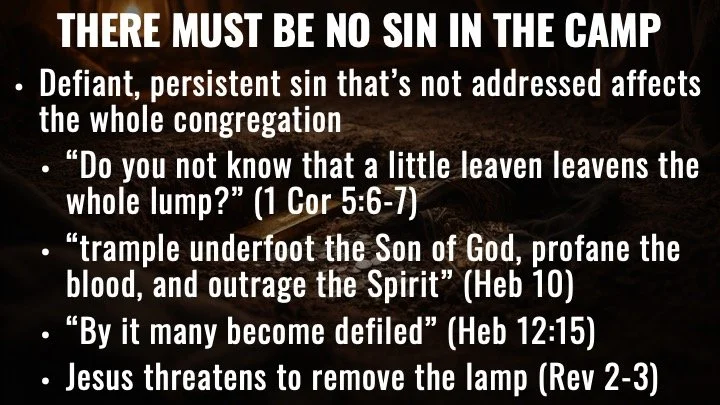
Sin in the camp is never just personal. Sometimes it is hidden carefully. Someone refuses to bring it into the light. They don’t want repentance; they want privacy. Over time, the whole congregation weakens. Trust erodes. Courage fades. Fear replaces faith.
There are moments when a church must remove someone who has chosen stubborn rebellion—not because the church is harsh, but because God is holy and His name matters.
The New Testament speaks with this same seriousness.
Hebrews 10:26–31 warns about deliberate sin after receiving the knowledge of the truth—treating Christ’s sacrifice as something to step over rather than submit to. The writer calls it trampling the Son of God underfoot, profaning the blood of the covenant, and outraging the Spirit of grace.
God is not going to be mocked.
And notice this: the consequences of sin never stop with the sinner. Israel could not move forward until the devoted thing was removed. And churches cannot move forward while hidden rebellion is quietly protected. The elephant in the room must be addressed before God’s people can walk in strength again.
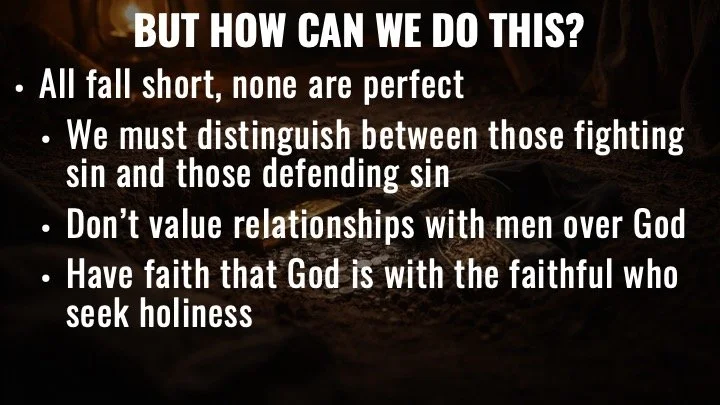
In 1 Corinthians 5, Paul tells the Christians to address the sinning brother who persists in sin. When we go through the process of rebuking and exhorting someone who is fully engaged in sin, we must be willing to withdraw and remove the bad leaven from the lump.
Overcoming Achan’s Sin
Achan is a picture of what we deserve. Every one of us knows what it is to see something we wanted, to crave it, to justify it, and to hide it. And once we get it, we realize it didn’t heal us—it only made us guilty.
So what do we do?
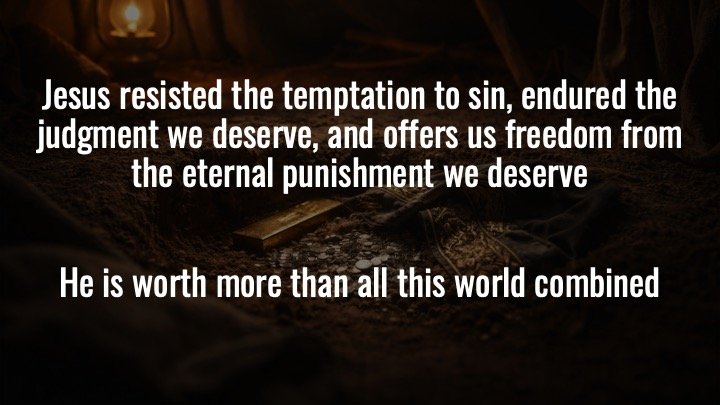
Jesus did what we could not do. He resisted temptation. He gave glory to God. And then He endured the judgment we deserved. We are the criminals. We are the rebels. And Jesus went to the cross so we would not bear the full weight of that judgment.
The answer to sin is not silence. God knows. God sees. God judges secret things. So it is better to bring sin into the light, confess it, turn from it, and pursue a holy life that honors God.
Grace is not permission to keep idols.
When we accept the sacrifice of Christ, we put away the devoted things. We hide nothing. We walk in the light. And then we enter the spiritual battle with confidence—not because we are strong, but because God is with us.
And where God is with His people, no enemy can stand.