
When God Says, “No”

At the start of the year, I told you that prayer is something I’ve struggled with at times. I’ve spent hours praying while driving long commutes, pouring out my heart to God. But I’ve also reduced prayer to habit—motions without expectation.
When prayers are answered quickly, prayer feels powerful. When they aren’t, prayer feels pointless. And if we’re honest, that’s where many of us begin to drift.
But how should we think about God when He doesn’t answer or when he answers, “No?” We can think about many things. We can think that He is evil and mean. We can think that He just doesn’t care about us or that we don’t matter. We can think that He has something in mind that we don’t know about. But we can also think that there is something wrong with us or what we are asking. Maybe we just don’t have enough faith.
We struggle to pray because we don’t like the idea that God will tell us “No” to something we really think needs to happen. Today, we are going to see that when God doesn’t give us any response or when He seems to be saying “No,” He is not absent. He is revealing His wisdom, His purposes, and our hearts in the silence. After we understand that, we will see why we need to keep praying through the doubts, fears, and periods of suffering.
Ten different reasons God says “No”
When we look throughout History, there are multiple occasions when God says, “No.”
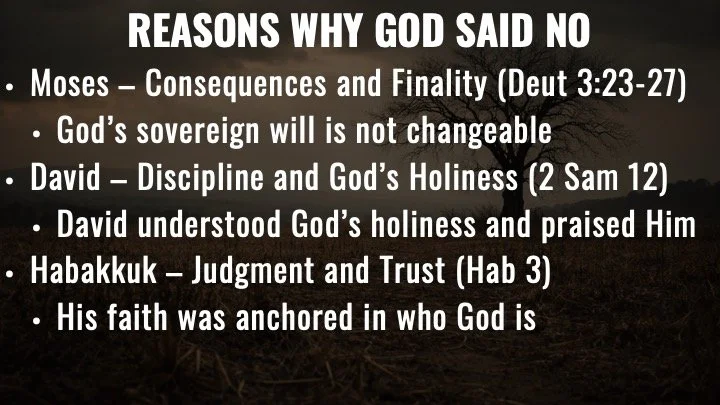
Moses - Consequences and Finality (Deut 3:23-27)
The first instance is when Moses was in the wilderness with Israel, he had failed to honor God by following His command to speak to the rock. Consequently, God told him he would die in the wilderness. But he prayed for God to let him go in and to let his eyes see the land. God said, “No” and He told Moses to stop asking. We aren’t really told why God wouldn’t change His mind on this, but it seems to make it clear that it was time for Moses to die. Sometimes, it’s about consequences and sometimes it’s just time for someone to die.
Sometimes God says no not because He hasn’t considered the request, but because He has. We have to recognize God’s wisdom and knowledge in every situation. God did not change His mind, not because He was unkind but, because the judgment had already been considered fully and finally.
David - Discipline and God’s Holiness (2 Sam 12:15-23)
The second instance is right after the events we learned about last week. David’s adultery and murder of Uriah. Though God forgave David, He promised that He would bring evil upon David’s house. This started with the child that Bathsheba had born to him. The boy fell deathly ill when he was still young. Can you imagine having a child sick like that and knowing it was a consequence of your sin? David fasted, prayed, and did not move for seven days. He was constantly calling out to God for mercy for the child, and no one could budge him. Again, God said, “No.” The boy died. But what’s most interesting about this story is the part afterward. As soon as David found out that the boy had died, he got up, washed himself, and went to the temple to offer worship to God. David didn’t hate God or wallow in self-pity. He said, “I will go to him, he will not come back to me.”
David didn’t stop believing when God said no. He stopped bargaining—and started worshiping. No bitterness. No accusations. No collapse of faith. David understood something we often forget: God’s holiness had not disappeared just because David’s heart was breaking.
Habakkuk - Judgment and Trust (Hab 1-3)
In Habakkuk, we read about a prophet who is told about the destruction of Judah before it happens. He prays for God to not do this, to fix Israel in some other way. But God tells Habakkuk, “No.” Again, the response is full of faith. Habakkuk says, “Even though everything around me is falling apart, I will praise you and rejoice in your greatness, believing that you will be with me and help me rise above my tribulation.”
God said no to Habakkuk’s request, and yet Habakkuk ends his prayer with praise. Even if everything collapses, even if the fields produce nothing, even if life falls apart—he will rejoice in God. Why? Because his faith was anchored in who God is, not in what God allows.
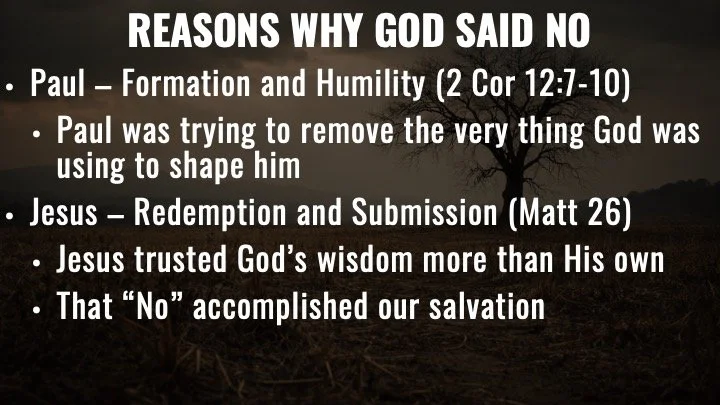
Paul - Formation and Humility (2 Cor 12:7-10)
As we come into the New Testament, we can see that Christians don’t fare any better. Paul reveals that he had gone to God on multiple occasions asking God to remove a constant pain in him, but God told him, “No, my grace is sufficient for you. My power is made perfect in weakness.” It turns out that in this case, the thorn in Paul’s side was keeping him from being conceited. There was an underlying function of the pain Paul wanted removed. Again, Paul doesn’t let this answer make him bitter. He instead continues in his efforts and glorifies God in his weakness, knowing that it is for his good.
The very thing Paul wanted removed was shaping him into the man God was using. And Paul learned to rejoice—not in comfort, but in grace.
Jesus - Redemption and Submission (Matt 26:36-46)
And, of course, we know that God the Son, himself did not get what he wanted. Jesus went to God in Gethsemane and prayed for the cup to pass, but God said, “No.” It is interesting, in this case, that Jesus says, “Nevertheless, not my will, but yours be done” in Matthew 26. This phrase is important. It indicates that Jesus leaves room for the wisdom and foreknowledge of God.
That was trust. Jesus trusted the wisdom of the Father more than His own desire to avoid pain. And because of that “No,” salvation was accomplished.
Why Does God Say, “No” To Me
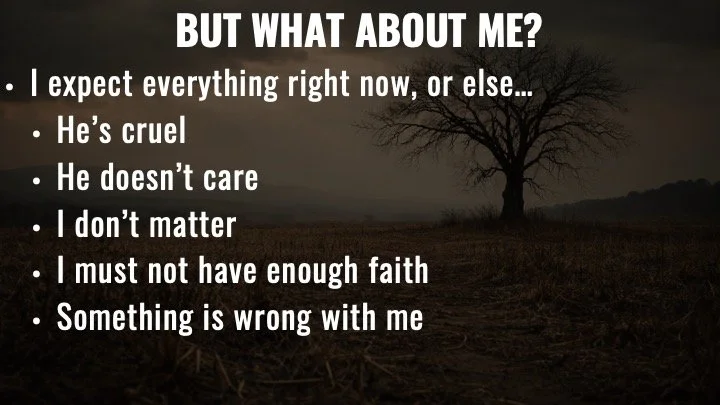
So, God does say, “No.” But why is He telling me no? When God says “No,” our minds race.
Maybe He’s cruel.
Maybe He doesn’t care.
Maybe I don’t matter.
Maybe I don’t have enough faith.
Maybe something is wrong with me.
And our culture has not helped us here. We live in a world that has turned prayer into a transaction. Push the right buttons. Say the right words. Have enough confidence. And if the miracle doesn’t happen, someone must be at fault. That kind of thinking has hurt people deeply. Because it teaches us to believe that unanswered prayer means failed faith.
But Scripture tells a very different story. These examples are supposed to show us that faithful men are told “No” by God. Maybe there is a punishment like in the case with David. Maybe it’s just not a part of God’s overall plan, like in the cases of Moses, Habakkuk, and Jesus. Or maybe what I’m asking for is not truly what is best for me like in the case of Paul. I really don’t know which it is. But there are some things we can know.
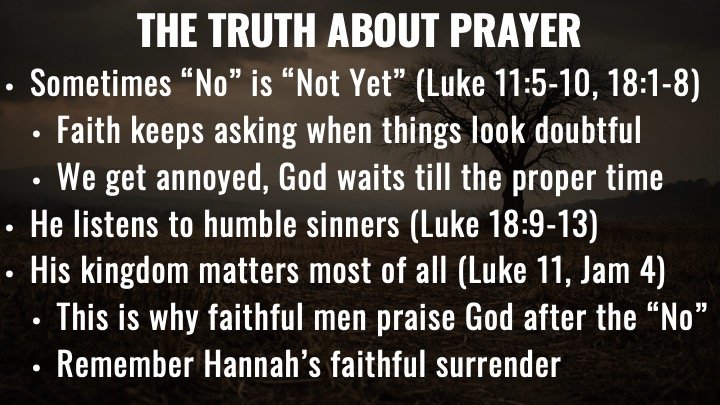
The Truth About Prayer
Sometimes “No” is “Not Yet” (Luke 11:5-10, 18:1-8)
The first thing we can know is that “No” might be “Not Yet.” Are there times in your life when you have prayed for something only to find it comes true years later, after you have stopped praying?
Luke 11:5–10 (ESV) — 5 And he said to them, “Which of you who has a friend will go to him at midnight and say to him, ‘Friend, lend me three loaves, 6 for a friend of mine has arrived on a journey, and I have nothing to set before him’; 7 and he will answer from within, ‘Do not bother me; the door is now shut, and my children are with me in bed. I cannot get up and give you anything’? 8 I tell you, though he will not get up and give him anything because he is his friend, yet because of his impudence he will rise and give him whatever he needs. 9 And I tell you, ask, and it will be given to you; seek, and you will find; knock, and it will be opened to you. 10 For everyone who asks receives, and the one who seeks finds, and to the one who knocks it will be opened.
When we read in Luke 11 about the man who doesn’t want to get out of bed and give bread to the neighbor, what are we supposed to notice? The main point seems to be the willingness of the man to grant a request due to the persistence of his neighbor. We connect this to the context and see that God will get up and open the door for us if we persist. He will give us what we ask of Him as we persist in prayer. He might tell us, “No” at first, but that “No” can turn into a “Yes.”
But I believe there is more to this story than that. Jesus is not teaching us how to wear God down. He is teaching us who God is. If a tired, annoyed neighbor will eventually respond, how much more will a loving Father respond to His children?
The issue is not whether God hears. The issue is whether we trust Him enough to wait and keep asking—even when the door stays closed longer than we expect.
Is It Because I Sinned? (Luke 18:9-13)
Also, notice that this story tells us that the neighbor says “Yes” to someone who is asking for things they should already have and He gives things when it’s not convenient for him to give. He rearranges the world to accommodate those who ask. Have you ever thought, “I shouldn’t pray because I’m a sinner and God doesn’t listen to sinners?” or “God’s got other things to worry about.”
Everyone is a sinner. In Luke 18:13, we read that the sinner who knew he was a sinner was heard over a religious and seemingly righteous man. Why? It’s not that God doesn’t listen to sinners. We read that He is opposed to the proud, but gives grace to the humble. The proud are selfish and ask of God wrongly, with a focus on themselves and their own pleasures (James 4:3).
So, it’s possible that there is something wrong with your heart and that’s why God is not providing what you are seeking. He is opposing you because of your pride. Repentance doesn’t force God’s hand—it corrects our posture and aligns our hearts. But I bet many of you aren’t receiving a “No” for that reason. It could be true of you, and if it is, you need to repent. But I bet the “No” is a “Not yet” or something else.
God’s Kingdom Matters Most Of All (Luke 11)
One core reason why I believe God tells us, “No” is because we aren’t focused on the right things. Notice what Jesus puts first in his model prayer. Jesus taught us to pray, “Hallowed be YOUR name; YOUR kingdom come.”
Then, Jesus demonstrated this humility in the Garden of Gethsemane. He asked God to take away His suffering, but then He recognized that it wasn’t about Him and His desire to avoid pain. It was about the kingdom and redemption of mankind.
Do you put God’s kingdom above your request for daily bread? Is God’s kingdom more important to you? When we look at all of these examples of men who are told, “No.” Those who accepted it and worshiped God afterward did so because they valued their relationship with God, His glory, and His kingdom more than they valued the life of their child, the pain and suffering they were going through, or their own wellbeing.
Maybe God is telling you “No” because your request is completely self-absorbed and self-centered. Remember Hannah’s surrender? She recognized that it’s not about her. Hannah did not ask God to serve her story. She asked God to use her story for His glory.
It can’t be about me. It has to be about God and His glory. That’s our purpose in life so that should be our purpose in every request. I want the job, child, spouse, etc. so I can glorify God in them.
Ask With Faith
Now, think about what was repeatedly asked for in Luke 11, bread. In the model prayer, he asks for daily bread, not a storehouse full of bread. In the story the neighbor was asking for bread. In the end, he says fathers know how to give bread. The picture is that if you ask, seek, and knock for what you actually need to survive, believe that God will give that to you. He is a good heavenly Father for you. We simply need to keep asking and keep believing that is true.
One might say, “I need this thorn out of my side,” “I need my child to live,” or “I need to avoid hanging on the cross.” These are all true statements to us, but why do you need those things? Is it not just because you want a comfortable life? What about the good that God can accomplish by allowing you to endure the loss of comfort? Do you need them for God’s glory?
Let God’s will be done in my job hunt. Let God's will be done with having children or acquiring a spouse. May God’s will be done with buying a house or anything else my heart desires. If I start with God’s will as my focus and the exaltation of God’s kingdom as my focus, I will find that all things have worked together for my good because I loved the Lord more than myself.
Some might hear that and say, “I shouldn’t even ask because I know He’ll say no.” But if you, like Hannah, have His glory in mind for the house, for the children, for the spouse, for the job, for the removal of pain or suffering, you should not only ask, but expect God to move in a way that benefits everyone.
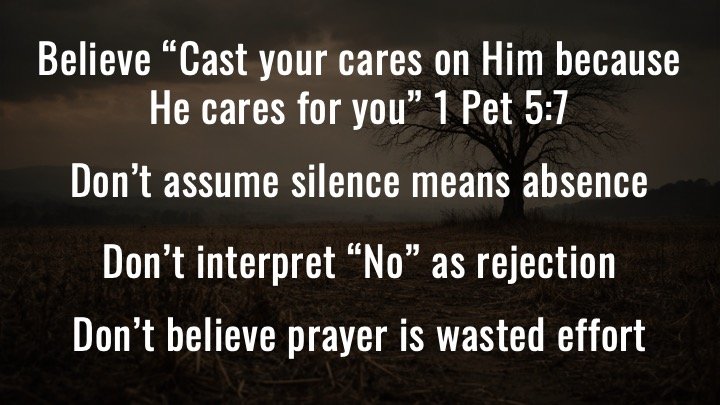
Believe that God always cares
I’m not spouting out health and wealth doctrine. I’m not telling you God is your genie in the bottle. But I am telling you that we would all do well to think more positively about our God after He responds negatively to our prayers. Don’t assume the worst and don’t give up on Him.
In light of all the no’s we read about in scripture and all the no’s we might face in our lives, it’s important for us to remember that praying to God is still worth the effort. Remember, God doesn’t say “No” because He doesn’t care about us. Peter tells us plainly to “cast your cares on Him because He cares for you.” If He tells us “No” it’s got to be because He does care. He is a good father who gives good gifts to His children. The problem is not with God. The problem is often with us, with what we are asking for, or with some larger scheme that God knows about and we do not.
Conclusion: Pray Through The “No”
Yes, it is true that faithful servants of God pray and do not receive what they ask for. I’d like to take a few moments and consider what might happen in this congregation if we took up a consistent routine of deep, passionate prayer for God’s kingdom in this place? What if we all spent fifteen minutes every day this week praying for God’s name to be exalted through us?
Fifteen minutes of prayer before I get on social media. Fifteen minutes of prayer after I study my Bible. Fifteen minutes to start my day or to end it. But in those fifteen minutes I do not focus on myself or my family. I focus on God’s kingdom and His glory being exalted through me.
What if we made our foremost joy in life the spread and exaltation of God’s kingdom on earth? Just think about how our congregation would be affected by all of us praying like this. We can pray for those who are weak to become strong, those who are lost to be found, those who are broken to be mended, and those who are enslaved to sin to be set free. The fullness of our prayers would become centralized on God being magnified through us.
If we don’t believe God will reward us when we go to Him in faith filled prayer, we won’t pray and He won’t do it.
If God is truly a good Father, then even His “No” is an act of love—and that means prayer is never wasted, never ignored, and never pointless.