
Drifting Away (Judges 1-3)





Have you ever noticed how easy it is to drift?
Nobody wakes up one morning and says, “Today I’m going to forget about God.” Nobody plans to disobey. Nobody puts it on the calendar: Start worshiping idols. Stop praying. Stop caring. Stop listening. That’s not how it happens.
It happens slowly. Quietly. You miss one opportunity to obey. You ignore one conviction. You let one habit hang around. You start making peace with something God told you to kill. And before you know it, you’re still religious, still busy, still showing up—but your heart isn’t clinging to the Lord anymore.
That’s exactly where Israel is when the book of Judges opens.
God brought them into the land. He gave them victories they never could’ve earned. And Joshua’s last words weren’t a celebration speech. They were a warning. He told them to cling to the Lord, love Him, obey Him, and never mix their hearts with the nations and their gods.
But Judges begins by showing us what happens when people stop clinging.
They don’t usually sprint away from God. They settle. They stop short. They do enough to feel faithful, but not enough to actually be faithful. And partial obedience is dangerous because it gives you the illusion that everything is fine while your soul is sliding.
So tonight, I want to show you three things from Judges 3, through the stories of Othniel, Ehud, and Shamgar:
- What happens when God’s people drift
- How God sends saviors anyways
- Why those rescues point us straight to Jesus
Because the big truth of Judges is this: If you won’t cling to God, you’ll end up chained to something else—but God still sends a Savior.
The Warning
God brought Israel into the land. He gave victories they couldn’t have earned. And Joshua’s final words were not a victory speech, they were a warning. He told them: cling to the LORD, love Him, obey Him, and do not mix your heart with the nations and their gods (Joshua 23–24). He said, in essence, “If you treat the covenant lightly, the land will become heavy.”
But Judges opens by showing us they stopped short. They fought some battles, won some ground, but they did not finish what God commanded. They settled into partial obedience, and partial obedience is always more dangerous than open rebellion because it lets you feel faithful while you’re drifting.
Judges 2 explains what God does next. The angel of the LORD announces: “You have not obeyed my voice… I will not drive them out before you, but they shall become thorns in your sides, and their gods shall be a snare to you” (Judges 2:1–3). And Israel weeps, not because their hearts are transformed but, because they realize the cost.
And it doesn’t take long for the snare to tighten.
The nations remain in the land, Canaanites, Hittites, Amorites, Perizzites, Hivites, Jebusites, and Israel begins to blend. They intermarry. They adopt the worship practices. They stop teaching the next generation who God is. And the book is not subtle about what’s happening: Israel is forgetting the LORD.
And God had already told them what that would mean. Deuteronomy was clear: faithfulness brings blessing, rebellion brings discipline, and foreign oppression would be part of that discipline. Judges is Deuteronomy playing out in real time.
So what’s surprising in Judges is not that Israel sins. The surprising thing is that God doesn’t erase them. He disciplines them, yes, but He also keeps rescuing them.
The Cycle
After Joshua’s generation dies, the book shows a repeating cycle:
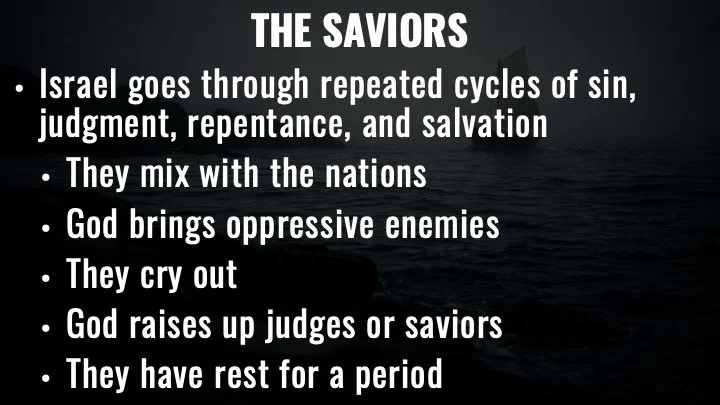
Israel sins → God hands them over → Israel cries out → God raises a deliverer → the land has rest → and then they drift again.
The judges are not primarily “heroes.” They are deliverers, saviors in the sense that God raises them up to rescue His people from oppression. And as the book goes on, the deliverers become more complicated, and Israel becomes more corrupt. The point is not, “Look at these great people.” The point is, “Look at this great God, and look at how deep the human problem goes.”
So tonight we start with two early deliverers: Othniel and Ehud.
The Saviors
The Judges are really just saviors. They are men and women whom God raises up to lead the people against an oppressive enemy. As we read through the book of Judges, we notice that these saviors come from many different tribes. They are not “heroes” in the way we might view heroes. There are fifteen judges, if we count Eli and Samuel in 1 Samuel. Some we have a lot of information about, some a small amount. But one thing becomes obvious as we read about them. They are becoming worse and worse over time. It is obvious that they lack an understanding of God’s word, until we get to Samuel. Today, we are going to look closely at all of the lesser known judges, and in future lessons we will look at those we know more about, individually.
Othniel and the Arameans
Judges 3 tells us plainly what happens:
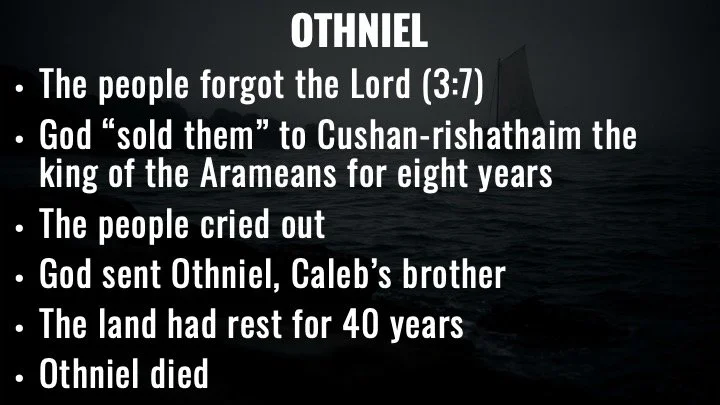
“The people of Israel did what was evil in the sight of the LORD. They forgot the LORD their God and served the Baals and the Asheroth.” (Judges 3:7)
They didn’t just sin. They replaced God. So:
“Therefore the anger of the LORD was kindled against Israel, and he sold them into the hand of Cushan-rishathaim… and the people of Israel served him eight years.” (Judges 3:8)
God sold them. This isn’t God being weak. This is God being faithful to His covenant warnings. Israel wants life without Him, and God lets them feel the chains that come with that choice. But then:
“When the people of Israel cried out to the LORD, the LORD raised up a deliverer… Othniel.” (Judges 3:9)
And the center of the story is not Othniel’s skill, it’s God’s power:
“The Spirit of the LORD was upon him… and the LORD gave Cushan-rishathaim… into his hand.” (Judges 3:10)
And the result:
“So the land had rest forty years.” (Judges 3:11)
Othniel’s story is clean, almost simple. It’s the “best-case” version of Judges. And it sets you up to hope: maybe the people learned. But then the next words hit:
“And the people of Israel again did what was evil…” (Judges 3:12)
Again. That’s the ache. Rest didn’t cure the heart.
Ehud
This time, the text says something that makes modern people uneasy:
“And the LORD strengthened Eglon the king of Moab against Israel.” (Judges 3:12)
God strengthens the oppressor, not because oppression is righteous but, because discipline is necessary. God refuses to let covenant rebellion drift without consequence. For eighteen years, Moab dominates Israel. Tribute is collected. Israel labors, and a foreign king grows fat on their work.
And again Israel cries out. And again God raises a deliverer: Ehud, a left-handed man from Benjamin. Ehud brings tribute with a sword attached to his right thigh, hidden under his cloak. He tells Eglon he has a secret message, then Ehud assassinates him when his servants are out of the room.
The story is graphic. It’s humiliating. It’s not the kind of scene you describe in detail in this setting. So what do we do with that?
First, we don’t pretend it isn’t there. Judges doesn’t sanitize reality. Second, we don’t turn Ehud into a moral model for how to handle problems. And third, we recognize what Judges is showing us: God is rescuing His people in a dark time, through a deliverer who fits the darkness of the time. The method is not the point. The deliverance is.
And after Ehud escapes, Israel rallies, and the LORD gives victory:
“So Moab was subdued that day… And the land had rest for eighty years.” (Judges 3:30)
But again, rest is temporary. The cycle will return. After Ehud comes Shamgar, Deborah, Gideon, Abimilech, Tola, Jair, Jephtha, Ibzan, Elon, Abdon, Samson, Eli, and Samuel. God uses all of these men and women to save his people.
Lessons
So here we are, staring at the cycle. Israel sins → God hands them over → Israel cries out → God raises a deliverer → the land has rest → and then they drift again.
Our Future
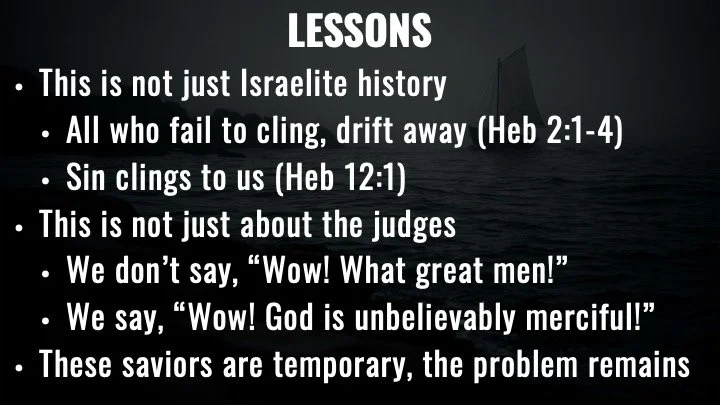
And if we’re honest, that cycle isn’t just Israel’s history. It’s a picture of the human heart. Some of us know exactly what it is to drift. Not in a dramatic way. Not in a headline way. But in a slow way. We still believe. We still come to church services. We still know the right answers. But we’ve stopped clinging to God.
And here’s what Judges teaches us: if you don’t cling to God, you won’t stay free. You will be mastered by something (lust, anger, bitterness, fear, comfort, money, control, our own pride)
And the scary part is, it doesn’t feel like chains at first. It feels like freedom. But sin always starts as a choice and ends as a master. Judges doesn’t exist to make you say, “Wow, Israel was awful.”
God Sends A Savior
Judges exists to make you say, “God is unbelievably merciful.”
Because even when they forgot Him, He didn’t erase them. He disciplined them, yes—but when they cried out, He raised up a savior (Othniel, Ehud, Shamgar). They are temporary saviors providing temporary peace because the deeper problem still lives inside them.
And that’s where Jesus steps in, not as the next judge in the cycle, but as the Savior who ends the cycle.
Jesus doesn’t sneak into a palace with a sword.
He walks up a hill with a cross.
He doesn’t kill the king of Moab.
He defeats the real tyrant, sin and death.
He doesn’t give you forty years of rest.
He gives you peace with God.
And He doesn’t just rescue you from consequences. He rescues you from the heart that keeps returning to the chains. That’s why the new covenant promise is so beautiful:
Jeremiah 31:31–34 (ESV) — 31 “Behold, the days are coming, declares the Lord, when I will make a new covenant with the house of Israel and the house of Judah, 32 not like the covenant that I made with their fathers on the day when I took them by the hand to bring them out of the land of Egypt, my covenant that they broke, though I was their husband, declares the Lord. 33 For this is the covenant that I will make with the house of Israel after those days, declares the Lord: I will put my law within them, and I will write it on their hearts. And I will be their God, and they shall be my people. 34 And no longer shall each one teach his neighbor and each his brother, saying, ‘Know the Lord,’ for they shall all know me, from the least of them to the greatest, declares the Lord. For I will forgive their iniquity, and I will remember their sin no more.”
God doesn’t just call you back, He changes you. So tonight the question is “Are you clinging to the Lord?” Because we have all forgotten God. We’ve ended up chained to something else, but God still sent a Savior. And His name is Jesus.
So don’t settle into partial obedience. Don’t live close to God but not with God. Don’t drift until the snare tightens. Cry out to Him. Come back to Him. Trust Him. Obey Him. And let the Savior do what only the Savior can do: break the cycle.