
Standing In The Breach (Daniel 9)

In this series on prayer, I’m ambitiously trying to push us past what’s normal. We’ve learned from Hannah what it looks like to pray through tears with faith that God hears. We’ve learned from David how to pray with humility when we’ve blown it. And last week we talked about praying when God says “No”—not quitting, not going cold, but continuing to trust Him.
And I challenged us to start shifting the center of our prayers. Not just “Lord, fix my day,” but “Lord, grow Your kingdom in me… and through me.” I wanted our voices to unite around the will and glory of God. I don’t know how God will fulfill those prayers, but I trust Him to do it.
Now let me ask you something. When you pray, how often is the prayer about what’s happening inside your house—your needs, your problems, your fears—and how often is it about what’s happening inside somebody else’s?
Most of us don’t mean to be selfish. We’re just overwhelmed. But one of the marks of spiritual maturity is when prayer stops being only an emergency button and becomes love—love that carries other people.
Today we’re going to look at Daniel 9. Daniel shows us what it looks like to pray for a mess you didn’t make, and to pray with humility for people who desperately need God’s mercy.
The Choice To Pray For Others (1-19)
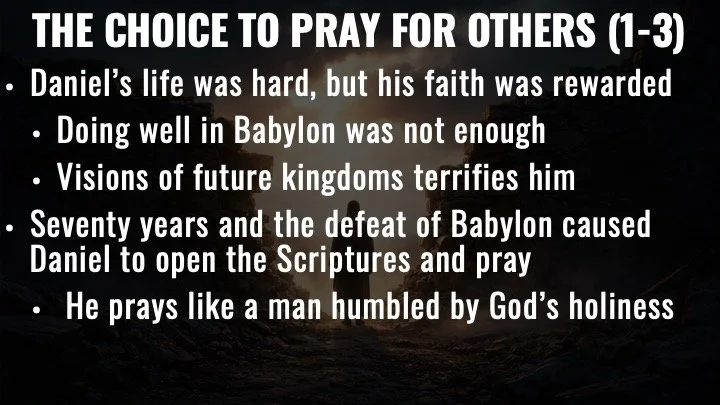
Daniel’s life is one of the most instructive stories in Scripture. He was taken from Jerusalem as a young man and carried into Babylon. He lived in a pagan empire, served under pagan kings, and yet remained faithful to God. The world tried to reshape him, rename him, and re-train him, but it couldn’t take his God from him.
While Daniel is doing well in Babylon, he has position and stability, his people back home are devastated. Jerusalem is ruined. The temple is destroyed. The heart of the nation has been crushed. Daniel is safe, but his people are not.
Then Daniel does something that shows the kind of man he is: he opens the Scriptures. Daniel 9 tells us he was reading Jeremiah and realized the time of exile was coming to an end. God had foretold seventy years, and Daniel sees God working as Babylon is taken over by the Medes and Persians.
So Daniel turns to God in prayer. But he doesn’t pray like a man demanding benefits. He prays like a man who has been humbled by God’s holiness and haunted by his people’s sin.
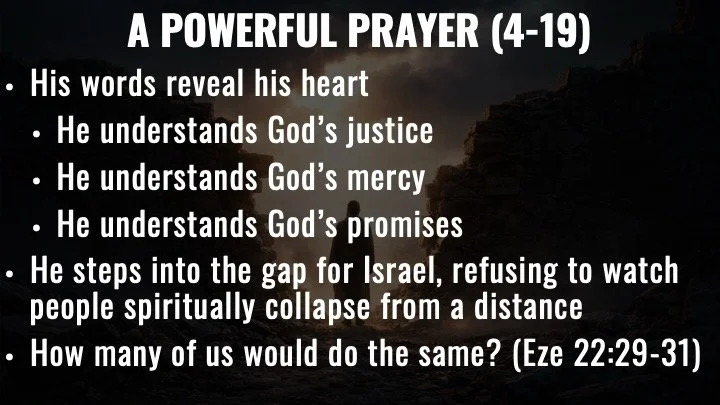
And what strikes me when I read Daniel 9 is the language. Daniel doesn’t say “they.” He says “we.” He doesn’t stand above the people and critique them. He stands with the people and pleads for mercy.
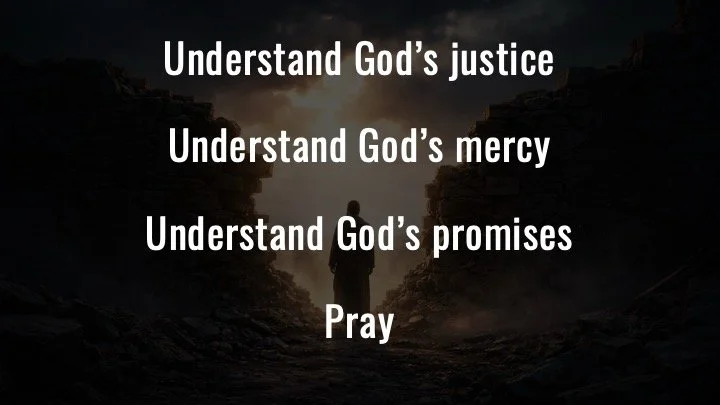
There are at least three things Daniel understands in this prayer.
First, he understands God’s justice. He does not call God unfair. He does not treat judgment like a mistake. He agrees with God about sin and its consequences.
Second, he understands God’s mercy. Daniel confesses, openly and honestly, not just the nation’s sin, but the sin of “us.” That is humility. It’s the posture that says, “Lord, I’m not above the people I’m praying for. I’m made of the same stuff. I need mercy too.”
Third, he understands God’s promises. Daniel isn’t trying to manipulate God. He’s praying according to what God has already said—calling on God to remain true to His word and to exalt His name by restoring His people.
Stepping Into The Gap
When we read this prayer, it should strike us how Daniel is trying to call on God to intervene in Israel’s future according to what He has already said He would do. How many of us would do the same if we were in Daniel’s position? Would we think that this is a wasted effort? That God will do what He wants to do with or without my help? Would we be willing to let go of our bitterness towards God for ruining our perfect life and taking us away from our families? Would we understand how we too are sinful, in spite of our best efforts to live faithfully? Would we study God’s word to see the promises and call for God to fulfill them for his own glory?
The words of Daniel’s prayer are impressive because his mind and spirit are focused on the mess that other people are primarily responsible for and dealing with hundreds of miles away from him. He could just be content and comfortable in Babylon, but instead, he chooses to pour himself out to God on behalf of the nation of Israel. He calls for God to do something that has no real benefit to him since he is already over 80 and unlikely to make the trip.
What Daniel has done in this prayer is called, “Stepping into the gap.” Stepping into the gap is what love looks like when it prays. It’s refusing to watch people spiritually collapse from a distance. If you could imagine a breach in a wall and the need to fill in the breach so that the enemy cannot come in and destroy the city.
Ezekiel 22:29–31 (ESV) — 29 The people of the land have practiced extortion and committed robbery. They have oppressed the poor and needy, and have extorted from the sojourner without justice. 30 And I sought for a man among them who should build up the wall and stand in the breach before me for the land, that I should not destroy it, but I found none. 31 Therefore I have poured out my indignation upon them. I have consumed them with the fire of my wrath. I have returned their way upon their heads, declares the Lord God.”
God tried to continue in his patience with Jerusalem and Judah, but he could not find anyone to “stand in the gap.” No one was able to build up the wall and strengthen the people spiritually. Their hearts could not be turned, and they could not be saved from judgment.
Daniel is stepping into the gap and attempting to build the relationship between God and His people through appeal and petition. This is what great men like Abraham did for Sodom and Gamorrah, Moses for the golden calf incident, and Job for His friends. They all spoke up on behalf of the wicked people who made a mess.
Do we have that mindset? Are we men and women of faith who would be willing to pray for the people who are around us? Do we have minds that are willing to dwell on the spiritual destruction others have created, and hearts that appeal to God on their behalf?
The Goodness of God (20-23)
Daniel’s prayer is not met with silence. God swiftly sends his angel, Gabriel, the very same angel who would reveal the coming of Christ to Mary. This angel speaks to Daniel and explains God’s plans for the future.
Daniel 9:20–23 (ESV) — 20 While I was speaking and praying, confessing my sin and the sin of my people Israel, and presenting my plea before the Lord my God for the holy hill of my God, 21 while I was speaking in prayer, the man Gabriel, whom I had seen in the vision at the first, came to me in swift flight at the time of the evening sacrifice. 22 He made me understand, speaking with me and saying, “O Daniel, I have now come out to give you insight and understanding. 23 At the beginning of your pleas for mercy a word went out, and I have come to tell it to you, for you are greatly loved. Therefore consider the word and understand the vision.
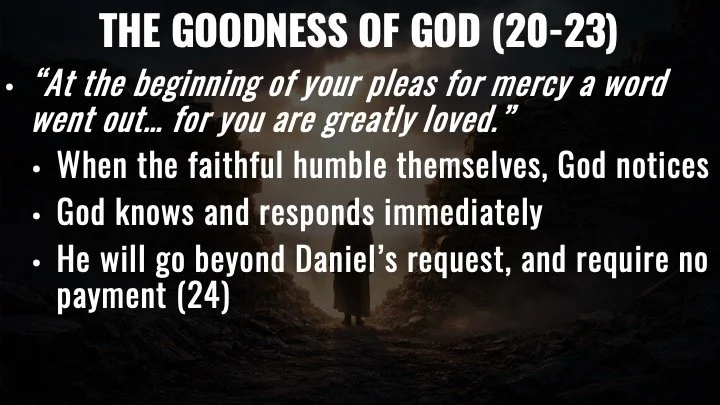
“At the beginning of your pleas for mercy a word went out… for you are greatly loved.”
Think about that. Daniel is not twisting God’s arm. Daniel is not performing for God. Daniel is coming low—honest, humble, and hopeful—and God answers with this sentence: “You are greatly loved.”
First, notice that Daniel’s humble prayer was heard by God. This is a consistent theme throughout scriptures. When the faithful humble themselves before God, he takes notice. He pays careful attention to the humble prayer and he responds. In this case, while Daniel was speaking this prayer God was already sending Gabriel to him.
This reality of God’s swift response, shows us something else. God moves faster than we expect. It’s not like God has to mull it over for a period of time and decide on something. He is not cold. He is not annoyed by repentance. He does not look at broken people and say, “Prove yourself first.”
The text tells us that God was moving while Daniel was speaking the words. He knew what answer he would have ready for Daniel. Don’t think of God as reluctant or uncaring. He loves and cares about each of his children.
Third, we see that God’s mercy will fix the mess that Daniel is praying for God to fix. Daniel’s prayer was basically, “We don’t deserve it, but You are more merciful than we can comprehend. So please be merciful toward us.” God doesn’t turn around and say, “Pray to me one hundred more times” or “Offer me 10,000 sacrifices.” The answer is not, “Try harder.” God responds by revealing his coming grace and providing additional understanding and insight for Daniel. For someone who wants to know, additional insight and understanding is the key to removing anxiety and fear.
Finally, God tells Daniel that He will provide what His people need most of all, but He provides it in His way at the time He has designed. God tells Daniel, in effect, “I’m not only rebuilding walls. I’m dealing with what broke the world.”
Daniel 9:24 (ESV) — 24 “Seventy weeks are decreed about your people and your holy city, to finish the transgression, to put an end to sin, and to atone for iniquity, to bring in everlasting righteousness, to seal both vision and prophet, and to anoint a most holy place.
Gabriel’s message stretches beyond Daniel’s immediate hopes. Daniel is thinking, “Rebuild now.” God is saying, “I’m going deeper than that. I’m dealing with sin itself. I’m bringing a salvation bigger than a city.”
Lessons For Us
So what do we learn from Daniel’s prayer?
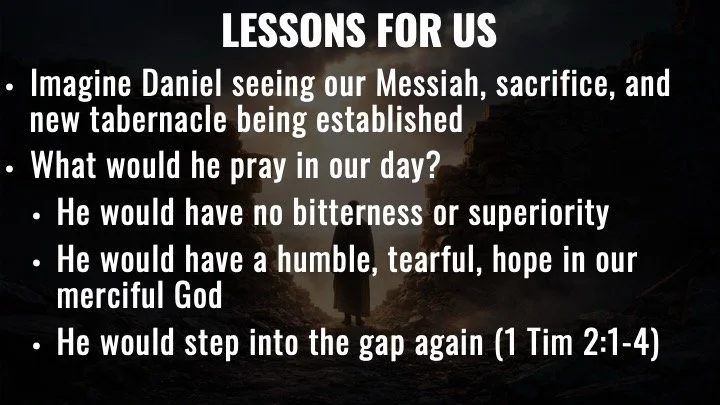
Daniel prayed facing Jerusalem, longing for the temple to be restored. But we have something Daniel only saw from a distance. We have the Messiah. We have the true sacrifice. We have access—not into a building in Jerusalem—but into the presence of God by the blood of Jesus. Hebrews says we have confidence to enter the holy places through Christ.
If Daniel could see that, I think his heart would burst with awe. And I also think he would look at the freedoms and blessings we have—and the spiritual apathy that can creep in—and he would do what he always did. He would pray. Not with bitterness. Not with superiority. With humility. With tears. With hope.
And that’s exactly what the Holy Spirit calls the church to do:
1 Timothy 2:1–4 (ESV) — 1 First of all, then, I urge that supplications, prayers, intercessions, and thanksgivings be made for all people, 2 for kings and all who are in high positions, that we may lead a peaceful and quiet life, godly and dignified in every way. 3 This is good, and it is pleasing in the sight of God our Savior, 4 who desires all people to be saved and to come to the knowledge of the truth.
Notice: this kind of praying is not a burden God lays on you to crush you. It is an invitation to join His heart. God desires people to be saved and to come to the knowledge of the truth. When you pray for others, you’re not dragging God toward mercy—you’re stepping into the stream of mercy that is already flowing from Him.
Here is what I want you to do this week: pray like Daniel prayed, humble, honest, and hopeful. Ask God for mercy. Ask God for growth. Ask God for open doors. And as you pray, remember this: God heard Daniel at the beginning of his pleas for mercy. He hears His people. He moves. And He delights to answer with grace.
Aren’t you glad we have such a compassionate and merciful God?